
Full profile
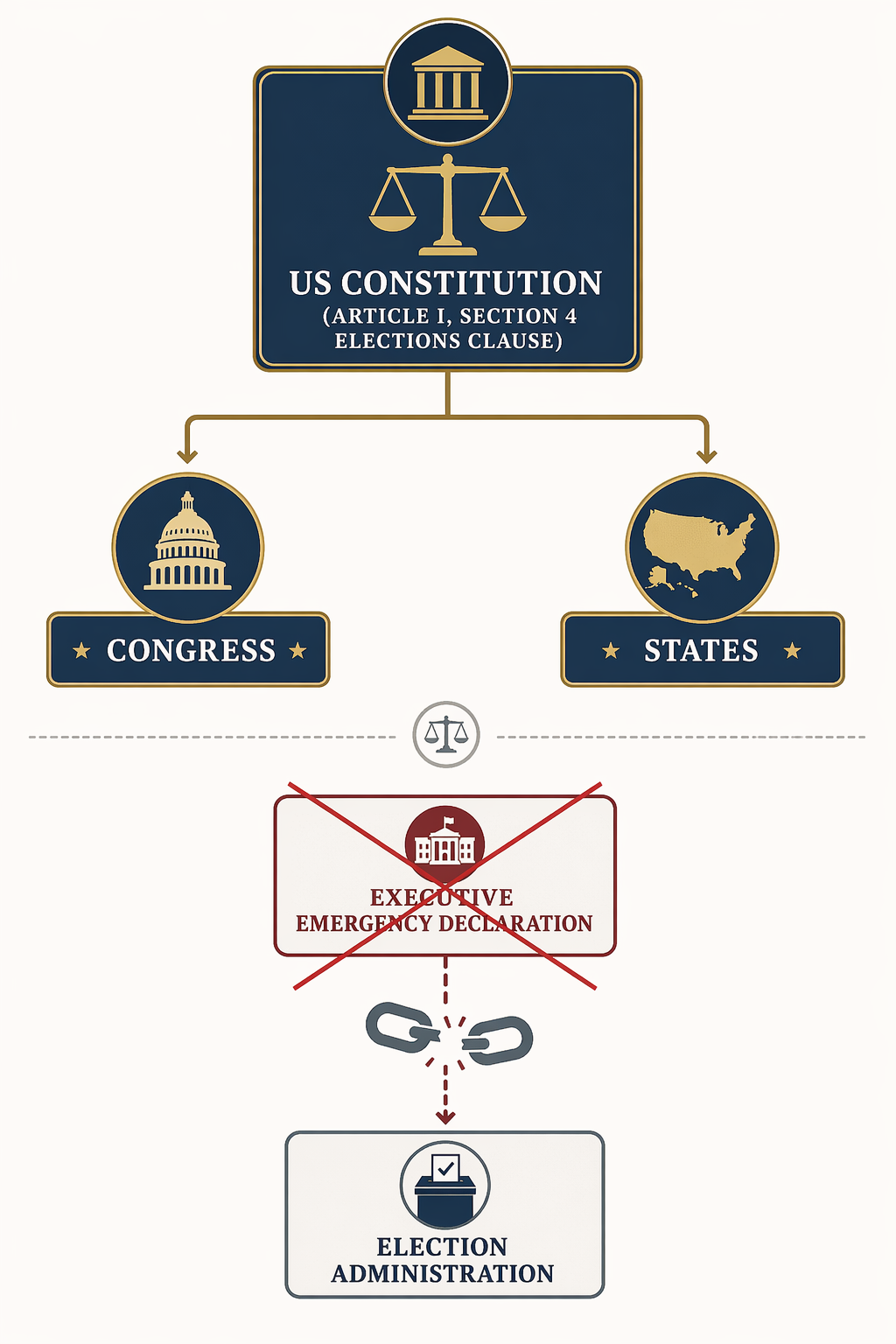
A president cannot make federal election law by labeling an election dispute a national emergency. The missing step is not political will, intelligence assessment, or a sufficiently grave press statement. It is legal authorization. The Constitution assigns federal election administration to Congress and the states; the National Emergencies Act opens only statutory powers Congress has already supplied; and the emergency statute most often floated in this setting, IEEPA, governs foreign economic interests rather than domestic voting rules. Federal courts that have reviewed the 2025 and 2026 election executive orders have treated that allocation as controlling, not optional.
The Legal Question Is Authority, Not Urgency
The useful question in analyzing a Trump election emergency declaration is not whether election administration can become politically urgent. It plainly can. The question is whether any constitutional clause or statute lets the president override rules for voter registration, mail ballots, certification, voting equipment, ballot receipt deadlines, or state election procedures by declaring an emergency.
That distinction matters because emergency law often sounds broader than it is. The National Emergencies Act of 1976 does not itself confer a freestanding power to regulate whatever subject the president identifies as urgent. It provides a mechanism for activating other statutes, and those other statutes must do the substantive work. American Progress, relying in part on Congressional Research Service analysis, frames the point in the election context this way: a national security label does not move election administration out of Article I and into unilateral presidential control.[1]
So the analysis has to proceed in a fairly unforgiving order. First, identify who holds election-administration power. Second, ask whether Congress delegated emergency authority over that subject. Third, read the invoked statute closely enough to see whether its verbs reach domestic election machinery, mail ballots, or registration rules. On the available materials as of July 19, 2026, each step closes the same door.
Article I Starts With Congress and the States
The Elections Clause, Article I, Section 4, gives state legislatures the initial role in prescribing the “Times, Places and Manner” of congressional elections, while reserving to Congress the power to “make or alter” those regulations. The presidency is not the named actor in that allocation. American Progress’s analysis treats that omission as dispositive for claims that the executive branch can take over election administration on national-security grounds.[1]
That is not a technicality. Election administration is made of assignments: who sets deadlines, who maintains registration lists, who receives ballots, who certifies equipment, who counts, who canvasses, who litigates when something goes wrong. Moving those assignments from states and Congress to the president would require a legal transfer. A declaration does not supply one merely because the declared subject is important.
The same constitutional allocation has been described from outside the usual progressive advocacy lane. The research materials identify a Cato Institute post as making the Elections Clause argument from a libertarian-constitutional perspective, although the post itself was not accessible for full independent review here. That limited use is still worth noting because the allocation point does not depend on a single ideological source: the text of Article I, Section 4 is doing the work, with Congress and the states named where a unilateral executive role is absent.[2]
The NEA Is a Doorway, Not a Blank Check
The National Emergencies Act is frequently where overbroad theories pick up speed. It sounds like a reservoir of presidential power. In operation, it is closer to a switchboard. The president may declare a national emergency, but the declaration activates only statutory authorities that Congress has already enacted and that apply to the situation at hand.[1]
The Brennan Center’s emergency-powers catalog, updated in July 2025, identifies 123 statutory powers that may become available when a national emergency is declared. The important election-law fact is not the size of that list but its content: the catalog does not identify an emergency power that authorizes presidential control over election administration.[3]
| Claimed step | Legal problem |
|---|---|
| Declare a national emergency | A declaration does not itself regulate elections. |
| Invoke emergency statutes | The invoked statute must contain a relevant delegation from Congress. |
| Apply that authority to election administration | The available emergency-power catalog does not identify an election-administration hook. |
| Override state or congressional rules | Article I assigns that field to Congress and the states, not unilateral presidential direction. |
This is where much of the emergency-election theory fails quietly. It is not enough to say that federal elections implicate national security, foreign influence, or public confidence. Those may be policy predicates for legislation. They are not the statutory verbs that let an executive order change ballot deadlines, seize voting machines, suspend mail voting, or direct state officials to use a different election code.
IEEPA Is the Wrong Tool for Domestic Election Rules
When advocates of emergency election authority look for a statute broad enough to carry the theory, the International Emergency Economic Powers Act is the usual candidate. IEEPA is powerful, but it is not a general domestic-governance statute. It authorizes the president, after declaring a national emergency based on an unusual and extraordinary foreign threat, to regulate certain transactions involving foreign interests and property. The Brennan Center’s analysis explains that this structure does not reach voting machines that lack a foreign property interest, and it does not authorize control over ordinary domestic election administration.[4]
The mail-ballot theory has an additional statutory problem. IEEPA contains an express exemption for postal, telegraphic, telephonic, and other personal communications that do not involve a transfer of anything of value. Brennan Center analysis identifies 50 U.S.C. § 1702(b)(3) as a barrier to using IEEPA to interfere with mail ballots through the postal system.[4]
That leaves little for IEEPA to do in the election-administration field. A foreign actor’s attempted interference might support sanctions against that actor, blocking of property, or other measures within IEEPA’s economic domain. It does not follow that the president may rewrite domestic rules for millions of voters, compel state election officials to abandon ordinary procedures, or treat voting equipment as covered foreign property without the statutory predicate Congress required.
The Supreme Court’s February 20, 2026 decision in Learning Resources v. Trump reinforces that narrow reading rather than weakening it. In that case, the Court confirmed that IEEPA’s language did not authorize the domestic economic intervention the administration had claimed. The decision matters here because it refused to convert IEEPA’s emergency language into general domestic regulatory authority.[5]
IEEPA can be aggressive within its lane. It can be a serious sanctions statute. It can respond to foreign threats through the tools Congress specified. But the gap between that and presidential supervision of voter registration, ballot receipt, tabulation, certification, or state election codes is not a policy gap. It is a delegation gap.
Article II Does Not Repair the Statutory Gap
Article II adds another route only if it supplies independent presidential authority over the subject. In election administration, it does not. The president has constitutional duties and national-security responsibilities, but Article II does not contain a competing grant that displaces the Elections Clause’s assignment to Congress and the states.
The Youngstown framework makes the institutional posture even worse for unilateral action. Protect Democracy’s emergency-powers explainer applies Justice Jackson’s familiar tripartite analysis: presidential authority is strongest when the president acts with congressional authorization, uncertain in a zone of congressional silence, and weakest when the president acts against Congress’s expressed or implied will.[6]
Election administration is not an empty zone. Congress has legislated extensively in and around federal elections, and Article I expressly reserves to Congress the power to make or alter the rules for congressional elections. A presidential order that overrides those rules would not occupy an untouched field. It would enter a field where the Constitution has already identified the lawmakers.
The Ticktin Memo Shows the Theory’s Weak Points
The reported Ticktin memo is useful mainly as a stress test. The memo itself was not independently reviewed here; the accessible record comes through Democracy Docket’s reporting and quoted analysis, which describes a theory that the president could declare a national voting emergency and use IEEPA to intervene in election administration.[7]
Liza Goitein’s critique, as reported by Democracy Docket, identifies four defects: no adequate factual basis for the kind of “unusual and extraordinary threat” IEEPA requires; no election-administration hook in IEEPA; the property-interest limitation prevents treating ordinary voting machines as covered foreign property; and the communications exemption blocks use of IEEPA against mail ballots.[7]
Those objections are not decorative. They are the questions counsel would have to answer before asking a court to let the executive branch alter election rules. What is the statutory hook? What property is covered? What foreign interest is being regulated? How does the postal exemption disappear? How does Article I yield? The reported memo theory does not become stronger by moving quickly past those questions.
The 2025 and 2026 Executive Orders Have Not Fared Better in Court
The litigation record is not a perfect substitute for Supreme Court merits review of every conceivable emergency-election order. It is still a useful reality check. Federal courts reviewing the March 2025 and March 2026 election executive orders have blocked core provisions, with judges concluding that the president lacked constitutional authority to impose the challenged election procedures. Votebeat reported on June 25, 2026 that Judge Talwani blocked key pillars of the 2026 order restricting mail voting, including provisions involving the Postal Service and federal agencies.[8]
The Brennan Center’s tracker of the 2025 anti-voting executive order likewise records court orders blocking central provisions of that order. The significance is not that each lawsuit had identical plaintiffs, claims, or procedural posture. It is that, when the executive branch’s claimed authority over election procedures reached federal courts, the courts did not find a presidential power to displace the constitutional structure.[9]
That record also narrows the practical risk analysis for officials and lawyers. State election directors, county clerks, postal officials, agency counsel, and litigators do not need a grand theory of democratic decline to see the operational problem. An overbroad order can still frighten vendors, confuse voters, trigger conflicting instructions, and force emergency litigation even if it is later enjoined. The harm often arrives before the appellate mandate.
The Supreme Court’s broader 2025-2026 term does not alter that conclusion. States United’s term summary describes a pattern of rejecting unilateral presidential assertions across matters including tariffs in Learning Resources, National Guard federalization in Trump v. Illinois, ballot deadline changes in Watson v. RNC, and birthright citizenship in Trump v. Barbara.[10]
What a Lawful Emergency Response Could Do
None of this means the federal government is powerless when foreign actors target election infrastructure. It means the response must use the powers actually assigned. Congress can legislate. States can administer elections under their own laws and federal constraints. Federal agencies can share threat information, support cybersecurity, investigate crimes, sanction foreign actors where statutes permit, and litigate within ordinary jurisdictional limits.
The line is the conversion of threat response into election control. A sanctions authority aimed at foreign property does not become a domestic ballot-receipt rule. A national emergency declaration does not become a substitute for the Help America Vote Act, the Electoral Count Reform Act, state election codes, or congressional legislation. An Article II duty to protect national security does not silently amend Article I.
The Bottom Line as of July 19, 2026
As of July 19, 2026, the legal basis for a Trump election emergency declaration overriding federal election administration rules is absent. The Elections Clause assigns federal election regulation to Congress and the states. The National Emergencies Act activates existing statutory powers but supplies no election-administration authority of its own. The Brennan Center’s catalog of emergency powers identifies no relevant election hook. IEEPA addresses foreign economic interests and contains limits that do not fit voting machines, mail ballots, voter registration, or domestic election procedures. Learning Resources narrows rather than expands IEEPA’s domestic reach. Article II does not cure those defects. The current federal court record has rejected, not validated, unilateral presidential control over election procedures.
That conclusion is a legal analysis for professional reference, not advice about any specific matter, party, jurisdiction, order, or litigation strategy.
References
- The Trump Administration Has No Legal Authority To Invoke National Security and Take Over Elections, American Progress.
- Emergency Authorities and the Constitutional Allocation of Election Power, Cato Institute.
- A Guide to Emergency Powers and Their Use, Brennan Center for Justice, updated July 2025.
- What the President Could Do If He Declares a State of Emergency, Brennan Center for Justice.
- Learning Resources v. Trump, No. 24-1287, Supreme Court of the United States, February 20, 2026.
- Presidential emergency powers, explained, Protect Democracy.
- Read the laughable legal memo behind the claim that Trump can declare a national voting emergency, Democracy Docket.
- Federal judge blocks key pillars of Trump executive order restricting mail voting in 2026 election, Votebeat, June 25, 2026.
- Status of Trump's 2025 Anti-Voting Executive Order, Brennan Center for Justice.
- What the 2025-2026 Supreme Court Rulings Mean for Democracy, States United.
Comments
Join the discussion with an anonymous comment.