
Full profile
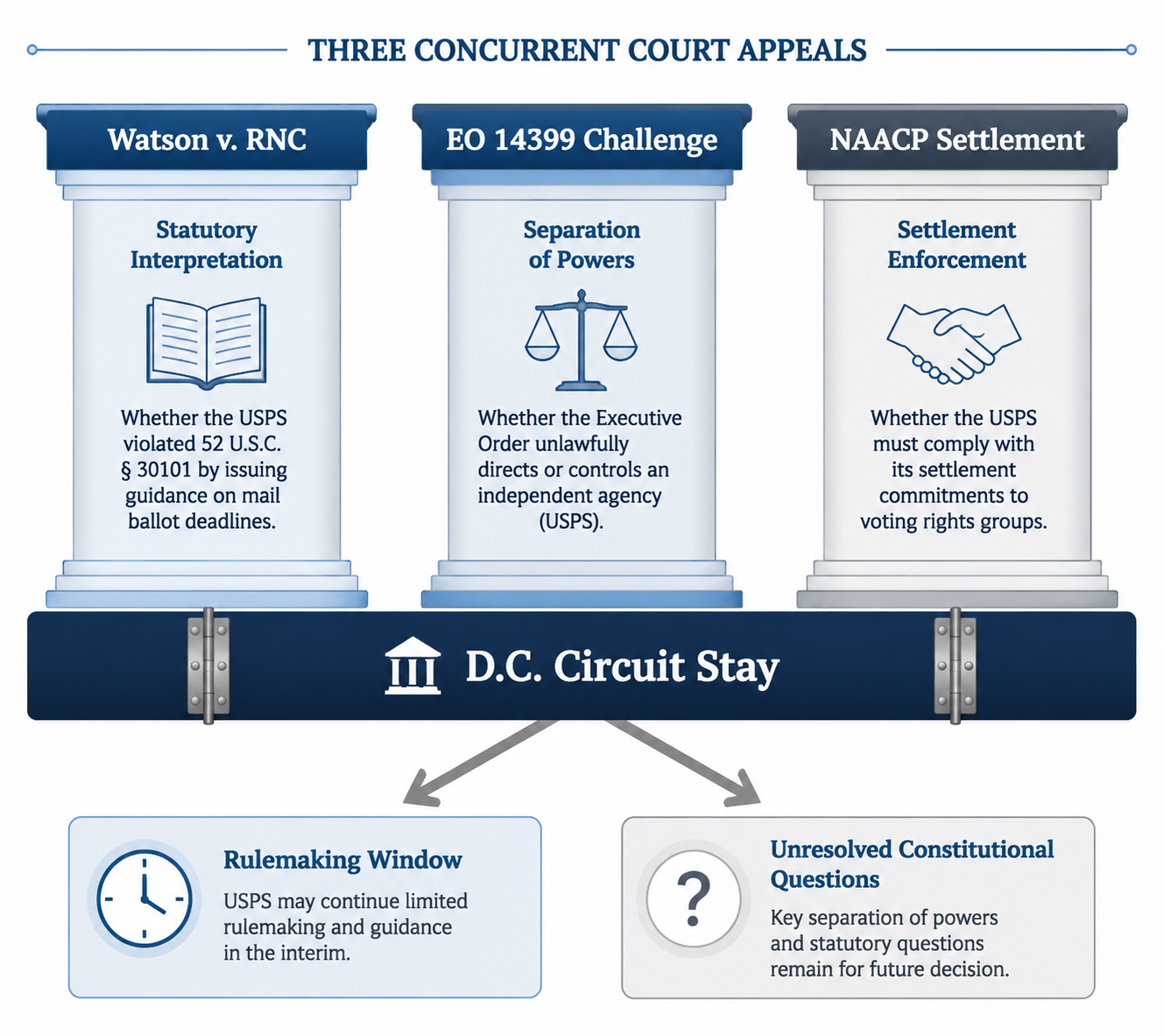
The immediate posture matters more than the rhetoric: the D.C. Circuit’s July 17 interim stay keeps USPS rulemaking moving while the merits remain unresolved, so the agency has a window to finish the rule before November even though the core constitutional fight is still live. That is the procedural fact that makes these cases interact instead of merely coexist.
The stay changes timing, not doctrine
Judge Sullivan’s injunction had halted implementation in the NAACP settlement-enforcement case, but the D.C. Circuit’s stay now leaves USPS free to proceed for the moment. That does not resolve the underlying dispute; it just prevents the injunction from freezing the agency while appellate review continues. In practical terms, the stay matters because election litigation is often decided by calendar pressure long before any final merits ruling arrives. [1]
The regulatory vehicle is already in place. USPS published the proposed rule, “Ballot Mail for Federal Elections,” on June 2, 2026, so the current fight is not over whether the agency has text to work from; it is over whether that text can survive the layered challenges now running through the courts. [4]
Watson and Talwani answer different questions
Watson v. RNC addressed the statutory side of the ledger. The Court’s 5-4 decision held that the federal election-day statutes do not set ballot-receipt deadlines, which leaves states free to enforce grace periods for ballots that arrive after Election Day. The majority’s move is narrow but consequential: it keeps receipt rules in state hands instead of reading a federal deadline into the statute. Justice Alito’s dissent, by contrast, focused on postmark reliability and warned that the decision was “opening Pandora’s box.” [2]
Judge Talwani’s June 25 ruling addresses a different source of authority and reaches the opposite conclusion about executive power. She held that three pillars of Executive Order 14399 were unconstitutional as ultra vires under the Elections Clause, reasoning that no statute delegates mail-in voting control to USPS and that any citizenship-list regime would necessarily be incomplete. The point is not just that the order was blocked; it is that the court refused to treat postal administration as a general reservoir of election authority. [3]
Read together, Watson and Talwani pull in different directions on method but not on institutional role. Watson preserves state grace-period authority; Talwani rejects a federal attempt to centralize ballot-handling authority inside USPS. Both decisions resist the idea that USPS can be recast as an election arbiter. That is why the neutral-carrier model matters: USPS is built to move mail under a universal service obligation, not to decide whose ballot is allowed to count. [2][3][6]
Why the practical stakes remain high
The operational problem is that postmarks are a weak substitute for a clean administrative rule. Brookings notes that USPS’s Domestic Mail Manual now acknowledges that postmarks “do not inherently or necessarily align” with acceptance dates, and it reports that mail from RTO-affected offices has been routed an average of 139 miles to RPDCs. Those facts do not prove ballots will fail, but they do show why using postmarks as a control point can produce avoidable disputes once election deadlines are in play. [5]
That is where the legal and operational questions meet. If USPS remains a carrier, the system can absorb some mismatch between mailing, postmarking, and receipt. If USPS becomes a gatekeeper, every imperfect postmark, routing delay, or list discrepancy becomes litigation fuel. The current record does not settle that question; it only shows that the stakes are now high enough for state administrators, postal operators, and litigators to inherit the uncertainty.
So the live issue for the 2026 midterms is narrower: whether USPS can finish the rule before November while the appeals continue. The July 17 stay buys time for implementation, but it does not resolve the merits or eliminate appellate risk.
References
- Democracy Docket — Appeals court allows USPS to move forward with Trump's anti-mail voting order (July 17, 2026)
- SCOTUSblog — Justices uphold state law allowing for late-arriving mail-in ballots (June 29, 2026)
- Votebeat — Trump election overhaul mail voting executive order blocked: Talwani, USPS, DHS (June 25, 2026)
- Federal Register — Ballot Mail for Federal Elections (June 2, 2026)
- Brookings — When a postmark no longer tracks mailing (December 2025)
- Protect Democracy — US Postal Service & elections
Comments
Join the discussion with an anonymous comment.