
Full profile
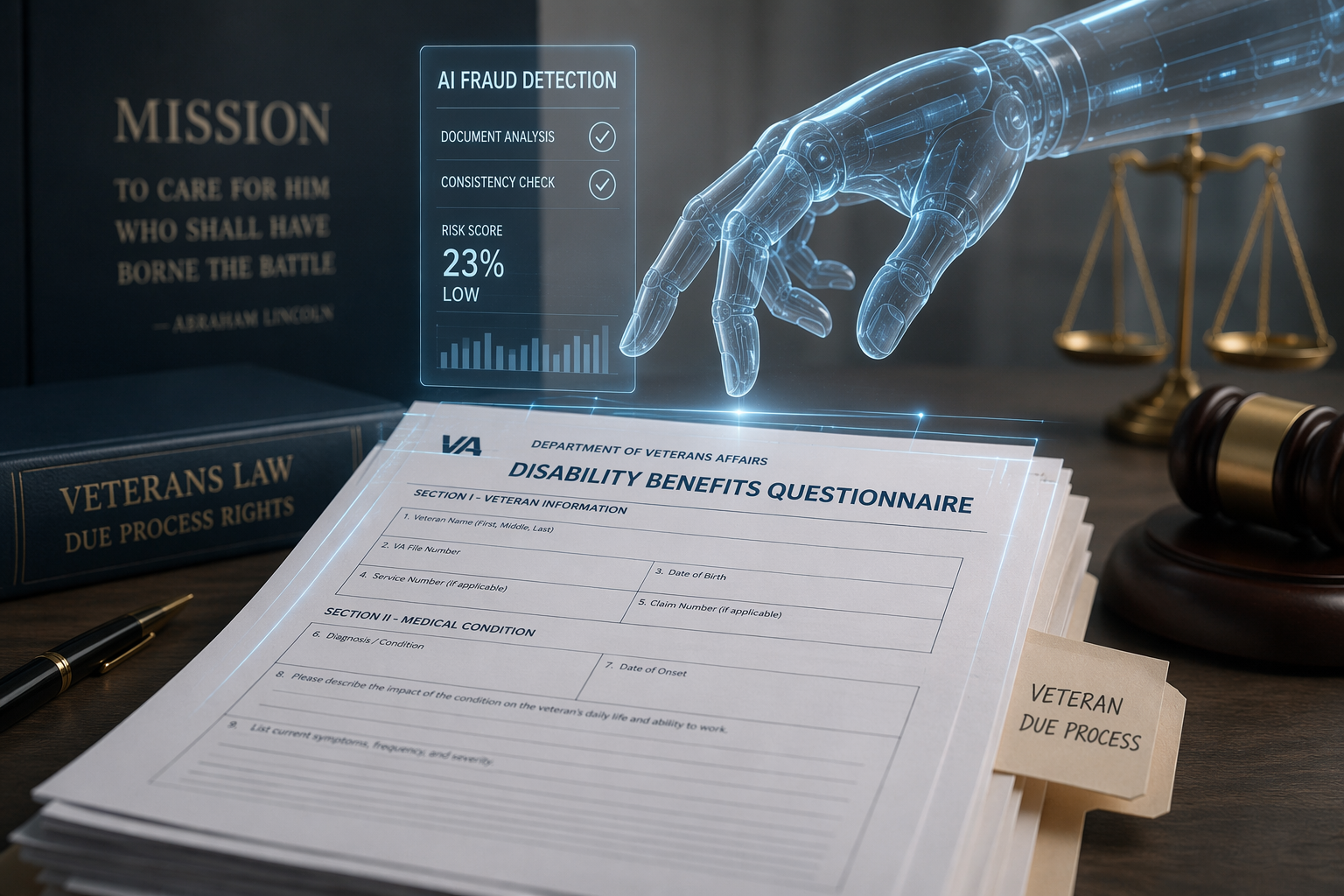
A veteran’s Disability Benefits Questionnaire could soon sit in a strange procedural posture: important enough to support a rating decision, but also capable of being swept into an automated fraud screen whose criteria the claimant may never see. DAV put the concern plainly in March 2026 when it asked the VA to disclose how the system was validated and what specific criteria would cause a DBQ to be flagged.[1] For attorneys, the legal analysis has to begin there—not with abstract enthusiasm or fear about artificial intelligence, but with the file sitting on the desk, the provider signature on the form, and the question of what happens after a machine marks it as suspicious.
The VA’s planned tool is expected to scan more than 1 million DBQs dating back to 2010, with launch expected in FY2026.[2] Public descriptions of the flag criteria include boilerplate language, a medical provider more than 100 miles from the veteran, missing fields, and altered documents.[3] Those are plausible fraud indicators in some files. They are also common features of ordinary veterans-benefits evidence: rural veterans travel for specialty exams, overworked clinicians copy forward language, private providers leave boxes blank, and scanned forms acquire artifacts when they pass through multiple hands.
The Legal Risk Starts After the Flag
A fraud flag is not, by itself, a rating decision. That distinction matters. Triage, investigation, adjudication, severance, and reduction are different administrative acts, and due process concerns sharpen as the flag moves closer to benefit deprivation. A system that helps investigators identify suspicious clusters of DBQs raises one set of questions. A system that slows a pending claim, discredits favorable medical evidence, triggers a reexamination, or contributes to a proposed reduction raises a different and more serious set.
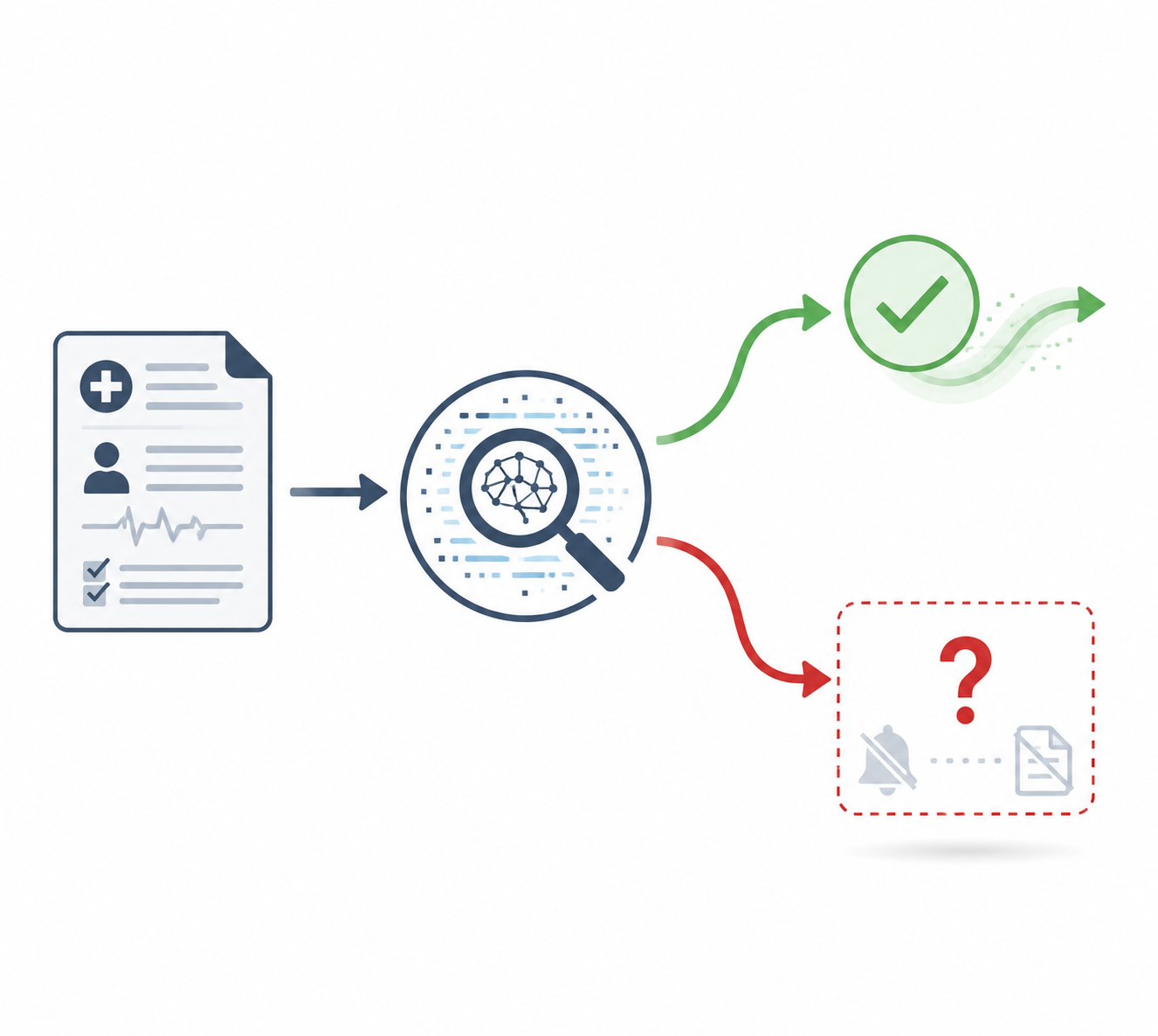
The publicly described workflow still leaves the hardest questions unanswered. If a DBQ is flagged, will the veteran receive notice? Will the claims file identify the automated basis for the flag? Will the VA disclose whether the concern was distance, language similarity, missing fields, alteration detection, or a combination of factors? Can counsel obtain the model’s output, the threshold applied, and the human review notes? The sources available as of July 19, 2026, do not establish those procedures.
That is why DAV’s demand for validation methodology and flag criteria deserves more weight than a general complaint about “AI.”[1] Validation is not a branding exercise. It is the difference between a triage tool that has been tested against known outcomes and a pattern-matching system whose error burden falls on claimants, veterans service officers, and attorneys after the delay has already occurred.
What the Public Criteria Actually Prove
| Publicly described criterion | Why it may interest fraud reviewers | Why it may also appear in legitimate evidence |
|---|---|---|
| Boilerplate language | Repeated phrasing may suggest templated evidence sold across multiple claims. | Clinicians often reuse phrasing, templates, and copy-forward text, especially in standardized forms. |
| Provider more than 100 miles away | Distance may suggest a claims company is steering veterans to a favored examiner. | Rural access problems, specialty-provider scarcity, relocation, and telehealth-related care patterns can produce long-distance records. |
| Missing fields | Omissions may suggest a low-quality or mass-produced DBQ. | Private providers may misunderstand VA forms, skip inapplicable boxes, or submit imperfect but probative evidence. |
| Altered documents | Changes may indicate tampering or manipulation. | Scanning, resubmission, correction, and document-conversion artifacts can create irregular-looking files. |
None of these criteria is meaningless. The VA has a legitimate interest in finding bad actors who sell veterans prepackaged medical evidence or use private examination mills to manufacture disability records. The problem is evidentiary weight. A distance measurement or repeated phrase may justify a closer look; it does not prove fraud, does not prove intent, and does not tell an adjudicator whether the medical opinion is competent, credible, and probative in the individual claim.
Practitioners should also resist the opposite mistake. A claimant-friendly explanation for a flag does not prove the DBQ is reliable. It means the flag is contestable. The proper legal question is whether the agency can explain how the suspicious fact relates to this claimant, this provider, this document, and this proposed action.
Scale Makes Procedure More Important, Not Less
The DBQ project does not sit alone. The VA’s January 2026 AI strategy identifies 28 AI use cases in benefits processing, and the agency’s Smart Search system has ingested more than 1 billion veteran documents.[4] That scale explains the institutional appeal. A benefits system that moves millions of documents cannot rely only on manual review, and a fraud scheme spread across standardized forms may be easier to detect through pattern analysis than through isolated file review.
But scale also changes the cost of error. A questionable assumption embedded in a single rater’s analysis affects one file. A questionable assumption embedded in an automated screen can appear across a class of claims before attorneys know what to request, what to challenge, or what explanation the VA believes it has already given internally.
The available reliability context is cautionary but limited. CCK Law reports that the VA processed 3,001,734 claims in FY2025, that VA has cited a 93.5% accuracy rate based on internal quality checks, and that a 2023 VA OIG report found automated claims-processing tools produced errors in roughly 27% of reviewed records.[5] That OIG finding does not prove the new DBQ fraud tool will fail. It does show why practitioners should be skeptical of assurances that rest only on internal checks, especially when the system’s validation methodology has not been made public.
Veterans groups are not simply asking the VA to slow down. VFW testimony in 2026 recognized the pressure to deliver faster decisions while continuing to flag quality concerns, including C&P exam adequacy and evidence-gathering bottlenecks.[6][7] That is the same tension the DBQ tool creates in sharper form: speed and fraud detection may improve agency performance, but only if the claimant can still understand and answer the reason a favorable document lost force.
What Due Process Would Need to Cover
The missing safeguards are not exotic. They are ordinary administrative fairness requirements adapted to an automated trigger. If a flagged DBQ remains merely an investigative lead, the agency still needs internal controls to prevent the flag from becoming an invisible credibility discount. If the flag affects the claim, the veteran needs enough information to respond.
- Notice: the claimant should know when an automated fraud concern has materially affected processing, evidentiary weight, or a proposed adverse action.
- Explanation: the VA should identify the relevant concern in usable terms, not simply state that a DBQ was flagged by an internal tool.
- Validation: the agency should disclose enough about testing, error measurement, and review protocols to permit meaningful challenge.
- Human review: an adjudicator or investigator should connect the flag to claim-specific facts rather than treating the automated output as a conclusion.
- Opportunity to respond: the veteran should be able to explain provider distance, form defects, clinical templates, or document history before benefits are reduced or evidence is rejected.
Those safeguards matter most where the record looks messy for reasons unrelated to fraud. A veteran in a rural area may have traveled far because no qualified specialist was nearby. A private clinician may have used repeated language because the DBQ itself asks standardized questions. A missing field may go to weight, not authenticity. Without disclosure, counsel is left arguing against a shadow premise.
Congress Is Splitting the Problem in Two
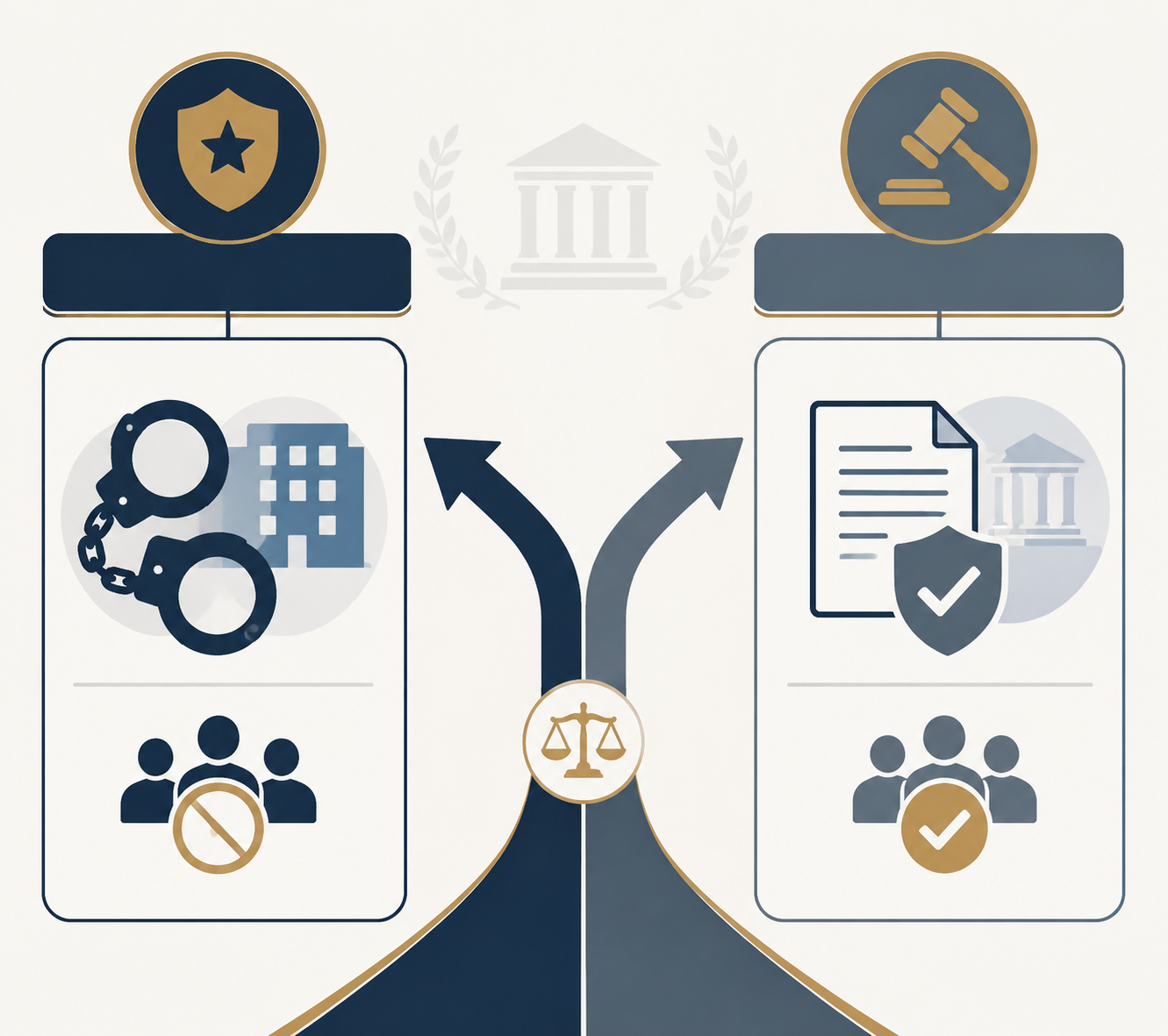
The legislative response is not a clean fight between fraud enforcement and claimant protection. The GUARD VA Benefits Act, HR 1732, targets unaccredited claims companies by criminalizing certain conduct by those intermediaries.[8] The FRAUD in VA Disability Exams Act, S. 3000, would require a criminal conviction before a veteran’s benefits could be reduced based on alleged fraud in disability examinations.[9] The bills aim at different pressure points.
| Bill | Primary legal instinct | Practical significance for practitioners |
|---|---|---|
| GUARD VA Benefits Act (HR 1732) | Punish unaccredited claims-company conduct. | Focuses attention on intermediaries who may be generating or selling suspect evidence. |
| FRAUD in VA Disability Exams Act (S. 3000) | Protect beneficiaries from reductions absent a criminal conviction. | Creates a procedural shield before alleged examination fraud can reduce benefits. |
The difference matters because the DBQ tool sits between those instincts. If the VA uses automated screening to identify networks of unaccredited actors, the GUARD approach fits naturally. If the agency uses a flag to support adverse action against an individual veteran, the FRAUD in VA Disability Exams approach responds to a different danger: benefit deprivation before fraud has been proven in a forum with criminal-law safeguards.
The bills are competing in emphasis, but they are not logically mutually exclusive. Congress could pursue stronger enforcement against claims companies while also limiting when a veteran’s existing benefits may be reduced because of alleged examination fraud. For lawyers, the important point is not which title sounds tougher. It is whether the law separates investigative triage from benefit deprivation.
How Practitioners Should Read an AI Fraud Signal
As of July 19, 2026, the public record does not provide actual flag rates, false-positive rates, or appeal outcomes for the planned DBQ tool. It supports a narrower conclusion: the VA intends to use automated criteria to screen a very large body of DBQs, veterans organizations have asked for transparency and safeguards, and Congress is considering different statutory responses.
In representation, that should change how counsel reads unexplained friction in a claim. A delayed decision, a sudden request for clarification, a diminished discussion of a favorable private DBQ, or a proposed reduction tied to examination concerns should prompt focused record development. The useful questions are concrete: who reviewed the DBQ, what concern was identified, whether an automated tool contributed, whether the concern was disclosed to the claimant, and whether the VA connected the concern to evidence in the individual file.
The VA may have sound reasons to detect fraudulent DBQs, particularly where unaccredited actors exploit veterans and contaminate the claims process. But without transparent validation and flag-notification procedures, an AI-generated fraud signal should be treated as a contestable administrative input, not reliable proof. The legal work begins where the automation stops explaining itself.
References
- DAV statement on VA's planned use of AI to review benefit questionnaires — DAV, March 2026.
- VA plans to scan a million veterans claims for signs of fraud — Stars and Stripes, March 9, 2026.
- AI, the VA, and Fraud: What You Need to Know — MOAA, 2026.
- Building the Future: VA's Strategy for Adopting High-Impact Artificial Intelligence — VA AI Working Group, January 2026.
- VA Backlog Drops 57% but Accuracy Still Matters — CCK Law.
- Faster Decisions, Stronger Outcomes — VFW, April 2026.
- PACT Act Implementation — VFW, July 2026.
- GUARD VA Benefits Act — HR 1732.
- FRAUD in VA Disability Exams Act — S. 3000.
Comments
Join the discussion with an anonymous comment.