
Full profile
State v. Shaw and the question the record actually raises
State v. Shaw is still early enough that the vaccine-reaction theory is not foreclosed as a matter of law, but it is already carrying a heavy factual burden. Andrea Shaw is charged in Idaho with two counts of first-degree murder after prosecutors alleged she suffocated her 15-month-old twin daughters, Kailey and Kinley Shaw. The charging case is a homicide prosecution first; the grand jury found probable cause, and the indictment itself does not mention vaccines [1][2].
No plea has been entered and no trial date is set, so the case is still at the stage where expert admissibility can matter more than public argument. Bond was denied in July, leaving Shaw detained while the defense theory still has not been tested in court [4].

The timeline is the defense's hardest fact problem
| Date | What the reported record says |
|---|---|
| Apr. 22, 2026 | Kailey and Kinley received routine vaccinations at a local health department: DTaP, hepatitis A, and influenza [1]. |
| Apr. 23, 2026 | They had a mild fever, were seen at St. Luke's ER, were diagnosed with a post-immunization reaction, and were discharged [1]. |
| Apr. 30, 2026 | Shaw later described the day as a "great day," saying the children were active, playing, and eating normally [1]. |
| Night of Apr. 30-May 1, 2026 | Shaw said she found both children not breathing and called 911; the autopsy later concluded suffocation [1]. |
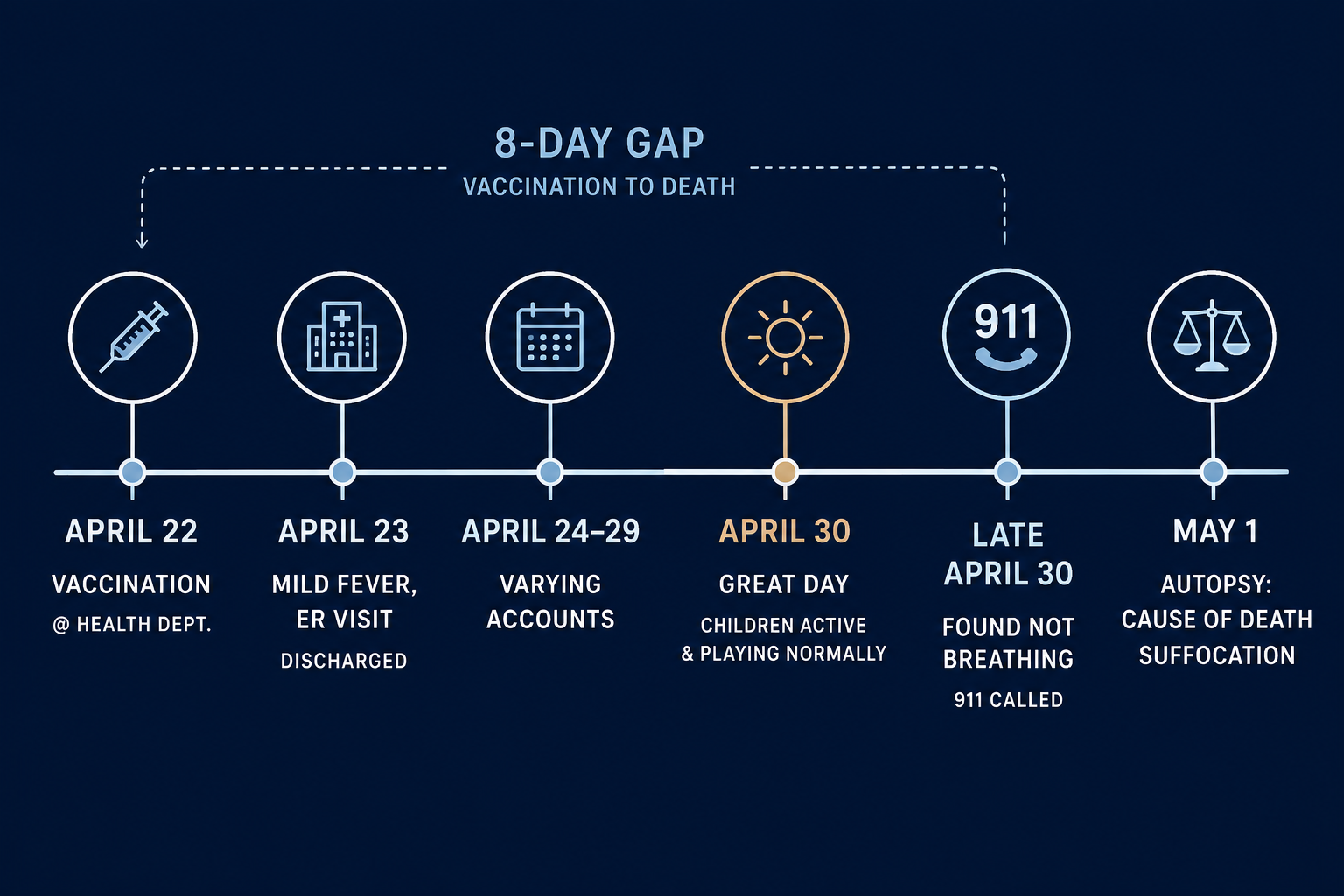
That is the first problem for the defense. The April 23 ER note gives the theory a foothold, but it does not carry the rest of the case. By April 30, the reported account is one of normal activity, and the next night the children were found not breathing. Prosecutors also say Shaw gave multiple inconsistent accounts of the night of death, which is exactly the sort of fact pattern that makes a causation story harder to sell as an innocent explanation [1][2].
The medical record is even less friendly to the defense. The Guardian reported that a Stanford pediatric infectious disease specialist, Dr. Jake Scott, called the timeline and mechanism "biologically implausible," and that Johns Hopkins' Dr. Amesh Adalja said, "There is no mechanism by which these vaccines could cause simultaneous death in two children 8 days later" [3]. The same reporting says three treating physicians at St. Luke's and the medical examiner's office independently ruled out vaccine causation [3].
A positive rotavirus result, if the defense emphasizes it, is not much better than a marker on the chart. It may be useful rhetorically, but it still has to be turned into a mechanism that explains why two children would die together after an intervening day of normal activity, and the prosecution will argue that it does not do that [3].
Why Idaho Rule 702 is the real gate
The legal fight is not whether counsel can say "vaccine reaction" in front of a jury. It is whether an expert can make that claim survive Idaho's Rule 702 gatekeeping with a reliable method, enough facts, and a causal bridge that actually fits the record. Temporal proximity and an ER label are not enough by themselves if the expert cannot explain how routine pediatric vaccines would produce simultaneous fatal airway compromise eight days later.
That is where the defense looks weakest. On the materials reported so far, there is no published medical support for a theory that DTaP, hepatitis A, and influenza vaccines caused simultaneous fatal reactions in two 15-month-olds on this timeline, and the treating doctors reportedly went the other way. If the defense expert cannot do more than stack a post-vaccination note, a positive test result, and a general suspicion of causation, the opinion will look like advocacy dressed up as science.
Still, the theory is not impossible as a matter of law. No Idaho judge has yet ruled on a motion to exclude the defense experts, and no evidentiary hearing has yet forced the parties to show their work. That matters because a novel homicide defense can survive the headlines for a while; it survives trial only if the science is coherent enough to confront the autopsy, the inconsistent accounts, and the doctors who already said vaccine causation was ruled out.
What is left for the defense
The remaining space for the defense is narrow. It needs a qualified expert who can tie symptoms, timing, and pathology together without relying on speculation; it needs literature or comparable data that does not collapse under cross-examination; and it needs to explain why two children would die in the same way from ordinary immunizations while the state's doctors and the autopsy point to suffocation instead. On today's record, that is an extraordinarily steep climb, even if it is not a legally impossible one.
References
- CNN: Idaho mother who said her toddlers died after vaccinations accused of suffocating them, charged with murder — CNN — July 7, 2026
- AP News: An Idaho mother who said her toddler twins died after vaccinations has been charged with murder — AP News
- The Guardian: An Idaho mom charged with murder says vaccines killed her twins. Doctors say it's not possible — The Guardian — July 18, 2026
- BBC News: US mum who blamed vaccines for twins' deaths is denied bail on murder charges — BBC News
Comments
Join the discussion with an anonymous comment.