
Full profile
The most important Westlaw AI hallucination sanctions ruling so far did not begin with a careless lawyer hiding from the court. It began with a Sixth Circuit filing whose electronic file name read “CoCounsel Skill Results,” a brief that attached fabricated quotations to real cases, and a lawyer with a 40-year clean disciplinary record. The sanction was not limited to embarrassment. The court removed counsel, denied Criminal Justice Act compensation, and referred the matter to the Sixth Circuit Chief Judge, the Eastern District of Kentucky Chief Judge, and the Kentucky Bar Association.[1]
That is the practical center of the Westlaw AI hallucination lawsuit sanctions record in 2025 and 2026. Publicly available materials support at least five relevant incidents in that window: three with confirmed Westlaw-family tools or workflows, and two adjacent AI sanctions matters where the specific tool attribution is either unspecified or not confirmed as Westlaw. The distinction matters. So does the pattern. Courts have not treated vendor assurances, staff delegation, multi-tool workflows, or post-filing cooperation as substitutes for counsel’s own verification.[1][2]
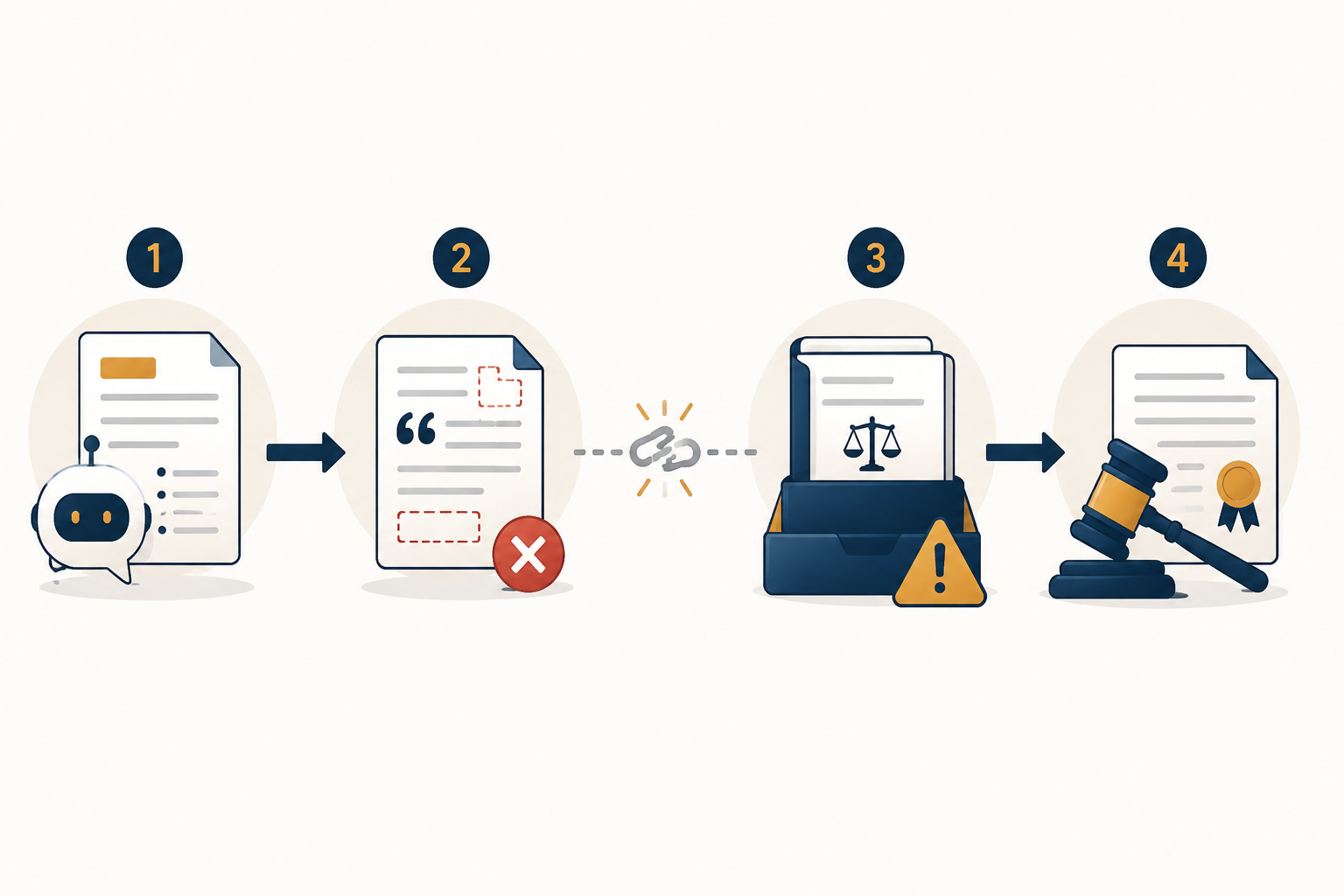
The Incident Record, Before the Lessons
The incidents below are organized by the point at which they entered the public sanctions record, not by product release history. Each entry asks the same practical questions: what tool was used or alleged, what failed, how the error surfaced, what consequence followed, and what judicial language now matters for supervision.
| Incident | Tool attribution | Failure | Consequence |
|---|---|---|---|
| Coomer v. Lindell, D. Colo., Apr. 2025 | Westlaw Precision used as a post-drafting check | Fabricated cases were not flagged | Sanctions proceedings tied to AI-generated authorities |
| Lacey v. State Farm, C.D. Cal., May 2025 | CoCounsel, Westlaw Precision, and Google Gemini involved | 9 of 27 citations were incorrect | $31,100 joint sanction |
| Texas bankruptcy attorney, Nov. 2025 | Unspecified AI tool | 32 inaccurate citations | Sanctions-related remedial consequences reported |
| U.S. v. Farris, 6th Cir., Apr. 2026 | CoCounsel-labeled file | Fabricated quotations attributed to real cases | Removal, CJA fee denial, disciplinary referrals |
| Sullivan & Cromwell, S.D.N.Y. Bankr., Apr. 2026 | AI tool not confirmed as Westlaw | AI hallucinations in a Chapter 15 filing | Emergency apology letter filed to avoid sanctions |
Coomer v. Lindell: Westlaw Precision Did Not Catch the Problem
Coomer is the narrowest and, for procurement purposes, one of the least comfortable entries. The reported workflow was not simply “a lawyer used AI and filed the output.” The attorneys ran their brief through Westlaw Precision after drafting to check for hallucinations. The check did not flag the fabricated authorities.[2]
That point should not be inflated into a claim that Westlaw Precision generally fails at citation validation. The public record supports a narrower conclusion: in this matter, a Westlaw-branded verification step did not prevent fabricated cases from reaching the court. For a risk officer, that is enough to defeat the easy version of the procurement promise. A closed legal-research environment may reduce some categories of error, but the court still sees the filed brief, not the vendor architecture.
Lacey v. State Farm: A Multi-Tool Workflow Made Responsibility Harder, Not Softer
Lacey v. State Farm is the strongest monetary sanction in the known Westlaw-related set. In May 2025, a special master in the Central District of California found that attorneys from K&L Gates and Ellis George had “collectively acted in a manner that was tantamount to bad faith” and imposed a $31,100 joint sanction. The filing problem was not marginal: 9 of 27 citations were incorrect.[2]
The workflow was also messy in the way real legal operations workflows are messy. CoCounsel, Westlaw Precision, and Google Gemini were all involved. That matters because multi-tool use is often described internally as a control: one system drafts, another researches, another checks. Lacey shows the other side of that design. When several systems and several lawyers touch the work, the audit trail can become more complicated without making the filed paper more reliable.[2]
The special master’s “collectively” language is the part that should survive in supervision memos. It signals that a court may not be interested in letting the team split the failure into tool-by-tool fragments. If the filed work contains incorrect authorities, the remedial work falls on humans in the case: opposing counsel must identify the defects, the court or special master must spend time unwinding them, and the responsible lawyers must explain why their process let the errors through.
The Texas Bankruptcy Matter: The Tool Is Unspecified, the Citation Failure Is Not
The November 2025 Texas bankruptcy matter belongs in the pattern, but not as a confirmed Westlaw-product incident. The public description identifies 32 inaccurate citations and an unspecified AI tool. That makes it useful for understanding the broader sanctions environment, while keeping it outside the confirmed Westlaw subset.[2]
Its value is scale. Thirty-two inaccurate citations is not a single bad parenthetical or a mistaken pincite. It is the kind of failure that turns verification from a last-minute cite check into a reconstruction project. By the time the court is involved, the calendar has already shifted: someone must identify which authorities exist, which propositions survive, whether the filing must be corrected, and whether the error was isolated or systemic.
U.S. v. Farris: The Appellate Warning Is About Personal Responsibility
Farris deserves the closest reading because it moved the issue to the appellate level and because its facts remove several common defenses at once. The Sixth Circuit saw a filing connected to CoCounsel, fabricated quotations attributed to real cases, and counsel who did not come to the court with a history of disciplinary trouble. The lawyer had a 40-year clean record. The court still imposed removal, denied CJA compensation, and made disciplinary referrals.[1]
The error was not that the brief cited imaginary case names alone. The more dangerous version appeared: real cases were used as containers for fabricated language. That failure mode is harder to catch by scanning for whether a citation exists. A case can be real, the reporter cite can look familiar, and the quoted proposition can still be invented. For a filing lawyer working under deadline pressure, that is the point where database confidence becomes a trap.
The court’s professional-responsibility language was direct: “new technologies are no substitute for tried-and-true safeguards managed by practicing attorneys.”[1] The phrase matters because it does not condemn legal AI as such. It places AI inside the existing duty structure. If a lawyer chooses a tool, delegates use of that tool, or relies on its output, the verification obligation remains attached to the lawyer whose name reaches the court.
Farris is also a useful answer to the idea that sanctions are reserved for only the most reckless outliers. A clean record and cooperation may affect how a court describes the lawyer. They did not prevent career-affecting consequences. Removal from the representation, loss of compensation, and disciplinary referrals are operational consequences, not public-relations discomfort.[1]
Sullivan & Cromwell: Institutional Sophistication Did Not Eliminate the Failure Mode
The Sullivan & Cromwell bankruptcy episode should be handled with care. Available materials describe an emergency apology letter in the Southern District of New York bankruptcy court after AI hallucinations appeared in a Chapter 15 filing. They also note the institutional context: a Vault 5 firm and reported $2,000-plus hourly rates. The specific AI tool has not been confirmed as a Westlaw product in the available sources.[2]
That caveat is not a courtesy; it is part of the risk record. Sullivan & Cromwell should not be used as proof that a particular Westlaw tool failed. It is better evidence for a different proposition: institutional sophistication, high billing rates, and emergency remediation do not make AI citation failures disappear from the court’s docket. At that point, the relevant audience is no longer the vendor’s sales team. It is the judge deciding whether the explanation is enough.
What Repeats Across the Cases
The confirmed and adjacent incidents do not support every sweeping claim made about legal AI. They do support several narrower failure patterns that matter for law-firm governance.
- Real authorities can carry fabricated content. Farris shows the risk of invented quotations attached to real cases, which is harder to detect than a wholly nonexistent citation.[1]
- A verification product is not the same thing as verified work. Coomer is important because Westlaw Precision was used as a check and still did not flag fabricated cases.[2]
- Multi-tool workflows can blur accountability. Lacey involved CoCounsel, Westlaw Precision, and Gemini, but the sanction landed on the lawyers and firms responsible for the filing.[2]
- Candor after detection does not erase the original duty. Farris shows severe consequences even where counsel had a long clean record.[1]
- Attribution must stay precise. The Texas bankruptcy and Sullivan & Cromwell matters belong in the broader AI sanctions landscape, but their tool connections should not be overstated.[2]
The common thread is not that every AI-assisted filing is suspect. The common thread is that courts are measuring the filed document against ordinary professional obligations. The novelty of the tool has not produced a new safe harbor.
The Broader Sanctions Environment Is Larger Than the Westlaw Subset
The Westlaw-related record sits inside a much larger hallucination docket. Damien Charlotin’s AI hallucination cases database listed 1,696 hallucination cases globally as of July 3, 2026, including 1,187 in the United States.[3] Those numbers should not be read as attorney-sanctions counts. The database includes pro se litigant cases as well as attorney conduct, and it is broader than Westlaw or any single vendor.
That broader count is still useful because it shows why judges, clerks, special masters, and opposing counsel are no longer encountering these filings as curiosities. The first hallucinated-citation sanctions opinions could be treated as warnings. By 2025 and 2026, courts had a growing body of examples to point to when deciding whether a lawyer should already have known better.[2][3]
Independent Testing Helps Explain the Failure Mechanism, With a Date Stamp
The best public benchmark for legal-research AI reliability remains the Stanford RegLab and HAI preprint, “Hallucination-Free? Assessing the Reliability of Leading AI Legal Research Tools.” In that testing, Westlaw AI-Assisted Research hallucinated more than 34% of the time, while Lexis+ AI hallucinated about 17% of the time.[4]
The caveat belongs in the same breath as the numbers: the study tested tool versions from May 2024, and Thomson Reuters has updated its products since then.[4] The benchmark should not be treated as a current product scorecard. Its more durable value is methodological. It demonstrates that legal-database grounding did not eliminate hallucination risk in the tested systems, and that product branding did not convert generated research into court-ready authority.
That is the same distinction the sanctions cases enforce after the fact. Adoption evidence shows that lawyers are using these systems. Reliability evidence asks whether a particular output can be trusted. Sanctions opinions answer a third question: who pays when unverified output becomes a filing.
What This Means for Westlaw AI Procurement and Supervision
The litigation-risk question is not whether Westlaw AI tools can save time. They can be useful in workflows that reduce rote work, surface starting points, or help organize research. The question for procurement is narrower and less forgiving: what happens between generated output and a signed filing, and who can prove that each proposition survived human verification?
The cases make several contract and supervision claims weaker than they may sound in a product demonstration. “Hallucination-free” language, closed-database positioning, or a second AI-assisted check may describe design intent or relative risk. They do not answer a sanctions order. If the filed brief contains fabricated authorities, the court’s remedial path runs through counsel.
- Treat vendor accuracy claims as procurement inputs, not filing controls.
- Require a record of human verification for quoted language, case holdings, and cited propositions.
- Do not count a second AI tool as an independent substitute for lawyer review.
- Keep attribution precise when investigating incidents; confirmed Westlaw failures and unspecified AI failures should not be merged.
- Design deadlines around verification time, not only drafting speed.
That last point is the least glamorous and the most operational. AI drafting can move a document forward quickly enough to compress the time left for cite checking. The sanction record shows why that compression is dangerous. Verification is not an abstract ethical preference. It is a calendar allocation problem with disciplinary consequences when it fails.
As of Q3 2026, the documented liability landscape is clear enough for risk assessment. Courts are not treating AI error as novel enough to excuse counsel, and they are willing to impose monetary, procedural, and career-affecting consequences even where counsel is candid after the fact. Westlaw’s legal-research branding may matter to product evaluation. It has not changed the lawyer’s duty once hallucinated content reaches a court.
References
- U.S. v. Farris, 2026 WL 915082, U.S. Court of Appeals for the Sixth Circuit, Apr. 3, 2026, https://www.opn.ca6.uscourts.gov/opinions.pdf/26a0105p-06.pdf
- AI in litigation: Update on Gen AI sanctions in 2026, Norton Rose Fulbright, https://www.nortonrosefulbright.com/en-us/knowledge/publications/792d8bf3/ai-in-litigation-update-on-gen-ai-sanctions-in-2026
- AI Hallucination Cases Database, Damien Charlotin, https://www.damiencharlotin.com/hallucinations/
- Hallucination-Free? Assessing the Reliability of Leading AI Legal Research Tools, Stanford RegLab and HAI, https://dho.stanford.edu/wp-content/uploads/Legal_RAG_Hallucinations.pdf
Comments
Join the discussion with an anonymous comment.