
Who Can Legally Claim an Amazon Tariff Refund?
A three-tier eligibility triage for lawyers deciding whether an Amazon importer, third-party seller, or consumer can lawfully claim an IEEPA tariff refund — including the controlling CBP rule, required documents, deadlines, and scam red flags for each pathway.
- Applicable role
- attorney
- Workflow stage
- pre-filing
- Primary source
- CBP IEEPA Duty Refunds page; CBP Form 7501 and Form 4811
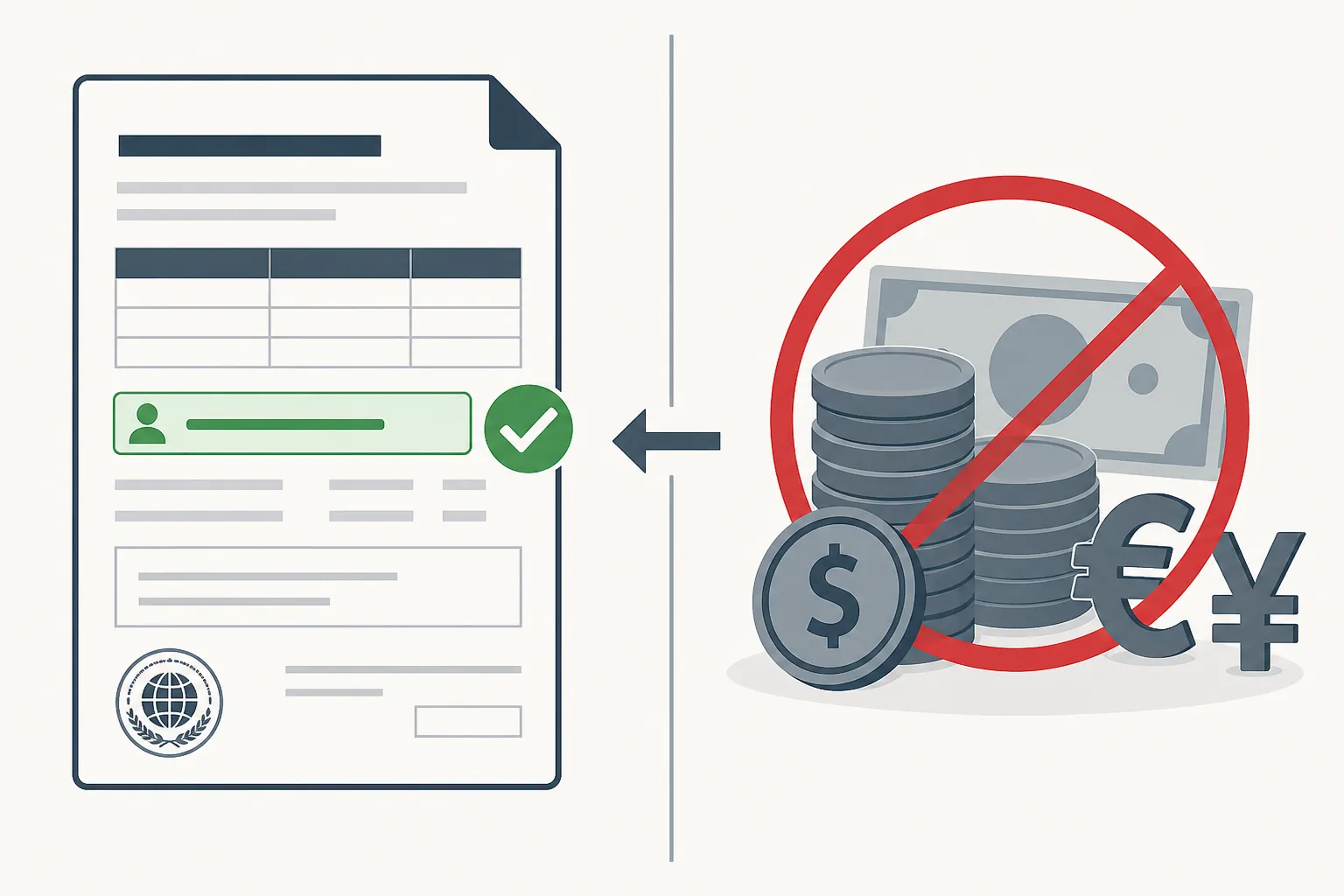
Start with the customs entry. For Amazon tariff refund legality and eligibility, the first useful question is not who felt the tariff in the price, who reimbursed whom, or whether the item was bought on Amazon. It is whose name appears as the Importer of Record on CBP Form 7501, or as the designated Notify Party on CBP Form 4811. CBP’s IEEPA refund page states that refunds go only to those parties, and that rule controls the government-refund pathway before any pass-through theory matters. [1]
That distinction is blunt enough to prevent many bad intake calls from becoming bad filings. Norton Rose Fulbright states the standing point in the same terms: “No refunds will be issued by the government to parties who may have reimbursed the importer for tariffs paid on their behalf.” [2]
Last verified: Aug. 2, 2026. This is legal information for verification and triage, not legal advice. For the litigation chronology, docket posture, and Amazon’s stated defenses, use the Amazon Trump tariff refund lawsuit, explained. This workflow is narrower: it sorts the claimant, the document set, the filing channel, and the deadline risk.
| Client status at intake | First document question | Likely pathway |
|---|---|---|
| Named Importer of Record, or designated Notify Party | Does CBP Form 7501 name the client as IOR, or does CBP Form 4811 designate the client as Notify Party? | Tier 1: CBP refund route through the official CAPE/ACE process, subject to entry status and deadlines. [1] |
| Amazon third-party seller, including FBA seller | Does the actual customs entry name the seller, rather than Amazon or another party, as IOR? | Tier 2: possible CBP route only if the seller is the named IOR/Notify Party; bearing the cost is not enough. [1][2] |
| Amazon.com consumer | Is the consumer named on the customs entry? In ordinary retail purchases, no. | Tier 3: no direct CBP refund claim; consumer recovery depends on Amazon’s voluntary pass-through process or pending consumer litigation. |

The customs entry decides Tier 1
A viable CBP refund file begins with the entry packet, not with an invoice total. The entry should identify the importer, the entry number, the duty line, the liquidation status, and the party that CBP is authorized to pay. If the client cannot produce the entry summary or broker records, the next operational step is document retrieval, not a refund demand.
For entries that require a protest, the deadline is not elastic. Holland & Knight describes the 180-day protest period for relevant liquidated entries as the statutory window, and identifies the ACE Portal as the filing channel for the CAPE process. The same discussion reports an estimated CAPE processing period of roughly 60 to 90 days, but that is a processing expectation, not a promise that a refund will issue within that time. [3]
A Tier 1 file therefore needs a different kind of checklist than a consumer refund complaint. The useful items are mundane and decisive:
- CBP Form 7501 showing the Importer of Record, or CBP Form 4811 showing the designated Notify Party;
- entry number, port, importer number, and broker contact;
- the IEEPA duty line or duty calculation at issue;
- liquidation status and liquidation date, if applicable;
- proof of payment and any broker correspondence;
- the ACE/CAPE filing record or protest record once submitted.
The Court of International Trade refund order remains part of the background, and Holland & Knight notes that the government was expected to appeal. That does not remove the need to preserve the entry-specific administrative route where it applies. [3]
The seller trap: “Amazon seller” is not a customs status
The most common wrong turn is to treat “third-party seller,” “FBA seller,” “Amazon seller,” and “importer” as synonyms. They are not. A seller may have felt the duty in landed cost, supplier pricing, storage economics, or margin compression. None of that tells CBP who can receive a government refund.
SellerForge’s Amazon-seller guidance makes the same operational point for FBA imports: seller eligibility depends on whether the seller was the Importer of Record on the customs entry, and unsolicited refund-processing offers should be treated as fraud risks rather than shortcuts. [4]
Amazon’s own public comments are useful here, but only after the entry rule is in place. CNBC reported that Amazon received about $600 million in IEEPA tariff refunds in Q2 2026. On Amazon’s July 30, 2026 earnings call, CFO Brian Olsavsky said the amount was “limited” because Amazon is not the Importer of Record for the “large majority” of items sold in its store; CNBC also reported that more than 60% of items sold on Amazon come from third-party sellers. [5]
Those figures do not answer a seller’s claim by themselves. They explain why a seller-side intake has to move straight to the customs-entry file. If Amazon appears as IOR, the seller does not become CBP’s refund payee merely because Amazon later charged, allocated, or economically passed through part of the tariff burden. If the seller appears as IOR, the seller’s file belongs in Tier 1 and should be evaluated against the entry status, ACE/CAPE channel, and protest deadline.
A seller intake should ask for documents before theories
A clean seller intake can be short. Ask for the entry summary, broker packet, supplier shipment terms, Amazon import records if any, and communications identifying who acted as importer. Do not start by asking whether the seller “paid the tariff.” That phrase can mean a customs payment, a reimbursement, a charge embedded in product cost, a marketplace fee change, or a lost-margin complaint. Only one of those possibilities may correspond to the party CBP is authorized to pay.
| If the file shows | Treat as | Immediate consequence |
|---|---|---|
| Seller is named as IOR on Form 7501 | Tier 1 claimant | Review entry status, liquidation date, protest deadline, and ACE/CAPE filing path. |
| Amazon is named as IOR | Seller pass-through or contract issue, not seller CBP refund eligibility | Do not present the seller as the government refund payee without a separate legal basis. |
| Broker packet is missing or inconsistent | Unverified | Retrieve broker records before classifying the claim. |
| Only invoices or Amazon fee reports are available | Economic-burden evidence | Useful for business or litigation analysis, but not enough to establish CBP payee status. |
Consumers are on a different path
A consumer who bought an imported product on Amazon may have a real pricing injury and still have no direct CBP refund claim. CBP does not refund IEEPA duties to a retail customer merely because the customer ultimately bore some amount in the purchase price. The consumer’s name is not on the customs entry, and the customs-refund mechanism does not become a retail price-adjustment system.
Amazon has described a voluntary consumer process, but the public description is narrow. CNBC reported Olsavsky’s statement that Amazon would automatically contact and refund customers “where we can trace that we’ve passed specific import charges onto customers,” while other refunds would be used to “invest in low prices.” CNBC did not report product categories, dollar thresholds, a customer lookup tool, or a public timeline that would let an individual consumer verify eligibility from the statement alone. [5]
The pending class actions are separate from CBP’s refund channel. Hagens Berman describes Markland v. Amazon, No. 2:26-cv-01670, and Rosen as consolidated in the Western District of Washington before Judge Tana Lin. The described class is limited to consumers who bought imported products “Sold by: Amazon.com” between Feb. 4, 2025 and Feb. 22, 2026, and it expressly excludes third-party sales. [6]
That class definition is narrower than many consumer assumptions. A product bought on Amazon is not necessarily a product sold by Amazon.com, and a third-party sale does not fit the Markland/Rosen class description as reported by plaintiffs’ counsel. For case-status details and the relationship between the consumer cases, see the site’s litigation record.
Spectrum Local News separately reported a Rittenhouse case filed in the Eastern District of New York in June 2026 alleging that Amazon spread tariff costs “across its product line,” including domestic goods. That allegation should be treated as a reported allegation, not as a reviewed pleading or an established finding. [7]
Refund communications need their own verification step
Once the claimant is sorted into the correct tier, the last risk is a bad communication that borrows official language. CBP is explicit: it charges no fees for IEEPA refund processing, and any request for a fee is a scam. [1]
The same caution applies on the consumer side. The FTC warned in July 2025 about scam texts offering “refunds” for Amazon purchases and instructing consumers to click links or provide information. [8]
Do not confuse tariff refunds with the separate FTC Amazon Prime settlement. The FTC’s Amazon Prime refund notice described automatic contact for eligible customers and stated that “the FTC will never contact you about this refund.” The Prime settlement deadline was July 27, 2026, which has already passed as of this article’s Aug. 2, 2026 verification date; it is not an IEEPA tariff-refund route. [9]
- For CBP refunds, verify the request against the official CBP channel and the entry record.
- Reject any processor that asks for a CBP refund fee.
- For Amazon consumer refunds, do not rely on unsolicited texts, payment links, or forms asking for credentials.
- For class-action notices, match the notice to the court, case name, class definition, and counsel information before treating it as legitimate.
- For expired or unrelated refund programs, do not let a familiar Amazon name substitute for the correct legal authority.
The working file is complete when the claimant can be classified without ambiguity: IOR or Notify Party with a CBP document set and deadline review; seller whose eligibility turns on the entry, not marketplace status; or consumer whose route is voluntary Amazon tracing or litigation, not a direct customs refund.
References
- International Emergency Economic Powers Act (IEEPA) Duty Refunds — U.S. Customs and Border Protection
- Potential refunds: US Supreme Court overturns IEEPA tariffs — Norton Rose Fulbright
- Court of International Trade Orders Nationwide Tariff Refunds, But Expect Government to Appeal — Holland & Knight — March 2026
- IEEPA Tariff Refunds: How Amazon Sellers Can Reclaim Duties Paid in 2025–2026 — SellerForge
- Amazon collected $600 million in Trump tariff refunds — CNBC — July 30, 2026
- Amazon.com Import Tariff Consumer Class Action — Hagens Berman
- Lawsuits: Amazon should pass tariff refunds back to customers for IEEPA duties — Spectrum Local News — June 22, 2026
- Scammy texts offering “refunds” for Amazon purchases — Federal Trade Commission — July 2025
- Who’s eligible for a refund from Amazon? — Federal Trade Commission — September 2025
Grounded in
This procedure is grounded in CBP IEEPA Duty Refunds page; CBP Form 7501 and Form 4811, independent of any single documented case. See the Regulation tracker for the governing text.
Cases this step would have prevented
No cases have been explicitly linked to this checklist yet. See Risk Digest for documented incidents generally.
← Back to WorkflowsReport a correction or tip
Spotted an outdated figure, a misstated fact, or a ruling this workflow checklist should reflect? Public comments are disabled for this content given the professional cost of a misreported case outcome, penalty amount, or rule text — use the structured correction channel instead.
Report a correction or tip for this record →