
Why a Claude Outage Demands a Legal Verification Workflow
When Claude goes down, the real exposure for legal teams is deadline-critical work with no fallback and AI output from the degraded window that gets filed without re-verification. This verification-workflow record lays out the steps to run before, during, and after an outage, anchored to the August 2026 Claude incident run and current status data.
- Applicable role
- attorney
- Workflow stage
- pre-filing, drafting, review
- Primary source
- ABA Formal Opinion 512
This is a legal AI outage verification workflow for Claude, Claude API, Claude Code, Claude Cowork, and Claude-dependent legal agents. It is not legal advice. The Claude status material discussed here was last verified against an Aug. 26, 2026 UTC crawl of the status page; status.claude.com remains the live authority for operational state. The two exposure zones are narrower than “Claude was down”: deadline-critical legal work that has no fallback route, and AI-assisted output created or modified during the degraded window that later gets filed, sent, or relied on as if nothing happened. [1]
The hard part is that a Claude outage does not pause court filing systems, docket calendars, statutes of limitation, appeal deadlines, response dates, renewal periods, or client promises. The Northern District of Iowa’s CM/ECF FAQ states that a technical failure, including a CM/ECF failure, will not excuse a filer from a jurisdictional deadline. [2] That FAQ is not a ruling about Claude, and extending the same discipline to AI vendor outages is analysis rather than settled law. But for workflow design, it is the right analogy: if the court’s own system failure does not automatically save a jurisdictional deadline, a third-party AI assistant certainly should not be treated as a deadline cushion.
The August incident record is not clean enough to outsource judgment
The August 2026 record is useful precisely because it is not a neat one-line outage story. TechTimes reported 164 documented Claude disruptions from January through Aug. 5, 2026, roughly one incident every 1.3 days. [3] Deployflow separately described ten incidents across eight consecutive days from Aug. 12 through Aug. 19, including an Aug. 14 failure of status.claude.com itself involving an invalid certificate for about three hours. [4] Those figures do not prove any particular legal deadline was missed. They do show why “we will check the status page if something happens” is not much of a control.
For the Aug. 24–26 incident, the status-page record showed elevated errors affecting Claude Mythos 5, Fable 5, Opus 5, and Opus 4.8. The status sequence recorded an investigating notice at 05:06 UTC, a cause-identified update at 05:27 UTC, and another update at 06:42 UTC. At the Aug. 26 crawl used for this article, the incident was still listed as unresolved, with Partial Outage states on claude.ai, API, Claude Code, and Claude Cowork. [1] PCMag, however, reported that Anthropic said all systems were operational by about 6:15 a.m. ET. [5]
There is no need to force those records into a single tidier timeline. A legal workflow has to survive that kind of ambiguity. If a partner, associate, agent, or API job generated work product between the first error report and the point at which the team can document normal operation, the file should reflect that the output came from a degraded-window period. The status page and a press report can disagree; the filing obligation still needs a defensible record.
| Record item | What the August material supports |
|---|---|
| Affected Claude models | Claude Mythos 5, Fable 5, Opus 5, and Opus 4.8 were listed in the elevated-error incident. [1] |
| Affected product surfaces | At the Aug. 26 crawl, claude.ai, API, Claude Code, and Claude Cowork were still shown with Partial Outage states. [1] |
| Status-page timestamps | Investigating at 05:06 UTC, cause identified at 05:27 UTC, and update at 06:42 UTC. [1] |
| Conflicting external report | PCMag reported Anthropic said systems were operational by about 6:15 a.m. ET. [5] |
| 90-day uptime contrast | Status-page 90-day figures showed claude.ai at 99.34%, API at 99.45%, Code at 99.37%, Cowork at 99.46%, and Claude for Government at 100.0%. [1] |
What actually breaks when Claude is impaired
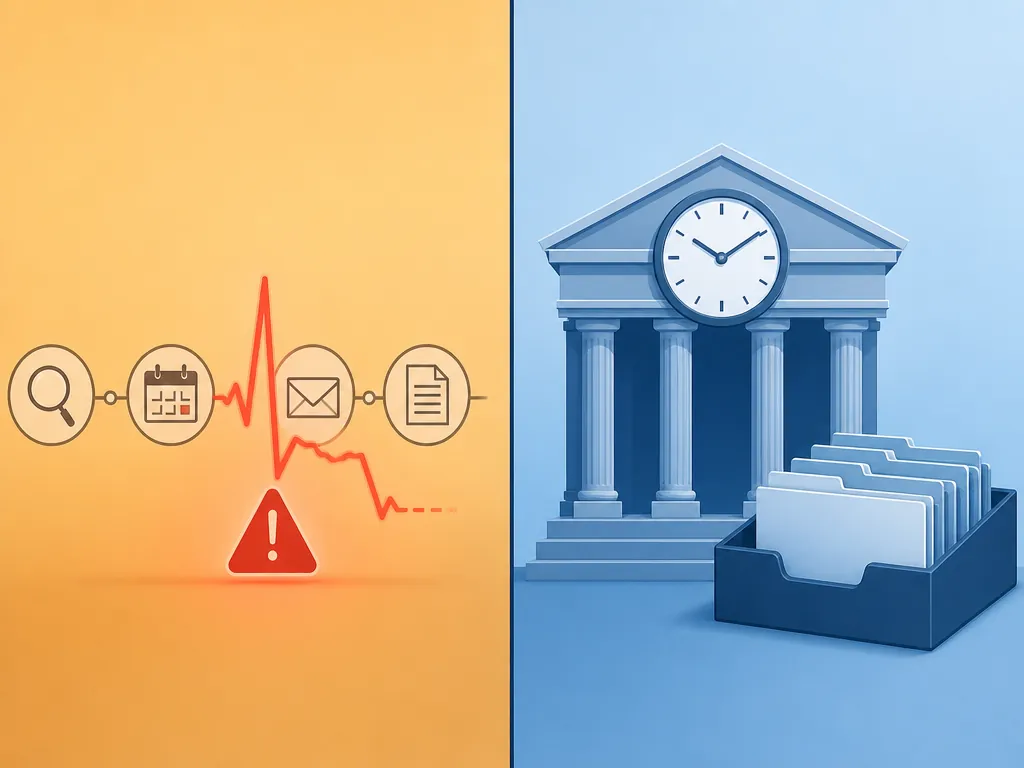
A Claude outage does not break “legal work” in the abstract. It breaks whichever steps the legal team has allowed Claude to carry. That can be harmless if Claude was helping polish an internal memo due next week. It is different if Claude is watching renewal dates, summarizing docket movement, preparing first-pass privilege tags, triaging DSAR responses, drafting a filing section hours before a deadline, or feeding a document pipeline through the API.
The unattended-agent problem deserves more attention than ordinary chatbot inconvenience. Artificial Lawyer reported that Claude for Legal ships with more than 90 workflow agents. [6] GC AI’s description includes examples such as a renewal-watcher, docket-watcher, and DSAR Responder, and describes agents that run continuously or on schedules rather than only while a lawyer is typing into a chat window. [7] That means an outage can create a silent queue, a stale observation, or a missed escalation—not merely an annoyed associate looking at a spinner.
| Claude-dependent surface | Likely legal workflow impact | What the outage does not change |
|---|---|---|
| claude.ai chat | Drafting, summarization, citation spotting, redline explanations, and first-pass research may slow, fail, or produce work during an unstable period. | The lawyer remains responsible for filing, review, client communication, and final legal judgment. |
| Claude API | Matter-intake, document-review, DSAR, knowledge-management, or batch-analysis pipelines may return errors, partial results, duplicate attempts, or delayed queues. | The system of record, court calendar, and client deadline do not automatically adjust. |
| Claude Code | Scripts used for document conversion, batch checking, repository review, or litigation-support automation may stall or complete unevenly. | A failed automation run is not proof that the underlying filing or production obligation was impossible. |
| Claude Cowork | Collaborative workstreams may contain stale AI suggestions, delayed responses, or inconsistent availability across team members. | Team supervision and matter ownership remain with the firm or legal department. |
| Claude for Legal agents | Docket-watchers, renewal-watchers, DSAR responders, or similar agents may miss scheduled checks, defer escalation, or resume with a backlog. | An unattended agent’s silence should not be treated as confirmation that nothing happened. |
The error code matters because it affects what the team can do next. A 529 overloaded_error indicates provider capacity pressure outside the user’s control and is described as not counting against the token quota; a 500 backend failure points to a vendor-side backend problem requiring a fix. [3] The practical difference is not semantic. A 529 may support retry, backoff, alternate-model, or alternate-provider routing if the firm has already approved those paths. A 500 may require the team to stop trying to coax the same workflow back into service and move the deadline-critical work outside Claude altogether. For the ethics-risk analysis around this distinction, see Claude 529 Outages Create an Ethics Exposure for Law Firms.
The outage workflow: before, during, after
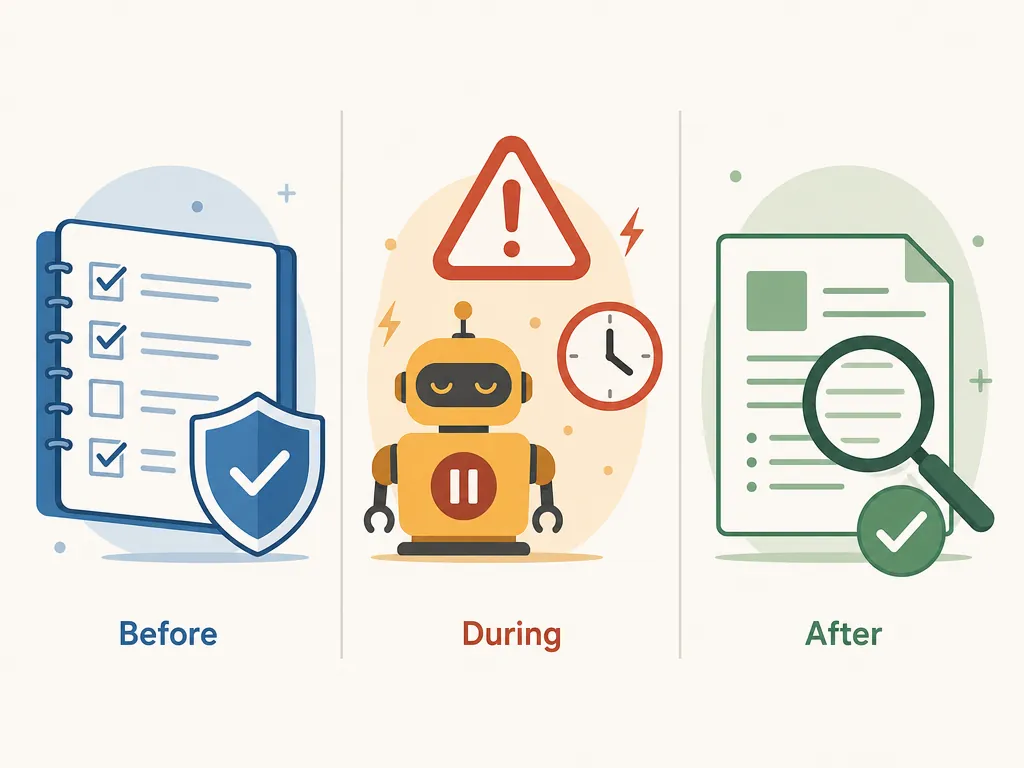
The workflow should be boring enough to run under pressure. It does not need a new committee meeting every time a status page turns yellow. It needs assigned owners, a known fallback, a record of the degraded window, and a mandatory re-verification step before degraded-window output is used.
| Phase | Control objective | Minimum action |
|---|---|---|
| Before | Know which legal tasks cannot wait for Claude to recover. | Classify Claude-dependent work by deadline sensitivity, fallback route, supervising lawyer, and required human signoff. |
| During | Keep deadlines outside the impaired system and stop treating AI output as normal. | Declare a degraded window, preserve status/session evidence where appropriate, reroute jurisdictional work, and mark affected output. |
| After | Prevent degraded-window material from flowing into a filing or client position without review. | Re-check legal propositions, citations, docket facts, client-facing text, and unattended-agent actions before reliance. |
Before: classify the work Claude is allowed to touch
The pre-outage inventory should be matter-facing, not vendor-facing. “We use Claude” is not a control. The useful inventory says which practice group uses Claude for which task, whether the task touches a court or client deadline, what system contains the authoritative record, who supervises the AI-assisted step, and how the work proceeds if Claude is unavailable.
- Identify deadline-critical Claude-dependent tasks: final filing drafts, emergency motion support, docket-change review, renewal monitoring, DSAR response queues, litigation-hold follow-up, production triage, and client deliverables with fixed delivery dates.
- Assign fallback routes before the outage: direct CM/ECF or state e-filing access, non-AI research tools, prior vetted work product, manual docket review, alternate approved AI systems if allowed, and named human reviewers.
- Separate 529 capacity events from 500 backend failures in the incident playbook so the first response is not improvisation.
- Define which AI outputs can never be used without human signoff: citations, legal propositions, docket-dependent assertions, deadline calculations, client-facing recommendations, and any agent-created external communication.
- For unattended agents, require an owner, a monitoring interval, an escalation route, and a post-outage backlog review.
Agent supervision should be documented with the same seriousness the team would apply to a delegated paralegal task. If an agent watches a docket or renewal calendar, the file should say who checks whether the agent actually ran, who receives failure notices, and who performs manual review when the agent is impaired. The broader supervision framework is discussed in the Agentforce ABA 512 obligations record; the same recordkeeping logic applies here even though the vendor and product are different.
During: mark the degraded window and move deadline work out of Claude
During the incident, the first useful act is to name the window. It can be conservative: begin with the first observed failure, first vendor status update, or first internal report, and end only when the team has enough evidence to treat the workflow as stable again. The point is not to win an outage-history debate; it is to know which outputs require extra handling.
- Declare an internal degraded-window start time in UTC and local matter time.
- Capture the relevant vendor status page, incident ID or incident text, affected products, and timestamps.
- Route jurisdictional deadlines, filing deadlines, and same-day client deliverables through non-Claude fallback procedures.
- Label drafts, summaries, extracts, code outputs, and agent-generated notes created or modified during the window.
- Pause external use of AI-generated citations, legal propositions, docket assertions, and deadline calculations until re-verified.
- Check unattended-agent queues manually where the task is deadline-sensitive.
Preserving logs is not a license to preserve everything. Session records, prompts, document names, client identifiers, and generated text may contain privileged or confidential material. The team should preserve enough evidence to reconstruct the outage handoff without unnecessarily widening access to matter content. The session-log and privilege-preservation issues are treated more fully in Meeting Generative AI Confidentiality Obligations.
The line to draw during the incident is simple: Claude may still be usable for low-risk internal drafting if the matter owner permits it, but output from that period should not slide into the ordinary production stream. A “looks fine” paragraph can become a filed representation. A docket summary can become a missed objection. A renewal-watcher’s silence can become a false sense that no action is due.
After: re-verify before filing, sending, or relying
Service restoration is not the end of the legal control. It is the point where the team decides which degraded-window outputs can be trusted, which must be rerun, and which should be discarded. ABA Formal Opinion 512 is commonly summarized as requiring an appropriate degree of independent verification when lawyers use generative AI in legal practice. [8] Clio’s legal AI quality-control checklist similarly places verification of citations, sources, and legal reasoning at the center of the review process. [9] GC AI’s Claude for Legal description also states that Claude output is a draft for attorney review, not legal advice, and that the attorney, not Anthropic, owns the legal positions. [7]
| Output created or modified during degraded window | Post-outage verification step |
|---|---|
| Legal citations | Open the cited authority in an approved legal research source; confirm existence, quotation accuracy, jurisdiction, procedural posture, and current validity. |
| Legal propositions | Confirm that the authority supports the proposition actually stated, not merely a related point. |
| Docket-dependent assertions | Check the docket or filing system directly; do not rely on an AI summary of docket movement during the outage window. |
| Deadline calculations | Recalculate from the governing rule, order, statute, or docket entry and have the responsible reviewer sign off where the deadline is material. |
| Client-facing text | Review for legal accuracy, privilege, confidentiality, tone, and whether the advice depends on any unverified AI-generated premise. |
| Agent actions and omissions | Review scheduled runs, failed runs, queued tasks, skipped notices, backlog items, and escalations that should have occurred during the degraded period. |
| Claude Code or API-generated workflow results | Check whether the job completed fully, partially, repeatedly, or with stale inputs; preserve enough job metadata to explain the result. |
Citation verification is the easiest place for a degraded-window error to become visible only after harm has already occurred. If a Claude-assisted brief section, motion draft, client memo, or research note was generated during the incident, the reviewer should not merely ask whether the citations “look normal.” The review should confirm the case exists, the quoted language exists, the proposition is supported, the procedural posture is usable, and the authority remains good law. The filing-stage risk is addressed in the Bianco AI-citation risk record; an outage just adds one more reason to make that review traceable.
The incident record the file should contain
A useful record is short, timestamped, and matter-specific. It should not read like a technology postmortem unless the matter actually requires one. The supervising lawyer or risk/KM owner needs enough to answer later: what was impaired, what work was affected, what deadline was protected, what output was re-verified, and who approved reliance.
- Incident source: status-page URL, vendor incident text, affected Claude products, and any external report relied on.
- Time window: first observed impairment, first vendor status update if different, internal declaration time, and restoration or closeout time used by the team.
- Matter impact: affected tasks, affected outputs, affected agents, deadline proximity, and fallback route used.
- Preservation decision: what session logs, screenshots, status captures, job records, or agent logs were preserved, and what was excluded for confidentiality reasons.
- Verification decision: who re-checked citations, legal propositions, docket facts, deadline calculations, client-facing text, and agent outputs.
- Reliance decision: whether the output was filed, sent, revised, rerun, or discarded.
That record also prevents a different failure: treating a vendor availability percentage as proof that a specific matter was safe. A 90-day uptime figure may be perfectly useful for procurement review, but it does not identify the brief section generated at 05:40 UTC, the agent that failed to check a docket, or the filing team that routed around Claude at 6 a.m. The unit of legal exposure is the matter workflow, not the platform average.
For broader business-continuity and professional-responsibility treatment of Claude outages, see Claude's June 2026 outages expose law firm ethics risk. This workflow is narrower: identify affected work, protect the deadline outside Claude, preserve the incident record, and re-verify degraded-window output before filing or reliance.
References
- Claude Status, Anthropic.
- How do I get documents filed when there is an outage that affects the CM/ECF system and I have a deadline to meet?, Northern District of Iowa.
- Claude Goes Down Again: $71B Compute Deal Cannot Prevent Anthropic's 164th Outage, TechTimes, Aug. 5, 2026.
- Claude & Anthropic Outage: Protect Claude Infrastructure, Deployflow.
- Is Claude Down? AI Chatbot Slowly Recovers From Latest Outage, PCMag.
- Claude for Legal Has Over 90 AI Agents, Artificial Lawyer, June 1, 2026.
- Claude Legal AI, GC AI.
- ABA Formal Opinion 512: The Paradigm for Generative AI in Legal Practice, UNC Law Library, February 2025.
- How to Verify Legal AI Output: A 7-Step Checklist, Clio.
Grounded in
This procedure is grounded in ABA Formal Opinion 512, independent of any single documented case. See the Regulation tracker for the governing text.
Cases this step would have prevented
No cases have been explicitly linked to this checklist yet. See Risk Digest for documented incidents generally.
← Back to WorkflowsReport a correction or tip
Spotted an outdated figure, a misstated fact, or a ruling this workflow checklist should reflect? Public comments are disabled for this content given the professional cost of a misreported case outcome, penalty amount, or rule text — use the structured correction channel instead.
Report a correction or tip for this record →