
Continuing Resolutions Affect Federal Courts and AI Oversight
During the FY2026 funding lapse, federal courts moved to limited operations and each court set its own schedule. Verify each court's orders, filing systems, payments, and federal AI-oversight capacity before relying on any filing deadline or payment program.
- Applicable role
- attorney
- Workflow stage
- pre-filing
- Primary source
- Anti-Deficiency Act; Continuing Appropriations and Extensions Act, 2026
A continuing resolution does not make federal-court practice stand still. If funding lapses, the first safe assumption is that filing deadlines remain in force unless the particular court, rule, or judge says otherwise. During the FY2026 lapse, the federal judiciary said CM/ECF and PACER would remain operational and the jury program would continue, but it also said each court would decide which cases and deadlines would proceed.[1]
That local qualifier is the part that matters in practice. “The judiciary” may announce a systemwide funding posture, but a lawyer files in a district, a bankruptcy court, a court of appeals, or a judge’s chambers calendar. Docketing staff still have to know whether that court entered an administrative order, whether the filing portal is accepting submissions, whether a fee payment moved, and whether a panel-attorney payment or other court-supported program is delayed.
For deadline-specific treatment of the 2025 shutdown, the companion analysis Did the 2025 Government Shutdown Pause Federal Filing Deadlines? reaches the same operational answer from the deadline side: a shutdown is not a pause button. This article extends that answer into the FY2026 continuing-resolution cycle, where the moving parts were funding phases, court orders, payment programs, and AI-oversight capacity.
The FY2026 Lapse Had Three Court-Operations Phases
FY2026 began on October 1, 2025 without full-year appropriations. The judiciary initially continued paid operations by using available court-fee balances, while warning that those balances would not last indefinitely.[2] The broader shutdown lasted 43 days and ended on November 12, 2025, when the Continuing Appropriations and Extensions Act, 2026 was enacted, funding most agencies at FY2025 rates through January 30, 2026.[3][4]
| Period | Judiciary posture | Practical consequence for counsel |
|---|---|---|
| October 1-17, 2025 | Paid operations continued using available fee balances | Do not assume normal practice was guaranteed; monitor judiciary and court notices |
| From October 20, 2025 | Limited operations under the Anti-Deficiency Act | Verify each court's order, case schedule, filing access, and payment status before relying on ordinary workflow |
| November 13, 2025 onward | Full paid operations restored | Confirm restored operations locally, especially for delayed payments or programs that had accumulated backlog |
The break point was October 17. The judiciary announced that funding would run out and that, beginning October 20, it would continue only limited operations under the Anti-Deficiency Act. Judges would continue serving. Some staff would be furloughed, while others would work without pay on activities treated as excepted. The same notice said CM/ECF and PACER would remain operational, the jury program would continue, and individual courts would decide which cases and deadlines would proceed.[1]
That is why a systemwide notice was necessary but not sufficient. It answered the broad funding question. It did not tell counsel whether a specific sentencing, evidentiary hearing, bankruptcy sale motion, sealed filing, emergency injunction schedule, or appellate deadline had moved. That answer lived in the court’s own orders and docket.

Why a CR Is Not Just “Last Year, Continued”
A continuing resolution usually keeps agencies funded temporarily at a prior-year rate and often restricts new activities unless Congress provides an exception or anomaly.[5] For court operations, that distinction matters less as political vocabulary than as a question of whether the judiciary has money to pay people and programs now, defer them, or run only excepted work.
The judiciary entered FY2026 already warning that budget pressure was reaching operational programs. In its FY2026 request, the Judicial Conference sought $9.4 billion and described deferred defender-services panel-attorney payments estimated at $76 million in July 2025.[6] By the fiscal year-end discussion in September, judiciary officials described deferred panel-attorney payments of $93 million and warned that a full-year continuing resolution could require downsizing of more than 600 positions or the longest deferral of panel-attorney payments in program history.[7]
Those figures are not filing deadlines. They are the conditions around the people who keep cases moving: clerk’s office staff, Administrative Office staff, federal defenders, and CJA panel counsel. A deadline can remain technically intact while the human and payment infrastructure around it is strained.
Full paid operations resumed on November 13, 2025 after the lapse ended.[1] Later FY2026 appropriations resolved some of the budget posture: the Commerce-Justice-Science appropriations legislation signed January 23, 2026 provided roughly $9.2 billion for the judiciary and $892 million for court security, according to public budget tracking and court-watch coverage.[3][8] Those enacted figures are useful context, but the operational lesson from the lapse is narrower: counsel needed to verify the court’s current operating condition at the moment of filing, not rely on the fact that a CR or full-year bill was being debated somewhere else.
The Court-by-Court Verification Run
During a funding cliff, the working question is not “Are federal courts open?” It is “What has this court ordered, what systems are functioning, what payments are moving, and what deadline am I about to certify by filing?” The difference sounds fussy until a filing is made against the wrong assumption and someone has to repair the record.
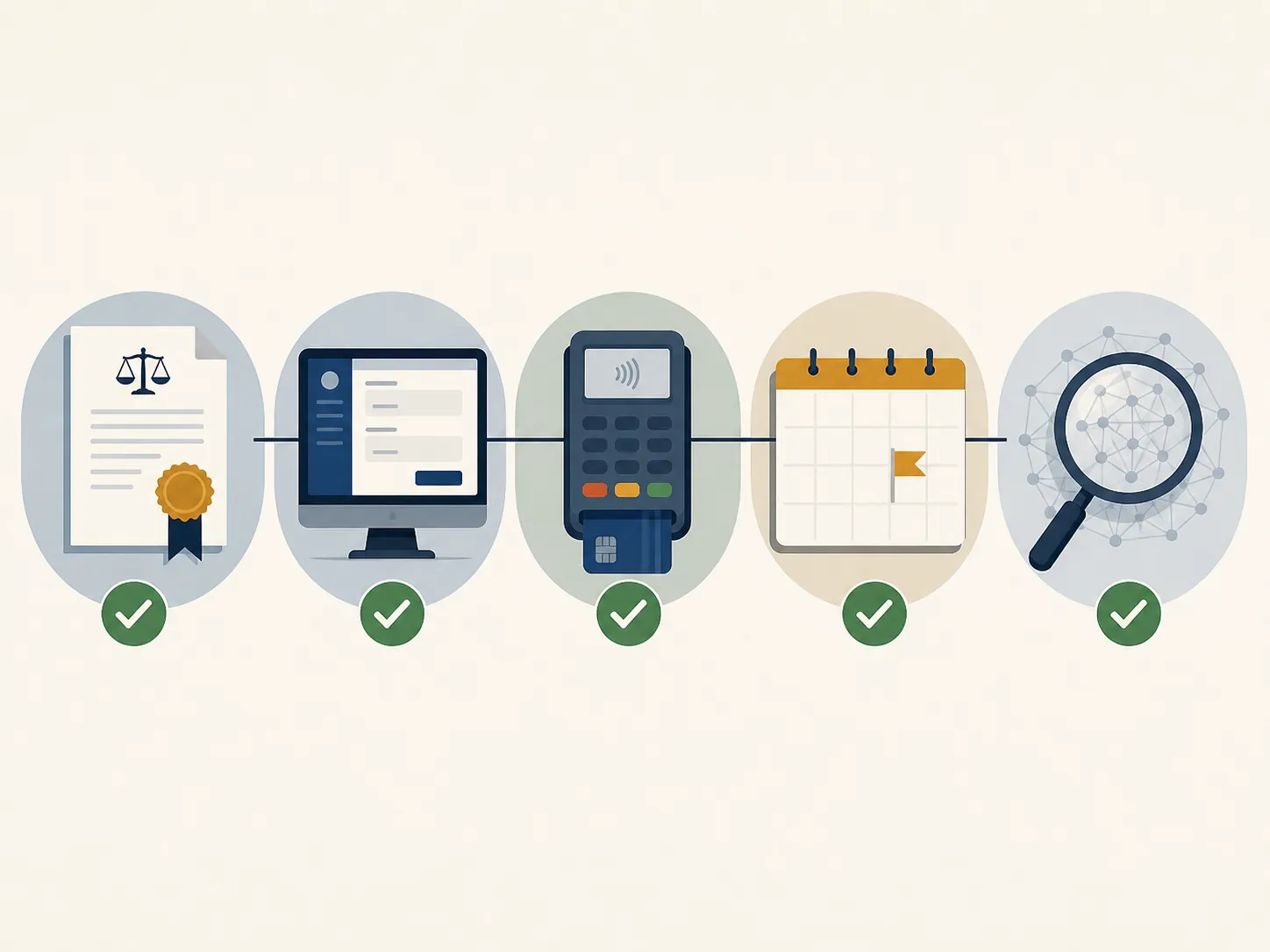
- Find the court’s own operating order first. Use the court website, not a general news summary, and save the version relied on for the filing record.
- Check the specific docket and judge’s orders. A systemwide statement that courts remain open does not answer whether this case’s hearing, briefing schedule, trial date, or response deadline changed.
- Confirm CM/ECF and PACER status from the court or judiciary source. During the FY2026 lapse they remained operational, but the safe habit is still to verify before the filing window narrows.[1]
- Verify fee and payment handling. Filing fees, CJA panel-attorney payments, interpreter payments, registry issues, and other money movements may not share the same operational status.
- Treat AI-assisted work as a verification item. Confirm the current state of federal AI evaluation capacity and the judiciary’s own AI rules before relying on an AI-assisted research, drafting, or evidence workflow.
The first checkpoint is the operating order. Courts often use emergency or administrative orders to state whether deadlines are extended, hearings are continued, criminal matters proceed, civil matters are limited, or clerk’s office services are reduced. If the order is silent on a deadline, silence should not be treated as relief. The next move is to check the docket and, when necessary, contact the clerk in the manner the court permits.
The second checkpoint is the filing system. The FY2026 notice that CM/ECF and PACER remained operational was helpful because it preserved the ordinary submission path for many filings.[1] It did not eliminate the need to check local notices about help-desk staffing, after-hours emergency procedures, sealed filing instructions, fee acceptance, or technical outages. A filing system can be “up” while the person who normally resolves a failed payment or sealed-document issue is unavailable or delayed.
The third checkpoint is payment. The defender-services numbers from 2025 show why “the court is operating” and “payments are current” cannot be merged into one sentence. Deferred panel-attorney payments were a known budget stress before the lapse and remained a practical risk for counsel appointed under the Criminal Justice Act.[6][7] For private counsel, the analogous concern may be filing fees, pro hac vice fees, transcript payments, registry funds, or other court-connected transactions. The repair work often lands on a docketing specialist with a receipt problem, not on the person who made the broad assumption.
A Short Filing-Risk Note Is Better Than a Long Postmortem
For a filing due during a lapse or near the end of a CR, the file should contain a short note identifying the court order reviewed, the docket entry checked, the filing system status observed, the payment path used, and any clerk communication. That is not bureaucracy for its own sake. It is the difference between “we thought the shutdown paused it” and “we checked the controlling source before filing.”
AI Oversight Belongs in the Same Workflow
The AI issue has to be split in two. One object is the executive branch’s AI measurement and evaluation capacity, including NIST and the Center for AI Standards and Innovation. The other is the judiciary’s own AI governance for court operations, evidence, and lawyer-facing expectations. They are related in the daily life of AI-assisted legal work, but they are not the same institution and they do not fail or recover on the same schedule.
During the 43-day lapse, NIST operated with roughly one-third of its workforce and suspended testing programs, according to Federal News Network reporting. The enacted FY2026 CJS legislation later provided about $1.8 billion for NIST, including $55 million for AI research and measurement and up to $10 million to expand CAISI.[10] The Institute for Progress has separately estimated that CAISI would need at least $84 million annually, while describing its FY2026 operational budget as roughly $15 million when accounting for appropriations and a Technology Modernization Fund loan spread across FY2025 and FY2026.[11]
Those numbers do not prove that every AI evaluation slowed in the same way, and they do not excuse counsel from checking AI output. They show a narrower but important point: the federal evaluation backstop itself can be operating under staffing and funding constraints. A law firm that relies on AI-assisted legal research, document review, or technical claims about model safety should not assume that public AI oversight capacity is stable during a funding lapse.
For law-firm compliance teams tracking the broader AI enforcement posture, How Vance's AI Stance Reshapes Law Firm Compliance is the more policy-facing companion. The operational point here is simpler: during a CR fight or shutdown, put AI oversight on the same pre-filing checklist as court orders and filing systems.
Do Not Blame the Shutdown for AI Rulemaking Unless the Record Does
The judiciary’s own AI governance continued on its documented track in 2025. The Administrative Office created an AI Task Force in early 2025 and issued interim AI guidance in October 2025, according to the judiciary’s 2025 annual report.[12] Separately, the Advisory Committee on Evidence Rules posted proposed Rule 707 for public comment through February 16, 2026.[13]
The available materials support verification, not speculation. They do not establish that the FY2026 lapse directly delayed Rule 707 or the judiciary’s AI rulemaking. The right practice is to check the current guidance, proposed-rule materials, local court standing orders, and judge-specific AI disclosure rules before filing AI-assisted work or AI-related evidence. For a case-specific checklist example, AI Verification Workflow for FedEx Truck Accident Cases in Texas shows the same habit in a narrower setting.
The same caution applies to model-performance claims. Public AI evaluation capacity, vendor disclosures, and internal testing are different sources of assurance. The tool-evaluation piece GPT-5.6 Leads DeepSeek V4 on Legal Research, Neither Is Safe makes the practical point from the tool side: even when a model performs well, counsel still owns verification.
What Changed After Funding Was Restored
Restoration of paid operations did not make every operational question disappear. Backlogged payments, deferred administrative work, and postponed local matters still had to be reconciled court by court. Later in 2026, the judiciary also approved a PACER per-page fee increase from 10 cents to 12 cents effective January 1, 2027, to help fund a $700 million to $800 million case-management and public-access modernization effort through FY2030.[9]
That modernization is not a shutdown fact, and it should not be treated as one. It belongs in the same operating file because counsel’s dependency on federal filing and access infrastructure is increasing, not decreasing. During any future lapse, the same questions will return: is the system available, what does the court say, what fees apply, and who can fix a problem before the deadline expires?
The Durable Rule for the Next Funding Cliff
The reusable rule is not complicated. A CR deadline, a lapse deadline, and a restored-funding announcement are all triggers for verification. Start with the judiciary’s systemwide notice, but do not stop there. Pull the court’s operating order. Check the docket and judge’s instructions. Confirm CM/ECF, PACER, fee payment, and any affected court-supported program. Then check the current state of federal AI evaluation capacity and judiciary AI governance before leaning on AI-assisted work.
That is the only discipline that matches how federal courts actually operate during a funding cliff: centrally affected, locally ordered, and unforgiving when a filing assumption turns out to be wrong.
References
- Judiciary Funding Runs Out; Only Limited Operations to Continue, uscourts.gov, October 17, 2025
- Judiciary Still Operating as Shutdown Starts, uscourts.gov, October 1, 2025
- Appropriations Watch: FY 2026, CRFB
- H.R.5371 - Continuing Appropriations and Extensions Act, 2026, Congress.gov
- Continuing Resolutions: Overview of Components and Practices, Congressional Research Service
- Judicial Branch Seeks $9.4 Billion in FY 2026 Budget Request, uscourts.gov, May 14, 2025
- Judiciary Budget Crisis Could Worsen, Conference Is Told, uscourts.gov, September 16, 2025
- Court Security Gets Funding Boost as Shutdown Ends, Fix the Court
- Judiciary Approves Funding for Case Management and Public Access Modernization, uscourts.gov, June 26, 2026
- Lawmakers boost funding for NIST after proposed cuts, Federal News Network
- What Will It Cost for the US to Be Ready for the Next Big AI Breakthrough?, Institute for Progress
- Court Operations – Annual Report 2025, uscourts.gov
- Report of the Advisory Committee on Evidence Rules, December 1, 2025
Grounded in
This procedure is grounded in Anti-Deficiency Act; Continuing Appropriations and Extensions Act, 2026, independent of any single documented case. See the Regulation tracker for the governing text.
Cases this step would have prevented
No cases have been explicitly linked to this checklist yet. See Risk Digest for documented incidents generally.
← Back to WorkflowsReport a correction or tip
Spotted an outdated figure, a misstated fact, or a ruling this workflow checklist should reflect? Public comments are disabled for this content given the professional cost of a misreported case outcome, penalty amount, or rule text — use the structured correction channel instead.
Report a correction or tip for this record →