
Deportation Proceedings Timeline for Green Card Holders in 2026
A verified, step-by-step breakdown of the five-stage removal process for lawful permanent residents, with current 2026 timeline estimates based on the immigration court backlog, detention policies, and key legal deadlines at each stage.
- Applicable role
- attorney
- Workflow stage
- review
- Primary source
- 8 C.F.R. § 1003.38
Last verified: July 29, 2026. This is a procedural reference for checking the deportation proceedings timeline for green card holders in 2026. It is not legal advice, and it should not be used to calculate a deadline without checking the controlling notice, court order, regulation, and current docket status.
The first correction to make is that there is no single green card deportation timeline. Removal proceedings follow a recognizable five-stage sequence, but backlog, detention status, and the form of relief sought can bend that sequence from years into weeks. TRAC reported 3,195,137 pending immigration court cases as of June 2026, with an average wait of about 900 days; in the same month, only 21.5% of immigrants had legal representation when a removal order was issued.[1]
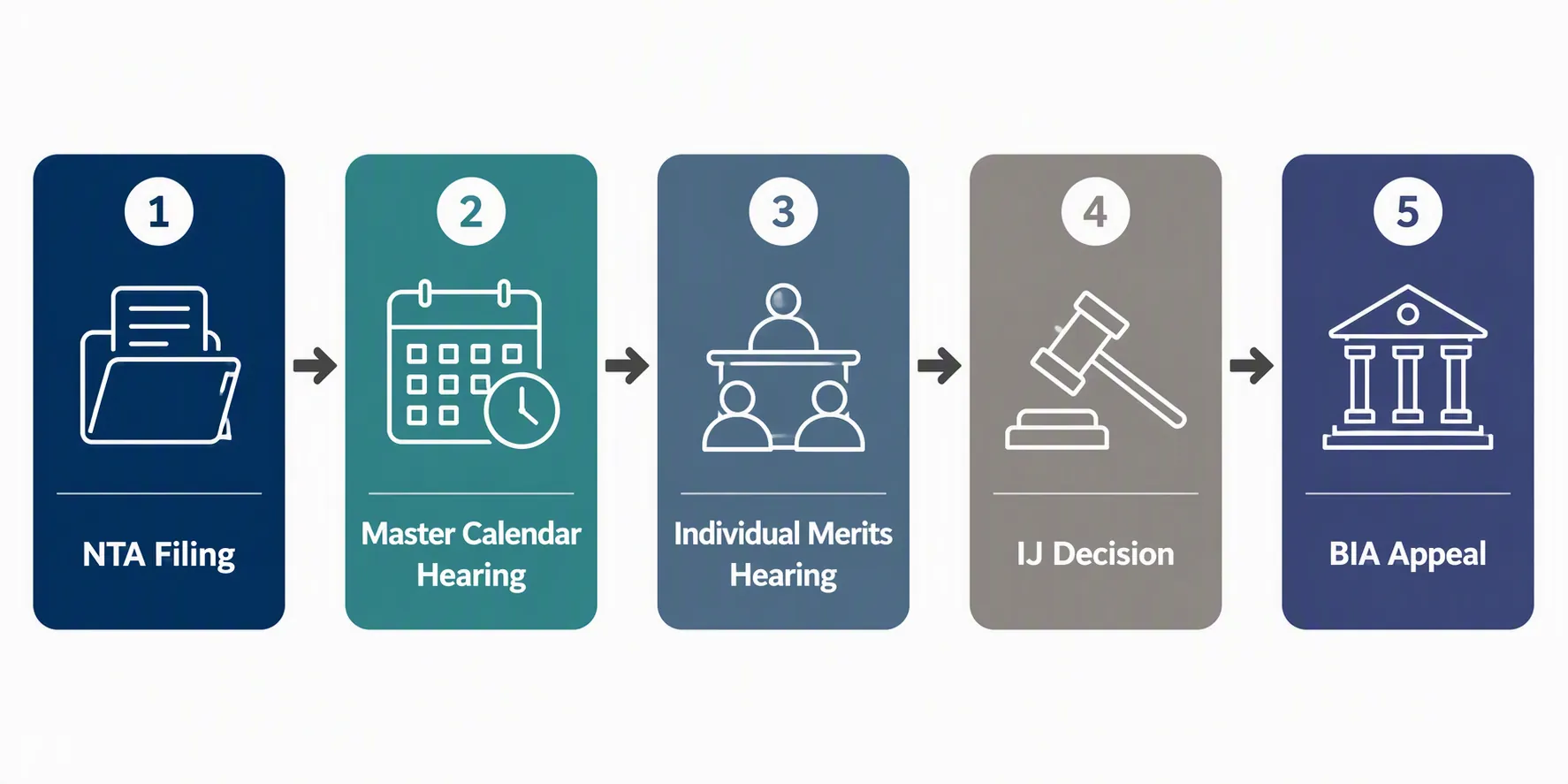
| Stage | Legal event | Typical timing pressure in 2026 | Key deadline or issue | Primary source |
|---|---|---|---|---|
| 1. NTA filing | DHS files a Notice to Appear with immigration court | Case does not move on the court calendar until filing and scheduling occur | Check charge, hearing notice, address, and whether stop-time issues are preserved | TRAC backlog data; INA removal provisions |
| 2. Master calendar hearing | Pleadings, scheduling, counsel issues, bond-related posture, and relief identification | Non-detained cases may wait in backlog; detained cases can move much faster | Admit or deny allegations carefully; request time, bond review if available, and relief schedule | TRAC court and detention data |
| 3. Individual merits hearing | Evidence and testimony on removability and relief | Timing depends on detention, court availability, and complexity of relief | Cancellation, waivers, asylum-related claims, or other relief must be supported by record evidence | INA § 240A and evidence guides |
| 4. Immigration judge decision | Oral or written decision sustaining or terminating removal, granting relief, or ordering removal | Decision may issue the same day or in writing later | Appeal clock starts from the oral or written decision | 8 C.F.R. § 1003.38 |
| 5. Appeal and post-order period | BIA appeal, finality questions, stay issues, and ICE execution of order | Thirty calendar days for BIA appeal; post-order removal period follows final order | BIA notice of appeal within 30 calendar days; ICE 90-day removal period after final order | 8 C.F.R. § 1003.38; INA § 241(a) |
The Five Stages Are Fixed; The Calendar Is Not
For a lawful permanent resident, the removal case usually begins with a Notice to Appear, not with an immediate deportation. The NTA lists factual allegations and legal charges. The government must then prove deportability by clear and convincing evidence, a standard higher than ordinary preponderance.[2] That burden matters. A green card holder is not supposed to be removed merely because the government opens a case.
The court sequence is still only a framework. A non-detained LPR in a heavily backlogged court may wait a long time for a master calendar hearing or an individual hearing. A detained LPR may have the same legal stages compressed into a much shorter period because detained dockets are prioritized. That compression changes the work: a family member may be trying to collect criminal records, tax filings, medical documents, and proof of rehabilitation while bond and pleadings are still unresolved.
A useful timeline therefore starts with three verification questions: Is the person detained? Has the NTA actually been filed with immigration court? What relief is realistically being prepared? Without those answers, an “average timeline” is more likely to mislead than help.
Stage 1: NTA Filing And The First Calendar Check
The Notice to Appear is the charging document. It usually states who DHS says the person is, how and when the person entered or was admitted, what immigration status the person has or had, and which statutory grounds of removability apply. For a green card holder, the most important first task is not to explain the whole immigration system. It is to compare the NTA against the person’s actual immigration record, criminal record, travel history, and court notices.
Filing matters because a served NTA and a filed NTA are not the same practical event. A person may receive a document before the immigration court has a live case on its docket. Once the case is filed and scheduled, hearing notices, address updates, and missed-hearing risks become immediate. In a backlogged court system with more than three million pending cases reported by TRAC in June 2026, the delay between procedural events can be substantial, but the obligation to read every notice carefully starts at once.[1]
This stage is also where a green card holder’s years of residence may become legally fragile. For cancellation of removal under INA § 240A(a), an LPR must generally show at least five years as a lawful permanent resident, seven years of continuous residence after admission in any status, and no aggravated felony conviction.[3] The stop-time rule can cut off accrual of residence when properly triggered. Under Niz-Chavez v. Garland, the Supreme Court held in 2021 that a notice to appear must contain all required information in a single document to trigger the stop-time rule.[4]
That does not mean every defective notice wins a case. It means the NTA should be checked before anyone assumes the person cannot meet the seven-year residence requirement. Older charging documents, especially pre-2021 documents, may require closer review. The point is narrow but important: the calendar may affect eligibility, not just scheduling.
Immediate checks after receiving an NTA
- Confirm whether the case appears in the immigration court system and whether a hearing has been scheduled.
- Compare every factual allegation with immigration documents, criminal dispositions, and travel history.
- Check whether the person is detained and, if so, whether bond review is available.
- Preserve possible stop-time arguments before conceding cancellation ineligibility.
- Calendar hearing dates, address-change duties, and document-gathering deadlines immediately.
Stage 2: Master Calendar Hearings, Pleadings, And Bond Pressure
The master calendar hearing is usually short, but it can determine the shape of the entire case. The immigration judge may address representation, language, pleadings to the NTA, removability, scheduling, filing deadlines, and the relief the LPR intends to pursue. A careless admission at this stage can narrow the dispute before the evidence has been assembled.
For non-detained green card holders, master calendar practice may involve repeated scheduling hearings before an individual merits date is set. For detained green card holders, the same issues may arise under pressure. Detention can make document collection harder, reduce the time available for counsel to investigate the record, and force the bond question to the front of the case.
TRAC reported 51,816 immigration bond hearings in FY2026 through June, with 15,347 grants. The same detention data should be read alongside the reported July 2025 ICE memo and September 2025 BIA decision reinterpreting mandatory detention to cover all “arriving aliens,” narrowing bond eligibility broadly.[5] Those figures do not say whether a particular LPR will receive bond. They do show why detained and non-detained timelines should not be blended.
Bond eligibility also depends on jurisdiction and detention category. For a deeper treatment of the current appellate split, see the site’s analysis of the federal appeals court split on bond hearings in 2026. At the master calendar stage, the practical question is narrower: is the person eligible to ask an immigration judge for release, and if so, what evidence will answer danger and flight-risk concerns?
Representation changes what can be done at this point. TRAC’s June 2026 figure that only 21.5% of immigrants had legal representation when a removal order was issued is not an LPR-only success statistic, and it should not be used that way.[1] It is still a serious procedural warning. Master calendar hearings are where counsel can deny unsupported allegations, refuse premature concessions, identify cancellation or waiver theories, request continuances when justified, and keep the case from drifting into an avoidable removal order.
Stage 3: Individual Merits Hearing And LPR Relief
The individual merits hearing is where the case stops being a scheduling problem and becomes an evidentiary record. The government still carries the burden to prove deportability by clear and convincing evidence.[2] If removability is established or conceded, the LPR must then prove eligibility for whatever relief is being requested.
For many green card holders, the central form of relief is cancellation of removal for certain permanent residents under INA § 240A(a). The statutory thresholds are specific: five years as an LPR, seven years of continuous residence after admission in any status, and no aggravated felony conviction.[3] Meeting those thresholds does not automatically win the case. It gets the applicant to the discretionary question, where equities and adverse facts are weighed.
The evidence plan usually has to cover family ties, length of residence, employment, taxes, property, military or community service where applicable, medical hardship, rehabilitation, criminal-history context, and the consequences of removal. FIRRP’s LPR cancellation guide is useful because it treats the application as an evidence problem rather than a character sketch: documents, witnesses, chronology, and explanation must match the legal elements.[6]
Approval-rate numbers need care here. A reported TRAC-based comparison, cited by Modern Law Group, stated that represented applicants had about a 28.1% approval rate for non-LPR cancellation compared with 12.3% for pro se applicants.[7] That is not an LPR cancellation approval rate. Non-LPR cancellation arises under a different statutory subsection, has different eligibility requirements, and is subject to an annual cap that LPR cancellation does not have. The number may support the broader point that representation and record preparation matter, but it should not be treated as a prediction for a green card holder’s § 240A(a) case.
The individual hearing date itself may arrive long after the first master calendar hearing in a non-detained case, especially in courts affected by the national backlog. In a detained case, the hearing may arrive before the family has found every document counsel would want. That is why the relief theory should be identified at the master calendar stage, not after the merits hearing is already set.
What the merits record must usually answer
- Whether DHS has proved the charged ground of removability.
- Whether the LPR meets the statutory eligibility requirements for the requested relief.
- Whether stop-time, criminal classification, or admission-date issues affect eligibility.
- Whether positive equities outweigh adverse facts as a matter of discretion.
- Whether the record is complete enough for appeal if the immigration judge rules against the applicant.
Stage 4: Immigration Judge Decision
At the end of the merits process, the immigration judge may issue an oral decision in court or a written decision later. The decision may terminate proceedings, sustain removability but grant relief, deny relief and order removal, or otherwise resolve the case under the available procedural posture. The important point for timeline purposes is that the case does not become less urgent when the hearing ends. In many cases, it becomes more urgent.
If the judge orders removal, the appeal clock must be calculated from the oral or written decision. A notice of appeal to the Board of Immigration Appeals must be filed within 30 calendar days.[8] This is not a business-day deadline. A family member or paralegal who hears “we have a month” should translate that immediately into a dated filing deadline.
The decision stage is also where earlier record choices show their cost. If an argument was not preserved, if a criminal disposition was not clarified, or if a witness was not prepared, appeal may be harder. The BIA generally reviews the record made before the immigration judge; it is not a fresh trial designed to repair missing evidence.
Stage 5: BIA Appeal, Final Order, And The 90-Day Removal Period
A BIA appeal is the standard administrative appeal from an immigration judge’s decision. The 30-calendar-day filing deadline under 8 C.F.R. § 1003.38 is the deadline that should be circled before any longer appellate strategy is discussed.[8] Missing it can make the removal order final, subject to only narrower and more difficult procedural options.
Once there is a final order of removal, a different statutory clock becomes relevant. INA § 241(a) provides a 90-day removal period for the government to execute the order; supervised release may follow after that period in some circumstances.[9] That 90-day period is not the same as the time to appeal. It belongs to the post-order enforcement phase.
This is a common place for timeline summaries to become dangerous. “Appeal pending,” “final order,” “stay,” and “post-order custody” are different statuses. A person can be in removal proceedings, on appeal, under a final order, or in post-order detention; each status changes who has authority, what filing is available, and what deadline matters.
Why 2026 Timeline Estimates Conflict
The June 2026 TRAC backlog number is the best anchor in the materials for current immigration court timing: 3,195,137 pending cases and an average wait of about 900 days.[1] Other published figures may be lower. The research brief notes a roughly 1.7 million figure from Vasquez Law, likely reflecting a different counting method, such as active pending cases versus individual respondents or a different reporting window. For a verified procedural guide, the safer method is to state the source, date, and measurement rather than smooth the discrepancy into a single blended number.
The backlog also does not affect everyone equally. Detained dockets move differently from non-detained dockets. A detained LPR may receive hearings much faster, but speed is not the same as fairness or preparedness. A non-detained LPR may have more time to gather documents, but more time can also mean more notices, continuances, address risks, and uncertainty.
Relief sought is the third major variable. A case contesting a narrow legal charge may require a different schedule than a case seeking cancellation of removal with multiple witnesses and extensive discretionary evidence. The court’s calendar may set the hearing date, but the relief theory determines what must be ready by that date.
A Pending Supreme Court Issue To Watch
One 2026 development should be kept separate from the ordinary five-stage removal timeline. Muk Choi Lau v. DHS, argued in April 2026, could affect whether some green card holders returning from abroad face expedited inadmissibility treatment rather than full removal proceedings, according to Courthouse News Service coverage.[10] Until the issue is resolved and applied to a specific posture, it should not be folded into routine timeline advice for every LPR.
The distinction matters because “green card holder in removal proceedings” and “green card holder stopped after travel” may raise different threshold questions. Travel history, admission status, and the government’s chosen procedure should be verified before assuming the standard five-stage immigration court path applies.
How To Use This Timeline Without Over-Relying On It
The safest use of a deportation proceedings timeline for green card holders is diagnostic. Identify the current stage first. Then identify the next binding deadline. Then verify the source that controls that deadline. A timeline that cannot tell the difference between a master calendar hearing, an individual hearing, a BIA appeal deadline, and the post-order removal period is not a legal guide; it is a scheduling hazard.
For a detained LPR, the first urgent issue may be bond eligibility and custody strategy. For an LPR approaching a master calendar hearing, it may be whether to admit or deny allegations and which relief to designate. For an LPR preparing for an individual hearing, it may be evidence under § 240A(a), stop-time analysis, and discretionary equities. For an LPR who has just lost before the immigration judge, it is the 30-calendar-day BIA appeal deadline.
The sequence is knowable. The outcome-sensitive work is stage-specific and deadline-driven. In 2026, with a documented national backlog, compressed detained dockets, and unsettled questions at the edges of LPR treatment, the practical task is not to memorize an average timeline. It is to locate the case precisely, verify the governing source, and act before the next procedural door closes.
References
- TRAC Immigration Court Quick Facts, TRAC, June 2026.
- 8 U.S.C. § 1229a(c)(3)(A) (INA § 240(c)(3)(A)).
- 8 U.S.C. § 1229b (INA § 240A).
- Niz-Chavez v. Garland, 593 U.S. 155 (2021), Supreme Court, 2021.
- TRAC Immigration Detention Quick Facts, TRAC, July 2026.
- LPR Cancellation of Removal Guide, FIRRP.
- Facing Deportation in 2026? Your Rights and Defense Options in Removal Proceedings, Modern Law Group.
- 8 C.F.R. § 1003.38.
- INA § 241(a).
- Green card holders at risk as feds seek deportation shortcut at SCOTUS, Courthouse News Service.
Grounded in
This procedure is grounded in 8 C.F.R. § 1003.38, independent of any single documented case. See the Regulation tracker for the governing text.
Cases this step would have prevented
No cases have been explicitly linked to this checklist yet. See Risk Digest for documented incidents generally.
← Back to WorkflowsReport a correction or tip
Spotted an outdated figure, a misstated fact, or a ruling this workflow checklist should reflect? Public comments are disabled for this content given the professional cost of a misreported case outcome, penalty amount, or rule text — use the structured correction channel instead.
Report a correction or tip for this record →