
NYC Housing Court fast track for vacate orders, explained
The NYC Housing Court fast track for vacate orders and hazardous conditions, announced Aug 25, 2026, is a scheduling directive — eligibility depends on checkable HPD and court records, not a new legal standard. This explainer breaks down the four qualifying conditions, the five-day appearance clock, and how to verify each element against primary records.
- Applicable role
- Tenant advocates and attorneys
- Workflow stage
- Pre-filing
- Primary source
- NYC Civil Court administrative directive (July 16, 2026)
Last verified: Aug. 26, 2026, 00:00 UTC. This article is a record-checking explainer, not legal advice. The full text of the July 16 administrative directive was not publicly located during this verification pass, so the mechanics below are tied to the Mayor’s Office announcement and consistent press reports rather than an independently reviewed copy of the directive itself.
The NYC Housing Court “fast track” for vacate orders is easy to misread. It is not a new tenant cause of action, and it is not a promise that repairs will be finished within five days. It is a Housing Court scheduling directive, announced by the Mamdani administration on Aug. 25, 2026, that gives certain HP and Article 7A cases same-day judge assignment and requires an appearance within five days after completed service.[1] Gothamist reported that the underlying directive was dated July 16, 2026, from NYC Civil Court Administrative Judge Shahabuddeen Ally.[2]
The practical question is therefore not whether a tenant’s situation sounds urgent. The question is whether the building record already shows one of the qualifying conditions: a sufficiently broad vacate order, a sufficiently broad open HPD Class C essential-services violation, all elevators out of service in the building or section, or — for Article 7A — an open HPD Class C or DOB Class 1 violation.[1]
One quick disambiguation matters. This article is not about “vacating” a default judgment, and it is not a general guide to Orders to Show Cause. If the problem is that a tenant or landlord missed a court date and wants to reopen a default, that is a different procedural track. Here, “vacate order” means an order requiring occupants to leave all or part of a building because of conditions in the premises.

What changed in the Housing Court file
The directive changes priority and timing inside Housing Court. It does not erase the need to file the right case, serve the right parties, and prove the building condition through records the court can check. That is why the words “completed service” do so much work: the five-day appearance period runs after service is completed, not simply after a tenant, attorney, elected official, or agency says the building is dangerous.[1]
| Fast-track element | What the record has to show | What not to assume |
|---|---|---|
| Same-day judge assignment | A qualifying case is filed and routed under the new priority rule. | That same-day assignment means the merits have been decided. |
| Appearance within five days | Service has been completed, starting the appearance clock. | That repairs must be completed within five days. |
| HP-case eligibility | One of the HP thresholds is met: broad vacate order, broad open Class C essential-services violation, or all elevators out. | That any HPD violation or any apartment-level emergency qualifies. |
| Article 7A eligibility | An open HPD Class C or DOB Class 1 violation appears for the 7A case. | That the same one-third unit threshold reported for HP cases applies to 7A. |
Bisnow reported another operational limit in the directive: adjournments are to be granted only “when determined to be absolutely necessary.”[3] That language does not make a landlord repair faster by itself. It does make delay harder to treat as ordinary scheduling drift once a qualifying case is in the lane.
The four qualifying conditions
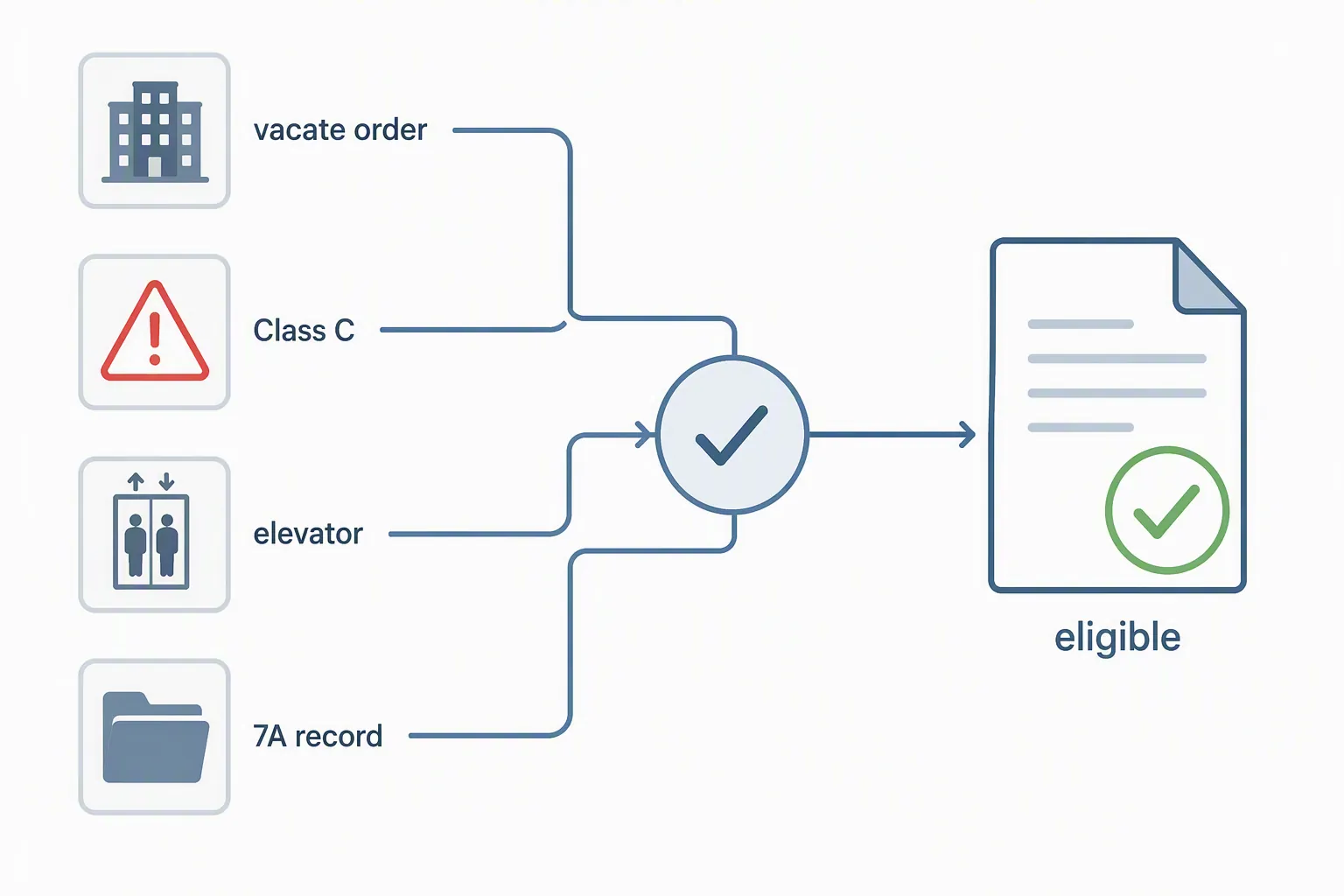
The Mayor’s Office summary describes four routes into the fast track. Three apply to HP cases. The fourth applies to Article 7A cases.[1] They should be checked separately because the thresholds are not identical.
1. HP case: a vacate order affecting one-third or more of apartments, or the whole building
For an HP case, the reported rule covers a vacate order affecting at least one-third of the building’s apartments or the entire building.[1] The count matters. A partial vacate order for one apartment in a large building may be severe for that household, but the fast-track summary does not say that every partial vacate order qualifies.
Start with the building’s HPD record. HPD’s violation guidance states that Orders to Repair/Vacate appear with hazard class “I.”[4] That label is useful because it keeps the check tied to the agency record instead of to a phrase in a letter, news story, or tenant narrative. The file still has to show whether the order is open and how much of the building it affects.
For this route, the advocate’s packet should be able to answer three questions without guesswork: which order is being relied on, whether it remains open, and whether it reaches the one-third-or-whole-building threshold. If the record uses apartment numbers, the apartment count has to be reconciled against the building total. If the record says the whole building is vacated, that should be preserved as the operative language.
2. HP case: an open Class C essential-services violation affecting one-third or more of apartments, or the whole building
The second HP route is narrower than “there are bad conditions.” It requires an open immediately hazardous HPD Class C violation involving essential services — heat, hot water, electricity, gas, or water — affecting one-third or more of apartments or the whole building.[1] HPD describes Class A violations as non-hazardous, Class B as hazardous, and Class C as immediately hazardous.[4]
That classification is why HPDONLINE status should be pulled before anyone relies on a press summary or building complaint history. The record has to show the violation class, the condition, the affected location or apartments, and whether the violation is still open. A closed Class C violation may matter to a tenant’s history of conditions, but the reported fast-track condition is an open one.[1]
HPD’s correction periods help explain why Class C is treated seriously, but they should not be confused with the new court appearance clock. HPD says heat and hot-water violations have no correction time, other Class C violations generally carry a 24-hour correction period, and certain lead and mold Class C violations carry a 21-day correction period.[4] Those agency correction periods are not the same thing as the Housing Court directive’s requirement that parties appear within five days after completed service.[1]
3. HP case: all elevators out of service in the building or section
The third HP route is elevator-specific: all elevators must be out of service in the building or section.[1] The word “all” should be treated as a record requirement, not a rhetorical flourish. A recurring elevator outage, a long repair delay, or one dead elevator in a bank may support other relief, but the fast-track summary describes a total outage for the building or section.
The cleanest packet will include the current elevator complaint or violation record, any HPD or DOB record showing status, and enough building layout information to explain whether the affected area is the whole building or a defined section. If the building has multiple elevator banks serving different towers, wings, or sections, the file should not leave the judge guessing what “all” refers to.
4. Article 7A case: an open HPD Class C or DOB Class 1 violation
Article 7A cases are described differently in the announcement. For 7A, the fast-track condition is an open HPD Class C violation or an open DOB Class 1 violation.[1] The reported summary does not add the one-third-of-apartments threshold that appears in the HP vacate-order and essential-services routes, so that threshold should not be imported into 7A unless the directive text later says so.
Article 7A is the proceeding category used when court appointment of an administrator is sought for a distressed building; HPD’s 7A Program page describes the program around administrators appointed by Housing Court for privately owned buildings with serious conditions.[5] That context matters because a 7A file is not just a repair-order file with a different caption. It asks the court to place management authority somewhere else when statutory conditions are met.
A practical record-checking sequence
The fastest way to lose the benefit of a fast track is to arrive with an urgent story and an underbuilt record. The court staff routing the filing will need to see why this case belongs in a priority lane. A tenant-side packet does not have to be ornate, but it should make each eligibility element visible.
- Identify the proceeding type first. Mark whether the filing is an HP case or an Article 7A case, because the reported thresholds differ.
- Pull the current HPD building record. Preserve the building identifier, address, violation list, open-or-closed status, violation class, and any Orders to Repair/Vacate shown with hazard class “I.”
- For an HP vacate-order route, count the affected apartments against the building total. The qualifying phrase is one-third or more of apartments, or the entire building.
- For an HP Class C essential-services route, verify both parts: the violation must be open and Class C, and it must involve heat, hot water, electricity, gas, or water at the required building scale.
- For an elevator route, document that all elevators are out in the building or the relevant section. If the building has multiple sections, explain the section instead of relying on shorthand.
- For Article 7A, attach the open HPD Class C or DOB Class 1 record being used for fast-track eligibility. Do not add an HP-case unit threshold unless the later public directive text requires it.
- After filing, track assignment and service separately. Same-day judge assignment is a filing event; the five-day appearance clock is tied to completed service.
For readers building a reusable checklist, this is the same discipline used in other verification workflows: separate the legal label from the docket event, and separate both from the record fact that proves eligibility.
The five-day appearance clock

The operational heart of the directive has three parts: a judge is assigned the same day the qualifying case is filed; the parties must appear within five days of completed service; and adjournments are limited to circumstances determined to be absolutely necessary.[1][3]
Those are three different court moments. Filing starts the routing problem. Service creates the appearance clock. The appearance gets the case in front of a judge. None of those moments is the same as a repair deadline, a finding of liability, or a completed return home for tenants under a vacate order.
This distinction is not a technicality for its own sake. If the proof of service is missing, disputed, or not yet complete, the five-day appearance language may not do what the filer expects. If the eligibility record is thin, court staff may have to sort the filing while a dangerous condition is still active. The directive can create priority only after a case can be recognized as the kind of case the directive covers.
The timing also explains why a tenant advocate should keep two folders, even if they are digital. One folder proves qualification: HPD, DOB, vacate-order, elevator, and 7A records. The other proves court posture: petition, index or docket information, judge assignment, affidavits or proof of service, and the date from which the five-day appearance period is being calculated.
Why a scheduling directive can still matter
A scheduling directive can sound modest until it lands in a courthouse already carrying too many cases. Bisnow reported that Housing Court had 55 judges averaging more than 60 cases per day, and that the new approach includes expanding the pool of judges eligible for Housing Part and 7A assignments.[3] In that setting, priority is not ceremonial. It determines which file gets in front of a judge while the violation is still live.
City Hall’s estimate, quoted by Bisnow, was that the fast track would apply to roughly 40 to 50 buildings annually.[3] That is an estimate from the administration, not an observed docket count. It should be used to understand expected scale, not to claim the directive has already produced outcomes.
The backdrop is larger than that annual estimate. In a separate analysis of city data, Bisnow reported that more than 600 buildings, covering about 2,000 units, had faced partial or full vacate orders in 2026 as of early August; that of 8,813 vacate orders since 2012, nearly half remained unresolved; and that resolved orders took an average of 1.5 years.[6] Those figures are Bisnow’s analysis, not an official court performance metric, but they show why a five-day appearance rule would be attractive to anyone staring at an open vacate order with no meaningful timeline.
What not to overread
The directive should not be treated as measured proof that tenants will return faster. No completed fast-track docket outcomes were identified during this verification pass. The available materials support a narrower conclusion: certain cases are supposed to be assigned and heard faster if the qualifying records are present.
It also should not be described as a single “vacate order fast track” with one threshold. HP cases and Article 7A cases are described differently. HP vacate-order and essential-services routes contain a one-third-or-whole-building scale requirement. The reported Article 7A route turns on an open HPD Class C or DOB Class 1 violation, without that unit threshold in the Mayor’s Office summary.[1]
Finally, a Class C correction period is not the court’s five-day clock. HPD’s correction windows govern agency violation correction expectations.[4] The fast track governs how quickly the parties are supposed to appear in Housing Court after completed service.[1] Confusing those two clocks will produce bad advice at exactly the moment tenants need the record to be clean.
The verification standard to use now
Until the directive text is publicly available and early dockets show how clerks and judges apply it, the safest standard is a conservative one. A fast-track file should show the proceeding type, the exact qualifying condition, the open status of the violation or order, the affected building scale where required, and the service date that starts the appearance clock.
That is the usable meaning of the new fast track for tenants and advocates. The immediate legal event is a prioritized Housing Court appearance, not completed repairs. The work is to assemble the primary-record proof that the building belongs in that lane before the file reaches the person who has to route it.
References
- Mamdani Administration Applauds Launch of Housing Court Fast Track to Get Tenants Urgent Relief Faster, NYC Mayor’s Office, Aug. 25, 2026
- Tenants in NYC's worst buildings to be put on housing court fast track, Gothamist
- Mamdani Reveals Housing Court Fast Track Targeting Landlords, Not Evictions, Bisnow
- Clear Violations, NYC Department of Housing Preservation and Development
- 7A Program, NYC Department of Housing Preservation and Development
- Orders To Vacate On The Rise, Leaving Tenants With No Home, No Timeline, Bisnow
Grounded in
This procedure is grounded in NYC Civil Court administrative directive (July 16, 2026), independent of any single documented case. See the Regulation tracker for the governing text.
Cases this step would have prevented
No cases have been explicitly linked to this checklist yet. See Risk Digest for documented incidents generally.
← Back to WorkflowsReport a correction or tip
Spotted an outdated figure, a misstated fact, or a ruling this workflow checklist should reflect? Public comments are disabled for this content given the professional cost of a misreported case outcome, penalty amount, or rule text — use the structured correction channel instead.
Report a correction or tip for this record →