
Can US Visa Holders Fly Domestically Without a REAL ID?
A verified checklist of the documents US visa holders and lawful permanent residents can present at TSA checkpoints after REAL ID enforcement, from foreign passports to EADs and trusted traveler cards. It also covers the optional $45 ConfirmID attempt available since February 1, 2026, and why the 2025 entry proclamations do not restrict domestic flights.
- Applicable role
- US visa holders and lawful permanent residents
- Workflow stage
- pre-travel
- Primary source
- TSA Acceptable Identification at the TSA Checkpoint
Verified checkpoint answer as of August 2, 2026
Yes. A U.S. visa holder can fly domestically without a REAL ID if they present another identification document on TSA’s acceptable-ID list. TSA’s list includes a foreign government-issued passport, a permanent resident card, a U.S. Citizenship and Immigration Services employment authorization card, a border crossing card, and DHS trusted traveler cards such as Global Entry, NEXUS, SENTRI, and FAST. [1]
This record is about TSA checkpoint document acceptability for domestic flights. It is not legal advice, and it does not cover what to do during an immigration-enforcement encounter at an airport. For that separate question, use the airport-rights workflow on ICE detention and airport encounters.
| Record item | Status |
|---|---|
| Last verified | August 2, 2026 |
| Checkpoint sources used | TSA acceptable identification page; TSA REAL ID FAQ; TSA ConfirmID page |
| Legal-background review | No named legal-background reviewer is identified for this record; the document rules below are tied directly to the cited TSA and professional sources. |
| Scope boundary | Domestic TSA identity screening only; not visa eligibility, admission at the border, removal defense, or airport-enforcement rights. |
What to carry if you are not using a REAL ID
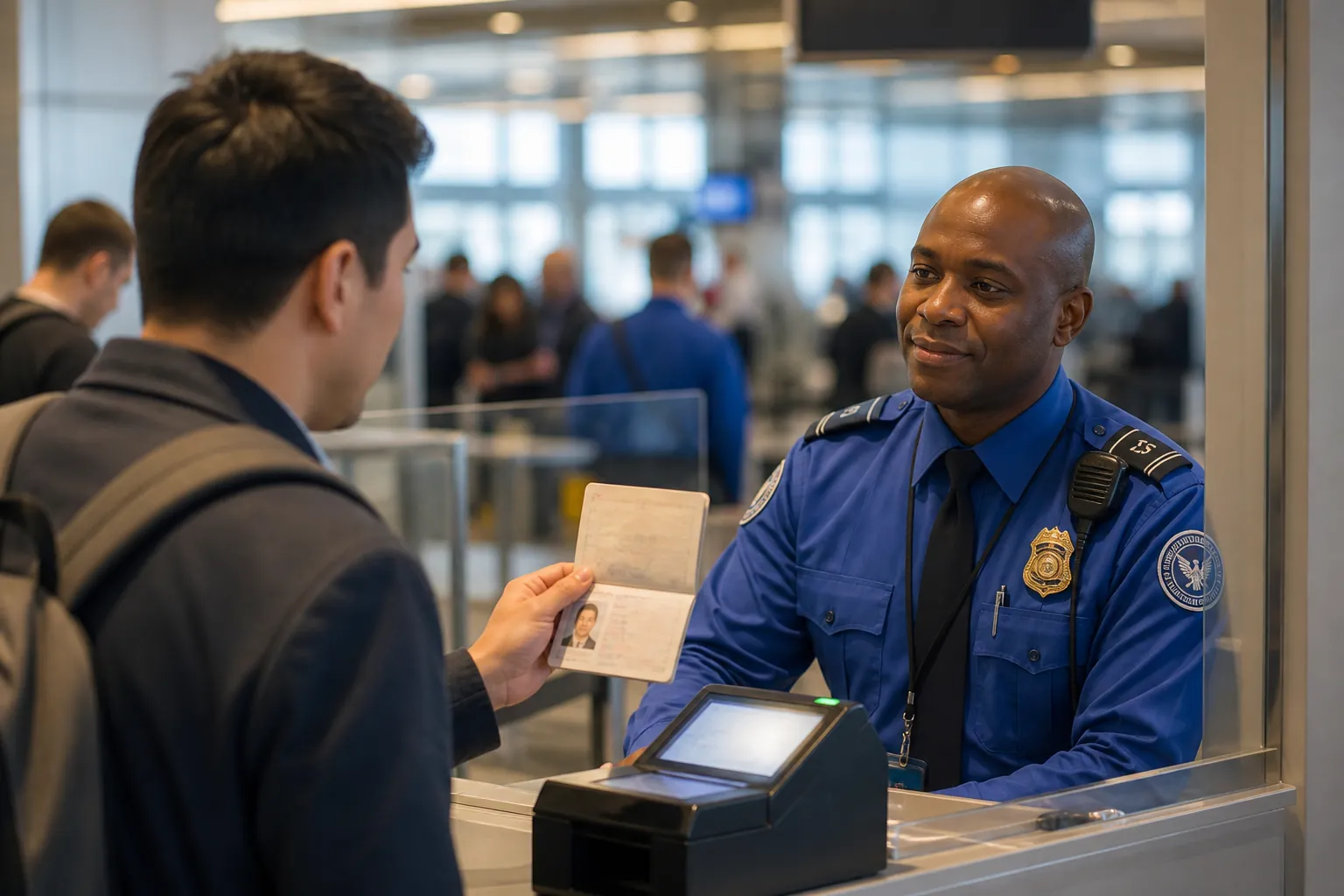
The domestic-flight question is not solved by naming a visa category. TSA’s checkpoint rule is a document rule. An H-1B worker, F-1 student, J-1 exchange visitor, L-1 employee, or B-1/B-2 visitor may be in very different immigration situations, but the TSA officer is checking whether the traveler is presenting an acceptable identity document.
| Traveler situation | TSA-listed document that may answer the checkpoint question | Operational note |
|---|---|---|
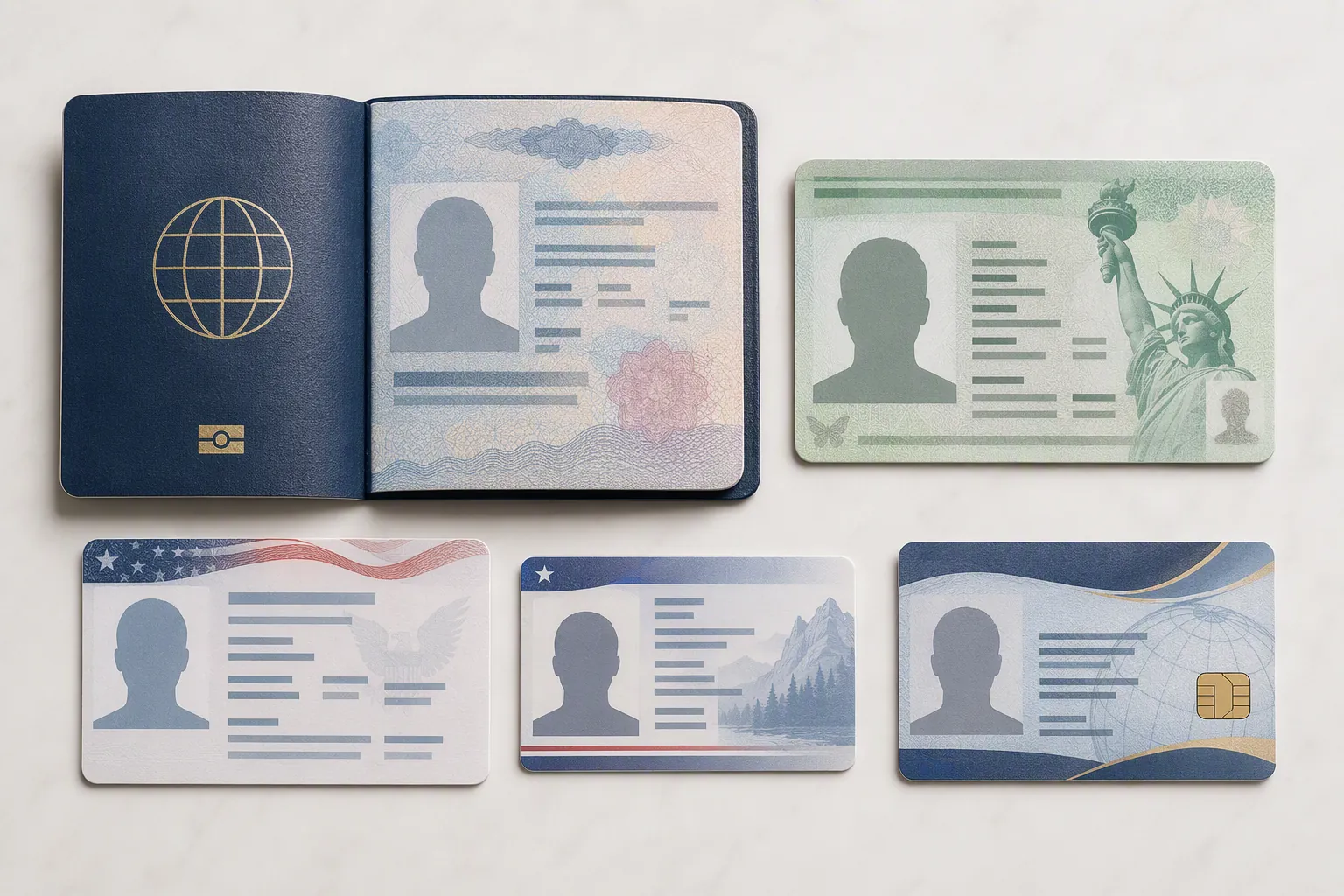
| Nonimmigrant visa holder with a valid foreign passport | Foreign government-issued passport | This is the cleanest document answer for many visa holders flying inside the United States. TSA lists the passport itself, not the visa classification, as acceptable. [1] |
| Lawful permanent resident | Permanent resident card | The green card is separately listed by TSA as acceptable identification. [1] |
| EAD holder | U.S. Citizenship and Immigration Services Employment Authorization Card, I-766 | The EAD is not just a work document for this purpose; TSA lists it as an acceptable checkpoint ID. [1] |
| Border commuter or traveler who has a border crossing card | Border crossing card | TSA lists the border crossing card as acceptable identification. [1] |
| Global Entry, NEXUS, SENTRI, or FAST member | DHS trusted traveler card | TSA lists DHS trusted traveler cards as acceptable identification; membership status alone is not the same as having the card available at the checkpoint. [1] |
| Traveler with a compliant state license or ID | REAL ID-compliant state driver’s license or state ID, or another TSA-listed state document | REAL ID enforcement matters most when the traveler was planning to use a state license or ID. A non-compliant state card is the weak point after enforcement. [2] |
If you are standing in front of a drawer the night before a flight and choosing between a foreign passport and a non-compliant state license, the foreign passport is the document TSA actually lists. The state license may still be useful in ordinary life, but the checkpoint list is the list that matters at 5 a.m.
Children under 18 and recently expired IDs
TSA says children under 18 do not need to provide identification when traveling within the United States with a companion. The companion still needs acceptable identification. [1]
TSA also states that it accepts expired identification up to two years after expiration for the acceptable-ID categories it lists. That tolerance should not be treated as permission to travel casually with stale documents, but it is a real checkpoint rule and often matters when a passport, green card, EAD, or license has recently expired. [1]
The visa stamp and I-94 trap
A visa stamp and an I-94 can be crucial immigration documents, but they are not the same kind of document as a TSA-listed checkpoint ID. TSA’s acceptable-ID page lists a foreign government-issued passport; it does not list a visa foil or I-94 printout as a stand-alone acceptable identity document. WR Immigration’s attorney analysis reaches the same practical point: noncitizens should rely on documents that appear on TSA’s identification list, not on a visa stamp or I-94 alone. [1][3]
That distinction is small enough to disappear in casual advice and important enough to ruin a morning. A passport containing a visa stamp is still a passport. A loose I-94 printout is not converted into a TSA-listed ID just because it proves something important about admission or status.
What REAL ID enforcement changed — and what it did not
REAL ID enforcement began on May 7, 2025. After that date, travelers using state-issued driver’s licenses or identification cards for domestic flights needed a REAL ID-compliant card or another TSA-acceptable form of identification. [2]
That did not turn domestic air travel into a REAL ID-only system. TSA’s acceptable-ID list continued to include multiple federal and foreign-document categories that matter to noncitizens: foreign passports, permanent resident cards, EADs, border crossing cards, and DHS trusted traveler cards. [1][2]
So the phrase “domestic air travel restrictions us visa holders 2025” needs careful sorting. The restriction that arrived through REAL ID enforcement was a restriction on using non-compliant state IDs as checkpoint identification. It was not a new rule barring visa holders from domestic flights.
ConfirmID is a paid verification attempt, not a substitute document
The post-REAL ID checkpoint feature that older explainers often miss is TSA ConfirmID. TSA describes ConfirmID as an optional identity-verification process for travelers who arrive without acceptable identification. It began on February 1, 2026, costs $45 per adult, is non-refundable, can be prepaid through Pay.gov, and applies to a ten-day travel window. TSA also states that payment does not guarantee that the agency can verify the traveler’s identity. [4]

That last sentence does most of the work. ConfirmID is not what visa holders now need after REAL ID. It is not a dependable replacement for a passport, green card, EAD, border crossing card, trusted traveler card, or other listed ID. It is a paid attempt to resolve an identity problem after the traveler has failed to present acceptable identification.
| ConfirmID question | Answer |
|---|---|
| Is it required for visa holders? | No. TSA presents it as optional for travelers without acceptable identification, not as a visa-holder requirement. [4] |
| Does it replace carrying a listed TSA ID? | No. TSA says verification is not guaranteed. [4] |
| How much does it cost? | $45 per adult. [4] |
| Is the fee refundable? | No. TSA describes the fee as non-refundable. [4] |
| How long is the travel window? | Ten days. [4] |
| Can it be paid before arriving at the airport? | Yes. TSA says it can be prepaid through Pay.gov. [4] |
For a traveler who has a foreign passport in hand, ConfirmID should usually be irrelevant. For a traveler who has arrived at the airport with no acceptable ID, it may be an available process, but the price, short window, and no-guarantee language make it a fallback attempt rather than a plan.
The 2025 proclamations are border-admission rules, not domestic-flight ID rules
Some travelers are mixing two different rule systems: TSA identification rules for domestic flights and presidential proclamations governing admission to the United States. Proclamation 10949, effective June 9, 2025, and Proclamation 10998, effective January 1, 2026, concern entry restrictions for covered nationals under specified conditions. NAFSA’s analysis treats these as travel-ban or admission rules, not as TSA domestic checkpoint document rules. [5]
Those proclamations do not rewrite TSA’s acceptable-ID list for a person already inside the United States and presenting acceptable identification for a domestic flight. If the actual problem is whether someone can be admitted to the United States after international travel, that is a different legal question. If the immediate problem is what to show at TSA for a flight from Chicago to Dallas, the checkpoint list controls.
Pre-flight document decision
- Carry a TSA-listed identification document, preferably the clearest one available: a foreign passport, permanent resident card, EAD, border crossing card, DHS trusted traveler card, REAL ID-compliant license or ID, or another document on TSA’s list.
- Do not treat a visa stamp or I-94 printout as a stand-alone TSA checkpoint ID.
- Do not assume a non-compliant state license or state ID is enough after May 7, 2025.
- Do not plan around ConfirmID if you already have acceptable identification; it is a paid, non-refundable verification attempt with no guaranteed outcome.
- Keep border-admission proclamations separate from domestic TSA identity screening unless your itinerary includes international travel or reentry to the United States.
References
- Acceptable Identification at the TSA Checkpoint, Transportation Security Administration
- REAL ID Frequently Asked Questions, Transportation Security Administration
- REAL ID Enforcement: What Non-Citizens Can Use to Board Domestic Flights, WR Immigration
- TSA ConfirmID, Transportation Security Administration
- Proclamation of December 16, 2025 Travel Ban Effective January 1, 2026, NAFSA
Grounded in
This procedure is grounded in TSA Acceptable Identification at the TSA Checkpoint, independent of any single documented case. See the Regulation tracker for the governing text.
Cases this step would have prevented
No cases have been explicitly linked to this checklist yet. See Risk Digest for documented incidents generally.
← Back to WorkflowsReport a correction or tip
Spotted an outdated figure, a misstated fact, or a ruling this workflow checklist should reflect? Public comments are disabled for this content given the professional cost of a misreported case outcome, penalty amount, or rule text — use the structured correction channel instead.
Report a correction or tip for this record →