
The Double-Compliance Burden: Building an AI Compliance Framework for Law Firms That Satisfies Ethics Rules and AI Regulations
Law firms face a unique challenge: they must comply with both professional responsibility rules (ABA Formal Opinion 512, state bar opinions) and emerging AI regulations (EU AI Act, NIST AI RMF, state AI laws). This guide provides a unified framework that maps ethics duties to specific AI controls, helping managing partners, GCs, and compliance officers build a single program that satisfies both layers.
Why Law Firms Face a Double-Compliance Burden That General Enterprises Do Not
When a general enterprise deploys an AI tool for customer service or internal operations, it typically needs to satisfy one primary compliance layer: the emerging set of AI-specific regulations such as the EU AI Act, state-level AI laws, or voluntary frameworks like the NIST AI Risk Management Framework. The compliance question is largely about risk classification, documentation, and transparency toward consumers or regulators.
A law firm deploying the same underlying AI model for legal research, document review, or contract analysis faces a fundamentally different landscape. It must satisfy not only those emerging AI regulations but also the entire body of professional responsibility rules that govern the conduct of attorneys as officers of the court. This is the double-compliance burden: two distinct regulatory domains, each with its own enforcement mechanisms, and neither designed with the other in mind.
The scale of adoption makes this burden urgent. The Clio 2025 Legal Trends Report found that close to 80% of US lawyers now say they are using AI in their practice, an increase of nearly 60% compared to two years ago. That rapid uptake has outpaced the development of firm-level governance structures. A 2025 Gartner survey cited by Hyperproof found that over 70% of IT leaders say compliance is one of their biggest problems when deploying AI tools, and only 23% feel they have a handle on AI governance. For law firms, the stakes are higher because a compliance failure can trigger not just a regulatory fine but also an ethics complaint, disqualification, or malpractice exposure.
The core thesis of this guide is that a unified AI compliance framework designed specifically for legal practice can satisfy both layers simultaneously. The professional responsibility duties — competence, confidentiality, candor, supervision, and fees — are not obstacles to AI adoption. They are, in fact, a pre-existing governance structure that maps remarkably well onto the controls required by the EU AI Act, NIST AI RMF, and ISO 42001. The challenge is making the crosswalk explicit and building the operational infrastructure to support it.
The Professional Responsibility Landscape: ABA Formal Opinion 512 and Diverging State Bar Opinions
In July 2024, the American Bar Association issued Formal Opinion 512, which remains the most authoritative national guidance on a lawyer's ethical obligations when using generative AI tools. The opinion addresses five core Model Rules and establishes a baseline that every law firm's AI compliance framework must meet.
Under Model Rule 1.1 (Competence), Opinion 512 requires that lawyers obtain a "reasonable understanding" of the capabilities and limitations of the AI tools they use and apply an "appropriate degree of independent verification" to AI-generated output. This is not a suggestion — it is an ethical mandate. A lawyer who delegates legal analysis to an AI without understanding how the model works or verifying its output risks a finding of incompetence.
Under Model Rule 1.6 (Confidentiality), the opinion makes clear that lawyers must take reasonable steps to prevent the disclosure of client information when using AI. This includes understanding whether the AI provider trains its models on user inputs, whether data is encrypted in transit and at rest, and whether the provider's terms of service create any third-party access rights.
Under Model Rules 3.1 and 3.3 (Candor), the opinion prohibits submitting AI-generated citations or arguments without independent verification. The growing body of hallucination sanction cases — over 1,400 globally, with more than 955 in the United States alone — demonstrates that this is not a theoretical concern. The Morgan & Morgan case, in which attorneys were sanctioned for filing a motion containing nonexistent AI-generated case citations, is among the most prominent examples.
Under Model Rules 5.1 and 5.3 (Supervision), the opinion holds that partners and supervisory lawyers must establish policies and procedures to ensure that all attorneys and non-lawyer assistants in the firm use AI competently and ethically. This extends to vendor relationships: a firm that engages an AI provider is responsible for ensuring that the provider's practices do not compromise the firm's ethical obligations.
Under Model Rule 1.5 (Fees), the opinion addresses whether lawyers may bill for AI-generated work and, if so, how. The ABA's position focuses on the value of the output to the client rather than the time saved. However, as the Clio guide notes, the Virginia Supreme Court has taken a different approach, focusing on the value of output to the client rather than time saved, diverging from the ABA's position. This is one of several areas where state-level guidance creates compliance complexity for firms operating in multiple jurisdictions.
State-by-State Divergence: Where the Guidance Agrees and Where It Does Not
As of mid-2026, at least 11 US states have issued formal ethics opinions on AI use by lawyers. While all agree on the core principles of competence and confidentiality, they diverge on several critical questions. The following table summarizes the key positions of the most influential state opinions.
| State | Opinion / Date | Key Requirements | Notable Divergence from ABA |
|---|---|---|---|
| California | Practical Guidance for Generative AI (Nov. 2023) | Competence, confidentiality, candor, supervision | Strong emphasis on understanding model training data and bias risks |
| Florida | Opinion 24-1 (Jan. 2024) | Prohibits use of AI that discloses client confidences without consent | More restrictive on data-sharing with third-party AI providers |
| Texas | Opinion 705 (Feb. 2025) | Requires disclosure to client before using AI on their matter | Explicit client disclosure obligation not present in ABA Opinion 512 |
| New York City | Formal Opinion 2024-5 | Competence, confidentiality, billing transparency | Requires itemized billing for AI-generated work |
| Virginia | Legal Ethics Opinion 1901 | Fees based on value to client, not time saved | Directly contradicts ABA's time-based billing framework |
| Oregon | Formal Opinion 2025-205 (Feb. 2025) | Comprehensive framework covering all five core duties | Most detailed guidance on vendor due diligence obligations |
| Pennsylvania | Joint Formal Opinion 2024-200 | Competence, confidentiality, supervision | Requires firms to maintain an AI use log for audit purposes |
| North Carolina | 2024 Formal Ethics Opinion 1 | Competence, candor, fees | Prohibits billing AI-generated work at full attorney rate without disclosure |
Mapping Professional Responsibility Duties to AI Compliance Framework Controls
The key insight for law firm compliance officers is that the professional responsibility duties imposed by the ABA Model Rules and state bar opinions are not separate from the controls required by AI regulatory frameworks. They overlap substantially. A single well-designed control — such as a human-in-the-loop verification protocol — can simultaneously satisfy Model Rule 1.1's competence requirement, the EU AI Act's transparency obligations under Articles 14 and 22, NIST AI RMF's Measure function, and ISO 42001's human oversight requirements.
The Trustible comparison of the three major AI frameworks demonstrates that they share enough common ground that one governance program can satisfy all three. The same principle applies when adding the professional responsibility layer. The following table provides a crosswalk between specific ABA Model Rules and the corresponding controls in each AI framework.
| ABA Model Rule | Duty | EU AI Act Control | NIST AI RMF Function | ISO 42001 Clause |
|---|---|---|---|---|
| Rule 1.1 | Competence — understand AI capabilities and verify output | Article 14: Human oversight; Article 22: Transparency obligations | Measure function: quality controls, performance monitoring | Clause 7.3: Competence; Annex B.3: Human oversight |
| Rule 1.6 | Confidentiality — protect client data from disclosure | Article 10: Data governance; Article 15: Accuracy and robustness | Govern function: data governance policies | Clause 7.2: Data governance; Annex A.5: Data management |
| Rule 3.3 | Candor — do not submit false or fabricated material | Article 13: Transparency and provision of information | Govern function: documentation and record-keeping | Clause 7.5: Documented information |
| Rules 5.1/5.3 | Supervision — establish policies and oversee AI use | Article 17: Quality management system | Map function: organizational context and stakeholder mapping | Clause 5.1: Leadership and commitment; Clause 6.1: Actions to address risks |
| Rule 1.5 | Fees — transparent billing for AI-generated work | Article 13: Transparency (disclosure of AI involvement) | Govern function: accountability and transparency | Clause 7.5: Documented information (billing records) |
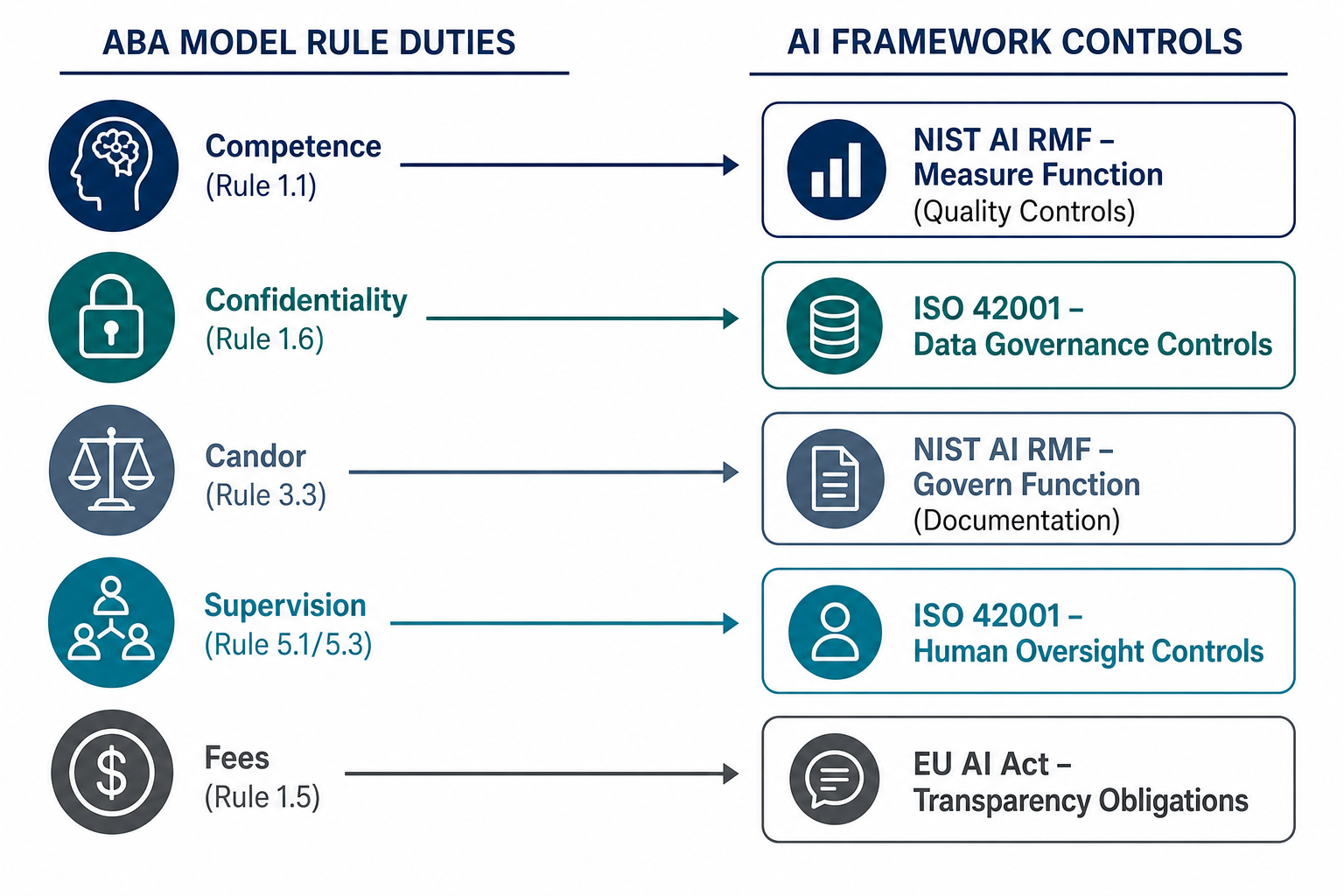
This mapping is not theoretical. The EC-Council crosswalk checklist demonstrates that a single human oversight control, properly documented, satisfies EU AI Act Articles 14/22, NIST AI RMF MAP-3.5/MEASURE-3.2, and ISO 42001 Annex B.3/B.4 simultaneously. For law firms, the same control also satisfies Model Rule 1.1's independent verification requirement and Model Rule 5.3's supervision obligation. The efficiency gain is substantial: instead of building separate compliance programs for ethics rules and AI regulations, firms can build one unified program that serves both masters.
Practical Framework Components for Law Firms
A unified AI compliance framework for a law firm should consist of six essential components. Each component is designed to satisfy both professional responsibility duties and AI regulatory requirements simultaneously.
1. AI Use Inventory and Risk Classification
Before any policy can be written, the firm must know what AI tools are in use. This includes not only firm-approved tools but also tools that individual attorneys may have adopted without authorization. The inventory should capture: the tool name and vendor, the specific use case (legal research, document review, contract analysis, etc.), the data types processed, the deployment model (cloud, on-premises, hybrid), and the vendor's data retention and confidentiality posture.
Once inventoried, each AI use case should be risk-classified. The EU AI Act's four-tier system (unacceptable, high, limited, minimal risk) provides a useful starting point, but law firms should add a professional responsibility dimension. For example, an AI tool used for legal research that generates citations carries higher professional responsibility risk than an AI tool used for internal document summarization, because a hallucinated citation could lead to a Model Rule 3.3 violation and court sanctions.
2. Acceptable Use Policy with Data Classification Tiers
An acceptable use policy (AUP) for AI tools must be grounded in the firm's data classification framework. Not all client data is equal: a publicly filed brief carries different confidentiality obligations than a draft merger agreement or privileged communication. The AUP should define which AI tools may be used with which data tiers and what safeguards are required for each tier.
For example, a firm might establish three tiers: (1) public or non-confidential data that may be used with any approved AI tool, (2) confidential client data that may only be used with AI tools that have contractual prohibitions on model training and data retention, and (3) highly sensitive or privileged data that requires on-premises deployment or a zero-data-retention agreement with the vendor.
3. Vendor Due Diligence for Legal-Specific AI Tools
Law firms cannot rely on vendor marketing claims when evaluating AI tools. The due diligence process must verify: whether the vendor trains its models on user inputs, what data retention and deletion policies are in place, whether the tool has been independently benchmarked for accuracy in legal tasks, what jurisdictions and practice areas the tool supports, and whether the vendor's terms of service are compatible with the firm's ethical obligations.
The Oregon Formal Opinion 2025-205 provides the most detailed guidance on vendor due diligence obligations, requiring firms to assess not only the tool's technical capabilities but also the vendor's security practices, data handling policies, and financial stability.
4. Human-in-the-Loop Verification Protocols
The single most important control in any law firm AI compliance framework is the human-in-the-loop verification protocol. This is where the professional responsibility duty of competence (Model Rule 1.1) and the AI regulatory requirement for human oversight (EU AI Act Article 14, NIST AI RMF MEASURE-3.2) converge.
The protocol should specify: what types of AI output require mandatory human review (e.g., all citations, all legal conclusions, all client-facing communications), what verification tools must be used (e.g., Westlaw KeyCite, Lexis Shepard's for citations), what documentation must be maintained (e.g., verification checklists, review logs), and what escalation path exists when an error is detected.
5. Training and Competency Certification
Model Rule 1.1 requires that lawyers maintain competence in the technology they use. This means that AI training cannot be a one-time onboarding session. Firms should implement an ongoing training program that covers: the capabilities and limitations of each approved AI tool, the firm's acceptable use policy and data classification framework, the verification protocols for AI-generated output, the professional responsibility implications of AI use, and the incident reporting procedures.
Some firms are moving toward annual competency certification, similar to the continuing legal education (CLE) model. This creates a documented record that the firm has satisfied its supervision obligations under Model Rules 5.1 and 5.3.
6. Incident Response
Despite the best controls, AI errors will occur. The question is whether the firm has a documented process for detecting, reporting, and remediating them. The incident response plan should cover: how AI errors are reported (e.g., a dedicated email or form), who is responsible for investigating and documenting the incident, what corrective actions are taken (e.g., retraining, tool reconfiguration, vendor notification), and what disclosure obligations exist (e.g., to the client, to the court, to the state bar).
Court-Specific AI Disclosure Rules and the Hallucination Sanction Crisis
The double-compliance burden is not limited to ethics rules and AI regulations. A growing number of federal and state courts have issued standing orders requiring attorneys to disclose their use of AI in filings. These court-specific rules create a third compliance layer that a unified framework must address.
The Clio guide reports that researchers have identified over 1,400 AI hallucination sanction cases globally, with more than 955 in the United States alone. The Morgan & Morgan case, in which attorneys were sanctioned for filing a motion containing nonexistent AI-generated case citations, is among the most prominent examples, but it is far from isolated. Courts in the Southern District of New York, the Northern District of Illinois, and other jurisdictions have imposed sanctions ranging from monetary penalties to referral to disciplinary authorities.
The following table summarizes the key court-specific AI disclosure rules that law firms must track.
| Court / Jurisdiction | Rule Type | Key Requirement | Effective Date |
|---|---|---|---|
| Southern District of New York (SDNY) | Standing Order | Mandatory disclosure of AI use in any filing; certification that AI-generated content has been verified by a human | 2024 |
| Northern District of Illinois (NDIL) | Standing Order | Disclosure of AI use; certification that citations have been verified against primary sources | 2024 |
| Multiple Federal Courts | Individual Judge Orders | Varies by judge; typically requires disclosure and verification certification | Ongoing |
| Texas State Courts | Proposed Rule | Disclosure of AI use in discovery responses and motions | Pending |
| California State Courts | Guidance | Strongly recommended disclosure of AI use; verification of AI-generated content | 2024 |
The connection to Model Rule 3.3 (candor) is direct. A lawyer who submits AI-generated citations without verification has violated the duty of candor, regardless of whether the court has a specific AI disclosure rule. The court-specific rules add an additional documentation and certification burden, but the underlying ethical obligation is the same.
Implementation Roadmap for Firms of Different Sizes
The implementation of a unified AI compliance framework must be scaled to the firm's size, practice areas, and risk profile. The following roadmap provides tiered guidance for solo/small firms, mid-size firms, and large/Am Law 200 firms.
Tier 1: Solo and Small Firms (Minimum Viable Compliance)
For solo practitioners and firms with fewer than 10 attorneys, the goal is minimum viable compliance: a framework that satisfies the core ethical duties without requiring a dedicated compliance staff. The recommended timeline is 3-4 months.
- Month 1: Conduct an AI use inventory. Identify every AI tool used by anyone in the firm, including tools adopted without formal approval.
- Month 2: Draft a single-page AI acceptable use policy that covers data classification, approved tools, and verification requirements.
- Month 3: Implement a citation verification protocol. Use existing tools (Westlaw KeyCite, Lexis Shepard's) to verify all AI-generated citations before filing.
- Month 4: Complete initial AI training for all attorneys and staff. Document completion for supervision compliance.
Tier 2: Mid-Size Firms (Structured Program)
For firms with 10-100 attorneys, a more structured program is warranted. The recommended timeline is 6-8 months.
- Months 1-2: Form an AI governance committee with representation from practice groups, IT, and risk management. Conduct a comprehensive AI use inventory and risk classification.
- Months 3-4: Develop a full AI acceptable use policy with data classification tiers, vendor due diligence procedures, and verification protocols. Implement a vendor approval process.
- Months 5-6: Deploy training program with annual competency certification. Establish incident response procedures and a reporting mechanism.
- Months 7-8: Conduct a first audit of AI use against the new policies. Remediate any gaps identified.
Tier 3: Large and Am Law 200 Firms (Comprehensive Governance)
For firms with over 100 attorneys, particularly those with international practices, a comprehensive governance program is essential. The recommended timeline is 12-18 months.
- Months 1-3: Establish a dedicated AI governance office with a full-time compliance officer. Conduct a firm-wide AI use inventory and risk classification, including shadow AI detection.
- Months 4-6: Develop comprehensive policies covering acceptable use, data classification, vendor due diligence, verification protocols, training, incident response, and record-keeping. Align policies with EU AI Act requirements if the firm serves EU clients.
- Months 7-9: Implement a technology stack for AI governance, including AI use monitoring, automated verification tools, and incident tracking. Deploy training program with role-based modules.
- Months 10-12: Conduct a first full audit. Establish a continuous monitoring program with quarterly reviews and annual updates.
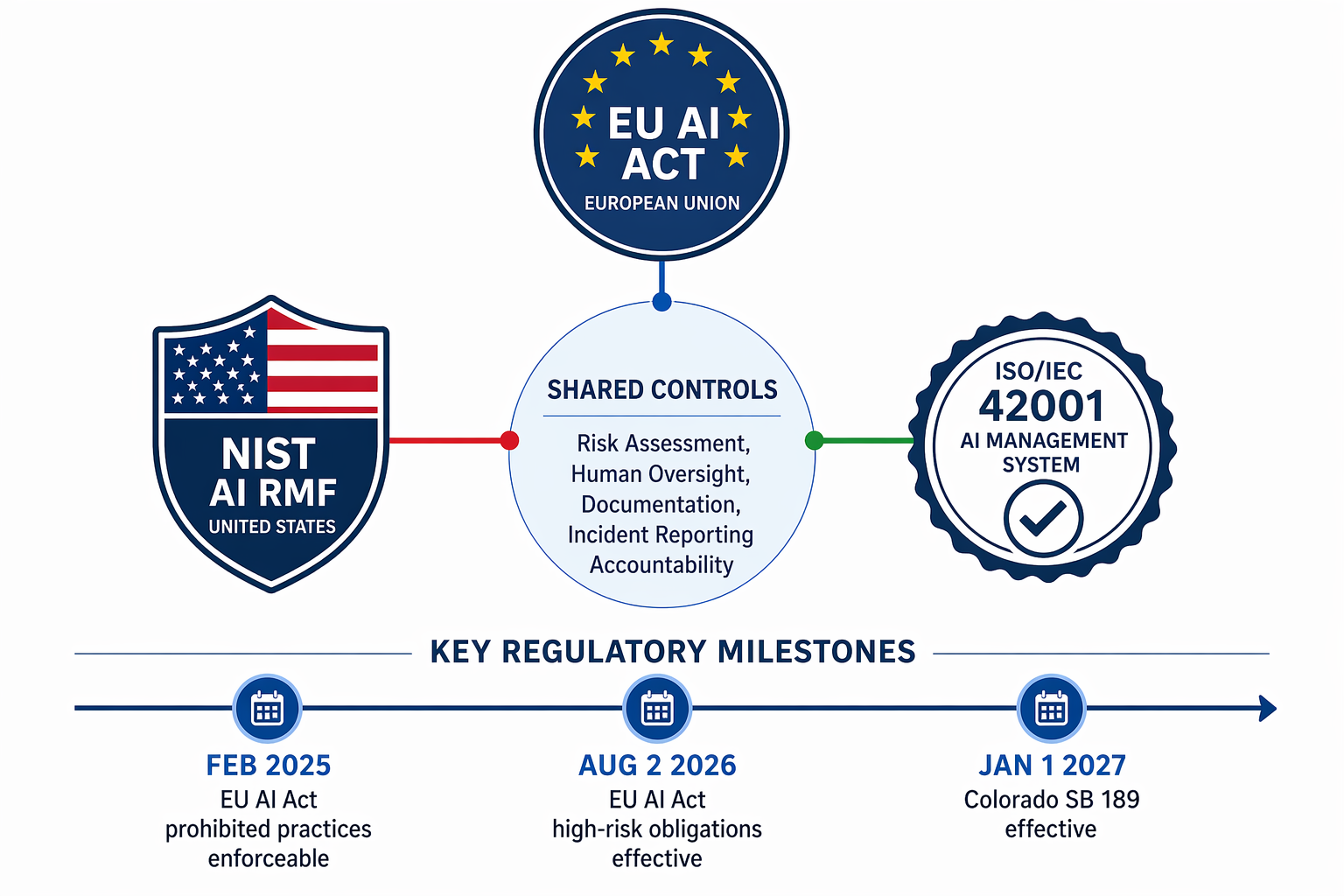
- Months 13-18: Achieve alignment with ISO 42001 or equivalent certifiable standard. Prepare for EU AI Act high-risk obligations (effective August 2, 2026) and Colorado SB 189 (effective January 1, 2027).
Two external deadlines should drive the implementation timeline for all firms. The EU AI Act's high-risk obligations become effective on August 2, 2026, with penalties of up to €35 million or 7% of global annual turnover. The Colorado SB 189, signed into law on May 14, 2026, becomes effective on January 1, 2027, and introduces a disclosure-based framework for automated decision-making technology with new documentation and consumer notice requirements.
Five Essential Policies Every Law Firm Needs in 2026
The following five policies form the operational backbone of a unified AI compliance framework. Each policy is designed to satisfy both professional responsibility duties and AI regulatory requirements. Firms should adopt these policies in writing, communicate them to all attorneys and staff, and document compliance.
1. AI Acceptable Use Policy
This policy defines which AI tools are approved for use, what data may be processed through each tool, and what safeguards are required. It should include a list of approved tools with their risk classification, a prohibition on using unapproved tools (shadow AI), and a requirement to obtain supervisory approval before adopting any new AI tool.
Ethics alignment: Satisfies Model Rule 1.1 (competence) by ensuring attorneys use only tools that have been evaluated for suitability. Satisfies Model Rule 5.3 (supervision) by establishing clear policies for non-lawyer staff.
Regulatory alignment: Satisfies EU AI Act Article 17 (quality management system) and NIST AI RMF Govern function by establishing a documented approval process.
2. Data Classification and Confidentiality Policy for AI Inputs
This policy defines how client data is classified (public, confidential, highly sensitive, privileged) and which AI tools may be used with each classification tier. It should include a requirement to verify that AI vendors do not train models on user inputs, do not retain data beyond the session, and provide contractual guarantees of confidentiality.
Ethics alignment: Satisfies Model Rule 1.6 (confidentiality) by establishing reasonable steps to prevent disclosure of client information.
Regulatory alignment: Satisfies EU AI Act Article 10 (data governance) and ISO 42001 Clause 7.2 (data governance) by implementing data classification and access controls.
3. Vendor Due Diligence Policy for AI Tools
This policy establishes the process for evaluating and approving AI vendors before their tools may be used in the firm. It should cover: security and data handling practices, model training policies, independent accuracy benchmarks, jurisdiction and practice area support, financial stability, and contractual terms related to liability, data ownership, and termination.
Ethics alignment: Satisfies Model Rule 5.3 (supervision) by ensuring that vendor relationships do not compromise the firm's ethical obligations. Satisfies Model Rule 1.1 (competence) by verifying tool capabilities before adoption.
Regulatory alignment: Satisfies EU AI Act Article 17 (quality management system) and NIST AI RMF Map function by documenting vendor risk assessments.
4. Human-in-the-Loop Verification and Citation Checking Policy
This policy is the operational heart of the compliance framework. It should specify: what AI output requires mandatory human review (all citations, all legal conclusions, all client-facing communications), what verification tools must be used (Westlaw KeyCite, Lexis Shepard's, or equivalent), what documentation must be maintained (verification checklists, review logs, sign-offs), and what escalation path exists when an error is detected.
Ethics alignment: Satisfies Model Rule 1.1 (competence — independent verification), Model Rule 3.3 (candor — preventing submission of false material), and Model Rule 5.1 (supervision — establishing review procedures).
Regulatory alignment: Satisfies EU AI Act Articles 14/22 (human oversight and transparency), NIST AI RMF MEASURE-3.2 (performance monitoring), and ISO 42001 Annex B.3/B.4 (human oversight).
5. AI Incident Response and Reporting Policy
This policy defines how the firm detects, reports, investigates, and remediates AI errors. It should cover: how incidents are reported (dedicated email, form, or hotline), who is responsible for investigation and documentation, what corrective actions are taken (retraining, tool reconfiguration, vendor notification), what disclosure obligations exist (to client, court, state bar, or regulator), and what record-keeping requirements apply.
Ethics alignment: Satisfies Model Rule 1.1 (competence — learning from errors), Model Rule 1.6 (confidentiality — mitigating disclosure risks), and Model Rule 8.4 (misconduct — taking corrective action).
Regulatory alignment: Satisfies EU AI Act Article 20 (post-market monitoring and incident reporting), NIST AI RMF Manage function (incident response), and ISO 42001 Clause 10.1 (nonconformity and corrective action).
Grounded in
This procedure is grounded in the cited rule or opinion, independent of any single documented case. See the Regulation tracker for the governing text.
Cases this step would have prevented
No cases have been explicitly linked to this checklist yet. See Risk Digest for documented incidents generally.
← Back to WorkflowsReport a correction or tip
Spotted an outdated figure, a misstated fact, or a ruling this workflow checklist should reflect? Public comments are disabled for this content given the professional cost of a misreported case outcome, penalty amount, or rule text — use the structured correction channel instead.
Report a correction or tip for this record →