
Free AI Lawyer: What You Actually Get, What You Risk, and When You Still Need a Licensed Attorney
A research-driven guide for consumers and pro se litigants on free AI legal tools — covering their real capabilities, documented risks like hallucinated citations and confidentiality breaches, the surge in AI-related sanctions, and a practical decision framework for when these tools are useful versus when you must consult a licensed attorney.

What “Free AI Lawyer” Tools Actually Are
When you search for a “free AI lawyer,” the results are not licensed attorneys. They are software applications powered by large language models (LLMs) — the same underlying technology that drives ChatGPT, Google Gemini, and similar general-purpose chatbots. Some of these tools are repurposed general chatbots that users direct toward legal questions. Others are specialized platforms marketed directly at consumers and pro se litigants, such as AI Lawyer, LawConnect, and Cicerai, which offer document templates, legal information retrieval, and basic drafting assistance.
None of these tools are licensed to practice law. They do not pass the bar, carry malpractice insurance, or owe you a fiduciary duty. What they provide is legal information — not legal advice. The distinction matters: legal advice applies the law to your specific facts and carries professional accountability. Legal information is general knowledge, like reading a statute or a how-to guide. A chatbot cannot know the nuances of your case, your jurisdiction's procedural rules, or the strategic considerations a human lawyer would weigh.
The technology works by predicting the next most probable word in a sequence based on its training data. It does not “understand” the law. It has no internal database of verified legal authorities. When it cites a case, it is generating text that looks like a real citation — which is why the phenomenon of hallucinated case law has become a central risk for anyone relying on these tools for legal work.
What These Tools Can and Cannot Do
Free AI legal tools have genuine utility for low-stakes tasks. They can help you understand the general outline of a legal concept, generate a first draft of a simple letter, or locate a statute. But their capabilities are sharply bounded, and the gap between what they promise and what they deliver has already produced real-world harm.
| Capability | What It Means in Practice | Limitation |
|---|---|---|
| Drafting simple letters or demand letters | Generate a basic eviction notice or small claims demand based on a template | May miss jurisdiction-specific formatting or legal requirements; no guarantee of enforceability |
| Summarizing statutes or legal concepts | Provide a plain-English explanation of a law like the Fair Housing Act | Summaries can be incomplete, outdated, or flatly wrong; no awareness of recent amendments or conflicting case law |
| Generating basic document templates | Produce a will template, lease agreement, or power of attorney form | Templates are generic; may not comply with your state's specific legal requirements; no review for your situation |
| Answering general legal questions | Explain what “summary judgment” means or how small claims court works | Answers may hallucinate case citations or misstate procedural rules; no accountability for errors |
| Appearing in court or filing documents | Cannot do this — period | Only a licensed attorney can represent you in court; AI-generated filings have led to sanctions |
| Providing jurisdiction-specific advice | Cannot reliably tailor advice to your state or local court rules | Most free tools are trained on general US law; state-specific nuances are frequently missed or invented |
| Protecting your confidential information | Free tiers typically retain and use your data for model training | Inputting sensitive facts about your case may waive confidentiality; see ABA Formal Opinion 512 on attorney obligations |
| Guaranteeing accuracy | No tool guarantees its output is correct | Hallucination rates remain significant; independent verification is always required |
The core takeaway: these tools are useful for starting points — not finishing points. If you use a free AI tool to draft a letter or research a legal question, treat its output as a rough first draft that must be verified against primary sources and, ideally, reviewed by a licensed attorney before you act on it.
Documented Risks: Hallucinations, Sanctions, and Confidentiality Breaches
The risks of relying on free AI legal tools are not theoretical. They are documented in court records, ethics opinions, and regulatory filings. Three categories of risk stand out as the most consequential for consumers.
Hallucinated Citations and Factual Errors
The most widely publicized failure mode of generative AI in legal contexts is the fabrication of case citations. A collection of datasets logged nearly 800 cases of AI-related citation errors or hallucinations across at least 25 countries by late 2025, according to a manuscript on Preprints.org. These are not minor mistakes — they are entirely invented cases with plausible-sounding names, docket numbers, and quotes that do not exist in any law library.
The frequency of court rulings addressing AI misuse is accelerating sharply. A database tracking such decisions recorded 52 AI-related court rulings in February 2026 alone, compared to just 2 in February 2025, according to research by Damien Charlotin of HEC Paris reported by Bloomberg Law. That is a 26-fold increase in one year.
Sanctions Against Pro Se Litigants
The consequences of filing AI-generated documents in court are severe and growing. At least 24 pro se litigants in the United States have been hit with monetary sanctions since the second half of 2023, with more than half of those fines levied since December 2025, according to data compiled by Bloomberg Law and Baker Donelson.
- The largest sanction on record is more than $66,000 in attorneys' fees against a Chinese plaintiff in a case involving Arnold Porter Kaye Scholer (Bloomberg Law).
- A pro se litigant in Missouri was fined $10,000 for using AI to generate fake citations (NYSBA).
- In Allen v. Casper (N.D. Ill., March 2026), a pro se litigant was sanctioned $1,500 for filing a 112-page opposition brief that contained fictitious cases (Baker Donelson).
- In Thomas v. Delaware Technical and Community College (D. Del., November 2025), the court relieved the employer from responding to future filings after the plaintiff submitted more than 49 AI-generated filings without verification (Baker Donelson).
- Additional sanctions range from $500 to $10,000 for similar misuse across multiple jurisdictions (Baker Donelson).
Confidentiality Risks on Free Tiers
When you use a free AI tool, you are the product. Free-tier AI services typically retain user conversations and use them for model training. This creates a direct conflict with the confidentiality obligations that govern attorney-client relationships — and a serious practical risk for anyone who inputs sensitive legal information.
The American Bar Association's Formal Opinion 512 (July 29, 2024) maps Model Rule 1.6 (Confidentiality) to AI use, requiring lawyers to protect client information when using AI tools. While this opinion is directed at attorneys, it signals the professional standard: if a lawyer cannot ethically input client data into a free AI tool without risking confidentiality, a consumer should think twice before doing the same with their personal legal information.
If you describe the facts of your case to a free chatbot — including names, dates, financial details, or sensitive personal information — that data may become part of the model's training set. There is no attorney-client privilege, no duty of confidentiality, and no way to retract the information once it has been submitted.
The Pro Se Litigation Surge: What the Data Shows
The rise of free AI legal tools coincides with a dramatic increase in pro se litigation — and the two trends are almost certainly connected. The data from multiple sources paints a clear picture of a legal system under strain.
| Metric | Value | Source |
|---|---|---|
| Pro se federal employment filings (2021) | 2,052 cases (9.7% of all employment cases) | Lex Machina 2026 Employment Litigation Report, cited by Baker Donelson |
| Pro se federal employment filings (2025) | 4,388 cases (16.5% of all employment cases) | Lex Machina 2026 Employment Litigation Report, cited by Baker Donelson |
| Increase in pro se employment filings | More than doubled (113% increase) | Baker Donelson analysis of Lex Machina data |
| Total federal employment lawsuits filed in 2025 | 26,635 — highest in at least a decade | Lex Machina 2026 Employment Litigation Report, cited by Baker Donelson |
| Surge in pro se employment lawsuits (2025) | 49% year-over-year increase | Fisher Phillips, cited by Bloomberg Law |
| Increase in FHA pro se filings (first 9 months of 2025) | 69% compared to prior year | Seyfarth Shaw, cited by Bloomberg Law |
| Defendant win rate in pro se employment cases (2023-2025) | More than 40 to 1 | Baker Donelson analysis of Lex Machina data |
| Settlement rate for pro se plaintiffs | 29% | Baker Donelson analysis of Lex Machina data |
| Settlement rate for represented plaintiffs | 77% | Baker Donelson analysis of Lex Machina data |
The implications are stark. Pro se litigants are not just filing more cases — they are losing at dramatically higher rates. When defendants prevail by a margin of more than 40 to 1, and nearly half of pro se cases are resolved on procedural grounds (meaning the litigant made a technical mistake rather than losing on the merits), the system is failing people who cannot afford a lawyer. Free AI tools, by encouraging people to file without understanding procedural rules, may be making this problem worse.
How Courts and Regulators Are Responding
The legal establishment is not standing still. Courts, bar associations, and legislators are all moving to address the risks posed by AI-generated legal work — and the pace of regulatory activity is accelerating.
ABA Formal Opinion 512 and State Bar Guidance
The ABA's Formal Opinion 512, issued in July 2024, maps six Model Rules to AI use: Competence (1.1), Confidentiality (1.6), Communication (1.4), Fees (1.5), Candor (3.1/3.3/8.4), and Supervision (5.1/5.3). While directed at attorneys, the opinion establishes a professional baseline that consumers should be aware of: lawyers must understand the AI tools they use, protect client confidentiality, verify AI output, and disclose AI use to clients and courts.
At the state level, more than 35 state bar associations have issued formal AI guidance as of early 2026, according to The Legal Prompts. These opinions vary in detail but consistently emphasize the duty to verify AI-generated content and protect client confidentiality.
Proposed Legislation: New York's SB S7263
New York state legislators are considering a bill — SB S7263 — that would ban generative AI tools from providing legal advice and allow civil suits against chatbot owners who violate the law, as reported by StateScoop and Bloomberg Law. The bill targets AI systems that provide “substantive” legal responses, creating a potential new avenue for liability if a chatbot gives bad advice that causes harm.
Court Standing Orders and Bans
Some courts have taken direct action. The New York State Bar Association reports that some courts have banned the use of generative AI by both attorneys and pro se parties. These orders typically require anyone filing documents to certify that they have not used AI to generate content without independent verification, or prohibit AI use entirely in certain types of filings.
The Insurer Lawsuit Against OpenAI
In a significant development, an insurer sued OpenAI in March 2026 for the unauthorized practice of law, alleging that ChatGPT convinced a litigant to fire her lawyer and re-litigate a disability settlement, according to Bloomberg Law. This case, if it proceeds, could establish new legal boundaries around what AI companies can claim their products can do and what liability they face when users rely on that advice to their detriment.
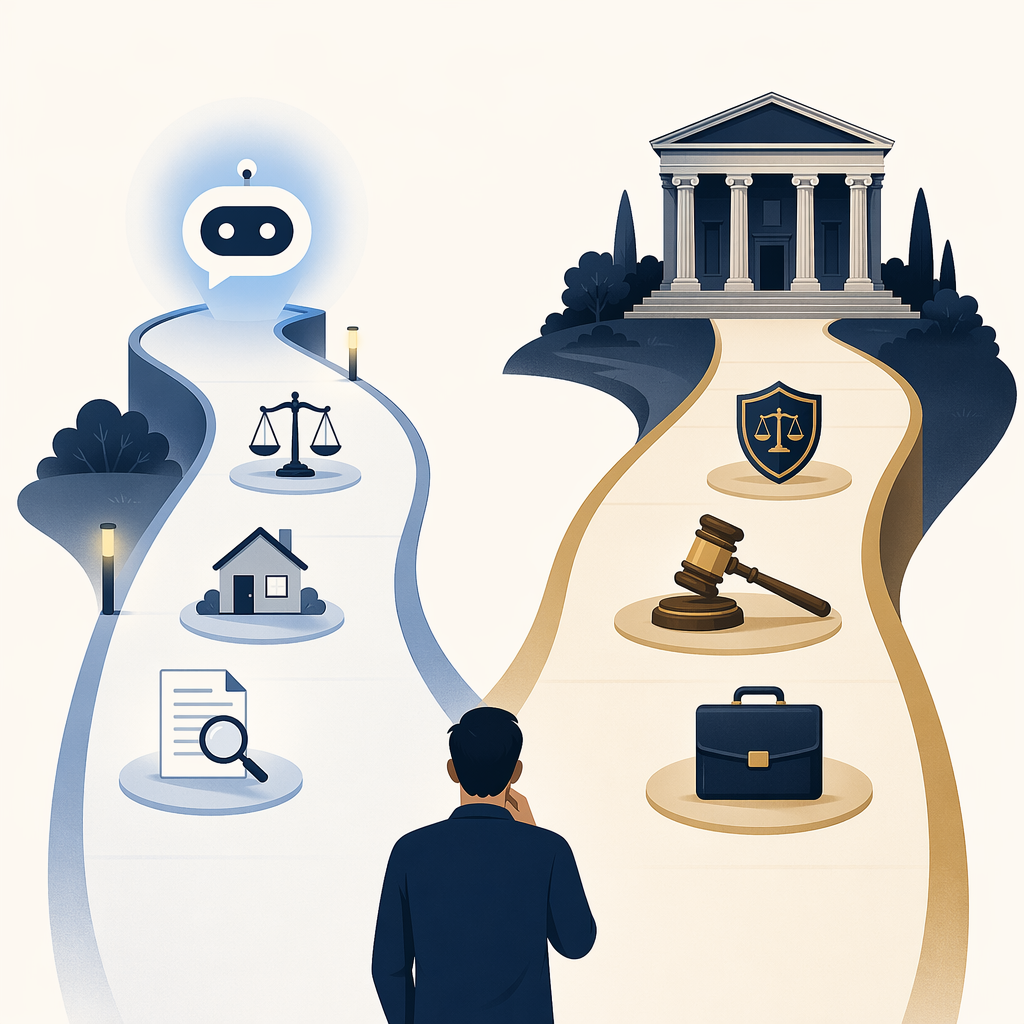
When Free AI Is Likely Sufficient vs. Red-Flag Situations
Not every legal situation requires a lawyer. Free AI tools can be genuinely helpful in low-stakes contexts where the cost of a mistake is minimal. The key is knowing where the line is.
| Situation | Risk Level | Recommendation |
|---|---|---|
| Understanding a general legal concept (e.g., “What is a summary judgment?”) | Low | Free AI is likely sufficient for basic education; verify with a secondary source |
| Drafting a simple demand letter for a small claims dispute | Low to Moderate | AI can provide a template; review carefully for jurisdiction-specific requirements |
| Finding the text of a statute or regulation | Low | AI may help locate it, but always verify against the official government source |
| Filing a lawsuit in federal court | High | Red flag — procedural rules are complex; AI-generated filings have led to sanctions |
| Responding to a lawsuit or motion | High | Red flag — deadlines, formatting, and legal arguments require professional judgment |
| Any matter involving confidential or sensitive information | High | Red flag — free tiers retain data; inputting facts may waive confidentiality |
| Appealing a court decision | Very High | Red flag — appellate rules are strict; errors can be fatal to your case |
| Criminal defense or family law (custody, divorce) | Very High | Red flag — stakes include liberty and family relationships; never proceed without an attorney |
| Any situation where a mistake could cost more than $5,000 | High to Very High | Red flag — the cost of a lawyer is often less than the cost of a bad outcome |
The general rule: if you would be upset about losing, if the outcome affects your rights or finances in a meaningful way, or if you are facing a deadline in court, you need a lawyer. Free AI tools are for learning and drafting — not for filing and relying.
Practical Safety Checklist for Using Free AI Legal Tools
If you choose to use a free AI legal tool, follow this checklist to minimize your risk:
- Never input confidential information on free tiers. Do not share names, addresses, financial details, case numbers, or any information that could identify you or your situation. Assume everything you type will be used for model training.
- Verify every citation against a primary source. If the AI gives you a case name and citation, look it up on a free legal research platform like Google Scholar, CourtListener, or the relevant court's website. If you cannot find it, assume it is fabricated.
- Never file AI-generated documents without attorney review. Courts are increasingly sanctioning pro se litigants for filing documents that contain hallucinated citations or procedural errors. A single mistake can derail your case and cost you money.
- Read the tool's privacy policy and terms of service. Look for language about data retention, model training, and whether your conversations are shared with third parties. If the policy is unclear or allows broad data use, assume your information is not private.
- Cross-check everything with a second source. AI tools can be confidently wrong. If the tool tells you the law is X, check a government website, a legal aid organization, or a reputable legal encyclopedia to confirm.
- Know when to walk away. If your situation involves a court filing, a deadline, a significant amount of money, or the potential loss of your rights or freedom, close the chatbot and contact a licensed attorney. Many legal aid organizations offer free or low-cost consultations.
The Bottom Line
Free AI legal tools are not a replacement for a lawyer. They are a new category of resource — useful for education, drafting, and low-stakes research, but dangerous when relied upon for anything that matters. The data is clear: pro se litigants who use AI without understanding its limitations are getting sanctioned, losing cases at overwhelming rates, and exposing their confidential information to unknown uses.
The regulatory landscape is shifting rapidly. Courts are issuing standing orders. State bars are publishing guidance. Legislators are proposing bills that would create new liability for AI companies. And the number of AI-related court rulings has exploded — from 2 in February 2025 to 52 in February 2026.
If you are considering using a free AI tool for a legal problem, treat it as a starting point, not a solution. Verify everything. Protect your privacy. And when the stakes are high, do what people have done for centuries: hire a licensed attorney who can be held accountable for the advice they give.
For deeper context on the risks discussed in this guide, see our glossary entry on AI hallucination in legal practice and our risk digest on AI hallucinations and attorney ethics, which cover the sanctions landscape and professional responsibility framework in greater detail.
Grounded in
This procedure is grounded in the cited rule or opinion, independent of any single documented case. See the Regulation tracker for the governing text.
Cases this step would have prevented
No cases have been explicitly linked to this checklist yet. See Risk Digest for documented incidents generally.
← Back to WorkflowsReport a correction or tip
Spotted an outdated figure, a misstated fact, or a ruling this workflow checklist should reflect? Public comments are disabled for this content given the professional cost of a misreported case outcome, penalty amount, or rule text — use the structured correction channel instead.
Report a correction or tip for this record →