
Why the Choice Between General and Purpose-Built AI Matters for Your Practice
Every week, another attorney asks a variation of the same question: "Can I just use ChatGPT for this contract review?" The answer is not a simple yes or no — it is a professional responsibility analysis that depends on what you are reviewing, for whom, and what standard of accuracy your client is entitled to expect.
The legal market has bifurcated into two distinct categories of AI tools for contract review. On one side sit general-purpose large language models (LLMs) — ChatGPT, Claude, Gemini — built to converse about anything, trained on internet-scale data, and repurposed for legal work without modification. On the other side sit purpose-built legal AI platforms — systems designed from the ground up for contract analysis, trained on legal documents, and structured around attorney-built playbooks and audit trails.
This is not a debate about which technology is more advanced. It is a debate about which technology is appropriate for a given task under the professional standards that govern legal practice. The structural differences between these two categories produce measurable gaps in accuracy, consistency, and auditability — gaps that map directly onto duties under the ABA Model Rules.
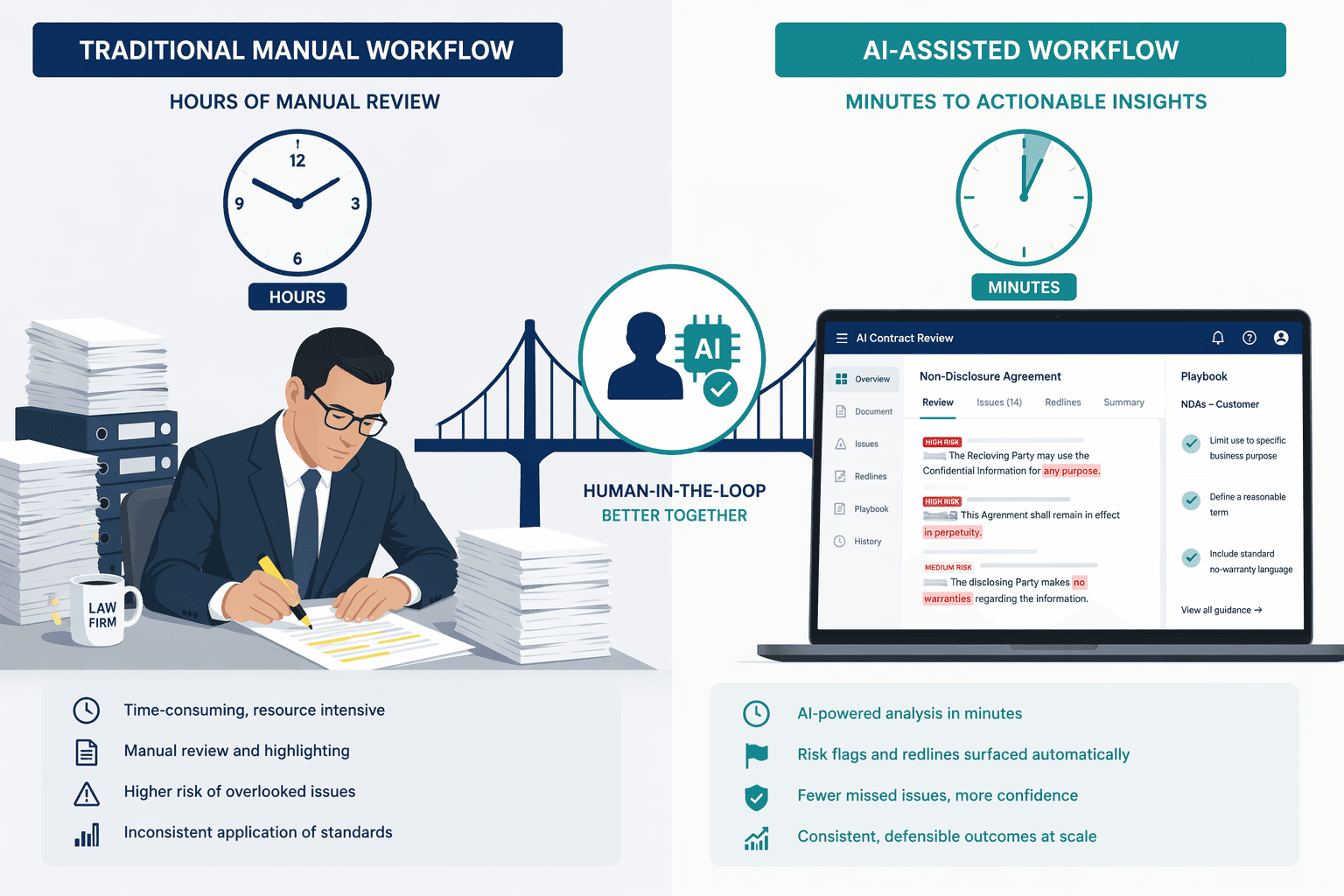
Architectural Differences: How General LLMs and Legal-Specific AI Pipelines Actually Work
Understanding why these two categories produce different results requires looking under the hood at how each processes a contract.
A general-purpose LLM like ChatGPT or Claude is a next-token prediction engine. It has been trained on billions of words from the public internet — Wikipedia, Reddit, books, news articles, and some legal documents mixed in. When you paste a contract into the chat window and ask "What are the risks in Section 4?", the model generates an answer by predicting the most statistically likely sequence of words that follows from your prompt and the document. It has no internal representation of what a contract is, what a risk is, or what Section 4 means. It has no database of legal rules, no playbook of your firm's preferred positions, and no mechanism to verify that its answer is correct.
A purpose-built legal AI platform operates on a fundamentally different architecture. These systems combine multiple AI approaches — natural language processing (NLP), machine learning classifiers, and LLMs — orchestrated by attorney-built playbooks. LegalOn, for example, uses what it describes as "hundreds to thousands of individual AI calls per review," each targeting a specific clause type or legal issue. The platform's playbooks cover more than 10,000 legal issues across 50+ contract types, built and maintained by attorneys.
The key architectural differences include:
- Training data scope. General-purpose models train on the open internet. Purpose-built platforms train on curated legal document sets, often including millions of contracts, and are fine-tuned on attorney-annotated examples.
- Output structure. A general LLM returns free-form text that may or may not address the specific clause. A purpose-built platform returns structured outputs — flagged clauses, risk ratings, suggested redlines — mapped to specific line numbers in the document.
- Consistency guarantees. General LLMs are non-deterministic: the same contract reviewed twice may produce different results. Purpose-built platforms enforce playbook rules consistently across every review.
- Audit trail. General LLMs cannot show you why they flagged a clause or cite the specific language that triggered the flag. Purpose-built platforms provide character-level citations linking each finding to the exact contract text and the playbook rule that produced it.
DocuSign's analysis of the market confirms that general-purpose AI tools "lack consistency guarantees, leading to inconsistent interpretations of the same clause across sessions." For a profession built on predictability and precedent, this is not a minor inconvenience — it is a structural risk.
What the Benchmarks Show: Accuracy, Speed, and Consistency Gaps
The performance gap between general-purpose and purpose-built AI is not theoretical. Multiple benchmarks published in 2024–2026 quantify the difference across accuracy, speed, and consistency.
| Benchmark | Purpose-Built Legal AI | General-Purpose AI | Human Manual Review | Source |
|---|---|---|---|---|
| LegalOn 2026 Contract Review Benchmark (3,282 contracts, 21 guidelines) | Ranked first across all provision types; 17x faster than Claude Opus 4.6 | Failed on specific clause identifications, thresholds, multi-part requirements, cross-references, and absence checks | Not tested in this benchmark | LegalOn 2026 Benchmark (vendor-published) |
| GC AI In-House Legal Bench (May 2026, 100 tasks scored by attorneys with 80+ combined practice years) | 82.7% overall accuracy | ChatGPT GPT-5.5: 72.8%; Claude Opus 4.7: 66.3%; Gemini 3.1 Pro: 42.9% | Not tested in this benchmark | GC AI (vendor-published) |
| LexCheck standard clause identification (2024) | 94–97% accuracy | Not tested | ~80% accuracy | LexCheck / Kira Systems benchmarks (vendor-published) |
| Stanford RegLab hallucination study (2024, 200,000+ queries per model) | Not tested | Hallucination rates of 69–88% on legal queries; models performed no better than random guessing on precedential relationship tasks | Not tested | Stanford HAI / RegLab (peer-reviewed academic research) |
Comments
Join the discussion with an anonymous comment.