
How Law Firms Can Build a Repeatable AI Adoption Playbook
Based on the latest industry data, this article outlines a structured framework for law firms to move from ungoverned individual AI use to institutional deployment with measurable ROI, covering workflow audits, embedded tool selection, pilot KPIs, and iterative scaling.
The practical problem with legal AI adoption in 2026 is no longer whether lawyers are curious. They are already using the tools. The harder question is whether the firm can tell the difference between scattered individual productivity and institutional competence.
The gap is now visible enough that it should make a technology committee uncomfortable: 69% of legal professionals reported using AI tools individually, while 54% of firms provided no AI training and 43% had no AI policy and no plans to create one, according to the 8am 2026 Legal Industry Report, which surveyed more than 1,300 respondents in September and October 2025.[1] Curiosity is not the scarce resource. Ownership is.
That distinction matters because clients are not waiting for every firm to finish debating policy language. In Thomson Reuters’ 2026 Future of Professionals Report, based on 1,816 respondents, 78% of corporate clients said AI-enabled quality improvements are essential, only 6% said providers currently deliver them, and 32% said they were reconsidering relationships with lagging firms.[2] The pressure is not just internal efficiency. It is service quality, responsiveness, and whether clients believe their outside counsel is improving the work rather than simply billing the same process with newer software.
The uncomfortable part is that many legal organizations still cannot prove what AI is costing or returning. Axiom’s 2026 In-House Legal AI Report, based on 528 respondents, found that 83% could not measure AI spend and only 7% had scaled AI organization-wide.[3] That finding comes from a legal staffing company and should not be treated as an independent market census, but it points to a familiar operating failure: tools arrive before measurement, and enthusiasm arrives before accountability.

The Tool-First Trap
Many firms still begin in the wrong place. A partner sees a demo. An associate finds a shortcut. A client asks whether AI is being used. The committee responds by comparing products, negotiating licenses, or drafting a broad acceptable-use policy. Those are necessary activities, but they do not answer the operational question: where does work actually slow down, duplicate, create avoidable review cycles, or frustrate clients?
A tool-first approach usually produces one of two bad outcomes. Either the firm buys a capable product that lawyers rarely open because it sits outside their normal workflow, or it tolerates unofficial use because individual lawyers can feel the benefit faster than the institution can govern it. Both outcomes leave the firm exposed. In the first, spend becomes hard to defend. In the second, training, privilege, confidentiality, supervision, and quality control become uneven.
A better adoption playbook starts with the work, not the product. The North Carolina Bar Association’s Center for Practice Management guidance emphasizes mapping bottlenecks and starting with one workflow rather than trying to transform the whole practice at once.[4] That is not a timid strategy. It is how a firm creates a baseline, assigns responsibility, and gives itself a fair chance to prove whether AI changed anything that matters.
A Repeatable AI Adoption Workflow
The firms that move from ad hoc use to governed deployment tend to follow a practical sequence. It does not need to become a heavyweight transformation office on day one, especially for smaller firms. But it does need to be explicit enough that the next pilot is easier than the last one.
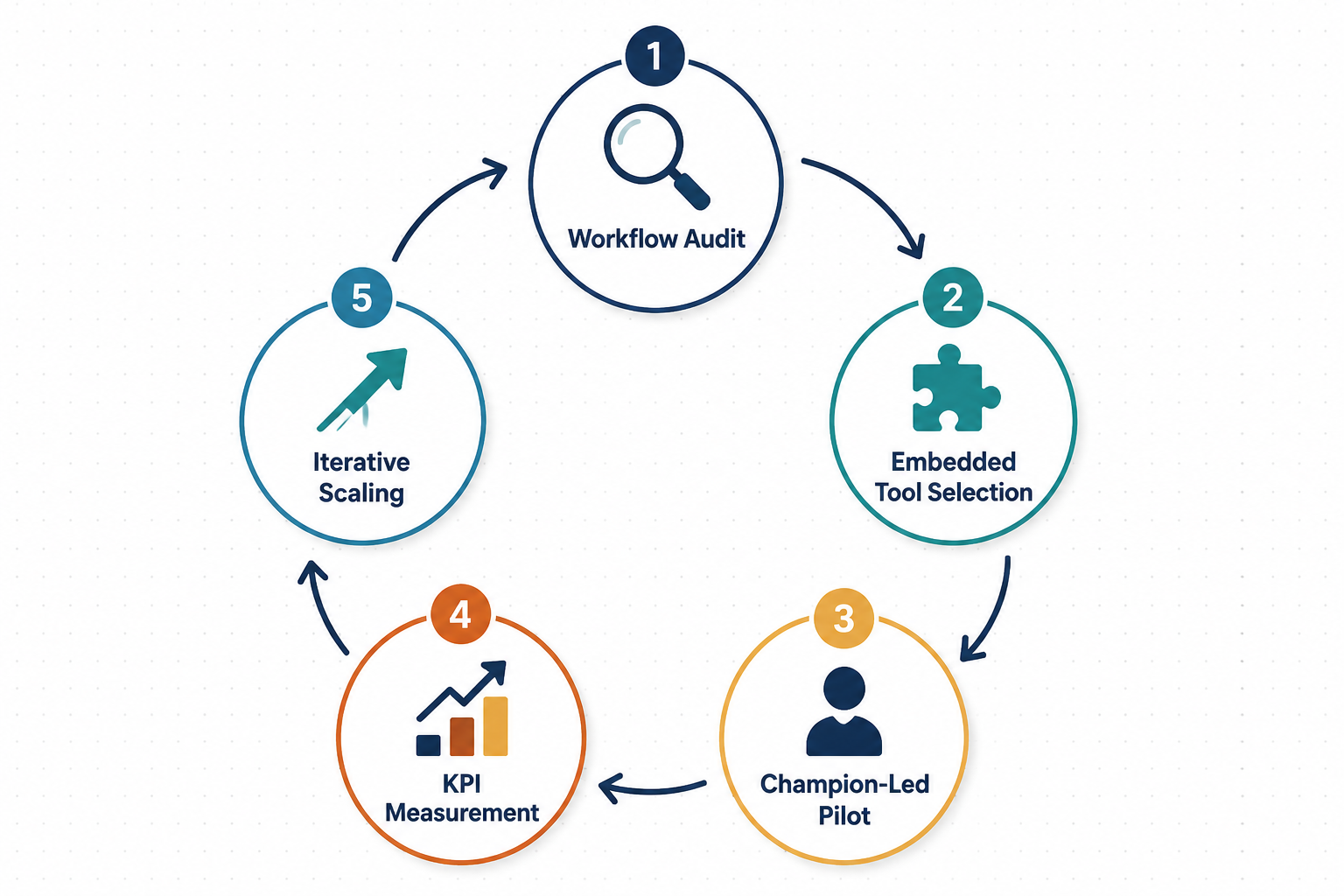
| Step | Operating Question | Evidence the Firm Should Capture |
|---|---|---|
| Workflow audit | Where is work high-volume, repeatable, and low enough risk to test safely? | Current cycle time, review burden, rework, handoffs, client complaints, write-offs |
| Embedded tool selection | Can the tool live inside systems lawyers already use? | Integration points, permissioning, matter context, audit trails, security review |
| Champion-led pilot | Who owns the test and who will actually use it next Tuesday morning? | Pilot group, use rules, training completion, escalation path, excluded use cases |
| KPI measurement | Did the workflow improve against a pre-AI baseline? | Turnaround time, error rate, client satisfaction, realization, margin, adoption |
| Iterative scaling | What justifies expanding, adjusting, or stopping? | Measured result, user feedback, risk incidents, client response, budget case |
Start With the Workflow Audit
The audit is where many firms are tempted to rush, because everyone already has opinions about what is inefficient. Opinions are not enough. A useful audit names the workflow, the volume, the people involved, the current baseline, the risk level, and the consequence of delay or error.
Good first candidates tend to be high-volume, repeatable, and bounded. Contract review, legal research, document summarization, and intake often fit that profile. They are not risk-free, but they are usually easier to define than broad promises such as “make litigation more efficient” or “improve client service.” A contract review pilot can specify the clause types, document set, reviewer role, escalation rules, and acceptance criteria. A legal research pilot can specify the question types, required verification steps, and what counts as a usable first pass.
The audit should also identify where AI should not begin. Novel legal theories, sensitive strategy calls, client-specific risk judgments, and work that lacks reliable human review are poor first pilots. If a workflow cannot be described clearly, it usually cannot be measured cleanly. If it cannot be measured cleanly, the firm will struggle to distinguish a genuine improvement from a few enthusiastic anecdotes.
A practical audit can be modest. The firm does not need a months-long process map for every practice. It does need enough information to rank candidate workflows by volume, risk, integration feasibility, and client impact. For readers who need a deeper governance layer after this point, an internal framework such as Implement AI in Your Law Firm with a Workflow-Guided Framework belongs at this stage rather than after tool selection.
- Name the workflow in operational terms, not technology terms.
- Record the current baseline before any AI tool enters the process.
- Separate low-risk drafting and review support from legal judgment that requires closer supervision.
- Identify the system of record, the people who touch the work, and the point where delay is felt by the client.
- Choose one workflow that can produce evidence quickly enough to inform the next decision.
Prefer Embedded Tools Over Another Standalone Login
Tool selection matters, but it should come after the firm knows which workflow it is trying to improve. The central question is not which product has the most impressive demo. It is whether the tool can sit inside the systems lawyers already use: document management, practice management, contract lifecycle tools, knowledge repositories, billing systems, research platforms, or intake systems.
Integration depth affects adoption because lawyers rarely have spare patience for a separate destination that requires duplicate uploading, re-keying matter context, or manually preserving the record of what happened. It also affects governance. Permissioning, audit trails, matter-level access, data retention, and supervision are easier to manage when AI activity is connected to existing systems rather than scattered across personal accounts.
This is where firm size matters. A smaller firm may not need the same procurement process, security questionnaire, or integration architecture as a global firm. A solo or small practice may reasonably start with lighter tools and tighter manual controls. But “lighter” should not mean invisible. Someone still needs to know which tool is used, on which workflow, under which rules, and how output is checked.
For firms comparing products after they have identified the workflow, a deeper tool-selection review such as How to Choose AI Tools for Your Law Firm in 2026 is useful. It should not substitute for the audit.
Run the Pilot Through Champions, Not Announcements
A pilot needs visible sponsorship, but sponsorship is not the same thing as usage. The people who make the pilot real are usually practice group champions, senior associates, knowledge lawyers, legal operations staff, and a partner who can remove friction when the first objections arrive. They translate policy into daily behavior.
The pilot group should be small enough to train properly and large enough to reveal whether the workflow works outside one unusually motivated user. The firm should define permitted uses, prohibited uses, verification requirements, client disclosure expectations where applicable, and an escalation path for uncertain outputs. Training should be attached to the specific workflow. General AI literacy has value, but a lawyer reviewing a contract needs different guardrails than a lawyer summarizing deposition materials or triaging intake.
This is also the point where the firm decides what will happen to saved time. If the answer is merely “lawyers will be more efficient,” the pilot is underdesigned. The saved time might become faster turnaround, more partner review, improved margins, reduced write-offs, more client communication, or capacity for additional work. Those are different business outcomes, and they require different metrics.
Measure Against the Baseline Clients Actually Feel
A pilot without a baseline is a story collection exercise. Before the tool is introduced, the firm should know how the workflow currently performs. How long does first review take? How many rounds of correction are typical? Where does partner review get stuck? How often does intake require follow-up because information is missing? What do clients complain about, explicitly or indirectly?
Client-facing KPIs deserve priority because they prevent the firm from treating internal speed as a complete answer. Turnaround time matters when a client is waiting on a contract position, an answer to a research question, or a first assessment of a new matter. Error rate matters because speed that increases correction burden is not an improvement. Client satisfaction matters because a workflow can become faster while still feeling opaque, rushed, or impersonal to the person paying for it.
| Workflow | Possible Baseline | Pilot KPI | Why It Matters |
|---|---|---|---|
| Contract review | Average time from receipt to first marked draft | Turnaround time, correction rate, escalation frequency | Shows whether AI accelerates review without pushing more cleanup to partners or clients |
| Legal research | Average time to produce a verified first-pass memo or answer | Research time, citation verification issues, reviewer acceptance | Separates faster searching from reliable legal analysis |
| Document summarization | Average time to summarize a defined document set | Summary completion time, missed issue rate, reviewer edits | Tests whether the tool reduces reading burden without hiding material facts |
| Intake | Time from inquiry to complete matter profile | Completion rate, follow-up requests, time to assignment | Measures whether the client or internal requester experiences a smoother start |
The metric set should be narrow enough to manage. A firm does not need ten dashboards for a first pilot. It needs a few measures that connect to the business case and the risk profile. For a high-volume contract workflow, that might mean cycle time, partner correction rate, and client satisfaction after delivery. For a research workflow, it might mean time saved, verification defects, and reviewer confidence.
The most common measurement failure is counting usage as success. Adoption data tells the firm whether people opened the tool. It does not prove that work improved. A high login count can coexist with poor output, duplicative review, or no client benefit. Conversely, a narrowly used tool may be highly valuable if it improves a costly bottleneck in a specific practice.
Scale Only What Survives Review
Scaling should be a decision, not the default next slide. After the pilot, the firm should review the baseline comparison, user feedback, risk incidents, client response, and cost. If the workflow improved, the next move may be expansion to a larger team, a related matter type, or a deeper integration. If the workflow did not improve, the answer may be retraining, redesign, a different tool, or stopping.
This is where staged maturity models can help, as long as they are treated as vocabulary rather than fate. Clio’s AI Adoption Curve describes stages from Skeptic to Explorer, Experimenter, Integrator, and Innovator.[5] That is a useful way to name the difference between occasional individual use and integrated operating practice. It is not a promise that every firm will move neatly through each stage. Practice area, client expectations, firm size, risk tolerance, and economics can all slow or redirect the path.
A more mature operating model usually shows up in small, concrete ways: the pilot template improves, training becomes workflow-specific, approved tools are easier to find, exceptions are documented, client questions have consistent answers, and budget requests are tied to measured results rather than urgency or fear of falling behind.
What the ROI Evidence Can and Cannot Prove
There is enough market evidence to justify disciplined experimentation. There is not enough to justify pretending every AI investment will pay for itself automatically.
A 2026 AI Vortex compilation citing Citi Hildebrandt reported 25% to 35% improvement in matter profitability and 5x to 8x average AI ROI for Am Law 100 firms.[6] Those are important figures, especially for firm leaders trying to connect AI to margin rather than novelty. They should also be read carefully. Am Law 100 economics, data resources, client mix, and implementation capacity do not map perfectly onto midsize, regional, boutique, or small-firm environments.
Workflow-specific research gives a more operational picture. RAND Corporation data points to 60% to 80% document review cost reduction, while Thomson Reuters 2025 data points to 40% to 65% legal research time reduction.[7][8] Those categories align with the recommended starting points because they involve repeatable work where time and cost can be measured. They do not eliminate the need for supervision, quality review, or context-specific judgment.
Vendor-published data can be useful as a signal, especially when it describes actual workflow behavior, but it is not neutral proof. Harvey reported in Q3 2026 that customers had created more than 25,000 custom workflows, that typical lawyers saved 15 to 25 hours per month, and that power users, described as 20% to 30% of teams, saved 30 to 50 or more hours, with results driven by integration depth.[9] Those figures support the case for embedded, workflow-specific deployment. They should not be treated as a guaranteed result for a firm that lacks training, governance, or measurement.
The stronger lesson across these sources is procedural. AI returns become more credible when the firm can say which workflow changed, what the baseline was, who reviewed output, what risk controls applied, and how the result affected clients or margins. Without that chain, ROI remains a presentation number.
Governance Should Follow the Work Closely Enough to Be Used
Governance fails when it is either absent or too abstract to guide behavior. A policy that says lawyers must use AI responsibly is not enough. A policy that prohibits everything until a committee approves every prompt will be bypassed. The useful middle ground is workflow-specific governance: approved uses, prohibited uses, verification steps, confidentiality rules, client disclosure procedures where required, and a named person or group responsible for resolving uncertainty.
Training should follow the same pattern. The 8am finding that 54% of firms provided no AI training is more troubling than the individual-use number because it suggests that many lawyers are learning alone, at the exact point where firms need consistent judgment.[1] Training does not need to be theatrical. It needs to be close to the work: what the tool may be used for, how output must be checked, what cannot be entered, when a lawyer must escalate, and how the firm records the use.
This is also where internal messaging matters. If leadership frames AI only as a productivity mandate, lawyers may hear a threat to hours, staffing, or quality. If leadership frames it only as innovation, clients may wonder why service delivery has not improved. A more credible message ties the pilot to a named workflow and an observable outcome: faster first drafts, fewer avoidable corrections, better intake completeness, more consistent research verification, or improved client responsiveness.
For firms wrestling specifically with research tools, Closing the Governance Gap for AI Legal Research is the right companion issue: the use case is attractive precisely because the time savings can be large, and risky precisely because verification cannot be optional.
A Playbook That Can Survive Partner Politics
AI adoption in a law firm is never only a technology project. It touches leverage, pricing, supervision, professional responsibility, client relationships, and partner confidence. That is why a repeatable playbook matters. It gives the cautious partner a way to say yes without pretending risk is gone. It gives the enthusiastic associate a sanctioned path instead of a private workaround. It gives legal operations and knowledge teams a structure for turning isolated use into firm capability.
The first version does not need to be elaborate. Pick one high-volume, low-risk workflow. Record the baseline. Choose a tool that fits the workflow and the existing system environment. Train a defined pilot group. Measure client-facing and internal KPIs. Review the result honestly. Then decide whether to expand, redesign, or stop.
The firms that scale AI are not necessarily the firms that experiment the most. They are the firms that turn one measured workflow win into the governance, confidence, and budget for the next one.
References
- 8am 2026 Legal Industry Report, 8am, 2026.
- 2026 Future of Professionals Report, Thomson Reuters, 2026.
- 2026 In-House Legal AI Report, Axiom, 2026.
- Center for Practice Management guidance on mapping bottlenecks and starting with one workflow, North Carolina Bar Association, February 2026.
- AI Adoption Curve, Clio, November 2025.
- AI Vortex compilation citing Citi Hildebrandt 2026 data, AI Vortex, 2026.
- RAND Corporation data on document review cost reduction, RAND Corporation.
- Thomson Reuters 2025 data on legal research time reduction, Thomson Reuters, 2025.
- Harvey Q3 2026 customer data, Harvey, Q3 2026.
Grounded in
This procedure is grounded in the cited rule or opinion, independent of any single documented case. See the Regulation tracker for the governing text.
Cases this step would have prevented
No cases have been explicitly linked to this checklist yet. See Risk Digest for documented incidents generally.
← Back to WorkflowsReport a correction or tip
Spotted an outdated figure, a misstated fact, or a ruling this workflow checklist should reflect? Public comments are disabled for this content given the professional cost of a misreported case outcome, penalty amount, or rule text — use the structured correction channel instead.
Report a correction or tip for this record →