
How to Use ChatGPT for Law Without Getting Sanctioned
This guide presents independent benchmarking data on AI hallucination rates for legal research tools, including ChatGPT and specialized platforms like Lexis+ AI and Westlaw AI-Assisted Research, and provides a structured verification workflow that helps attorneys avoid court sanctions under ABA Model Rule 1.1.
The immediate question for a lawyer using ChatGPT for law is not whether the tool sounds competent. It is what would make a court say the lawyer’s use of AI was diligent rather than reckless. The available evidence in Q3 2026 points to a practical answer: use AI as a draft-and-discovery aid, then force every legal proposition through a verification workflow that does not depend on the model’s own confidence, citations, or vendor description.
That answer is uncomfortable because the problem is not limited to public ChatGPT. Stanford RegLab’s preregistered benchmark, published in the Journal of Empirical Legal Studies in 2025, found that Lexis+ AI and Ask Practical Law AI hallucinated more than 17% of the time, Westlaw AI-Assisted Research hallucinated more than 34% of the time, and general-purpose ChatGPT hallucinated 58% to 82% of the time on legal queries.[1] The study tested only three legal-specific products, so those rates should not be projected onto Harvey, CoCounsel, Paxton, or any other untested system. But the result is enough to defeat the lazy comfort that legal RAG products are categorically safe because they retrieve from a legal database.
The legal-specific findings matter more than the ChatGPT range for day-to-day risk management. ChatGPT’s higher error rate marks the outer boundary of danger for legal research, but the harder workflow problem comes from the tools lawyers are more likely to treat as professionally curated. If a platform returns an answer in a legal interface, wrapped in citations and written in a calm research tone, the associate reviewing it may spend less time asking whether the answer is structurally wrong.
A Yale replication study in the same journal confirmed the broader pattern that leading AI legal research tools still produce unreliable answers, rather than eliminating hallucination through legal-data retrieval alone.[2] Separately, the Thomson Reuters Institute reported 22 separate cases with hallucinated citations in one month of federal court filings across practice areas.[3] That is not a measure of every AI-assisted filing, and it does not prove that hallucinated citations are common in all courts. It does show that the failure mode is no longer hypothetical or confined to the first wave of ChatGPT mishaps.
The Three Failures a Verification Workflow Has to Catch
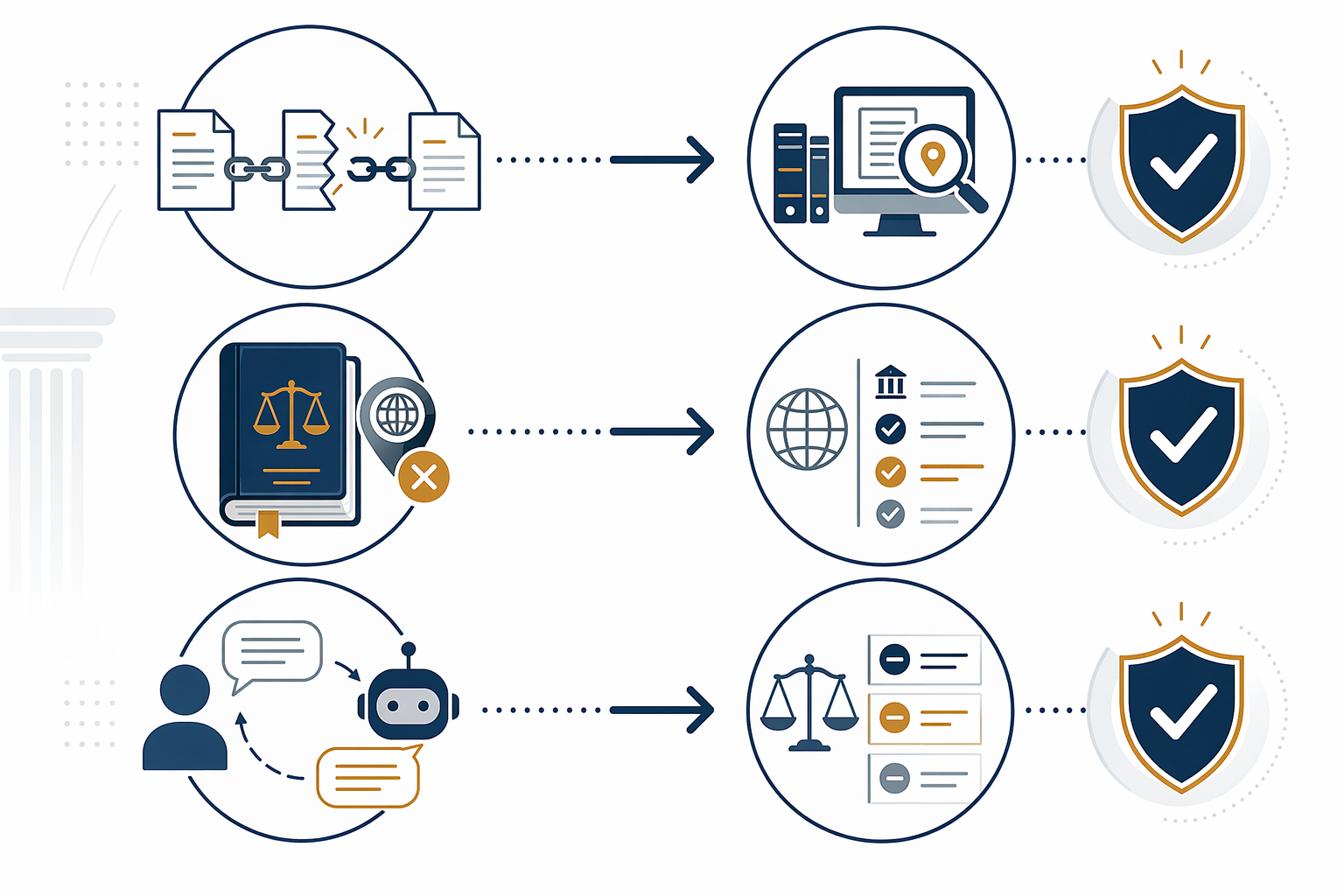
The useful part of the Stanford benchmark is not only the headline rate. It is the taxonomy. The study identified three legal RAG failure modes: retrieval failure, inapplicable authority, and sycophancy.[1] Those are different problems. A single “check the citations” instruction does not catch all three.
| AI failure mode | What it looks like in legal work | Verification response |
|---|---|---|
| Retrieval failure | The system does not find the controlling or best authority, even though it may produce a plausible answer. | Locate the source independently in a trusted legal database or court source before relying on the proposition. |
| Inapplicable authority | The system retrieves a real source, but the source is from the wrong jurisdiction, wrong time, wrong procedural posture, or has been limited or overruled. | Check jurisdiction, date, procedural posture, and treatment before using the authority. |
| Sycophancy | The system agrees with the lawyer’s premise instead of testing whether the premise is wrong. | Reframe the prompt, ask for contrary authority, and test the answer against the strongest adverse position. |
This is where many AI policies become too vague to help. “Human review required” sounds responsible, but it does not say what the human is supposed to do. A partner can sign that policy and still leave the actual labor to a junior lawyer who is now verifying an answer whose missing premise is invisible. The workflow has to assign checks to the known failure modes.
For Retrieval Failure, Find the Authority Without the Model
Retrieval failure is not solved by asking the AI to provide more citations. If the system failed to retrieve the right authority the first time, a second answer may only produce a more decorated version of the same gap. The reviewer should take the legal proposition out of the AI interface and search for it independently.
That means identifying the proposition in ordinary legal-research terms: claim, defense, element, standard of review, burden, remedy, deadline, or evidentiary rule. Then the reviewer searches a trusted database, court website, statute source, rule source, or treatise workflow without relying on the AI-generated citation list as the research universe.
- Confirm that the cited case, statute, rule, regulation, or administrative material exists.
- Confirm that the cited text supports the exact proposition in the draft.
- Search for controlling authority using independent terms, not only the model’s citation trail.
- Record the database, source path, or court source used for verification.
The last item is not clerical decoration. If a court later asks how the filing was checked, “the AI provided citations” is a bad answer. “The cited proposition was verified in Westlaw, Lexis, Bloomberg Law, a court docket, or the official statutory source on this date” is a different record.
For Inapplicable Authority, Treat Real Citations as Unproven
A real citation can still be useless. It may be from another jurisdiction, predate a statutory amendment, arise from a different procedural posture, or state a rule that has been narrowed into irrelevance. This is the failure that makes legal AI more dangerous than a simple fake-case generator. The citation exists, so the reviewer relaxes too early.
The verification step should move from existence to fit. A case cited for a motion to dismiss standard does not automatically support a summary judgment argument. A federal district court decision may be persuasive but not controlling. A criminal-procedure rule may not travel cleanly into a civil enforcement setting. A pre-amendment statute may be accurate history and still bad law for the present filing.
| Check | Question the reviewer answers |
|---|---|
| Jurisdiction | Is this authority controlling, persuasive, or irrelevant for the court receiving the filing? |
| Date | Does the authority predate a statutory amendment, rule change, or later controlling decision? |
| Procedural posture | Was the cited language written in a posture that matches the filing’s use of it? |
| Treatment | Has the authority been overruled, abrogated, distinguished, limited, questioned, or superseded? |
| Quoted language | Does the quotation appear exactly as used, and does the surrounding text change its meaning? |
This is ordinary lawyering, but AI changes where it sits in the production process. Instead of verifying a proposition the lawyer found through research, the lawyer may be verifying a proposition generated before the research was ever done. That inversion should be visible in the workflow, because it changes how much skepticism the first reviewer needs to bring.
For Sycophancy, Stop Asking the Model to Agree
Sycophancy is the failure mode that fits too neatly into litigation culture. A lawyer drafts a prompt with a desired premise: “Find cases showing that the opposing party waived this argument.” The model responds by helping. The problem is not that assistance is malicious. The problem is that the answer may be organized around pleasing the premise rather than testing it.
The practical fix is to run adversarial prompts before the answer enters a filing. Ask for the strongest authority against the position. Ask what would make the premise fail. Ask whether courts in the relevant jurisdiction have rejected similar arguments. Ask the model to separate controlling authority from persuasive authority. Then verify the adverse material outside the model just as carefully as favorable material.
A useful AI session should leave a lawyer with research leads and issue maps, not with a finished legal conclusion. If the model cannot produce adverse authority, that absence is not proof that no adverse authority exists. It is a research task.
A Defensible ChatGPT-for-Law Workflow
The workflow below is for litigation research and drafting environments where AI output might influence a filing, memo, letter, or argument. It is not legal advice, and it does not resolve a lawyer’s duties in any specific jurisdiction or matter. It is a way to make the verification labor explicit before a draft becomes someone else’s emergency.
| Stage | Permitted use | Required control |
|---|---|---|
| 1. Frame the task | Use AI to identify possible issues, research terms, or drafting angles. | Do not include confidential client information unless the firm has approved the tool, settings, and data treatment. |
| 2. Generate leads | Ask for possible authorities, counterarguments, and issue structure. | Treat every citation and proposition as unverified. |
| 3. Independently locate sources | Move out of the AI interface and find authorities in trusted legal sources. | Reject any proposition that cannot be independently located. |
| 4. Test applicability | Check whether real authorities actually fit the court, issue, date, and posture. | Document jurisdiction, date, procedural posture, and treatment checks. |
| 5. Test against the premise | Search for adverse authority and contrary framing. | Do not rely on the model’s agreement as evidence that the premise is sound. |
| 6. Review before filing | Have the responsible lawyer review the verified authorities and final text. | Maintain a record of what was checked, by whom, and where. |
The record does not have to become a ceremonial binder. It can be a research note, a citation-check column, a matter-specific AI log, or a short verification memo. What matters is that the firm can reconstruct the path from AI-generated lead to verified legal proposition. Courts do not need a lecture on prompt engineering. They need to know whether the lawyer made a reasonable inquiry before signing and filing.
For a short internal memo, the workflow may be lighter. For a dispositive motion, appellate brief, sanctions motion, emergency injunction filing, expert challenge, or anything involving quoted authority, it should be heavier. Risk does not attach only to the tool; it attaches to the consequence of using the output.
The Sanctions Pattern Is Moving From Embarrassment to Deterrence
The earliest AI-citation stories were often treated as humiliating one-offs. That is no longer a safe read. In ByoPlanet, reporting described a trajectory that included dismissal, a bar referral, and approximately $86,000 in sanctions, though that dollar figure should be treated as reported rather than independently verified against the district court docket from the materials available here. The court’s language is the part no risk officer should miss: “wholesale reliance on AI without further inquiry or diligence by a lawyer is conduct which a court should deter.”[3]
Johnson v. Dunn, a Northern District of Alabama matter from July 2025, pushed the point further by declaring monetary sanctions insufficient in response to fabricated AI citations.[3] The lesson is not that every AI error will produce the same sanction. It is that courts are increasingly framing the issue as deterrence, not mere correction.
Noland, a California 2026 case, adds another uncomfortable layer: opposing counsel may have responsibilities to detect and report fabricated AI citations.[3] That shifts the burden outward. A hallucinated citation is no longer only the filing lawyer’s professional problem. It can become an adversary’s review problem, a court-administration problem, and a cost-shifting problem.
This matters for workflow design because the injury is not limited to a bad brief. Someone has to read the cited authority, discover the defect, alert the court, brief the consequence, and repair the docket. AI does not merely save or waste the drafting lawyer’s time. It can export verification labor to associates, paralegals, opposing counsel, clerks, and judges.
Competence Means Supervision, Not Vendor Confidence
ABA Formal Opinion 512, issued in 2024, addresses lawyers’ use of generative AI and connects that use to existing professional duties, including competence under Model Rule 1.1.[4] The opinion does not make AI forbidden. It also does not let a lawyer outsource professional judgment to an interface that produces plausible legal prose.
For litigation teams, the operational question is simple enough to be hard: who is responsible for making the AI output safe? If the answer is “the associate will check it,” the next question is how. If the answer is “the tool uses RAG,” the Stanford and Yale findings are already a warning that retrieval architecture does not remove the need for lawyer verification.[1][2]
Competence also has a confidentiality and supervision dimension. A firm may approve one tool for internal research, restrict another to non-client hypotheticals, and prohibit a third for matter-specific facts. The point is not to write a policy that sounds modern. The point is to make sure the person using the tool knows which data can go in, what output can come out, and what review must happen before the work product leaves the firm.
What This Means for Procurement
Procurement teams often ask whether a legal AI platform answers well. The better question is whether the firm can measure the cost of making the answer safe. A tool that produces a polished memo in minutes may still be expensive if verification consumes the saved time, especially when the review has to be performed by lawyers with enough experience to catch jurisdictional, procedural, and treatment problems.
The Paul Weiss experience illustrates the measurement problem. After 18 months of testing, the firm reportedly had not developed hard metrics because verification undermined the efficiency gains the tools appeared to offer.[3] That does not prove AI tools lack value. It does show why “time to first draft” is the wrong procurement metric for legal research products.
Adoption data should be read with the same care. The 8am 2026 Legal Industry Report found that AI adoption among legal professionals had more than doubled in a year, but the reported sample skewed heavily toward solo and small-firm practitioners, with 83% from firms with five or fewer lawyers.[5] That is useful market context, not a profession-wide proof that large-firm litigation workflows have solved supervision, confidentiality, and verification.
A serious evaluation should ask vendors to demonstrate auditability, source handling, adverse-authority testing, data controls, usage logs, and error escalation—not only interface quality. Readers building a full vendor review process can use How to Evaluate Legal AI Software in 2026 as the next layer after the hallucination evidence.
Where ChatGPT for Law Can Still Be Useful
The evidence does not require lawyers to pretend AI has no value. ChatGPT and legal-specific tools can help with issue spotting, plain-language explanations, deposition-outline brainstorming, chronology cleanup, first-pass summaries, research-term generation, and drafting alternatives. Those are bounded uses when the lawyer understands that the output is not authority.
The line should be drawn at unsupported reliance. If a tool suggests a case, the case must be found. If it quotes a rule, the rule must be checked. If it characterizes a holding, the holding must be read in context. If it says the law is settled, adverse authority still has to be searched. If it gives a confident answer to a premise-laden prompt, the premise has to be attacked before it is used.
That is the defensible stopping point. AI legal research can be used as a draft-and-discovery aid inside a standardized verification workflow. The evidence available in Q3 2026 does not support treating ChatGPT, legal RAG, or vendor assurances as a sanction-proof substitute for lawyer review.
References
- AI on Trial: Legal Models Hallucinate in 1 out of 6 (or More) Benchmarking Queries, Stanford HAI
- Hallucination-Free? Assessing the Reliability of Leading AI Legal Research Tools, Yale ISPS, 2025
- GenAI hallucinations are still pervasive in legal filings, Thomson Reuters Institute
- ABA issues first ethics guidance on a lawyer’s use of AI tools, American Bar Association, July 2024
- AI adoption among legal professionals has more than doubled in a year, new 8am report finds, but firms lag far behind individual practitioners, LawNext, March 2026
Grounded in
This procedure is grounded in the cited rule or opinion, independent of any single documented case. See the Regulation tracker for the governing text.
Cases this step would have prevented
No cases have been explicitly linked to this checklist yet. See Risk Digest for documented incidents generally.
← Back to WorkflowsReport a correction or tip
Spotted an outdated figure, a misstated fact, or a ruling this workflow checklist should reflect? Public comments are disabled for this content given the professional cost of a misreported case outcome, penalty amount, or rule text — use the structured correction channel instead.
Report a correction or tip for this record →