
The Binary Debate Is Misleading — Here’s What the Data Actually Shows
A lawyer reading the headlines in 2026 could be forgiven for concluding that the profession faces an existential threat. Goldman Sachs estimates that 17.2% of US legal jobs — roughly 228,000 people — are exposed to automation risk. McKinsey pegs the automatable share of a lawyer’s daily tasks at 22%. The 8am 2026 Legal Industry Report, surveying more than 1,300 legal professionals, found that 69% now use general-purpose AI tools, more than double the 31% reported just one year earlier. These numbers are real, and they demand attention.
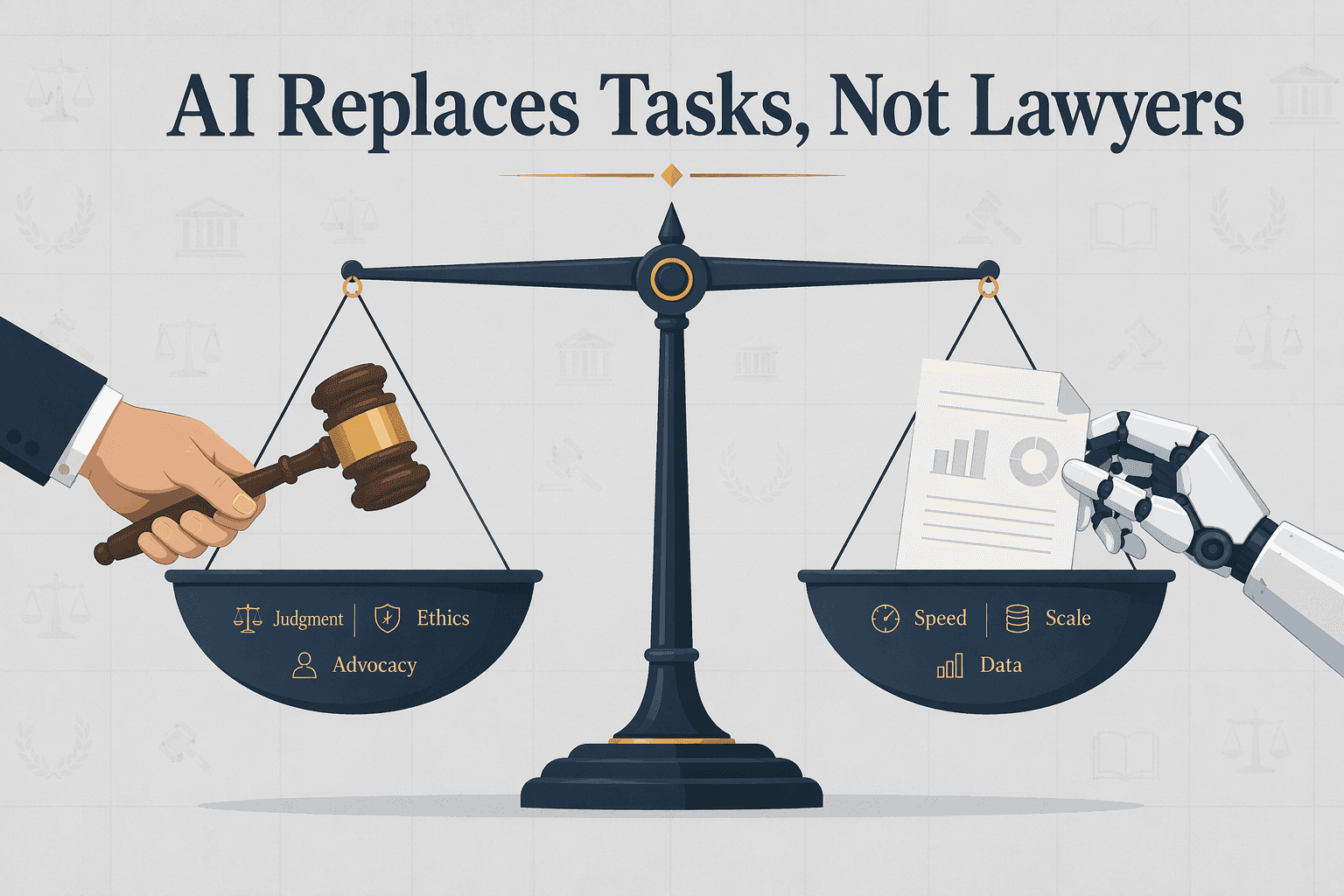
But the binary framing — AI replaces lawyers or it does not — obscures a far more useful reality. The Will AI Replace Lawyers? Tracker, which curates 46 expert opinions verified through April 2026, found that 55% of experts argue AI will not replace lawyers at all, 15% predict replacement to some extent, and only 2% predict full replacement. The consensus is not that lawyers are safe — it is that tasks, not jobs, are being replaced. That distinction matters enormously for career planning, firm strategy, and technology investment.
This article provides a granular, task-by-task breakdown of what AI actually automates today — with specific data points — and what remains firmly in human hands. The goal is not to dismiss the threat or amplify it, but to give practicing attorneys, partners, and legal ops leaders a framework for making decisions based on evidence rather than anxiety.
Task-by-Task: What AI Automates Today — With the Numbers
The most productive way to assess AI’s impact on legal work is to stop asking whether AI will replace lawyers and start asking which specific tasks AI can already perform at or above human competence. The answer varies dramatically by task type, and the data supports a clear hierarchy of automation readiness.
| Legal Task | Automation Level | Key Data Point | Source |
|---|---|---|---|
| Document review / e-discovery | High — widely deployed | 95% of legal professionals trust AI for e-discovery (Lighthouse 2025) | Lighthouse / industry survey |
| Legal research | High — rapidly growing | 58% of AI-using legal professionals cite research as primary use; 30–50% cost savings reported | 8am 2026 Report; Thomson Reuters |
| Contract review (NDAs, standard agreements) | High — benchmarked | AI achieved 94% accuracy vs. 85% median for human lawyers on NDA review (LawGeex) | LawGeex study |
| Document drafting (correspondence, memos) | Moderate — common use | 58% of AI users draft correspondence with AI tools | 8am 2026 Report |
| Due diligence (standardized reviews) | Moderate — task-dependent | 44% of legal tasks automatable per Goldman Sachs methodology | Goldman Sachs |
| Predictive analytics / outcome forecasting | Emerging — limited deployment | Used primarily in litigation analytics; accuracy varies by jurisdiction and data quality | Multiple sources |
| Client counseling / strategy | Low — not automatable | AI cannot be licensed, swear an oath, or be held professionally accountable | NYSBA analysis |
| Court advocacy / negotiation | Low — not automatable | Requires human judgment, persuasion, and ethical reasoning | NYSBA analysis |
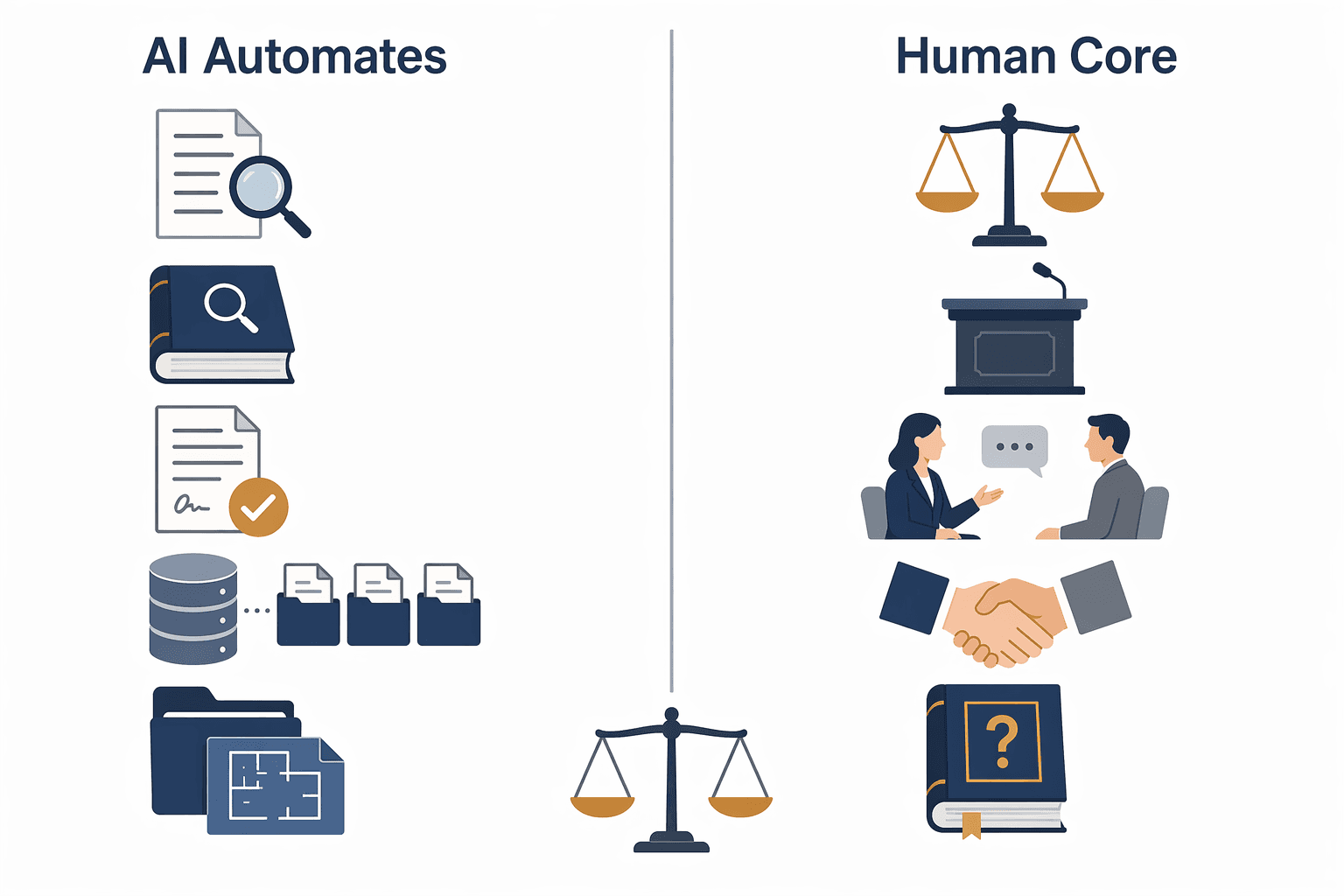
The pattern is clear: high-volume, pattern-recognition tasks with clear success criteria are the most automated. Document review, standard contract analysis, and legal research — tasks that consume a significant portion of associate and paralegal time — are where AI has made the deepest inroads. The 8am report confirms that 47% of law firms were already using AI for document review as early as 2019, and the share has only grown.
Document Review and E-Discovery
E-discovery was the first legal workflow to see significant AI deployment, and it remains the most mature. The 2025 Lighthouse survey found that 95% of legal professionals trust AI for e-discovery tasks. McKinsey estimates that 35% of a law clerk’s job can be automated with current technology, much of it concentrated in document review. For a detailed look at how practitioners are building defensible AI workflows in this area, see our guide to human-in-the-lead e-discovery automation.
Legal Research
Legal research is the second most common AI use case among legal professionals, cited by 58% of AI users in the 8am 2026 survey — up from 46% the prior year. Thomson Reuters reports that AI legal research tools yield 30–50% cost savings compared to traditional methods. The technology excels at surfacing relevant cases and statutes quickly, but practitioners must still verify citations and evaluate applicability. The risk of hallucinated authority — documented in more than 729 cases by early 2026 — means that AI-generated research outputs require systematic human verification.
Contract Review
The LawGeex study remains the most cited benchmark for AI contract review performance: AI reviewed non-disclosure agreements with up to 94% accuracy, compared to a median of 85% for human lawyers. However, as our analysis of contract review adoption and ROI details, controlled-test performance does not always translate to practice. Complex contracts with ambiguous language, unusual provisions, or multi-jurisdictional considerations still require human judgment.
What AI Cannot Do: The Irreplaceable Core of Legal Practice
If the first half of this article establishes what AI can do, the second half must be equally honest about what it cannot. The New York State Bar Association’s comprehensive October 2025 analysis makes the case directly: an AI tool cannot be licensed to practice law, pass the bar exam for admission purposes, swear an oath, or be held professionally accountable. These are not technical limitations that future iterations will solve — they are structural features of the regulatory and ethical framework that governs legal practice.
The functions that remain firmly human include:
- Ethical reasoning and professional judgment: AI cannot weigh competing ethical obligations under the Model Rules, assess conflicts of interest, or make discretionary calls about disclosure.
- Court advocacy and persuasion: Oral argument, witness examination, and judicial persuasion require real-time human judgment, emotional intelligence, and strategic adaptation that no current AI system can replicate.
- Client trust and empathy: Clients hire lawyers for counsel during high-stakes personal and business decisions. The relationship is built on trust, confidentiality, and human understanding — not information retrieval.
- Negotiation and deal-making: Effective negotiation involves reading human signals, building rapport, and making strategic concessions. These are fundamentally interpersonal skills.
- Ambiguous regulatory interpretation: When statutes, regulations, or case law are unclear or contradictory, lawyers must exercise judgment about which interpretation is most defensible. AI systems trained on existing data cannot navigate genuine legal ambiguity.
The hallucination problem underscores these limitations. By early 2026, documented AI hallucination cases in legal contexts exceeded 729, with sanctions exceeding $100,000 in some cases. The Mata v. Avianca case, in which attorneys were fined $5,000 each for submitting AI-generated briefs containing fabricated citations, is only the most famous example. For a full analysis of the ethical rules triggered by these incidents and how sanctions have escalated, see our AI hallucinations and attorney ethics coverage.
There is also a gap between controlled-test performance and real-world practice integration that deserves attention. As our analysis of Harvey AI and CoCounsel documents, tools that outperform lawyers in benchmark tests often lag in daily practice due to workflow friction, training gaps, and the complexity of real legal problems. The benchmark-to-practice gap is a reminder that task automation and practice integration are different challenges.
The Economics: How AI Reshapes Law Firm Margins and the Billable Hour
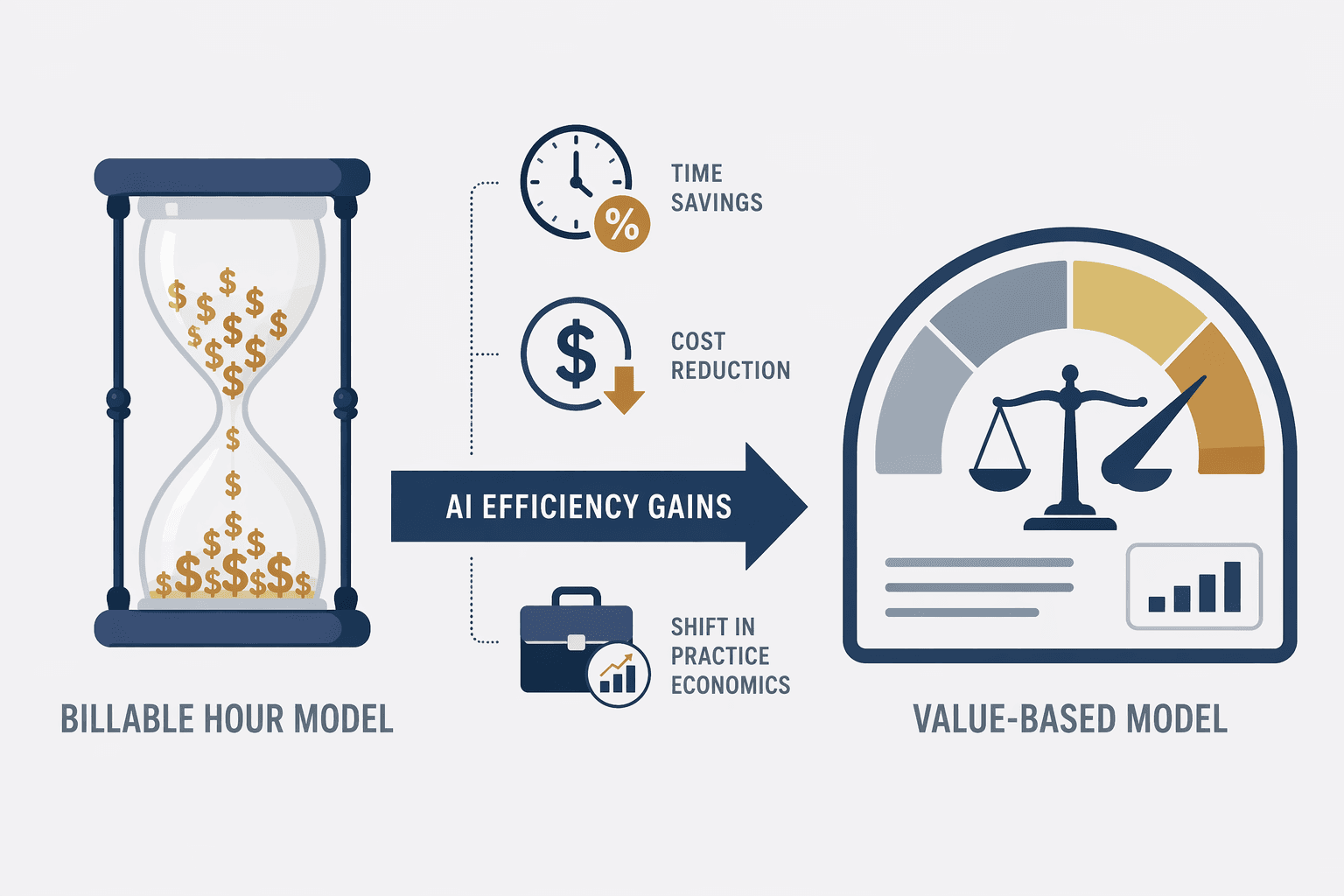
The economic pressures driving AI adoption are not abstract. The 8am 2026 report found that 38% of AI-using legal professionals save 1–5 hours per week, and 14% save 6–10 hours. Sixty-one percent say AI saves them time overall. When multiplied across a firm’s associate ranks, these efficiencies translate directly into margin changes — and into pressure on the billable hour model.
Thomson Reuters reports that AI legal research tools deliver 30–50% cost reductions. If a task that previously billed 10 hours now takes 5, the firm faces a choice: bill fewer hours (reducing revenue) or shift to value-based pricing (capturing efficiency gains as profit). The latter requires client acceptance, which is not guaranteed. The 8am survey found that 29% of legal professionals expect AI tools to deliver the best ROI among legal technology investments — ahead of practice management software, cybersecurity tools, and other categories.
| Economic Factor | Current State | Direction of Change |
|---|---|---|
| Time savings from AI | 38% save 1–5 hrs/week; 14% save 6–10 hrs/week | Increasing as adoption grows and tools improve |
| Legal research cost reduction | 30–50% savings (Thomson Reuters) | Downward pressure on research billing |
| Billable hour model | Widely predicted not to die in 2026 (Artificial Lawyer expert predictions) | Gradual erosion for commoditized tasks; resilience for high-judgment work |
| AI tool ROI expectations | 29% of legal professionals rank AI as top ROI category | Driving further investment and adoption |
| New role creation | 39% of firms expect new AI-specialist or legal technologist roles | Shifting skill demand toward AI oversight and data literacy |
The billable hour is widely predicted not to die in 2026, according to the Artificial Lawyer expert predictions compilation. But it is under structural pressure. For commoditized tasks — document review, standard contract drafting, routine research — clients will increasingly expect AI-driven efficiencies to be passed through as cost savings. For high-judgment work — litigation strategy, complex negotiations, regulatory counseling — the billable hour remains resilient because the value is in the lawyer’s judgment, not the time spent.
Career Implications: What the Data Says About Legal Employment
The employment data tells a more nuanced story than either the optimists or the pessimists suggest. Goldman Sachs estimates that 17.2% of US legal jobs — approximately 228,000 people — are exposed to AI automation risk. But the Bureau of Labor Statistics still projects 4% lawyer employment growth, and an MIT study cited in the Artificial Lawyer 2026 predictions found a 6.4% increase in legal employment despite AI adoption. These figures are not contradictory: they describe different dynamics.
The Goldman Sachs figure measures exposure to automation risk — the share of tasks that could theoretically be automated. The MIT and BLS figures measure actual employment outcomes, which are shaped by many factors beyond technical feasibility: client demand, regulatory constraints, firm business models, and the time required to integrate new tools into practice. The Goldman Sachs report itself notes that being exposed to the risk of job replacement and it actually happening are two different things.
What is changing is the composition of legal employment. The 8am report found that 39% of firms expect to create new AI-specialist or legal technologist roles, and 41% of individual respondents expect new AI-specialist roles to emerge. The demand for skills is shifting from document review and manual research toward AI oversight, prompt engineering, data literacy, and technology governance. For a detailed breakdown of the emerging roles and skill sets, see our practice-area breakdown of AI law jobs.
The risk to junior lawyer training is a genuine concern. The NYSBA analysis flags the 'AI crutch' problem: if junior associates rely on AI for research and drafting, they may not develop the foundational skills that come from doing the work manually. Law schools are widely seen as unprepared — 84% of respondents to the National Law Review survey said law schools have significant gaps in preparing students for AI. The profession faces a training challenge that no technology vendor can solve.
| Employment Indicator | Data Point | Source |
|---|---|---|
| US legal jobs exposed to AI automation risk | 17.2% (~228,000 people) | Goldman Sachs |
| Projected lawyer employment growth | 4% | Bureau of Labor Statistics |
| Actual legal employment change despite AI adoption | +6.4% | MIT (cited in Artificial Lawyer 2026 predictions) |
| Firms expecting new AI-specialist roles | 39% | 8am 2026 Report |
| Law schools with significant AI preparedness gaps | 84% | National Law Review survey of 85 legal professionals |
Conclusion: Task Replacement, Not Job Replacement — What Lawyers Should Do Next
The evidence assembled in this article supports a single, clear conclusion: AI is replacing tasks, not lawyers. The tasks being automated are real and consequential — document review, legal research, standard contract analysis, e-discovery — and they represent a significant share of what many lawyers, particularly junior associates and paralegals, spend their time on. But the core functions of legal practice — judgment, advocacy, client relationships, ethical reasoning, negotiation, and ambiguous interpretation — remain firmly in human hands, and there is no credible path to automating them within the current regulatory and professional framework.
For practicing attorneys, partners, and legal ops leaders, the strategic implications are actionable:
- Invest in AI literacy: Understand what the tools in your practice area can and cannot do. The 8am report found that only 11% of firms provide mandatory AI training, and 54% provide no training with no plans to offer it. That gap is a competitive vulnerability.
- Double down on irreplaceable human skills: Judgment, advocacy, client relationships, ethical reasoning, and negotiation are not at risk of automation. Lawyers who develop deep expertise in these areas will be more valuable, not less, as AI handles routine tasks.
- Monitor task-level automation trends in your practice area: The automation frontier is moving. Tasks that are not automatable today may become automatable in 2–3 years. Staying informed through sources like this publication and the primary research cited here is a professional responsibility under Model Rule 1.1.
- Rethink staffing and training models: If AI handles first-pass document review and research, how do junior lawyers develop the judgment to review AI outputs critically? Firms that answer this question well will have a long-term talent advantage.
- Prepare for pricing model evolution: The billable hour is not dying in 2026, but it is under pressure for commoditized tasks. Firms that develop value-based pricing for AI-augmented work will be better positioned than those that simply discount hours.
The question is no longer whether AI will change legal practice. It already has. The real question is whether individual lawyers and firms will adapt deliberately — investing in the skills and models that the new division of labor demands — or wait until the economics force the change upon them.
Comments
Join the discussion with an anonymous comment.