
What Does an 'AI Lawyer' Actually Do? — A Practice-Area Breakdown of AI Law Jobs
This article disambiguates the vague 'AI lawyer' label into four distinct career paths — regulatory compliance, transactional & IP, litigation & risk, and legal tech product roles — with specific salary data, skill requirements, and entry strategies for attorneys, law students, and in-house counsel evaluating this growing field.
Lex Machina Review is an independent risk-tracking and reference resource. Nothing on this site is legal advice, and using it does not create an attorney-client relationship. Every record is reviewed against primary sources but may not reflect the most current status of a matter — always verify directly against the cited court order, rule text, or a licensed attorney before relying on it.
Companion explanation — secondary to the source document above
Introduction: 'AI Lawyer' Is Not One Job — It's Four Distinct Career Paths
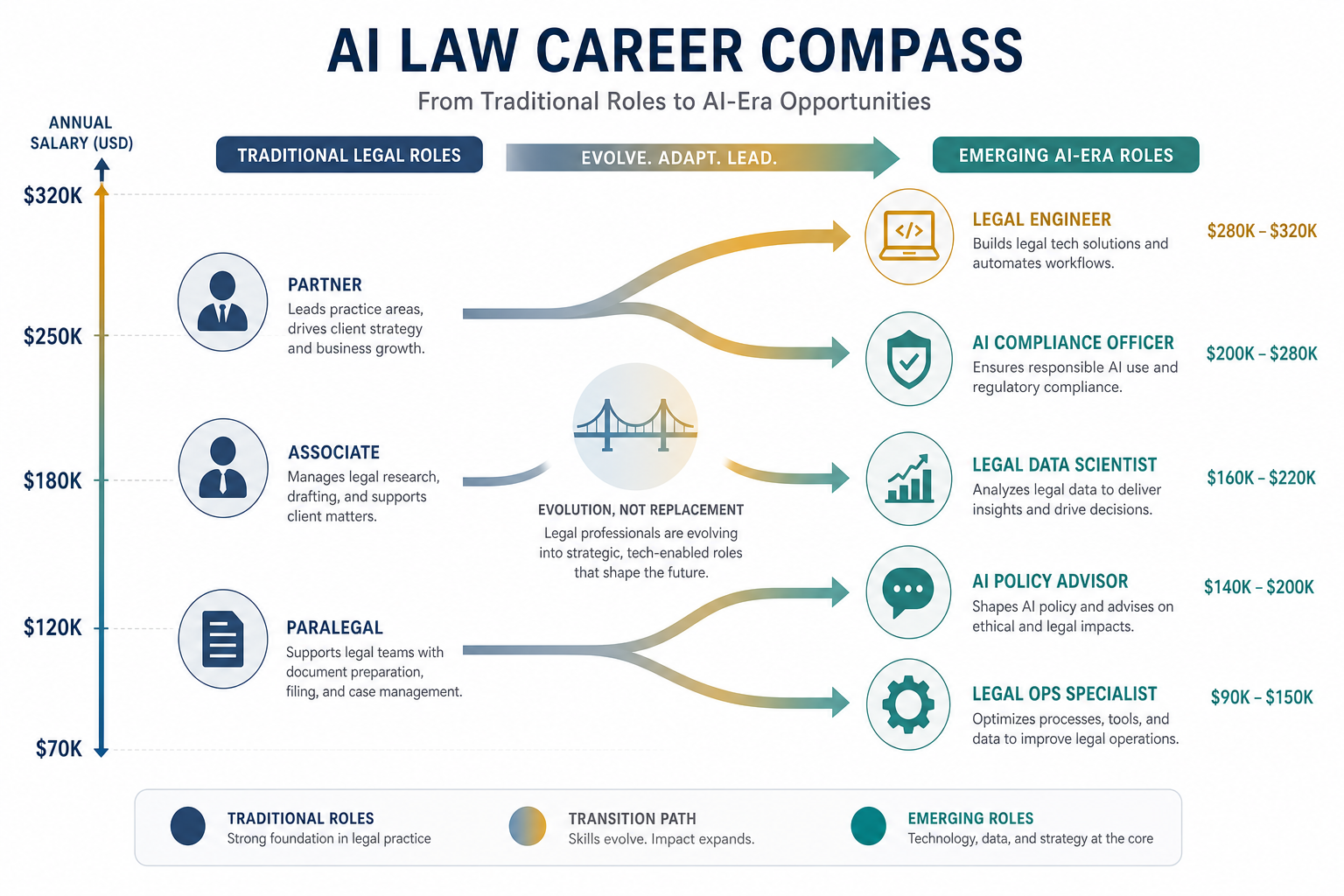
Search for "AI attorney jobs" and you will find listings for roles as varied as AI Compliance Officer, Legal Engineer, and Litigation Analytics Consultant. The label "AI lawyer" is a convenient shorthand, but it collapses at least four fundamentally different career paths — each with its own skill requirements, employer types, compensation structures, and entry strategies. Treating them as a single category is a disservice to anyone planning a career move or building a legal AI practice.
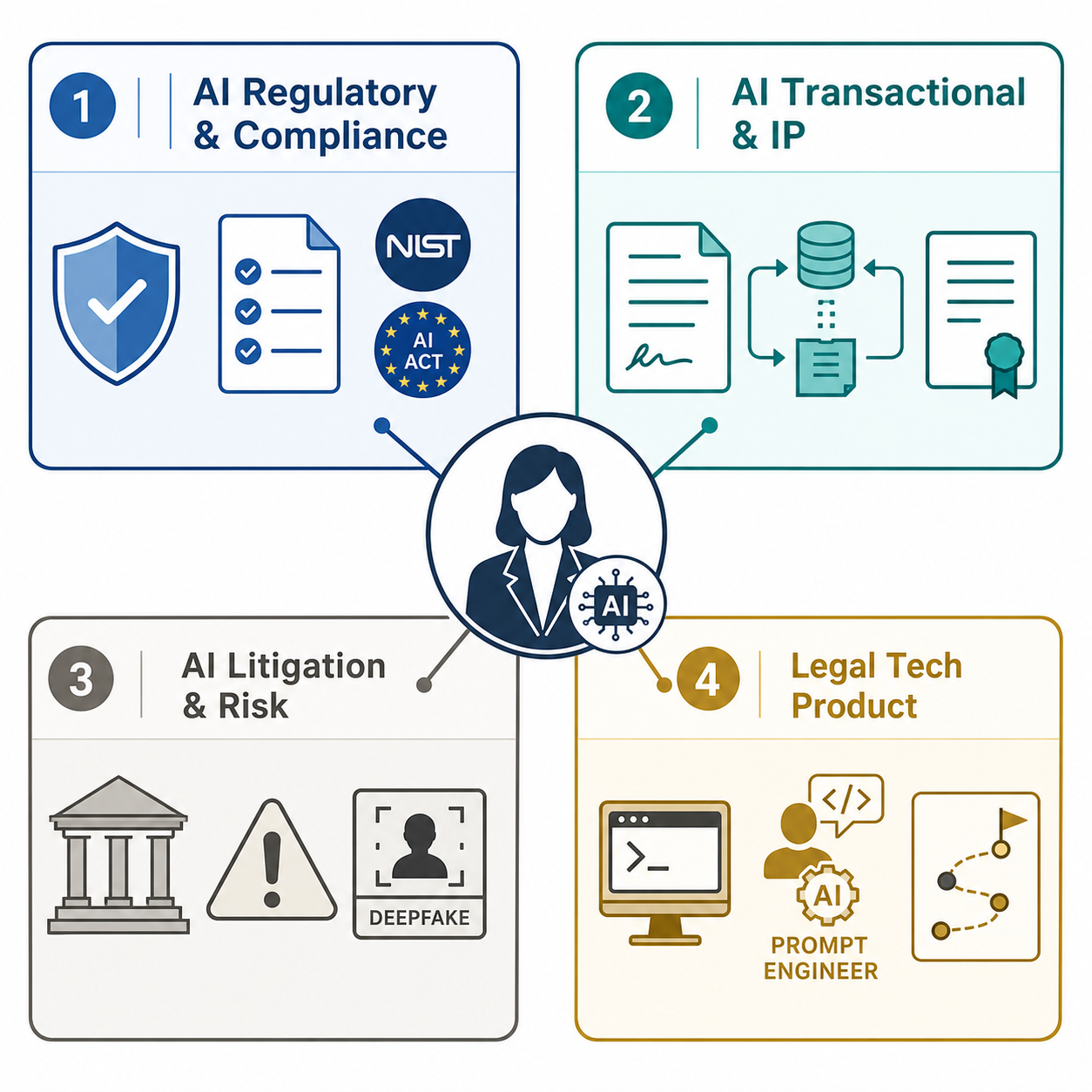
This article disambiguates those four paths: AI regulatory and compliance, AI transactional and intellectual property, AI litigation and risk, and legal tech product roles. For each, we provide specific salary data from multiple recruitment platforms, the core skills required, and the types of organizations that hire for these roles. The goal is not to predict the future of the legal profession — it is to give you a usable taxonomy for navigating a job market that is restructuring in real time.
As of early 2026, legal employment sits at a 10-year high of 1.24 million jobs, according to Bureau of Labor Statistics data cited by The Agency Recruiting. Lateral associate hiring rose nearly 25% in 2024. Yet Baker McKenzie cut 600 to 1,000 business services roles in February 2026, citing AI integration. These are not contradictory signals — they are evidence of a profession that is adding specialized roles while compressing others. Understanding which path you are on, or want to be on, is the first step to navigating this shift.
Path 1: AI Regulatory & Compliance — Advising on AI Governance
The regulatory compliance path is the most straightforward translation of traditional legal skills into the AI domain. It involves interpreting statutes, drafting policies, conducting risk assessments, and advising clients on compliance obligations — applied to a rapidly growing body of AI-specific regulation.
The regulatory landscape is already complex. The EU AI Act imposes tiered obligations based on risk classification, with phased compliance deadlines that began in 2025 and continue through 2027. In the United States, there is no single federal AI law, but a patchwork of state-level statutes — the Colorado AI Act being the most comprehensive so far — combined with sector-specific guidance from agencies including the FTC, DOJ, CFPB, and EEOC. In April 2023, those four agencies issued a joint policy statement making clear that "there is no AI exemption to the laws on the books," as reported by the IAPP. The NIST AI Risk Management Framework provides a voluntary but influential standard for governance practices.
Typical employers include law firms with dedicated AI practices, in-house legal departments at technology companies and financial institutions, and consulting firms that advise clients on AI governance. The core skills are statutory interpretation, risk assessment methodology, familiarity with technical AI concepts (enough to evaluate model documentation), and the ability to track regulatory developments across multiple jurisdictions.
| Role Title | Salary Range (2026) | Source |
|---|---|---|
| AI Compliance Officer | $85,000 – $140,000 | Murray Resources |
| AI Compliance Officer (projected) | $105,000 – $220,000 | Refonte Learning |
| AI Ethics & Governance Consultant | $90,000 – $150,000 | Murray Resources |
| AI Ethics & Governance Consultant (projected) | $95,000 – $195,000 | Refonte Learning |
| AI Policy Advisor | $95,000 – $160,000 | Murray Resources |
| AI Policy Analyst (projected) | $90,000 – $180,000 | Refonte Learning |
For attorneys entering this path, the CIPP/E (Certified Information Privacy Professional/Europe) certification is widely recognized. Familiarity with the EU AI Act's risk classification system — unacceptable risk, high-risk, limited risk, and minimal risk — is essential. The site's EU AI Act High-Risk AI Obligations for Legal Services: A Deployer's Guide provides a detailed walkthrough of the obligations that apply specifically to law firms and legal departments as deployers of high-risk AI systems.
Path 2: AI Transactional & IP — Structuring AI Deals and Protecting Data Rights
The transactional and IP path addresses a fundamental problem: existing contract law was not designed for assets that are trained on data, deployed as models, and updated continuously. As the IAPP notes, AI lawyers in this space advise on corporate transactions where the central asset is an AI model, requiring novel deal structures and representations and warranties. They negotiate over concepts that did not exist in standard commercial contracts a few years ago: retrieval-augmented generation (RAG), model weights, floating point operations, and synthetic content.
Key issues include data provenance (where did the training data come from, and was it lawfully obtained?), IP ownership of model outputs, licensing terms for foundation model APIs, liability allocation for model-generated errors, and data privacy obligations in vendor management. This work requires a combination of traditional transactional skills — contract drafting, negotiation, due diligence — and enough technical fluency to evaluate data pipelines, model architectures, and deployment architectures.
| Role Title | Salary Range (2026) | Source |
|---|---|---|
| IP & AI Legal Counsel (projected) | $115,000 – $230,000 | Refonte Learning |
| AI-Powered M&A Analyst | $100,000 – $170,000 | Murray Resources |
| AI Policy Advisor | $95,000 – $160,000 | Murray Resources |
| AI-Powered Contract Analyst | $80,000 – $130,000 | Murray Resources |
Employers include law firm corporate and IP practices, in-house legal departments at AI companies and technology firms, and specialized boutique firms focused on AI transactions. The skill set overlaps significantly with traditional technology transactions work, but requires additional depth in data rights, model licensing, and the evolving case law around AI-generated content and copyright.
- Data provenance and training data licensing agreements
- Model weight licensing and API service terms
- R&D partnership structures for joint model development
- Liability allocation for model-generated outputs and hallucinations
- IP ownership of synthetic content and fine-tuned model derivatives
Path 3: AI Litigation & Risk — Hallucination Sanctions, AI Evidence, and Agentic Liability
The litigation and risk path is the most reactive of the four — it responds to failures that have already occurred. Documented cases of lawyers filing pleadings with AI-hallucinated authorities now exceed 729 reported instances, according to Damien Charlotin's tracker, as cited by the National Law Review's 85 Predictions for AI and the Law in 2026. These are not hypothetical risks. Courts have imposed sanctions ranging from monetary penalties to referrals to bar disciplinary authorities. The site's AI Hallucinations and Attorney Ethics: Which Professional Responsibility Rules Are Triggered and How Sanctions Have Escalated provides a detailed breakdown of the professional responsibility rules triggered by these incidents and the escalating sanction landscape.
Beyond hallucination cases, this path covers deepfake evidence authentication, discovery obligations for AI-generated materials, and the emerging area of agentic liability — who is responsible when an AI agent makes a decision that causes harm? The work involves traditional litigation skills (motion practice, discovery, trial advocacy) applied to novel factual scenarios where the AI system itself is both the subject of the dispute and a source of evidence.
| Role Title | Salary Range (2026) | Source |
|---|---|---|
| AI-Powered Litigation Analyst | $80,000 – $130,000 | Murray Resources |
| Litigation Analytics Consultant (projected) | $100,000 – $205,000 | Refonte Learning |
| AI Risk & Legal Strategy Advisor (projected) | $115,000 – $230,000 | Refonte Learning |
| AI-Powered eDiscovery Specialist | $80,000 – $130,000 | Murray Resources |
Employers include law firm litigation departments, e-discovery providers, legal risk consulting firms, and increasingly, in-house legal departments at large corporations that are building internal e-discovery and litigation analytics capabilities. TruLegal data cited by Law.com indicates that corporations are hiring e-discovery professionals in-house at the largest rate in 15 years, while vendor-side e-discovery compensation was down 4% to 34% in 2025, suggesting a structural shift in where this work is performed.
Path 4: Legal Tech Product — Legal Engineer, Prompt Engineer, and AI Product Manager
The legal tech product path is the most divergent from traditional legal practice. It involves building the tools that the other three paths use. Roles in this category require a hybrid skill set that combines legal domain knowledge with software engineering, product management, or data science capabilities.
The highest-profile role in this category is the Legal Engineer — a position that Harvey and Legora have filled at compensation levels that far exceed traditional law firm associate salaries. Multiple sources report that Legal Engineers at these companies command $270,000 to $320,000 plus equity. These roles require the ability to translate legal workflows into structured prompts, evaluate model outputs for legal accuracy, and build evaluation datasets for fine-tuning.
| Role Title | Salary Range (2026) | Source |
|---|---|---|
| Legal Engineer (Harvey, Legora) | $270,000 – $320,000 + equity | Multiple sources |
| Legal AI Product Manager (projected) | $105,000 – $215,000 | Refonte Learning |
| AI Legal Tech Developer | $100,000 – $160,000 | Murray Resources |
| Legal Data Scientist | $90,000 – $150,000 | Murray Resources |
| Legal Data Scientist (projected) | $100,000 – $205,000 | Refonte Learning |
Employers are primarily legal AI startups, legal technology divisions of large law firms, and the legal product teams at companies like Thomson Reuters, LexisNexis, and Clio. The skill requirements are demanding: a Legal Engineer typically needs a law degree plus demonstrable programming ability (Python is the most common language), familiarity with large language model architectures, and experience with prompt engineering and retrieval-augmented generation. For readers who need a technical foundation, the site's What Is an LLM? A Legal Professional's Guide to Large Language Models provides the necessary technical grounding.
Salary Comparison Across All Four Paths
The following table consolidates salary data across all four paths, organized by experience level where available. The data comes from multiple recruitment platforms — Robert Half, Murray Resources, Refonte Learning, and TruLegal — and should be treated as directional rather than guaranteed. Actual compensation varies significantly by geographic market, firm size, and individual experience.
| Path | Entry-Level / Junior | Mid-Career | Senior / Partner-Level |
|---|---|---|---|
| Regulatory & Compliance | $85K – $105K | $105K – $160K | $195K – $220K |
| Transactional & IP | $80K – $115K | $130K – $170K | $180K – $230K |
| Litigation & Risk | $80K – $100K | $100K – $150K | $160K – $230K |
| Legal Tech Product | $90K – $160K | $160K – $215K | $270K – $320K + equity |
TruLegal tracked the largest average base compensation adjustments for AI-enabled legal talent at 14% in late 2025 and early 2026, as reported by Law.com. This premium applies across all four paths — employers are paying more for candidates who can demonstrate mastery of AI tools and AI-specific legal knowledge. The premium is most pronounced in the Legal Tech Product path, where the combination of legal and technical skills is rarest.
Entry Strategies for Each Path
Each path requires a different combination of credentials, skills, and networking strategies. The following guidance is based on current hiring trends and the specific requirements documented in job postings and recruitment data.
Regulatory & Compliance Path
The regulatory path is the most accessible for attorneys without a technical background. The CIPP/E certification is the most widely recognized credential for EU AI Act work. Familiarity with the NIST AI RMF and the Colorado AI Act is valuable for US-focused roles. The site's AI Compliance Framework in 2026: A Jurisdiction-by-Jurisdiction Guide provides a structured overview of the regulatory landscape across jurisdictions.
- Obtain CIPP/E certification for EU AI Act expertise
- Study the NIST AI RMF and the Colorado AI Act for US regulatory knowledge
- Develop familiarity with AI risk classification frameworks and compliance documentation requirements
- Target law firms with dedicated AI practices, in-house legal departments at tech companies, and Big Four consulting firms
Transactional & IP Path
This path requires strong traditional transactional skills plus technical fluency. Attorneys with experience in technology transactions, IP licensing, or data privacy are well-positioned. The key is to develop enough understanding of AI model architectures to evaluate data provenance, model licensing terms, and liability allocation provisions.
- Build on existing technology transactions or IP licensing experience
- Learn the basics of model architectures, training data pipelines, and RAG systems
- Develop expertise in data provenance documentation and synthetic content IP issues
- Target law firm corporate/IP practices, in-house legal at AI companies, and specialized AI boutiques
Litigation & Risk Path
The litigation path rewards attorneys who can combine traditional litigation skills with knowledge of AI failure modes. Familiarity with the documented hallucination cases, e-discovery best practices for AI-generated materials, and the emerging case law on deepfake evidence is essential. The site's incident record on AI hallucinations and sanctions is a practical starting point for understanding the current risk landscape.
- Study documented hallucination cases and sanction orders to understand judicial expectations
- Develop expertise in e-discovery for AI-generated and AI-assisted materials
- Monitor emerging case law on deepfake evidence authentication and agentic liability
- Target law firm litigation departments, e-discovery providers, and in-house litigation teams at large corporations
Legal Tech Product Path
This path has the highest barrier to entry but also the highest compensation ceiling. It requires demonstrable programming ability — Python is the most common language — plus legal domain knowledge and product sense. Law students and attorneys who are willing to invest in technical skills can access roles that are largely insulated from the compression of traditional legal hiring.
- Learn Python and gain familiarity with LLM APIs and prompt engineering frameworks
- Build a portfolio of projects that demonstrate legal domain knowledge applied through technical work
- Understand retrieval-augmented generation (RAG) architectures and model evaluation methodologies
- Target legal AI startups, legal technology divisions of large law firms, and product teams at legal information providers
Conclusion: The Legal Profession Is Restructuring, Not Shrinking
The data does not support the narrative that AI is eliminating legal jobs. Legal employment hit a 10-year high of 1.24 million jobs in January 2026. A survey of 85 legal professionals conducted by the National Law Review found that 58.3% reject the claim that AI will replace entry-level lawyers within five years; only 20.2% believe replacement is likely. Multiple experts quoted by Artificial Lawyer — including Beau Wysong of Opus2, Ed Walters of Clio, and Winston Weinberg of Harvey — explicitly stated that AI will not replace lawyers or legal support professionals in 2026.
What is happening is a restructuring. The pyramid model of large junior associate classes is compressing, as The Agency Recruiting notes. Firms are hiring more legal ops specialists and tech-fluent paralegals, and fewer junior associates. One small firm cited in their reporting chose not to replace a departing 8th-year associate, leaned on AI, and saw staffing costs drop 27% and profits increase. These are not signs of a shrinking profession — they are signs of a profession that is reallocating labor toward higher-value, AI-augmented work.
The "AI lawyer" label is a useful shorthand, but it obscures four distinct, growing career paths with different requirements and compensation structures. Whether you are an attorney considering a specialization, a law student exploring practice areas, or an in-house counsel evaluating AI governance needs, the first step is to understand which path aligns with your skills and interests. The second step is to invest in the specific credentials, technical knowledge, and networking strategies that path requires. The legal profession is not being replaced by AI — it is being reshaped by it, and the attorneys who understand the new taxonomy of roles will be the ones who thrive.
Related records
Tool profile
Browse tool evaluations →Governing regulation
Browse the obligations tracker →Preventive workflow
Browse verification workflows →
Report a correction or tip
Spotted an outdated figure, a misstated fact, or a ruling this case record should reflect? Public comments are disabled for this content given the professional cost of a misreported case outcome, penalty amount, or rule text — use the structured correction channel instead.
Report a correction or tip for this record →