
Lawyers can use ChatGPT in legal practice, but the safe answer is narrower than the popular answer. It belongs comfortably in low-risk productivity work: turning rough notes into an agenda, summarizing non-confidential training material, drafting a neutral email template, or helping a team think through project steps. It does not belong, unmediated, in core legal research, citation work, client-specific legal analysis, or filing-ready drafting unless a lawyer can satisfy the same duties that applied before generative AI arrived: competence, confidentiality, communication, reasonable fees, supervision, meritorious claims, and candor to the tribunal.
That is the practical meaning of ABA Formal Opinion 512, issued on July 29, 2024. The opinion does not ban generative AI. It does something more useful: it names the professional-responsibility rules that attach when lawyers use it, including Model Rules 1.1, 1.6, 1.4, 1.5, 5.1, 5.3, 3.1, and 3.3.[1]
This article is general information for lawyers and legal-operations teams. It is not legal advice, and it does not replace the rules, ethics opinions, court orders, client terms, or supervisory policies that apply in a particular matter.
The Question Is Not Whether ChatGPT Is Legal. It Is Where the Duty Lands.
A lawyer who asks whether ChatGPT can be used for law is usually asking several different questions at once. Can a prompt be sent without disclosing client information? Can the answer be trusted? Must the client be told? Can the time be billed? Must a court disclosure be filed? Who checks the work of an associate, paralegal, or contract lawyer who used the tool first?
ABA 512 makes those questions harder to wave away. Competence requires enough understanding of the tool’s capabilities and limits to use it responsibly. Confidentiality requires lawyers to consider whether information entered into a generative AI tool may be stored, reviewed, trained on, or disclosed under the vendor’s terms. Communication may require telling the client when AI use is relevant to the representation. Fee rules matter because a lawyer cannot bill a client for time saved by automation as if the lawyer had performed the same task manually. Supervisory rules make partners and managers responsible for reasonable policies and oversight when lawyers or nonlawyer staff use these systems.[1]
That framework is more useful than a blanket yes or no. ChatGPT can be acceptable for legal-adjacent work when the input is sanitized, the output is treated as a draft or idea generator, and no one mistakes fluency for authority. It becomes dangerous when the output is passed forward as research, analysis, or advocacy without primary-source verification and lawyer judgment.
For firms trying to translate those duties into an operating policy, a practical verification protocol belongs in the same conversation as tool selection. A Lawyer's Guide to ChatGPT and Ethics Compliance can help turn the ethics categories into review steps, escalation rules, and red-line uses.
Why General-Purpose ChatGPT Is a Poor Starting Point for Legal Research
Legal research is an unusually bad place to rely on a general-purpose chatbot. The problem is not merely that ChatGPT can be wrong. Lawyers already work with sources that can be incomplete, outdated, or strategically framed. The harder problem is that a fluent model can produce a confident legal answer with fabricated authorities, distorted holdings, or citations that look plausible enough to survive a hurried read.
Stanford RegLab researchers reported hallucination rates of 58% to 88% for general-purpose large language models on legal queries in work collected during March to May 2024.[2] Those figures should not be treated as a permanent measurement of every current model. Models change, prompts change, and vendors add retrieval features. But the study is still important because it describes the failure pattern lawyers actually care about: authoritative-looking legal answers that cannot be accepted without independent verification.
The comfortable vendor distinction is that legal AI tools are different because they sit on legal databases and cite sources. They are different. They are not magic. In a peer-reviewed study of leading legal research tools, researchers reported hallucination rates of 17% to 33% for Lexis+ AI and Westlaw AI-Assisted Research.[3] That is a meaningful improvement over the general-purpose results, but it is not a warrant to skip review.
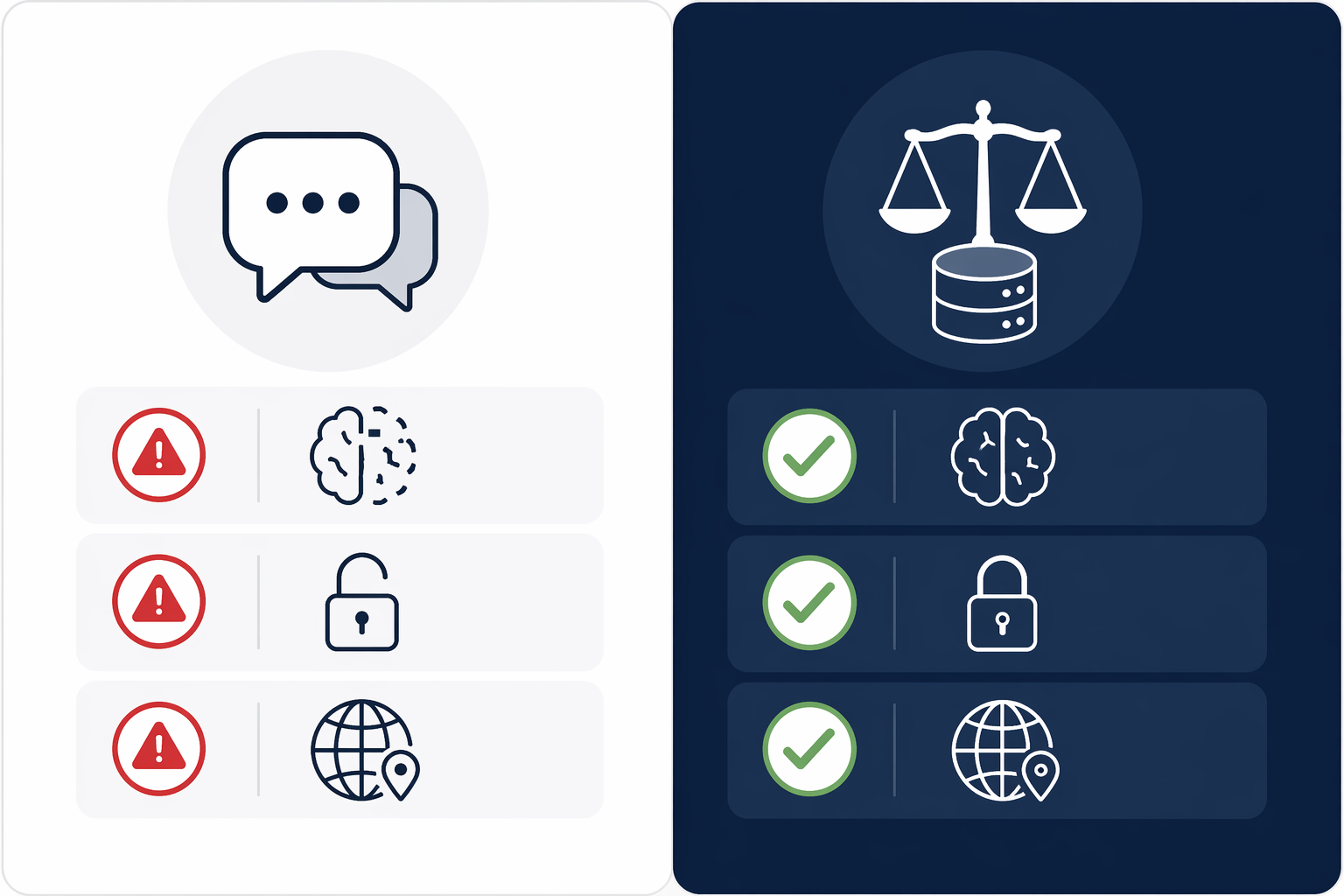
For core legal research, the safer hierarchy is plain enough. A purpose-built legal research platform with source-linked answers, jurisdiction filters, citator integration, enterprise controls, and professional support is a better starting point than general-purpose ChatGPT. It still remains only a starting point. The lawyer must check the cited authority, confirm that it says what the tool claims, run the citator or equivalent validation, and account for local rules, judge-specific requirements, and procedural posture.
Cost complicates this in real practice. A small firm or solo lawyer may not have access to every specialized platform. That does not make ChatGPT a substitute for legal research infrastructure. It means the lawyer has to narrow the use case, rely on authoritative sources where available, document verification, and avoid letting a free or low-cost tool become the only source behind a legal position. A detailed platform-by-platform discussion belongs in a separate comparison of which AI legal research tool your firm should adopt.
What Courts Are Punishing
The sanctions cases are often retold as AI folklore: a lawyer asked a chatbot, the chatbot invented cases, the court got angry. That version is too shallow. The recurring court concern is not mere tool use. It is the professional failure that follows: fabricated citations, false representations about research, inadequate verification, and a breakdown of candor after the problem is exposed.
The early warning case was Mata v. Avianca, where lawyers were sanctioned $5,000 after filing briefing that included fictitious cases generated through ChatGPT.[4] Later examples increased the consequences. Reports have described sanctions including $31,100 in Lacey v. State Farm and more than $95,000 plus $15,500 in Couvrette v. Wisnovsky, along with disciplinary or case-management consequences in other matters involving AI-generated authorities.[4]
Other reported cases show that the failure mode has moved beyond the first wave of ChatGPT misuse. Johnson v. Dunn, in the Northern District of Alabama in July 2025, involved disqualification after concerns tied to AI-assisted work. Malkeet Lnu v. Blanche involved a six-month Ninth Circuit suspension in 2026. Cassata v. Macrina and Deutsche Bank v. LeTennier were reported as New York matters in 2026, with Deutsche Bank described as a New York appellate-level example.[4]
The point is not that every AI mistake becomes a sanctions order. It is that courts have little patience for the argument that the tool produced the false authority. Once a lawyer signs, files, certifies, or argues from the output, the responsibility has moved from the model to the lawyer.
Court Orders and State Guidance Make the Risk Local
A national ethics opinion gives the floor, not the full map. By 2026, lawyers also have to contend with court standing orders, local certification requirements, and state-level guidance. Reports tracking federal practice have identified standing orders from more than 21 federal judges, while New York Part 161 became effective June 1, 2026, and California’s Judicial Council issued generative AI guidelines in September 2025.[5]
Those counts should be used carefully. Trackers can lag, some orders are judge-specific, and state-court materials are harder to collect consistently than federal docket orders. Still, the operational consequence is clear: a lawyer cannot build one national ChatGPT policy and assume it satisfies every filing environment.
Before filing, the responsible question is no longer only whether the brief is accurate. It is whether the court requires disclosure of generative AI use, certification that citations were verified, limits on AI-generated content, or any other representation that could itself become a candor issue. A matter team needs a live way to check judge-by-judge obligations; a federal court AI standing-orders tracker is useful precisely because this area does not move in one clean national line.
State ethics guidance adds another layer. The research record supports saying that guidance now exists in many states, with secondary CLE materials describing more than 30 states as having addressed generative AI in some form. Because that count depends on secondary tracking that may not be fully verifiable from public sources, it is better treated as a warning about variation than as a precise compliance number.
For firms working across jurisdictions, the practical baseline is an ethics stack: national professional-responsibility duties, state rules and opinions, client requirements, court orders, vendor terms, and internal policy. The AI Ethics Stack Every Lawyer Needs in 2026 is a better model than a single-page “AI allowed” memo.
A Practical Risk Map for ChatGPT in Legal Work
The cleanest policy does not classify AI by excitement level. It classifies it by consequence. Who sees the input? What legal judgment is being made? What source will be relied on? Who reviews the output? Could the work reach a client, counterparty, agency, or court? Those answers decide whether ChatGPT is a convenience, a supervised drafting aid, or an unacceptable shortcut.
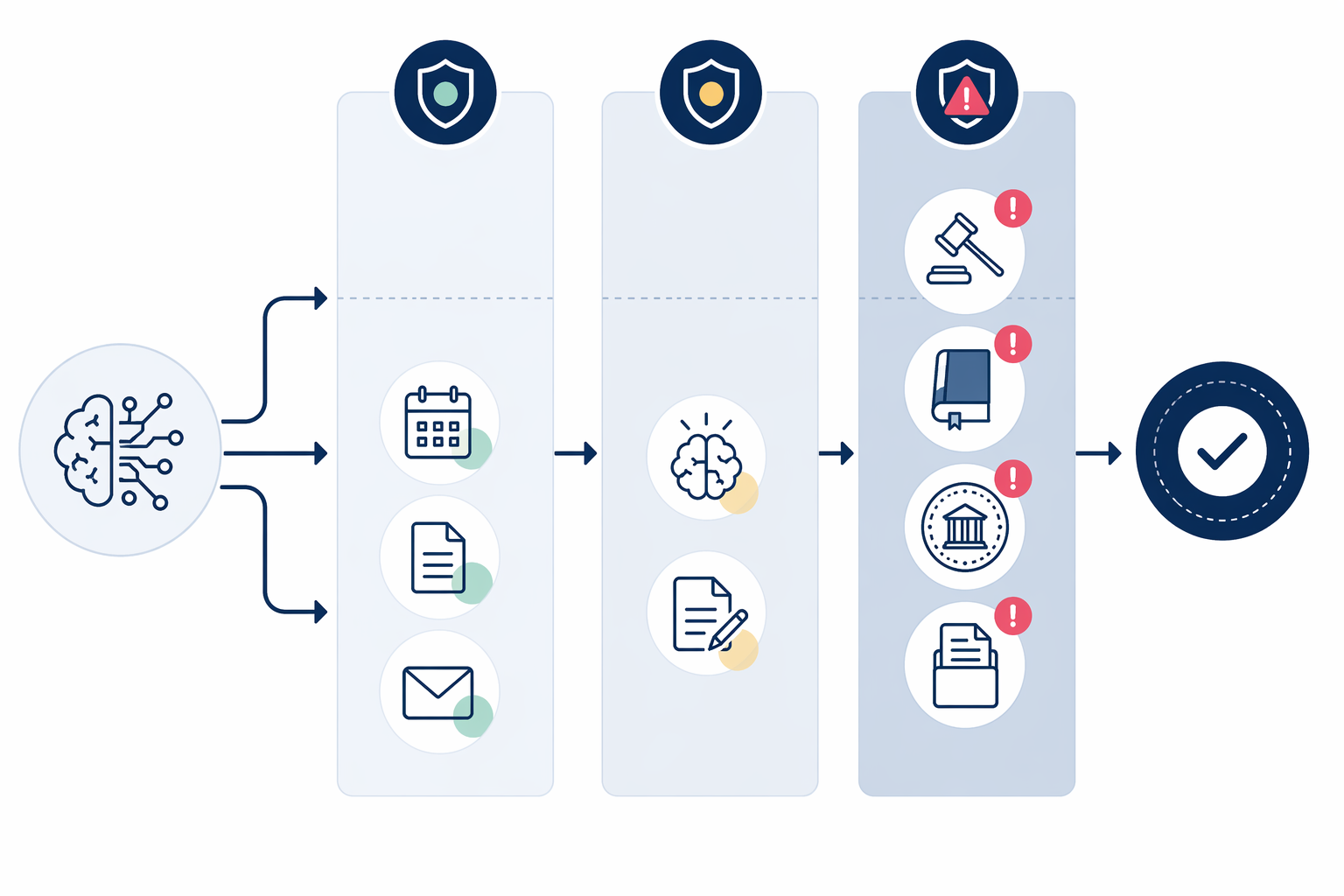
| Use case | ChatGPT risk level | Safer operating rule |
|---|---|---|
| Administrative productivity | Low, if no confidential information is entered | Use for agendas, checklists, formatting help, and generic project planning; keep client facts out unless the tool is approved for confidential use. |
| Internal brainstorming | Low to moderate | Use for issue spotting or alternative phrasing, but treat the output as prompts for lawyer analysis rather than conclusions. |
| Client-specific drafting | Moderate to high | Use only with approved confidentiality controls, lawyer review, and verification against the file and governing law. |
| Legal research and citations | High | Do not rely on general-purpose ChatGPT as authority; verify through primary sources and citators, preferably starting from a legal research platform. |
| Court filings | Highest | Check court-specific AI orders, verify every authority, and ensure any required disclosure or certification is accurate. |
Administrative Work
ChatGPT is most defensible where it is farthest from legal authority and client secrets. A lawyer can ask it to turn a generic training outline into a meeting agenda, convert a public article into talking points, create a first draft of an internal checklist, or make a plain-language version of a non-confidential process note. The output still needs review, but the chance of professional harm is lower because the task is not asking the tool to determine law or apply confidential facts.
Even here, confidentiality habits matter. “Remove the client name” is not always enough. Dates, transaction structure, industry, geography, personnel descriptions, and unusual fact patterns can identify a matter. A good internal policy should train lawyers to think in terms of re-identification risk, not just obvious names.
Brainstorming and Issue Spotting
Brainstorming is where lawyers often get real value without pretending the model is a research database. A prompt can ask for possible contract negotiation issues, categories of diligence questions, themes for a witness outline, or ways to explain a procedural step to a nonlawyer audience. The lawyer’s job is to decide what belongs, what is missing, and what is wrong.
The danger is subtle. Brainstorming output can anchor the lawyer’s thinking. If the model lists five issues and misses the sixth, the omission may feel like the lawyer’s own judgment. For high-stakes matters, brainstorming should be paired with independent review: the pleadings, the contract, the governing rule, the supervising lawyer’s experience, and, where appropriate, specialized research tools.
Client-Confidential Work
Confidentiality is not a decorative concern. Under ABA 512, lawyers must consider whether entering information into a generative AI tool risks disclosure or unauthorized access, including through the tool’s terms of use and data-handling practices.[1] The right question is not “Does the vendor say enterprise?” It is whether the specific configuration, contract, retention setting, training exclusion, access control, and audit process support the lawyer’s Rule 1.6 obligations.
Client communication may also be required. Not every use of AI requires a client memo. But if the method is material to the representation, if confidential information will be processed by a third-party system, if the client has outside-counsel guidelines addressing AI, or if the lawyer’s use affects fees or staffing, silence is a poor default.
Research, Drafting, and Filing
Research is where general-purpose ChatGPT should usually leave the workflow or be confined to preliminary orientation. If a lawyer uses it to ask, “What issues might arise in this kind of dispute?” the answer may help frame a research plan. If the lawyer asks it for controlling law, leading cases, quotations, or jurisdiction-specific standards, the output must be treated as unverified until checked against authoritative sources.
Drafting creates a different version of the same problem. A model can produce a clean paragraph with a bad premise. It can smooth over uncertainty, invent a procedural posture, or make a rule sound more settled than it is. The more the draft moves toward client advice or a filed document, the more the review must look like legal work rather than proofreading.
A defensible review sequence is simple to describe and demanding to perform: identify every legal proposition; trace it to primary or otherwise authoritative sources; confirm the source is current; check whether the cited passage supports the sentence; confirm jurisdiction and procedural posture; test adverse authority; and document who reviewed the final work. Firms that want to operationalize that sequence should build it into matter workflows, not leave it to individual memory. A guide on how to build an AI workflow your law firm can defend is useful here because ABA 512 is not self-executing.
Fees and Supervision Are Part of the AI Analysis
Generative AI is often sold as efficiency, but legal ethics asks who receives the benefit and who bears the risk. If an associate uses ChatGPT to complete in 20 minutes what previously took two hours, the firm cannot simply bill the old amount because the old amount sounds reasonable in a pre-AI world. ABA 512 flags fee reasonableness as part of the analysis.[1]
Supervision is just as practical. A partner who prohibits all AI use while associates quietly use it on personal accounts has not solved the risk. A partner who encourages AI use without training, approved tools, review standards, and disclosure rules has merely relocated the risk to the person least able to absorb it. The better policy names permitted tools, forbidden uses, required review steps, client-consent triggers, billing treatment, and escalation points.
Legal operations teams can help by separating workflow design from aspiration. Which tasks are eligible? Which systems are approved? Are prompts logged? Is confidential data excluded from training? Who audits outputs? What happens if a lawyer finds a hallucinated citation before filing? What happens if one is found after filing? These are not vendor-demo questions. They are management questions.
ChatGPT vs. Specialized Legal AI: The Usable Distinction
The distinction between ChatGPT and specialized legal AI is not that one is risky and the other is safe. The distinction is that they fail differently, and the lawyer’s controls should match the failure mode.
| Factor | General-purpose ChatGPT | Specialized legal AI |
|---|---|---|
| Best role | Productivity, brainstorming, plain-language drafting, internal structure | Research starting point, source-linked summaries, drafting support tied to legal databases |
| Main risk | Plausible legal-sounding output without reliable legal grounding | Overreliance on retrieved or summarized sources that may still be incomplete or wrong |
| Source access | Depends on model, browsing, uploaded material, or user-provided sources | Typically connected to legal databases, citations, and research infrastructure |
| Confidentiality posture | Depends heavily on account type, settings, and vendor terms | Often better suited to enterprise controls, but still requires contract and configuration review |
| Ethical bottom line | Acceptable for controlled low-risk use; poor default for legal authority | Safer for core legal work, but not a substitute for lawyer verification |
A legal AI platform that returns source-linked answers can reduce some research risk because the lawyer can move from answer to authority. That matters. But the Stanford findings on Lexis+ AI and Westlaw AI-Assisted Research are a useful check against complacency: lower hallucination rates are not zero hallucination rates.[3]
The safest comparison is therefore procedural. If the task requires law, use tools that connect the work to law. If the task requires filing, comply with the court’s AI rules. If the task requires client facts, use only systems whose confidentiality posture has been reviewed and approved. If the task requires judgment, do not outsource the judgment to the output.
Where ChatGPT Belongs in a Law Practice
ChatGPT belongs in a lawyer’s workflow where the firm can control inputs, verify outputs, supervise users, explain the process when necessary, and comply with court and client requirements. That gives it real room to be useful. Legal teams can use it for internal training drafts, workflow maps, generic client-education outlines, deposition-preparation logistics, public-law summaries that are separately checked, and first-pass organization of non-confidential material.
It does not belong as the final authority behind a legal position. It should not be the only source for citations. It should not receive client confidential information through an unapproved account. It should not produce filing-ready text that no lawyer checks against the record and governing law. And it should not be used in a way that leaves an associate or paralegal holding responsibility for a tool choice management never governed.
For core legal research and drafting, specialized legal AI is generally the safer starting point because it is closer to authoritative sources and more likely to support enterprise controls. It is still only a tool inside the lawyer’s professional duties. The operational judgment for 2026 is not abstinence and not blind adoption: use ChatGPT where the risk is low and the controls are real; use legal research AI for legal research; verify everything that matters; and never let a polished answer become a substitute for candor, competence, or supervision.
References
- ABA issues first ethics guidance on a lawyer’s use of AI tools, American Bar Association, July 29, 2024
- AI Liability and Hallucinations in a Changing Tech and Law Environment, Stanford Law School
- Hallucination-Free? Assessing the Reliability of Leading AI Legal Research Tools, Journal of Empirical Legal Studies, 2025
- Federal Court Turns Up the Heat on Attorneys Using ChatGPT for Research, Esquire Solutions
- Beyond the Mirage: Beware of Generative AI and Hallucinations, New York State Bar Association
Comments
Join the discussion with an anonymous comment.