
The AI Compliance Talent Gap: Why This Market Exists Now
The numbers are stark enough to demand attention from any compliance, risk, or privacy professional evaluating their next career move. According to the International Association of Privacy Professionals (IAPP), 98.5% of organizations report inadequate AI governance staffing. Only 1.5% say they are fully satisfied with their current headcount. This is not a niche shortage — it is a structural gap across every regulated industry.
The hiring data confirms the trend is accelerating. LinkedIn's 2026 Skills on the Rise report found that AI governance job postings grew 150% year-over-year, while AI ethics demand rose 125%. Axial Search's analysis of 146 AI governance postings identified a 1,257% surge in AI governance postings over a comparable prior period. Meanwhile, 92% of companies plan to increase AI investments, yet McKinsey reports that only 1% have reached AI maturity. The result is a labor market where demand far outpaces the supply of qualified professionals.
The urgency is not abstract. The EU AI Act imposes fines up to €35 million or 7% of global annual turnover for the most serious violations. Over 1,200 AI regulations now exist worldwide, according to the OECD. Organizations that cannot staff AI governance functions face both regulatory exposure and operational risk from unmonitored AI deployments — including the persistent challenge of shadow AI, where tools are adopted informally without compliance oversight.
For compliance professionals, this gap represents an opportunity. The skills you already possess — regulatory mapping, risk assessment, policy development, audit readiness — are directly transferable. The question is not whether you can enter this field, but how quickly you can position yourself for the roles that exist right now.
What Roles Exist? The AI Governance Career Ladder
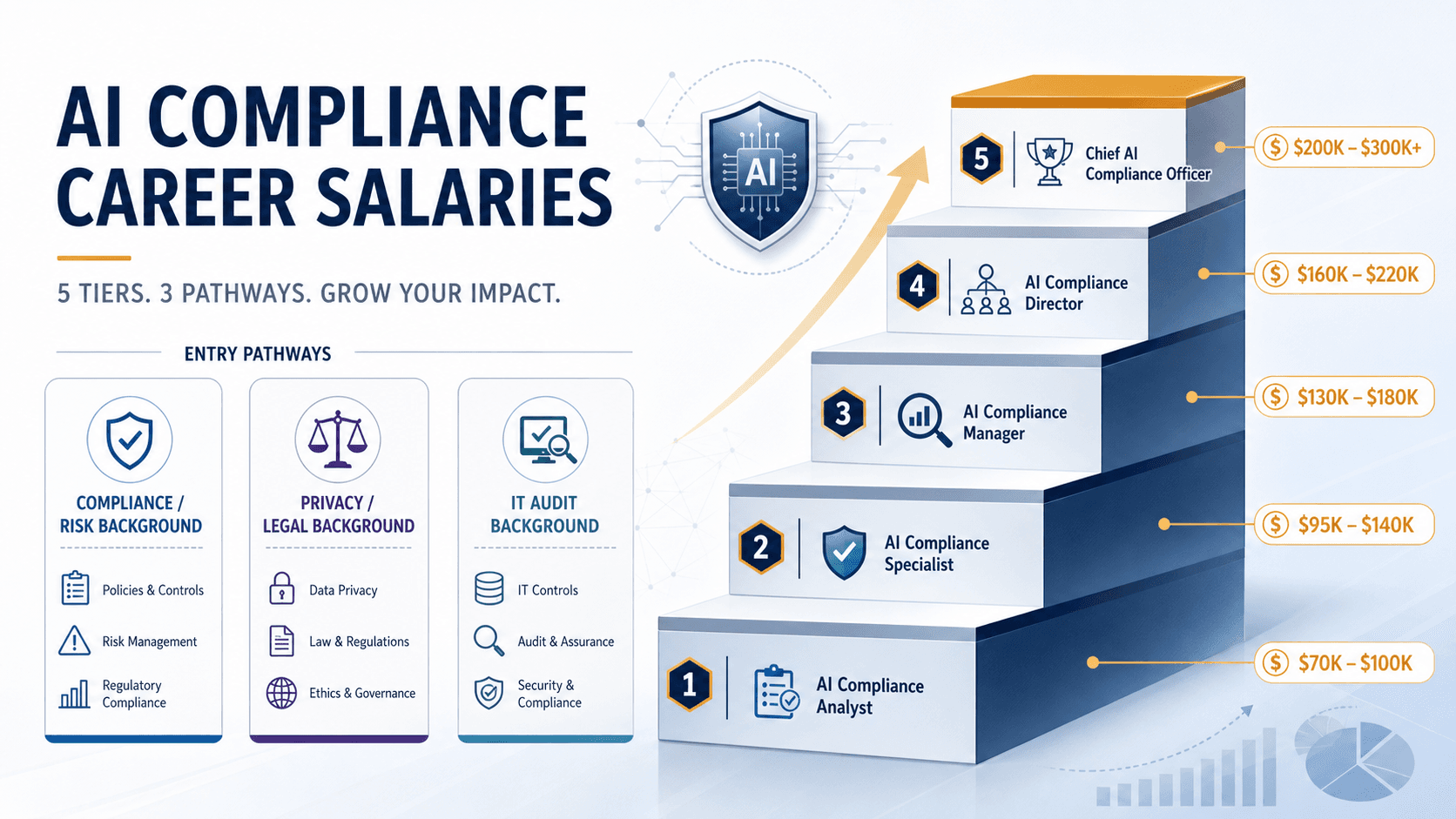
AI governance is not a single job title. It is a career ladder with five primary tiers, each carrying distinct responsibilities, authority levels, and compensation bands. Understanding where you sit — or where you want to sit — is the first step in planning a transition.
| Tier | Typical Title | Core Responsibilities | Experience Range |
|---|---|---|---|
| Entry-Level | AI Compliance Analyst / AI Ethics Analyst | Regulatory research, policy drafting support, stakeholder training coordination, incident logging | 0–3 years |
| Mid-Level | AI Compliance Specialist / AI Compliance Manager | Regulatory mapping, algorithmic audit execution, risk assessment ownership, cross-functional coordination | 3–7 years |
| Senior / Lead | Senior AI Compliance Manager / Lead AI Governance Advisor | Program design, audit methodology development, vendor risk oversight, regulatory engagement | 7–12 years |
| Director | Director of AI Governance / Director of AI Risk | Enterprise governance framework ownership, board-level reporting, team leadership, budget authority | 10+ years |
| Executive | Chief AI Officer / Chief AI Ethics Officer / VP AI Regulatory Compliance | Organizational strategy, regulatory relationship management, C-suite advisory, public accountability | 10+ years |
Within these tiers, six specializations have emerged, as documented by CareerExplorer and Planet Compliance: Global Regulatory Lead, AI Bias Auditor, AI Privacy Officer, Financial AI Compliance Manager, Generative AI Specialist, and Third-Party Risk Manager. Each specialization maps to a specific regulatory pressure point — bias auditing maps to EU AI Act conformity assessment requirements, while third-party risk management addresses the growing challenge of vendor AI governance.
A critical market reality: 85% of AI governance postings target mid-level professionals with 5+ years of experience, according to Axial Search's analysis of 146 postings. Only 3% target entry-level candidates. This means the primary entry point is not a junior role — it is a lateral move from an adjacent compliance, privacy, risk, or audit function where you already have domain expertise.
Salary Landscape: What Each Tier Pays in 2026
Compensation in AI governance has risen sharply as demand outpaces supply. The following table synthesizes data from the IAPP 2025-26 Salary Survey, Heidrick & Struggles' analysis of 318 executives, Axial Search's posting analysis, and VerifyWise's multi-source market report. All figures are US-market unless otherwise noted.
| Tier | Salary Range (US) | Notes |
|---|---|---|
| Entry-Level (0–3 yrs) | $75,000 – $120,000 | Limited openings; most entry roles are analyst positions at large consultancies |
| Mid-Level (3–7 yrs) | $120,000 – $188,000 | Largest hiring segment; AI Compliance Manager roles cluster at $125K–$200K |
| Senior / Lead (7–12 yrs) | $150,000 – $221,000 | Senior managers and lead advisors; technical AI governance roles median $221K |
| Director (10+ yrs) | $190,000 – $250,000+ | Director of AI Governance; 72% pay bump from Manager level in one promotion cycle |
| CAIO / VP (10+ yrs) | $250,000 – $540,000+ | Chief AI Officer base $250K–$352K; total comp at large enterprises exceeds $540K |
Comments
Join the discussion with an anonymous comment.