
In the Sam Nordquist prosecution, “timeline” is not a tidy trial graphic waiting to be designed. It is the work of locating alleged events across a 22-plus-month span, seven defendants, a shifting set of witness accounts, and a digital record that reportedly includes more than 40 cell phones, dozens of social media accounts, TikTok material, Snapchat messages, faked text messages, and body-camera footage.[1][2][3]
That scale matters because the procedural posture has not reduced the chronology problem to a simple before-and-after story. Three defendants entered guilty pleas between June 2 and July 15, 2026, while four defendants still had September 2026 trial dates remaining as of the July 15 plea report.[2] For the lawyers still preparing contested proceedings, a master chronology would need to track what allegedly happened, when it allegedly happened, who said it happened, which device or platform records support or complicate it, and which parts remain disputed.
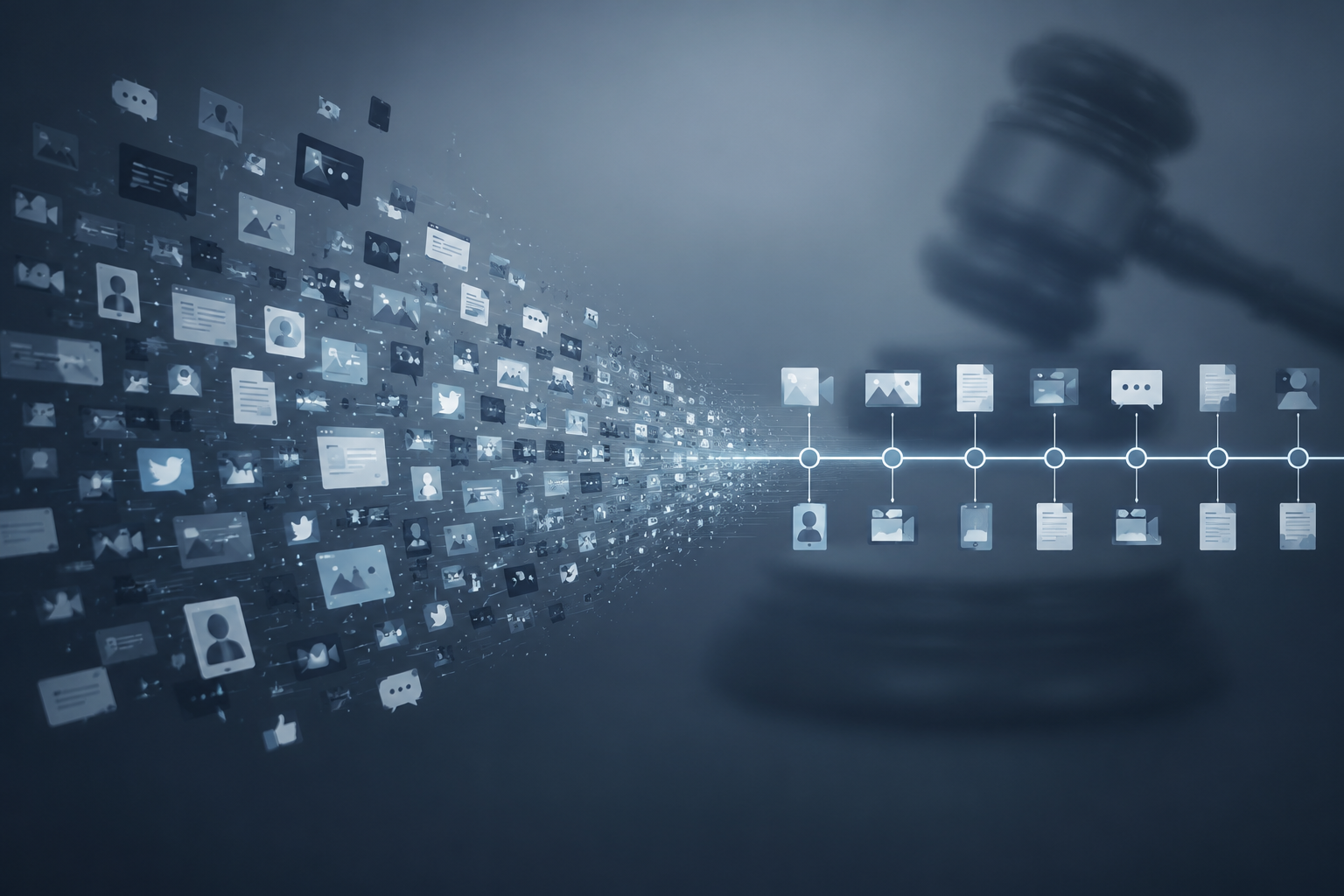
That is the narrow question for legal AI timeline tools in a case like Nordquist: if a legal team must build and defend a working chronology from tens of thousands of digital evidence files, what can software safely automate, and what must remain attorney-verified?
The Nordquist File As A Chronology Stress Test
A large criminal file does not become a hard chronology problem merely because there are many documents. It becomes hard when different evidence types carry different clocks, authors, custodians, and reliability problems. A phone extraction may preserve message metadata. A screenshot may show content but not the collection path. A police interview may fix a witness’s account at one date while describing events from another. Body-camera footage may show what an officer saw at a scene, but not what happened before the camera was activated.
The Nordquist evidence mix, as publicly described, is exactly the sort of file where that distinction becomes important. Reports describe evidence from more than 40 phones, dozens of social media accounts, TikTok hostage videos, Snapchat witness accounts, faked text messages, and police body-camera footage.[1][3] None of those categories is self-ordering. They have to be placed into time, connected to people, and tied back to source material in a way that can survive challenge.
A useful master chronology in that environment is not just a list of dates. It is closer to an evidentiary map: event, timestamp, actor, source, confidence level, conflict, and next verification step. If a witness account says one thing and platform metadata points somewhere else, the point is not to let the software pick a winner. The point is to make sure the conflict is visible before a lawyer builds a motion, plea position, examination outline, or trial narrative around the wrong sequence.
What AI Timeline Tools Can Plausibly Do
The strongest use case for AI chronology software is not that it “understands” a criminal case. That word asks for more trust than the technology deserves. The better claim is narrower: these systems can process large sets of text-heavy material, identify candidate dates and times, extract names or roles, summarize event descriptions, and propose links between a timeline entry and its source document.
NexLaw markets an AI Trial Copilot with a chronology builder and says it can reduce chronology-building from days to minutes.[4] That is an attractive claim to anyone who has watched a case team lose nights to spreadsheet repair. It should still be read as a vendor claim, not as an independently proven benchmark for criminal files of this complexity.
Paxton is described in UC Berkeley Law’s 2026 criminal-defense AI tools materials as supporting timeline generation and deposition analysis, while Casefleet is described as supporting fact and evidence mapping for visual chronology creation.[5] ChronoVault is part of the same broad category of chronology-focused legal tools discussed in the market. The important point is functional, not brand-specific: tools in this class promise to move the first pass of chronology work away from manual line-by-line extraction and toward machine-assisted event identification.
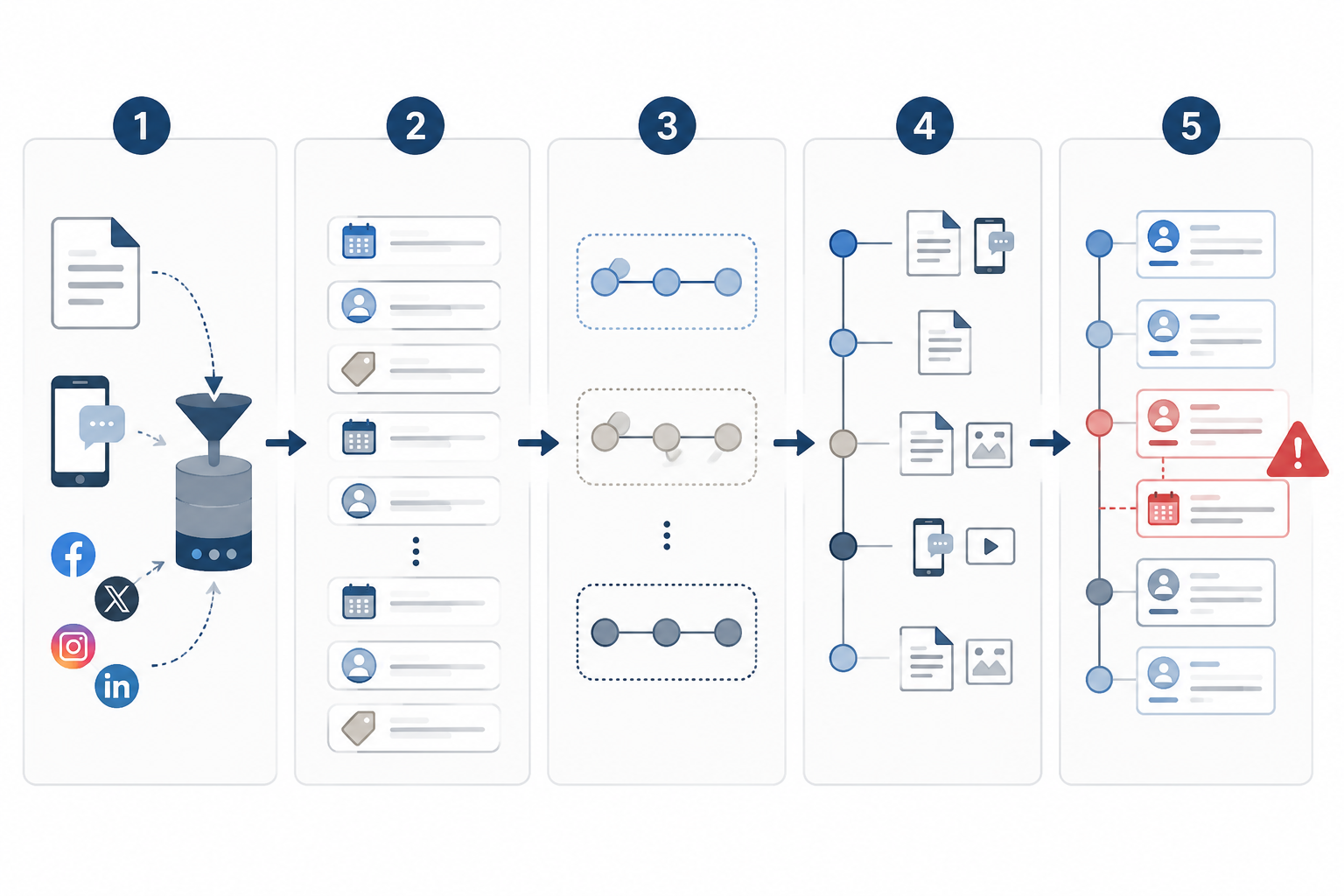
In a Nordquist-style file, the workflow would usually begin with ingestion. Messages, social posts, interview transcripts, reports, video references, body-camera logs, and extracted phone data would be loaded into a system that can read text, metadata, or both. Some media would still require transcription, indexing, or human tagging before it could become useful chronology material.
| Chronology Task | What Automation Can Help With | What Still Needs Legal Review |
|---|---|---|
| Ingest evidence | Collect text, message exports, transcripts, reports, and metadata into a searchable workspace. | Confirm collection scope, custodians, privilege handling, and whether source files are complete. |
| Extract events | Identify candidate dates, times, people, locations, message content, and described acts. | Check whether the system confused a message date with the date of the event being discussed. |
| Cluster related material | Group messages, statements, posts, and video references that appear to concern the same episode. | Separate similar incidents, distinguish speakers, and avoid merging defendants or witnesses. |
| Link sources | Attach each timeline entry to source documents, media clips, transcripts, or metadata fields. | Verify that every material assertion has a retrievable evidentiary basis. |
| Flag conflicts | Surface discrepancies between accounts, timestamps, and metadata. | Decide whether the conflict is impeachment, uncertainty, error, or irrelevant noise. |
The extraction step is where the apparent speed gains appear. Instead of assigning a paralegal to read every interview transcript and copy dates into a spreadsheet, a tool can propose entries: a described incident, the person speaking, the people named, the date stated in the transcript, and the document page or timestamp where the statement appears. In a phone-heavy file, the same process can identify message timestamps, account handles, and recurring names.
Clustering is the next useful layer. If several messages, a social media post, and a later police statement appear to describe the same alleged episode, a system can place them near each other for review. That does not prove they are the same event. It gives the reviewer a shorter path to the question that matters: are these records corroborating one another, contradicting one another, or merely using similar language?
The source link is nonnegotiable. A timeline entry that says “Defendant A sent message about incident” is not enough. The entry has to take the lawyer back to the actual message, the extraction report, the platform record, the transcript page, or the video timestamp. Without that link, the chronology becomes a persuasive writing exercise detached from the file.
The Hard Part Is Not Ordering Dates
Chronology tools are easiest to trust when the task is mechanical: sort these records by timestamp. Criminal evidence rarely stays that clean. A message sent on one day may describe something said to have happened earlier. A witness may estimate a date. A video may be reposted after the event it depicts. A fake text, if treated as ordinary message evidence, can poison the timeline at the point where the case team most needs precision.
That is why conflict detection matters more than presentation. Public reporting identifies contradictory accounts to police as a feature of the Nordquist record.[3] In a chronology platform, those contradictions should not be smoothed into a clean narrative. They should be flagged: witness statement date versus metadata timestamp; account name versus device custodian; asserted sequence versus video or body-camera reference; message content versus later interview.
For prosecutors, that can affect charging presentation, witness preparation, and disclosure review. For defense counsel, it can affect impeachment, severance analysis, plea evaluation, and investigation priorities. For both sides, it can affect whether the person reviewing the file sees the one timestamp that changes the meaning of a witness account.
This is related to, but distinct from, the Brady and discovery issues discussed in AI Discovery and Brady Compliance in the Sam Nordquist Case. Disclosure analysis asks what must be produced and when. Chronology analysis asks how the produced and collected material is organized into a working account that lawyers can test.
Resource Pressure Makes The Tools Attractive
The public-sector setting adds a practical edge. Reporting on Ontario County described the district attorney’s office as having dropped from about 20 staff members to four by the end of 2025, with Jason MacBride as the new district attorney and James Nobles as lead prosecutor in the Nordquist case.[2][6] That does not tell us what technology the office uses. It does explain why chronology automation has a real audience in criminal practice.
A small team facing a sprawling digital file has only a few options: add people, narrow the work, extend the schedule, or use tools that reduce manual sorting. AI timeline software is attractive because it promises relief at the exact point where the file becomes operationally punishing. The risk is that relief can be mistaken for reliability.
White v. Walmart And The Verification Boundary
The professional-responsibility problem is no longer limited to hallucinated case citations. In White v. Walmart, a federal court in the Southern District of Indiana imposed sanctions in April 2026 after attorneys presented an AI-generated case chronology without independent attorney verification, according to Law & Forensics’ 2026 mid-year review of digital evidence in court.[7]
That matters for chronology work because a bad timeline can be more dangerous than a bad research memo. A fake citation may be caught when opposing counsel or the court looks for the case. A misdated event can quietly shape witness preparation, opening theory, impeachment strategy, plea advice, or the sequencing of a motion. If the timeline merges two actors, omits an exculpatory inconsistency, or converts uncertain source material into a confident narrative, the error can move through the case before anyone realizes the foundation is wrong.
ABA Model Rule 1.1 requires competent representation, and Comment 8 directs lawyers to keep abreast of changes in the law and its practice, including the benefits and risks associated with relevant technology.[8] In an AI chronology setting, that competence duty has a concrete shape. A lawyer does not need to become a machine-learning engineer, but the lawyer does need to understand what the tool is extracting, what source material it can and cannot read, how it handles uncertainty, and how a human reviewer can audit each entry.
The Cyberjustice Laboratory’s April 2026 analysis of AI-generated evidence in criminal cases similarly cautions against treating AI outputs as self-validating evidence.[9] That caution fits chronology work. A timeline generated by software is not evidence. It is a work product layer built on top of evidence, and its usefulness depends on whether the links, assumptions, omissions, and conflicts remain visible.
A Safer Review Pattern For Criminal Chronologies
The safest use of AI chronology tools is to treat the first output as a draft evidentiary map. The system can propose. The lawyer verifies. That division of labor is not a slogan; it changes the workflow.
- Require every timeline entry to link back to a source document, message, transcript page, metadata field, or media timestamp.
- Separate the date of a record from the date of the event described inside the record.
- Mark uncertain entries as uncertain instead of letting the software normalize them into a confident sequence.
- Review actor names, nicknames, account handles, and device custodians before relying on clustered events.
- Preserve contradictions rather than editing them away during cleanup.
- Keep a record of who reviewed each material timeline entry and what source was checked.
A hypothetical example shows the issue without pretending to describe the Nordquist evidence. Suppose an AI tool extracts a social media post dated Friday and places an alleged confrontation on Friday. The post itself, however, says “what happened last night.” If the reviewer does not distinguish posting date from event date, the master chronology is already wrong. If the tool links the entry to the post and exposes the quoted language, the lawyer can correct it quickly.
The same discipline applies to body-camera footage and interviews. The time a recording begins is not necessarily the time of the underlying event. The time a witness gives a statement is not the time the witness claims something occurred. A chronology tool that preserves those layers can help. A timeline that collapses them into one date column can mislead.
What This Case Does Not Prove
No public source in the research record confirms that the Ontario County District Attorney’s Office, defense counsel, investigators, or any court actor used NexLaw, Paxton, Casefleet, ChronoVault, or any other AI chronology platform in the Nordquist prosecution. The case is useful here as an evidence-management stress test, not as a case study in actual tool deployment.
It also does not prove that AI timelines improve outcomes in criminal cases. Adoption and effectiveness are different questions. Vendor materials can show what products claim to do; independent research and court experience are needed before broader claims can be made about accuracy, time savings, fairness, or litigation results.
What the Nordquist prosecution does show, from the outside, is why chronology tools are becoming difficult to ignore. When a case spans months, defendants, devices, platforms, interviews, and video records, a manual timeline can become a second case file with its own error risks. AI can help build that map faster. It cannot relieve lawyers of the duty to verify the map before they rely on it.
References
- Killing of Sam Nordquist, Wikipedia.
- Quijano plea article, Finger Lakes Times, July 15, 2026.
- Evidence details in the Sam Nordquist case, syracuse.com, April 2026.
- The Master Narrative: Building Effective Case Timelines with AI, NexLaw, 2026.
- Existing AI Tools for Criminal Defense, UC Berkeley Law, 2026.
- Ontario County District Attorney staffing and Nordquist prosecution reporting, WHEC.com.
- Digital Evidence in the Courtroom: A 2026 Mid-Year Review, Law & Forensics, 2026.
- AI in the Criminal Courts, ABA Criminal Justice Magazine, Spring 2026.
- Limits of AI-generated evidence in criminal cases, Cyberjustice Laboratory, April 2026.
Comments
Join the discussion with an anonymous comment.