
After Argentina beat England in the World Cup semifinal on July 15, the image that traveled fastest was not tactical. It was legal: Argentina players on the pitch with a blue-and-white banner reading “Las Malvinas son Argentinas.” FIFA opened an inquiry, British political reaction followed, and Atlanta was left with the practical aftermath of a match already treated as a security problem before kickoff.[1][2]
That is the first point often lost in the noise around the incident. The banner did not create one dispute. It activated at least three legal planes at once: FIFA discipline for conduct inside the tournament, host-city exposure for security operations around the event, and a separate state-to-state quarrel over the Falklands/Malvinas that FIFA has no institutional power to decide.
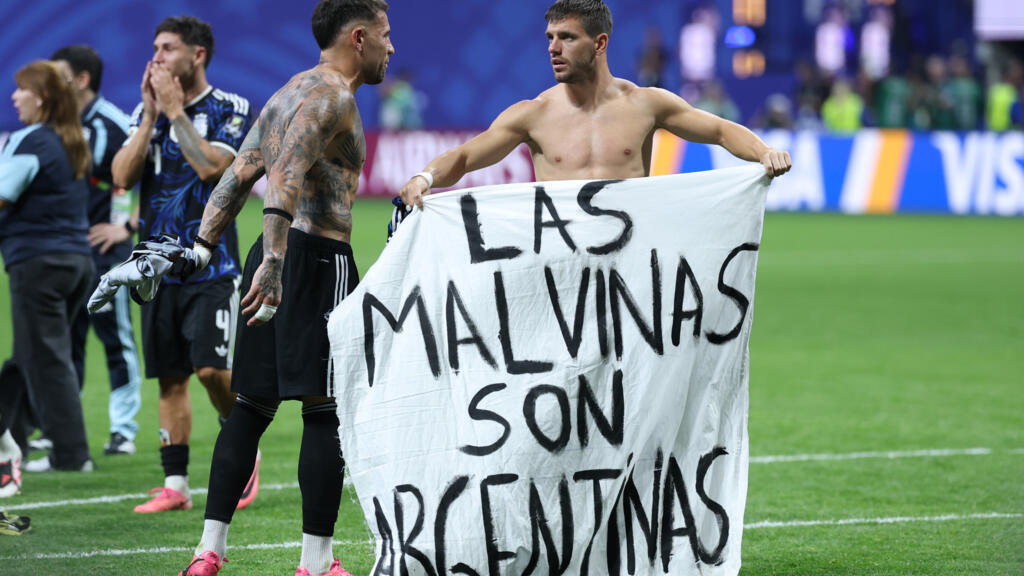
Argentina had been here before, but not in this posture. In 2014, FIFA fined the federation CHF 30,000 after Argentina players displayed the same slogan before a friendly against Slovenia.[3][4] That precedent matters because it shows FIFA has already treated the phrase as sanctionable political messaging. It does not settle the 2026 case, because a pre-tournament friendly is not a World Cup semifinal between Argentina and England, in a host city preparing for a match classified at the top of the tournament’s risk scale.
The Same Act, Three Different Forums
The cleanest way to read the incident is not by asking who was offended first. It is by asking who had authority over which part of the event.
| Legal plane | Institution with practical authority | What it can reach | What it cannot resolve |
|---|---|---|---|
| FIFA disciplinary rules | FIFA and its disciplinary bodies | Player and federation conduct, political messaging, sanctions inside football | The underlying UK-Argentina sovereignty dispute |
| Host city and security framework | Atlanta, local law enforcement, tournament organizers, and contract counterparties | Crowd management, policing costs, access control, public-safety consequences | Player discipline under FIFA rules or diplomatic responsibility |
| Public international law | States and diplomatic channels | Formal protests over maritime activity, treaty language, sovereignty positions | Stadium conduct sanctions or municipal cost allocation |
Those planes overlap factually, but not jurisdictionally. A single banner can be political expression under FIFA rules, an operational risk multiplier for a host city, and background to a diplomatic protest. No one forum carries all of those consequences.
FIFA Has the Easiest Door Into the Case
FIFA’s disciplinary route is the most visible because the conduct occurred inside the tournament space and involved participating players. The available reports point to several overlapping instruments: the Stadium Code of Conduct’s limits on political messaging, IFAB Law 4’s prohibition on equipment carrying political slogans, and the 2026 FIFA Disciplinary Code’s machinery for inappropriate messages or offensive acts.[1][2][7]
Those rules do different work. Stadium rules govern the event environment. Law 4 speaks through the language of equipment and on-field display. The Disciplinary Code supplies the sanctioning architecture, including the fine scale in Annex 1, Article 15 on offensive acts, and Article 27 discretion to suspend sanctions.[7] If FIFA proceeds, it is unlikely to be forced into a single doctrinal box.
That does not make the case simple. “Political” is doing a great deal of work here. A sovereignty slogan tied to a live territorial dispute is not the same as a generic campaign message, and the opponent was not incidental. England was the other semifinalist. The crowd controls were already designed around the Falklands/Malvinas risk. The banner therefore sits in the awkward zone between symbolic conduct and foreseeable event-management consequence.
FIFA can punish that within association law without deciding who has sovereignty over the islands. That boundary matters. A FIFA fine would say something about tournament neutrality and participant conduct. It would not say anything competent about maritime rights, territorial title, or the merits of Argentina’s diplomatic position.
The domestic free-speech lane is also narrower than public commentary often assumes. The U.S. First Amendment question is a different issue because FIFA is not normally treated as a state actor merely because a World Cup match is played in the United States. That boundary is covered more directly in the site’s earlier analysis of Andrew Giuliani’s First Amendment defense of a Falklands banner; the point here is that FIFA’s private disciplinary jurisdiction is not converted into constitutional adjudication simply because Atlanta was the venue.
Why the Balogun Episode Still Matters
The hardest legitimacy problem for FIFA is not whether it can find a rule. It is whether it can explain enforcement consistently. On July 5, 2026, FIFA’s Disciplinary Committee suspended a mandatory one-match ban for U.S. forward Folarin Balogun after evidence of a Trump-Infantino call, according to Sport Resolutions’ account of the controversy.[8]
That episode should not be overused. The full written reasoning behind the Balogun decision has not been fully published, and opacity is not proof that FIFA must decide the Argentina matter a particular way.[8] But opacity is corrosive in exactly this setting. If FIFA treats political neutrality as a bright tournament value in one case and a discretionary inconvenience in another, the legal problem becomes less about jurisdiction and more about institutional credibility.
For disciplinary panels, unequal enforcement rarely has to be perfect to be damaging. It is enough that the affected parties can point to a recent case, involving political pressure around the same tournament, where the sanctioning path appears incompletely explained. FIFA may still have authority. Authority and legitimacy are not the same asset.
Atlanta Was Managing a Risk It Did Not Create
The host-city plane is less intuitive because it does not look like the center of the controversy. It is also where the architecture shows the most strain. Before the semifinal, the FBI designated Argentina-England as the tournament’s highest-risk match. Security planning included 1,600 officers, separate fan entrances, and a Falklands-specific flag ban, with reporting that Argentina’s own Security Minister was involved in enforcing that restriction.[5][6]
Those details matter because they answer the notice question. This was not a neutral match suddenly ambushed by an obscure geopolitical reference. The relevant actors knew the Falklands/Malvinas dispute could become operational. They planned around fans, symbols, movement, and crowd separation. The banned object was not an abstraction; flags connected to the dispute were part of the security design.
Then the conduct came from the wrong side of the perimeter. The banner was not brought through a public entrance by supporters. It was displayed by players inside the controlled sporting environment after the match. That is where the host-city contract model begins to creak.
Public analyses of 2026 Host City Agreements describe an indemnification structure that can place significant financial risk for security failures and public-safety obligations on host cities, while disputes may be channeled through Swiss arbitration and while several city-specific terms remain only partially visible.[9][10] The model is familiar for mega-events: FIFA controls the competition product and imposes extensive operational requirements; the city supplies infrastructure, policing, permitting, and emergency capacity.
That bargain is already asymmetrical. It becomes harder to justify cleanly when the risk does not originate from ordinary spectators, protestors, or external disruption. A player display inside FIFA’s competition environment can increase the very security pressures that the city must manage outside the technical area. If additional policing, separation, transport controls, or post-match response become necessary, the city may absorb consequences generated by conduct it neither authorized nor controlled.
This is not an argument that Atlanta had no responsibility. Host cities agree to carry serious event-management obligations, and public safety cannot pause while lawyers sort institutional causation. The narrower point is that the indemnification model is better at allocating external-threat risk than participant-generated political risk. It can tell a city to bear costs without giving that city meaningful control over the player conduct that helped produce them.

The handoff is easy to miss because the public story stays on the banner. In contract terms, the harder question is who priced the risk. FIFA’s rules make federations responsible for conduct. Host-city agreements make cities responsible for much of the event environment. Security agencies classify threats and deploy resources. When a participating team turns a known diplomatic dispute into a stadium incident, those categories no longer map neatly onto the costs.
The Diplomatic Protest Belongs Somewhere Else
The third plane is public international law, and it should not be folded into FIFA discipline just because the same sovereignty dispute supplies the language. Argentina’s foreign ministry issued a formal diplomatic note on July 13 protesting the UK warship HMS Medway’s transit near the Falklands/Malvinas, invoking UNCLOS Article 19 on innocent passage and the 2016 bilateral accord.[6]
That protest is legally relevant to the World Cup story only in a limited sense. It shows that the banner did not appear against a quiet diplomatic backdrop. There was an active state-to-state dispute moving through foreign-ministry channels at the same time as the tournament controversy. But the protest does not give FIFA jurisdiction over maritime passage, and FIFA’s disciplinary code cannot adjudicate the UK’s naval activity.
The converse is also true. A diplomatic note over HMS Medway does not decide whether Argentina’s players violated tournament rules. Public international law can preserve claims, register objections, and frame state conduct. It cannot tell FIFA how to apply Law 4 to a post-match banner or determine whether Atlanta should bear incremental policing costs under event agreements.
Keeping the planes separate is not pedantry. It is the only way to avoid turning every World Cup symbol into a substitute sovereignty hearing. The Falklands/Malvinas dispute may explain why the banner was powerful. It does not mean the proper forum for every resulting consequence is the same.
Where the Architecture Fails
The semifinal exposes a governance gap rather than a missing rule. FIFA has rules. Atlanta had security plans. Argentina and the United Kingdom have diplomatic channels. The problem is that none of those systems is designed to account for the others in a disciplined way.
FIFA can fine a federation, suspend a sanction, or open proceedings under its disciplinary code. That may express tournament neutrality, but it does not reimburse a city for security burdens unless a separate contractual mechanism does that work. The city can deploy police, separate fans, restrict symbols at entrances, and manage public space. That does not give it authority over the private sporting sanctions that shape team incentives. States can protest naval movements and preserve legal positions. That does not discipline players or allocate municipal costs.
Mega-events often produce this kind of fragmented accountability. The site’s companion analysis of World Cup AI regulation gaps deals with a different technology problem, but the institutional pattern is similar: a tournament creates a concentrated risk environment, while authority is split among private regulators, public agencies, contractors, and states.
The Falklands banner is sharper because the handoffs were visible. The match was identified as highest risk. The flag issue was specific enough to be operationalized at entrances. FIFA retained control over the sporting environment. The players, not fans, produced the act. A parallel diplomatic protest was already alive outside the stadium. Each institution can point to the edge of its mandate and be partly right.
That is the structural lesson of the semifinal. FIFA can discipline, the host city can be left managing security consequences, and states can continue their legal protests, but the architecture does not turn those consequences into one accountable process. The banner crossed the seams. The law did not.
References
- Argentina Falklands banner investigated by FIFA, BBC Sport.
- England-Argentina World Cup Falkland Islands Malvinas, AP News.
- Keir Starmer Calls For FIFA To Investigate Argentina Over Controversial Falklands Banner, Forbes, July 16, 2026.
- Argentina risks FIFA sanction over Falklands banner: rules, history and what comes next, AS.com.
- Argentina-England match Falkland Islands, The National, July 15, 2026.
- Hours after World Cup clash, Argentina protests UK warship movement near Malvinas, Buenos Aires Times.
- FIFA Disciplinary Code 2026 Changes, FIFA Sports Agent Institute.
- FIFA Political Neutrality Questioned After Balogun Ban Suspension, Sport Resolutions.
- The 2026 FIFA World Cup Host City Agreement: A Legal Analysis, Mondaq/OAL.
- The Legal Realities Behind FIFA 2026 World Cup Agreements Amid Public Safety Concerns, Felicello Law, October 27, 2025.
Comments
Join the discussion with an anonymous comment.