
The Legal AI Trust and Governance Gap: Why Startups Are Flourishing While Institutional Readiness Lags
Legal AI startup funding and adoption are at all-time highs in 2026, but the institutional infrastructure for responsible AI use is dangerously underdeveloped. This article analyzes the governance gap for risk officers, managing partners, and in-house counsel, backed by multi-source survey data and the ABA ethical framework.
- Hallucination rate
- Not measured / undisclosed
The Adoption Paradox: 69% Using AI vs. Institutional Deficits
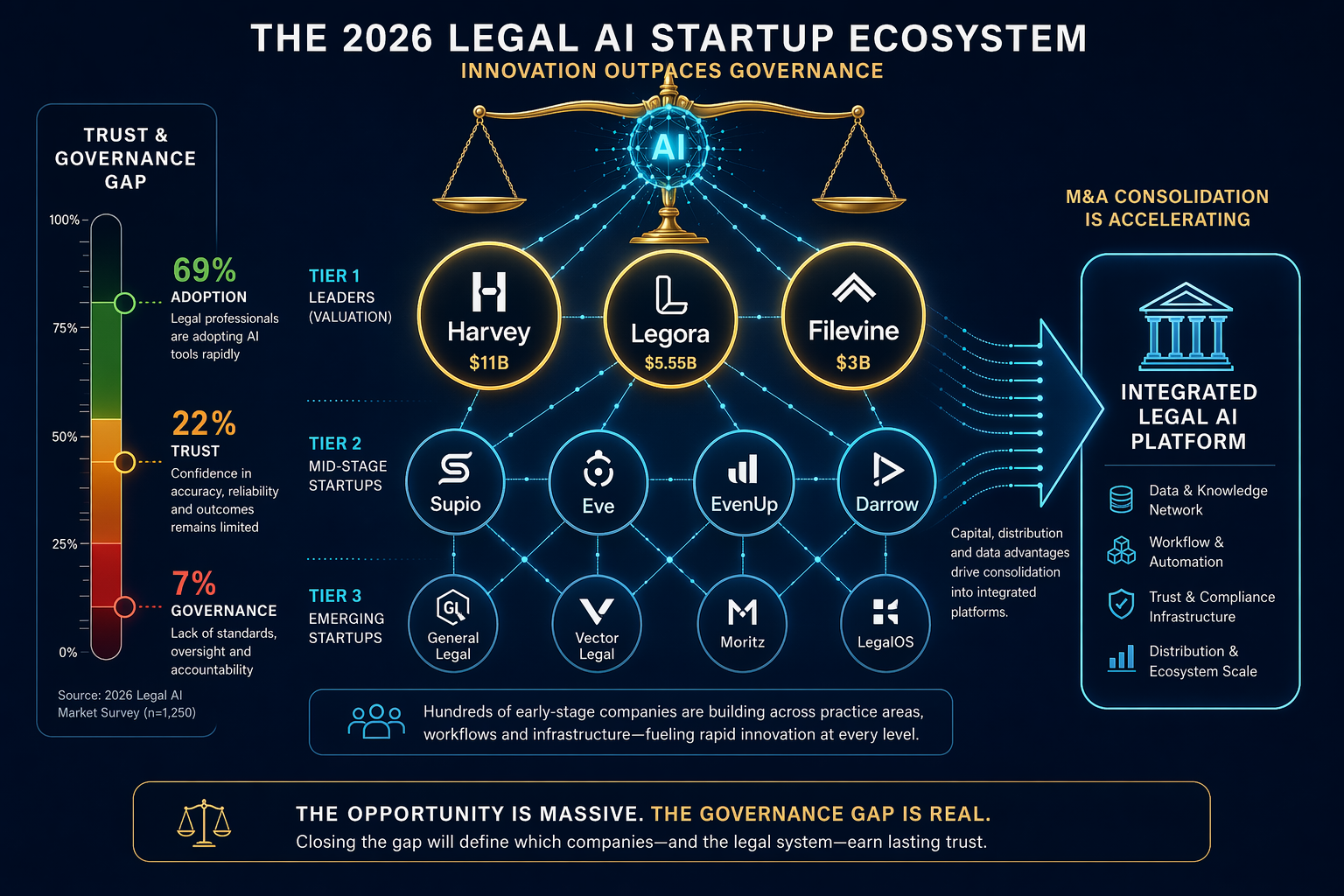
The legal profession has crossed an inflection point that few predicted would arrive this quickly. According to the 8am 2026 Legal Industry Report, which surveyed over 1,300 legal professionals, 69% now use generative AI for work — more than double the 31% recorded in 2025. Daily use has reached 28%, and 59% of respondents report using AI at least weekly. The tools are no longer experimental curiosities; they are embedded into the daily workflow of a majority of practitioners.
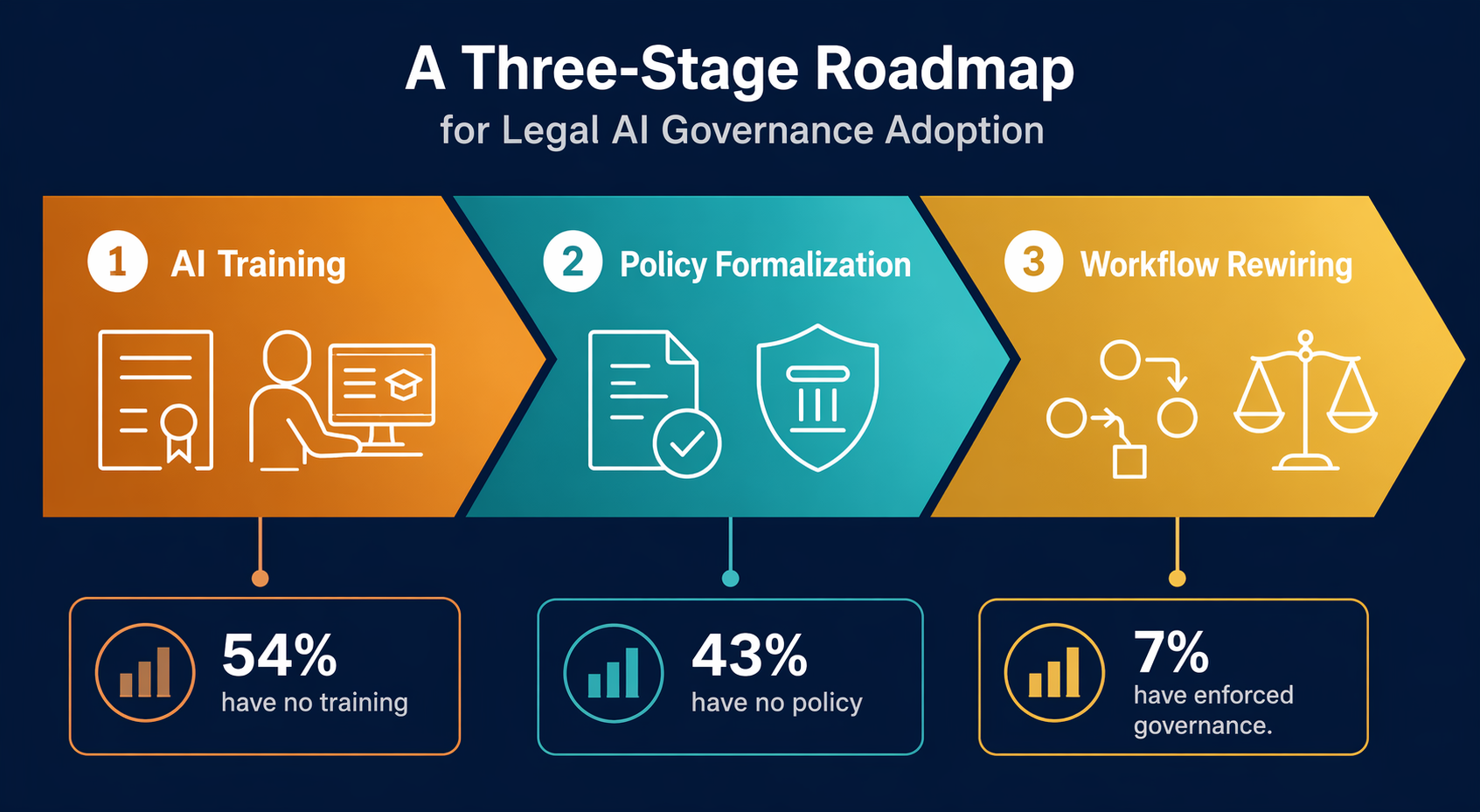
Yet this rapid adoption has not been accompanied by a corresponding investment in the institutional infrastructure that responsible AI use requires. The same 8am report found that 54% of firms provide no AI training and have no plans to provide any. A separate 43% of firms have no formal AI policy whatsoever. The adoption curve is steep, but the governance curve is nearly flat.
This paradox creates a specific kind of risk for the professionals who are accountable for it. Managing partners, risk officers, and in-house counsel are being asked to reconcile two conflicting pressures: the competitive necessity of AI adoption — driven by clients, peers, and the startup ecosystem — and the professional responsibility obligations that require competence, diligence, and supervision over every tool used in legal practice. The tension between these forces is the central story of legal AI in 2026.
The Trust Data: Why Confidence Has Not Kept Pace with Access
The Factor 2026 GenAI in Legal Benchmarking Report, based on 204 survey responses (roughly 60% from in-house teams and 40% from law firms), provides the clearest window into the trust deficit. While 82.7% of respondents now have broad access to AI — up more than 20 percentage points from the prior year — only 22.1% report high trust in generative AI outputs. Just 32.1% say they are very confident using AI for legal work.
The gap between access and confidence is not a curiosity — it has direct financial consequences. The Factor report found that 89.5% of high-trust teams had seen positive ROI from AI investments, compared to only 27.8% of low-trust teams. Trust is not a soft metric; it is a leading indicator of whether an organization can actually capture value from the tools it has purchased.
The Consilio 2026 Global Survey, which drew from a 50/50 split of corporate legal and law firm respondents, reinforces this picture. 58% of respondents cited accuracy and lack of trust as the biggest blocker to broader AI use. The same survey found that 73% of legal professionals say their top concern is incorrect or hallucinated outputs — AI-generated content that is fabricated or factually wrong.
| Metric | Source | Value |
|---|---|---|
| Broad access to gen AI | Factor 2026 Report (204 respondents) | 82.7% |
| High trust in AI outputs | Factor 2026 Report | 22.1% |
| Very confident using AI for legal work | Factor 2026 Report | 32.1% |
| Positive ROI among high-trust teams | Factor 2026 Report | 89.5% |
| Positive ROI among low-trust teams | Factor 2026 Report | 27.8% |
| Accuracy/trust as biggest blocker | Consilio 2026 Survey (50/50 in-house/law firm) | 58% |
| Hallucinated outputs as top concern | Consilio 2026 Survey | 73% |
The Governance Data: 7% Enforced Frameworks, 54% No Training
If the trust data reveals a confidence problem, the governance data reveals a structural one. The Consilio survey found that only 7% of legal organizations have a documented AI governance framework that is actively followed. A further 14% have no formal AI governance in place at all. The remaining organizations fall somewhere in between — they may have a policy document, but it is not enforced, not updated, or not understood by the people who need to follow it.
The 8am report paints a similar picture from a different angle. Beyond the 54% of firms that offer no AI training, the survey found that 43% of firms have no formal AI policy. Only 9% have an actively enforced policy. These numbers are not merely disappointing — they are professionally dangerous when set against the ethical obligations that govern legal practice.
The governance gap is particularly acute in the context of the contract review workflow, where AI tools are being deployed to analyze, redline, and summarize agreements that carry direct financial and legal consequences. Without governance frameworks, the risk of undetected errors compounds across every document processed.
| Governance Metric | Source | Value |
|---|---|---|
| Actively enforced AI governance framework | Consilio 2026 Survey | 7% |
| No formal AI governance in place | Consilio 2026 Survey | 14% |
| Firms providing no AI training | 8am 2026 Report (1,300+ respondents) | 54% |
| Firms with no formal AI policy | 8am 2026 Report | 43% |
| Firms with actively enforced AI policy | 8am 2026 Report | 9% |
The Ethical Framework: What ABA Formal Opinion 512 Requires
The ethical obligations governing AI use in legal practice are not new. In July 2024, the American Bar Association issued Formal Opinion 512, which made explicit what many practitioners had already begun to suspect: the duties of competence, diligence, confidentiality, and supervision apply fully to AI-assisted legal work. There is no AI exception to the duty of technology competence under Model Rule 1.1.
Opinion 512 establishes several concrete obligations. Lawyers must understand the capabilities and limitations of the AI tools they use — not merely how to operate them, but how they generate outputs and where they are likely to fail. They must review AI-generated work product with the same diligence they would apply to work produced by a human associate or paralegal. They must ensure that client confidential information is protected when transmitted to or processed by AI systems. And they must supervise the use of AI by non-lawyer staff within the firm.
The governance data from 2026 suggests that these obligations are not being operationalized. When 43% of firms have no formal AI policy, and 54% provide no training, the question is not whether a firm is complying with Opinion 512 — it is whether the firm has even begun to assess what compliance would require. The ethical framework exists. The institutional infrastructure to implement it does not.
How Legal AI Startups Are Responding — and What They Are Not Addressing
While institutional governance lags, the legal AI startup ecosystem is experiencing a funding boom of historic proportions. At Stanford Law School's CodeX Future of Law conference in April 2026, executives from the leading AI-native legal startups reported record valuations. Harvey AI raised $200 million at an $11 billion valuation in March 2026. Legora tripled its valuation to $5.55 billion after a $550 million investor round. Filevine is valued at approximately $3 billion.
These startups are responding to the trust and governance gap in several ways. Many are racing to add agentic AI capabilities — systems that can execute multi-step legal workflows autonomously rather than simply answering isolated queries. Others are pursuing enterprise security certifications (SOC 2 Type II, ISO 27001) and building partnership models with established legal technology platforms to signal reliability.
- Agentic AI features: Startups are building systems that can draft pleadings, review contracts across multiple stages, and manage compliance workflows without human intervention at every step.
- Enterprise security certifications: SOC 2 Type II and ISO 27001 compliance are becoming table stakes for any startup targeting law firm or in-house legal department clients.
- Partnership models: AI-native startups are forming integration partnerships with CLM platforms (Ironclad, Icertis) and practice management systems (Clio, NetDocuments) to embed within existing workflows.
- Data privacy commitments: Several vendors now offer zero-data-retention policies or on-premises deployment options to address confidentiality concerns under Model Rule 1.6.
However, these responses address technical and security concerns — they do not solve the institutional governance gap. A startup can provide the most accurate model and the most secure deployment architecture, but it cannot train a firm's lawyers, write a firm's AI policy, or embed human verification steps into a firm's workflow. As Gabe Pereyra of Harvey noted at the CodeX conference, regulations on AI-delivered legal advice exist for good reasons and "place responsibility on a human, and no model is right every time."
For a detailed analysis of how a leading AI platform addresses — and does not address — the governance gap, see our Harvey AI risk profile.
The Liability Exposure for Firms Without Policies
The governance gap is not an abstract risk. Courts have already demonstrated a willingness to sanction attorneys for AI-generated citation errors, and the trajectory of those sanctions is escalating. The AI hallucinations and attorney ethics risk digest documents multiple cases where lawyers have been sanctioned — in some cases ordered to pay opposing counsel's fees — after submitting briefs containing fabricated citations generated by AI tools.
The liability exposure extends beyond citation errors. Firms that deploy AI tools without adequate training and supervision face potential malpractice claims if an AI-generated error causes client harm. Ethics complaints are a growing risk: bar associations in multiple states have begun investigating attorneys for AI-related misconduct, and the ABA's Formal Opinion 512 provides a clear framework for evaluating whether a lawyer's use of AI meets the standard of care.
The startup marketing narrative — that AI tools are safe, accurate, and ready for unsupervised use — does not address this liability exposure. A vendor's terms of service typically disclaim all liability for AI-generated outputs. The professional responsibility burden falls entirely on the lawyer or firm that uses the tool. When 43% of firms have no policy governing that use, the exposure is not hypothetical.
A Practical Roadmap for Legal Leaders: Training, Policy, and Workflow Rewiring
The data from the Factor report offers a clear signal about what works: high-trust teams invest in training and workflow re-engineering. The 89.5% ROI rate among high-trust organizations is not an accident — it is the result of deliberate institutional investment. Legal leaders who want to close the governance gap can follow a structured path.
1. Mandatory AI Training Programs
The most immediate gap to close is the training deficit. With 54% of firms providing no AI training, the baseline is low — but so is the bar for meaningful improvement. Effective training programs do not need to be expensive or time-consuming. They need to cover three things: how the firm's AI tools work (including their limitations), how to verify AI-generated outputs, and how to identify and escalate potential errors.
- Tool-specific training: Every lawyer and paralegal who uses an AI tool should understand its underlying model type, its known failure modes, and the specific verification steps required for their workflow.
- Error identification training: Practitioners should be trained to recognize common AI error patterns — fabricated citations, incorrect legal standards, plausible-sounding but wrong statutory references.
- Escalation protocols: Clear procedures for what to do when an AI error is detected, including documentation requirements and supervisory review.
2. Formal AI Policy Development
Moving from 43% no-policy to enforceable governance requires a policy that addresses the specific obligations under ABA Formal Opinion 512. The policy should define which AI tools are approved for use, what types of work they can be used for, what verification steps are required before AI-generated work product is submitted to a client or court, and how data confidentiality will be maintained.
| Policy Element | What It Should Address | ABA Obligation |
|---|---|---|
| Approved tools list | Which AI products are authorized for firm use | Duty of competence (Rule 1.1) |
| Permitted use cases | What types of work AI can and cannot be used for | Duty of supervision (Rule 5.1) |
| Verification requirements | Mandatory human review steps before submission | Duty of diligence (Rule 1.3) |
| Data handling rules | How client data is protected when using AI | Duty of confidentiality (Rule 1.6) |
| Error reporting | Procedures for documenting and escalating AI errors | Duty of supervision (Rule 5.1) |
3. Workflow Rewiring with Human Verification
The Factor report found that high-trust teams were more likely to have redesigned their workflows around AI — not simply added AI tools to existing processes. This workflow rewiring is the most impactful step a firm can take. It means identifying the specific points in each workflow where AI can add value, where it introduces risk, and where human judgment is irreplaceable.
In practice, this often means creating structured human verification checkpoints. For example, in a contract review workflow, the AI might flag unusual clauses and suggest alternative language, but a senior attorney must review every flagged clause before the contract is executed. In legal research, the AI might surface relevant cases, but every citation must be Shepardized or KeyCited before it appears in a brief.
Outlook: Closing the Gap in 2027 and Beyond
The governance gap will not close on its own. The forces that created it — rapid adoption without institutional preparation, startup marketing that emphasizes capability over limitation, and the absence of clear regulatory mandates — will persist until external pressure forces change.
Several developments are likely to accelerate governance adoption. State bar associations are increasingly issuing guidance on AI use, and court AI disclosure rules are becoming more common. Malpractice insurers are beginning to ask about AI governance during underwriting, and firms without policies may face higher premiums or coverage exclusions. The ROI data from high-trust teams — 89.5% positive ROI versus 27.8% — provides a business case that is difficult to ignore.
The firms that invest in governance now — training their people, formalizing their policies, and rewiring their workflows — will have a competitive advantage in the years ahead. They will be able to adopt new AI capabilities faster because their institutional infrastructure is ready. They will face lower liability exposure because their verification processes are embedded. And they will capture more value from their AI investments because their teams trust the tools enough to use them effectively.
The legal AI startup ecosystem will continue to flourish. The question is whether the institutions that deploy those tools will catch up.
Chronological incident history
No sanction cases have named this tool in the tracked record set to date. This does not imply the tool is safe — see Risk Digest for ongoing monitoring.
← Compare peer toolsReport a correction or tip
Spotted an outdated figure, a misstated fact, or a ruling this tool profile should reflect? Public comments are disabled for this content given the professional cost of a misreported case outcome, penalty amount, or rule text — use the structured correction channel instead.
Report a correction or tip for this record →