
The practical shock of Louisiana v. Callais is not that Section 2 plaintiffs lost one Louisiana congressional map. It is that the Supreme Court changed what a vote-dilution plaintiff must build before the case can do the work Section 2 cases used to do. After Callais, showing that a politically cohesive minority community is large and compact enough to form an additional effective district is no longer enough if the illustrative map does not also satisfy the state’s legitimate districting objectives without using race as a criterion. Nor is it enough to show racially polarized voting if party affiliation can explain the same pattern. And the familiar totality-of-circumstances inquiry now has to center on present-day intentional discrimination rather than the broader effects record that had carried Section 2 cases since the 1982 amendments.
That matters immediately in Louisiana. The map at issue created a second majority-Black congressional district after earlier litigation over whether Louisiana’s prior map diluted Black voting strength. The decision now affects not only the Cleo Fields Louisiana redistricting legal challenges but the way lawyers will plead, model, and defend Section 2 cases elsewhere. Amy Howe’s SCOTUSblog analysis identifies the majority’s three main moves: a stricter illustrative-map requirement, a party-control requirement for racial bloc voting evidence, and a narrowed totality inquiry focused on present-day intentional discrimination.[1]
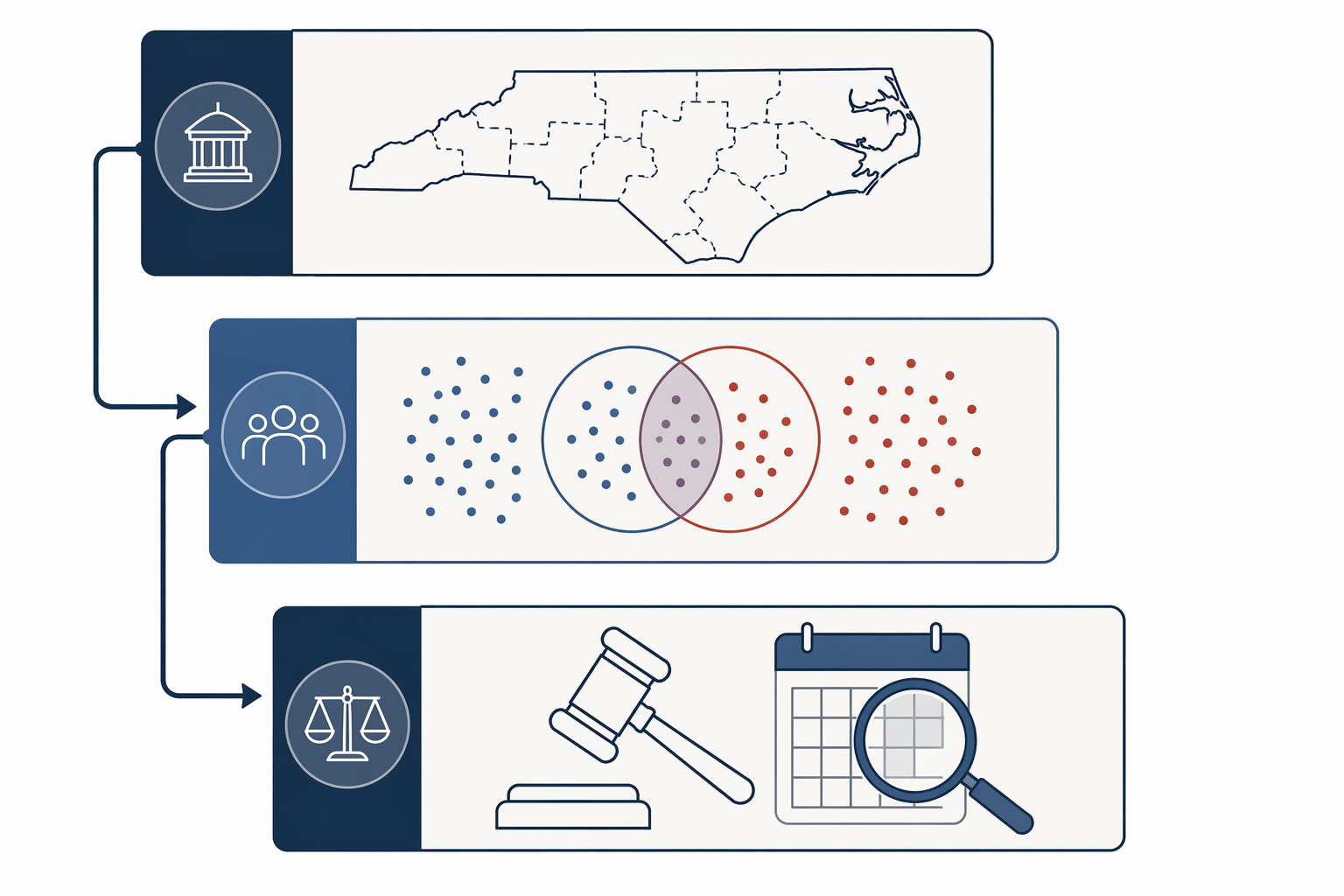
The New Sequence After Callais
Before Callais, Section 2 litigation usually began with Thornburg v. Gingles: the minority group had to be sufficiently large and geographically compact to constitute a majority in a reasonably configured district; it had to be politically cohesive; and the majority had to vote sufficiently as a bloc usually to defeat the minority’s preferred candidate. If those preconditions were met, courts moved to the totality of circumstances, where history, electoral opportunity, socioeconomic conditions, candidate success, and other evidence could matter.
Callais does not formally erase that structure. It makes each disputed part harder to satisfy. The Brennan Center describes the case as part of the Court’s continuing reconsideration of Section 2’s role in redistricting, particularly after Allen v. Milligan reaffirmed the Gingles framework only a few years earlier.[2] The difference is that Callais asks questions that often arrive before plaintiffs can benefit from the old totality record.
| Issue | Before Callais | After Callais |
|---|---|---|
| Illustrative map | A plaintiff used a reasonably configured alternative district to show that an additional effective minority district could be drawn. | The map must satisfy all legitimate state districting objectives, including partisan distribution and incumbent protection, without using race as a criterion. |
| Racial bloc voting | Plaintiffs often relied on election analysis showing that minority and majority voters preferred different candidates. | Plaintiffs must account for party affiliation when race and party preference are correlated. |
| Totality of circumstances | Historical discrimination, socioeconomic disparities, and electoral conditions could support an effects-based dilution claim. | The inquiry must focus on present-day intentional racial discrimination, reducing the force of generalized historical and socioeconomic evidence. |
The combined effect is more important than any single line in the opinion. A plaintiff who survives the map-design challenge may still lose because the bloc-voting proof is treated as partisan rather than racial. A plaintiff who clears both hurdles may still find that the totality evidence has been narrowed to something closer to an intent record. That is why calling Callais simply a “racial gerrymandering” case misses the part practitioners have to live with.
Illustrative Maps Now Carry the State’s Objectives Too
The first change will be felt in expert reports before it is felt in appellate briefs. The majority’s account, as summarized by SCOTUSblog, requires a Section 2 plaintiff’s illustrative map to comply with all legitimate state districting objectives, including partisan distribution and incumbent protection, without race operating as a criterion.[1] That is not a modest instruction to draw tidy districts. It turns the illustrative map from a compactness demonstration into a full alternative plan that must anticipate the state’s entire remedial defense.
Traditional Gingles compactness already asked whether the minority population could form a reasonably configured district. But Callais adds a different kind of burden. The plaintiff must now show that the additional effective district can be drawn while honoring the state’s asserted political and institutional choices. If the state says it protected incumbents, preserved a partisan distribution, avoided pairing members, or followed a particular configuration principle, the plaintiff’s map must be prepared to satisfy those objectives too.
That matters because partisan distribution is not just another line-drawing preference. Since Rucho v. Common Cause, federal courts do not adjudicate partisan gerrymandering claims as justiciable federal constitutional claims. Callais now asks Section 2 plaintiffs to build illustrative maps that respect partisan objectives federal courts generally will not police directly. The sources do not resolve how lower courts will manage that tension. The problem is not theoretical: if partisan design is both insulated from direct federal attack and available as a reason to reject a Section 2 illustrative map, the plaintiff’s first Gingles showing becomes entangled with a political objective the statute was not originally built to absorb.
Incumbent protection creates a similar litigation problem. It may be a legitimate districting objective, but it is also intensely fact-specific. A plaintiff’s expert now has to know not only where voters live and how they vote, but which incumbents the state sought to protect, how the enacted map protected them, whether the alternative map disrupts that protection, and whether a different configuration could preserve it. That turns map construction into a record-building exercise about legislative purpose and political baseline.
The no-race-as-criterion instruction is the hardest piece to square with Section 2 practice. Vote-dilution plaintiffs bring claims because race and electoral opportunity are central to the injury. Yet the illustrative map must now show the possibility of an additional effective district without using race as a criterion in constructing it. The Court’s formulation forces plaintiffs into a careful expert posture: race can explain the claim, but if it appears to drive the map, the map itself becomes vulnerable.
Defendants will know where to press. They can challenge the plaintiff’s alternative plan as insufficiently attentive to partisan goals, incumbent pairings, continuity of representation, or other state criteria. They can argue that the map’s racial performance reveals race-based sorting. They can demand simulations or alternative plans showing that the plaintiff’s configuration emerges from neutral criteria rather than racial targeting. Plaintiffs, in turn, will need more than one attractive illustrative map; they will need a defensible account of why the map satisfies the state’s own objectives better than the state says it does.
Racial Bloc Voting Must Now Survive the Party Problem
The second change goes to the heart of racial vote-dilution proof. In many jurisdictions, race and party preference are highly correlated. Before Callais, plaintiffs could use racially polarized voting analysis to show that minority voters were politically cohesive and that majority voters usually defeated their preferred candidates. After Callais, that proof must account for party affiliation; if the pattern can be explained as partisan rather than racial, the Section 2 claim is in trouble.[1]
This is where the doctrinal shift is easy to understate. Racial bloc voting analysis has always involved statistical inference. Experts look at election returns, demographic data, precinct-level patterns, ecological inference, homogeneous precinct analysis, and related methods to estimate how racial groups voted. Callais does not merely ask experts to be more careful. It changes the legal significance of a familiar empirical reality: where minority voters heavily support one party and white voters heavily support another, correlation no longer carries the same Section 2 weight unless the plaintiff can disentangle race from party.
The Harvard Kennedy School analysis frames Callais as a major shift toward an intent-centered Voting Rights Act regime, and the race-party requirement is one reason why.[3] If the defendant can characterize electoral defeat as partisan competition rather than racial exclusion, the plaintiff must prove more than divergent candidate preference by racial group. The plaintiff must show that race, not only party, explains the defeat of minority-preferred candidates in the legally relevant way.
There is a practical difficulty here that no doctrinal label solves. Party affiliation is not an independent laboratory variable. In many places it reflects, channels, or is reinforced by racialized political experience. A model that “controls for party” may remove from the race variable some of the very political reality Section 2 was meant to capture. But after Callais, plaintiffs cannot simply object that race and party are intertwined. They need expert testimony explaining why the remaining evidence still shows legally cognizable racial bloc voting.
For plaintiffs, that means election selection becomes more important. Endogenous elections, primary elections, biracial contests, contests with cross-party minority-preferred candidates, and other elections that might help separate racial preference from partisan affiliation will receive heavier pressure. For defendants, the obvious move is to argue that the plaintiff’s preferred candidates lose because of party sorting, not racial vote dilution. That argument is now more than a merits theme; it is built into the plaintiff’s evidentiary burden.
The Brennan Center’s treatment of Section 2 helps explain why this is such a large change inside a familiar framework. Gingles did not ask whether white voters opposed minority-preferred candidates for racially hostile reasons. It asked whether bloc voting usually defeated minority political choice under the totality of circumstances.[2] Callais makes the causation inquiry more demanding at the bloc-voting stage, before the broader record can do as much work.
The Totality Inquiry Narrows Toward Present-Day Intent
The third change is conceptually the largest, even if it may not consume the most expert hours. Callais directs courts to focus the totality-of-circumstances inquiry on present-day intentional racial discrimination, giving substantially reduced weight to historical discrimination and generalized socioeconomic disparities.[1] Courthouse News described the decision as “further eroding the Voting Rights Act,” a characterization that captures the civil-rights reaction but not the full doctrinal mechanism.[4]
The mechanism matters because Section 2’s modern form was built to avoid an intent-only regime. Justice Kagan’s dissent, discussed in the Harvard Kennedy School analysis, argued that the majority revived the kind of intent-based standard Congress rejected when it amended the Voting Rights Act in 1982.[3] That is not just rhetoric. It identifies the statutory problem: Section 2 liability had turned on discriminatory results, assessed through a structured inquiry, rather than requiring plaintiffs to prove current discriminatory purpose.
Still, “intent-based” needs precision. The majority did not announce that Section 2 contains only an intent test. It reached that result functionally by reducing the weight of evidence that had made effects claims viable: historical official discrimination, racial disparities in political participation, socioeconomic conditions linked to past exclusion, and the broader Senate-factor record. Those facts may not disappear from the case file, but they no longer carry the same load unless tied to present-day intentional discrimination.
That shift changes discovery. Plaintiffs will look harder for contemporary legislative records, map-drawing communications, departures from ordinary procedures, stated and unstated districting goals, and evidence that current officials selected lines because of racial consequences. Defendants will work to keep the case on neutral criteria: partisanship, incumbency, geography, communities of interest, compliance with other legal constraints, and ordinary political compromise. The old totality record may still provide context, but context is no longer the same thing as proof.
Why the Compelling-Interest Holding Does Not Solve the Problem
Callais also leaves a paradox that lower courts will have to administer. The Court recognized, for the first time, that compliance with Section 2 can be a compelling governmental interest under strict scrutiny, but it held that Louisiana’s remedial map was not justified because Section 2, properly interpreted, did not require that map.[1] In ordinary litigation terms, the state won the category and lost the application.
That sounds cleaner than it is. If Section 2 compliance can justify race-conscious districting only when the state has correctly identified a genuine Section 2 violation under Callais, then states face risk on both sides. Draw a remedial district too aggressively, and the map may be attacked as an unconstitutional racial gerrymander. Decline to draw one, and the state may still face a Section 2 vote-dilution suit. The space between those risks is now narrower and more fact-intensive.
For state lawyers, that means the pre-enactment record becomes critical. A state considering a race-conscious remedy will need evidence that the Gingles preconditions, the new party-control requirement, the state-objective map requirement, and the present-day discrimination inquiry are all satisfied. For plaintiffs, the same point cuts the other way: a state’s refusal to draw an additional opportunity district may now be defended by pointing to any one of those unresolved predicates.
The Mandate Fight Was Not the Merits, but It Was Not Nothing
The post-decision mandate dispute should not be mistaken for the doctrinal center of Callais. It is a legitimacy consequence. On May 4, 2026, the Court issued an expedited order sending the case back ahead of the midterms; Justice Jackson dissented and warned about the “appearance of partiality.”[5] Politico’s account places that order in the immediate election-calendar setting, where timing can decide whether a remedial map exists in practice even when the formal legal dispute continues.[5]
Election lawyers are used to timing doing substantive work. Filing deadlines, candidate qualification periods, ballot printing, Purcell arguments, remedial hearings, and appellate stays can make a nominally procedural order decisive. Jackson’s concern belongs there: not as proof that the majority’s Section 2 analysis is wrong, but as a warning that accelerated implementation in redistricting cases can make the Court look less like a court and more like a participant in the election calendar.
The Next Cases Will Test the Edges
The immediate doctrinal consequences are clear enough for litigators to adjust their files. Plaintiffs need alternative maps that satisfy the state’s asserted objectives, expert proof that separates race from party where possible, and present-day evidence that can survive a narrower totality inquiry. Defendants now have new pressure points: attack the illustrative map, recast bloc voting as partisan sorting, and insist that historical and socioeconomic evidence cannot substitute for current intentional discrimination.
The outer boundary is less settled. NPR reported in May 2026 that 17 active lawsuits faced new barriers after the decision, including disputes beyond congressional line-drawing.[6] But few lower courts have yet resolved how far Callais extends in local redistricting, at-large election systems, and other Section 2 settings where the map-drawing problem may look different from a statewide congressional plan.[6]
That uncertainty is not a reason to soften the professional takeaway. In Louisiana congressional map legal challenges and other redistricting cases after Callais, Section 2 plaintiffs cannot rely on the old sequence of compact illustrative district, racially polarized voting, and broad totality evidence as though each piece still carries the same legal force. The work has moved earlier, deeper, and closer to intent. Lower courts will decide how far the new standard reaches, but the burden has already moved.
References
- In major voting rights act case, Supreme Court strikes down redistricting map challenged as racial gerrymander — Amy Howe, SCOTUSblog, April 29, 2026
- Section 2 of the Voting Rights Act at the Supreme Court — Brennan Center for Justice, updated April 29, 2026
- What Louisiana v. Callais Means for the Voting Rights Act — Harvard Kennedy School, April 30, 2026
- Supreme Court strikes down Louisiana congressional map, further eroding Voting Rights Act — Courthouse News, April 29, 2026
- Supreme Court clears way for Louisiana to redistrict ahead of midterms — Politico, May 4, 2026
- How the Voting Rights Act ruling affects local redistricting — NPR, May 18, 2026
Comments
Join the discussion with an anonymous comment.