
A legal and historical analysis of a Charles Manson documentary can easily become another tour through spectacle: the forehead carving, the courtroom lunges, the loyal co-defendants, the presidential sound bite, the vanished lawyer. Those facts are dramatic, but in the trial record they are not merely atmosphere. Each one pressed on a rule that had to do work in real time.
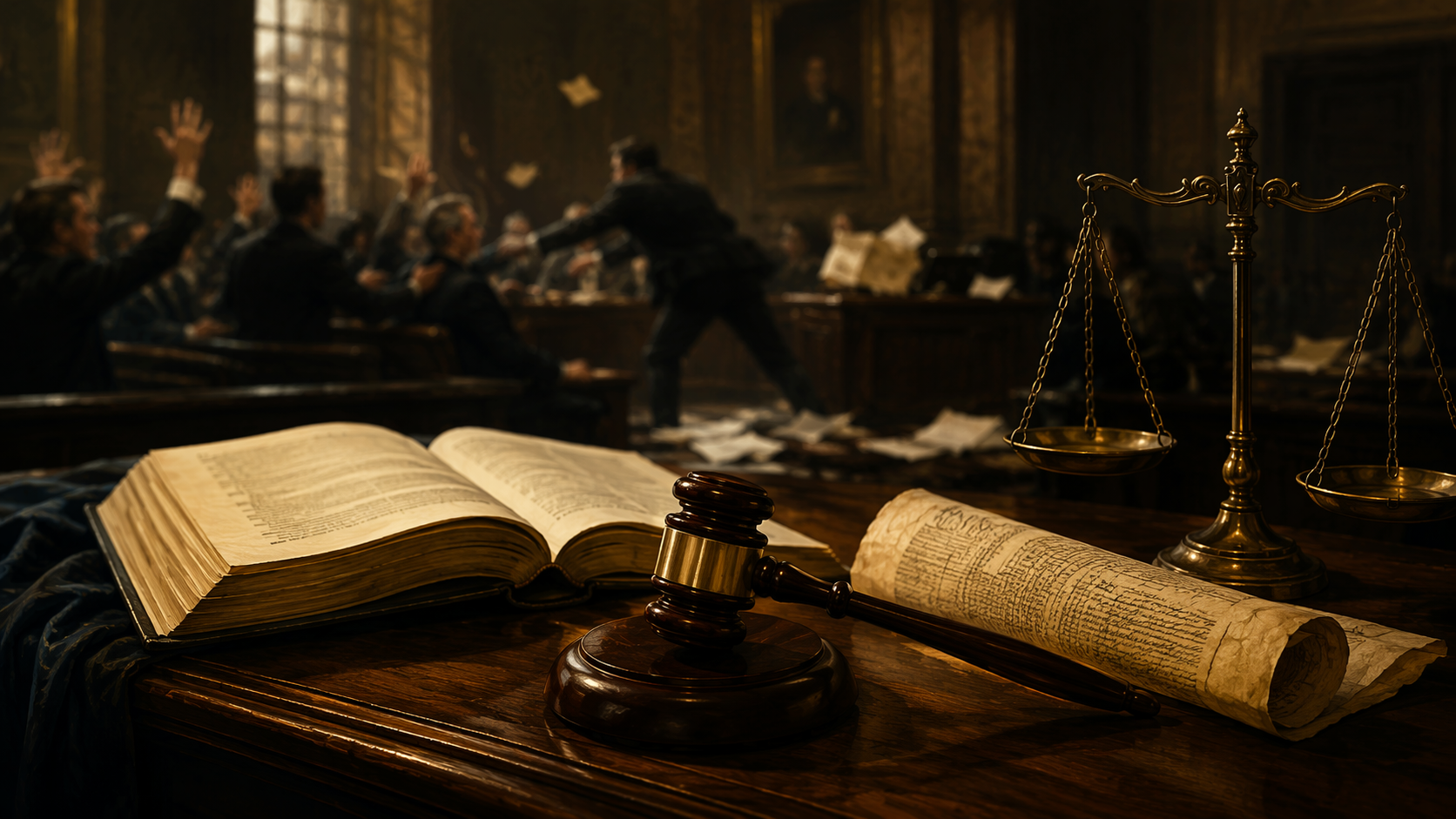
That is the legal story a chaos-driven treatment tends to flatten. The Manson trial was not a clean lesson in adversarial failure. It was closer to a constitutional stress test: courtroom control under a Supreme Court decision issued the same year, jury selection under extreme publicity and death-qualification pressure, and a defense-counsel crisis that still sits uneasily in Sixth Amendment terms.
The result matters because the proceeding did not collapse. The convictions were affirmed on appeal, including after litigation over suppressed-evidence claims tied to the Springer rap sheet.[1][2] But appellate durability is not the same thing as procedural comfort. The strongest caution in the record is not Manson’s conduct. It is what happened when Leslie Van Houten’s lawyer disappeared.
The three pressure points
The Sixth Amendment questions are easier to see if the trial is stripped of its mythology. Three problems carried the legal load.
- Courtroom control: whether a defendant who turned the courtroom into a stage could be restrained or removed without forfeiting the legitimacy of the proceeding.
- Jury impartiality: whether a death-qualified jury could be selected after saturation publicity and a president’s public pre-verdict statement.
- Assistance of counsel: whether Van Houten received meaningful representation after Ronald Hughes disappeared and replacement counsel entered a capital trial with only days to prepare.
Only the first two produced relatively visible rulings. The third produced the most enduring discomfort, partly because it never received the square appellate answer it deserved.
Courtroom disorder was not just theater
Manson’s disruptions are often remembered as images: the X carved into his forehead, the co-defendants following him, the attempted attack on the bench. Judge Charles Older had to treat them as procedural events. The trial was unfolding in the same year the Supreme Court decided Illinois v. Allen, which confirmed that a defendant can lose the right to be present at trial through disruptive conduct, after warning, if the court cannot otherwise proceed with dignity and order.[3]
That doctrine is easy to recite in appellate prose. It is harder to apply when exclusion itself risks becoming part of the performance. Older’s task was not simply to punish misbehavior. He had to maintain a record in which the jury could continue to function, the defendants’ rights remained recognizable, and the court’s own response did not become the reversible error.
The attempted attack on the bench was not a decorative anecdote. It was the sort of moment that tests whether courtroom-control doctrine is a practical tool or merely an appellate abstraction. The answer, at least in the Manson record, was that the court could use the available rule structure without letting Manson dictate the proceeding’s form.
The Hughes disappearance is the harder Sixth Amendment problem
Ronald Hughes represented Leslie Van Houten. He had been appointed after Manson wanted him involved, but Hughes eventually broke from Manson’s preferred strategy. Most importantly, he refused to let Van Houten take the stand when doing so would have aligned her defense with Manson’s demands rather than her own legal interest.[4]

Then Hughes disappeared during a trial recess. Four months later, his body was found. The cause of death was ruled undetermined.[4] Those facts invite speculation, and speculation has supplied plenty. But the procedural problem does not require a solved homicide. A capital defendant lost the lawyer who had been resisting pressure over her testimony, and the trial went forward with newly appointed counsel who had only days to prepare.[4]
That sequence is where the formal answer feels thinnest. Replacement counsel can sometimes cure a disruption. Continuances can sometimes protect the defense. But the adequacy of substitute representation depends on what the lawyer had to absorb: the record already made, the defense theory already chosen or rejected, the witness strategy, the client’s exposure, and the dynamics among co-defendants whose interests may no longer be aligned.
Van Houten’s situation was not a routine late substitution. Her counsel disappeared after taking a position that separated her from Manson’s control. The problem therefore was not only preparation time in the abstract. It was continuity of independent judgment. Hughes had already made the kind of defense decision that belongs to counsel, not to a charismatic co-defendant trying to control the narrative.
The narrow conclusion is the important one: the available materials do not support saying that an appellate court squarely held this arrangement violated Van Houten’s Sixth Amendment right. They also do not support treating the issue as comfortably resolved. It is the portion of the Manson trial where appellate durability and fairness anxiety separate most sharply.
Modern counsel-of-choice and effective-assistance doctrine would still have to ask fact-bound questions. What did substitute counsel know? What did the court deny or grant? What investigation was still possible? What strategic choices were locked in before substitution? The Manson record’s discomfort is that those questions arrived in a capital trial after a lawyer vanished, not after a calendaring mistake or an ordinary conflict.
Voir dire did real work under extraordinary publicity
The jury problem was visible from the beginning. Jury selection reportedly lasted 24 days, described as the longest in American history at the time, and it unfolded against both pervasive publicity and death-qualification screening after Witherspoon v. Illinois.[5]
The death-qualification issue matters because it was not merely administrative. Witherspoon limited the exclusion of jurors based on general objections to capital punishment. In a case where the death penalty was on the table, voir dire had to screen for lawful eligibility without converting the jury into a panel selected for conviction-proneness.
Publicity added a separate burden. The question was not whether prospective jurors had heard of the case. In a prosecution this notorious, many had. The operational question was whether the court could identify jurors capable of deciding on the evidence and instructions rather than on press accounts, rumor, or public outrage.
That is why the length of voir dire is legally meaningful. It shows the court using procedure as a filter rather than pretending notoriety could be wished away. Long screening does not guarantee impartiality, but short screening in this setting would have made the record look unserious.
Nixon’s statement sharpened the exposure problem
The publicity problem became still more acute when President Richard Nixon publicly declared, before verdict, that Manson was guilty. Judge Older refused to declare a mistrial, relying on a finding that the jury had not been exposed to the statement.[3]
That ruling depends on a factual premise, not on any charming idea that presidential commentary is harmless. If the jurors did not hear it, the mistrial motion looked different. If they had heard it, the court would have faced a much harder contamination question.
This is one place where a modern court would have fewer clean edges. In 1970, sequestration, admonitions, and controlled access could support a factual finding about exposure. In a social-media environment, the same finding would be harder to police and harder to credit without a more developed record. High-profile proceedings still present that problem, even when the facts are far removed from Manson; contemporary fair-trial disputes in cases such as the Tate brothers extradition timeline show how quickly publicity, jurisdiction, and procedure can start moving at different speeds.
What held, and what did not fully answer itself
The California appellate decisions are the durability check. In People v. Manson, the Court of Appeal affirmed the convictions.[1] Later proceedings addressed suppressed-evidence claims, including claims involving the Springer rap sheet, without disturbing the convictions.[2]
That appellate history matters because it prevents an overbroad conclusion. The Manson trial did not prove that a notorious defendant can defeat the adversarial system by making the courtroom unmanageable. Nor did it prove that publicity automatically makes trial impossible. The courts used existing safeguards: warnings, removal authority, extended voir dire, juror-exposure findings, and post-trial appellate review.
But the same history should not be turned into institutional self-congratulation. A conviction can survive appeal while still leaving a lesson in the margins. Hughes’s disappearance exposed a problem that conventional appellate categories do not easily capture: what happens when independent defense counsel is abruptly removed from the case by events outside the courtroom, after resisting pressure from the very figure dominating the defense environment?
The cleaner doctrinal legacy sits with courtroom control and juror screening. The less settled legacy sits with replacement counsel. That distinction is the point. The trial’s constitutional machinery mostly held, but it held unevenly. Some parts produced rulings that could be reviewed. One part produced a human and procedural rupture that the record could contain but not fully quiet.
The precedent a documentary tends to miss
The lasting legal value of the Manson trial is not that it generated one neat constitutional rule. It shows how several Sixth Amendment safeguards have to operate at once. Courtroom control protects the proceeding from sabotage. Voir dire protects the jury from contamination and unlawful exclusion. Counsel protections are supposed to ensure that an individual defendant is not swallowed by the drama around her.
That last safeguard is the one modern courts should look at longest. Publicity is faster now. Outside commentary is harder to isolate. Co-defendant dynamics can still distort individual defenses. Emergency substitution can still be described in tidy docket language while leaving the incoming lawyer to perform triage.
The adversarial system survived Manson, Nixon’s statement, courtroom spectacle, and a defense-counsel crisis. Survival is not the same as vindication. The record is strongest where the court made explicit procedural findings and weakest where a lawyer’s disappearance forced the system to keep moving before anyone could fully measure what had been lost.
References
- People v. Manson, Justia Law, 1976, https://law.justia.com/cases/california/court-of-appeal/3d/61/102.html
- People v. Manson, FindLaw, 1977, https://caselaw.findlaw.com/court/ca-court-of-appeal/1832178.html
- Charles Older, Wikipedia, https://en.wikipedia.org/wiki/Charles_Older
- He was Leslie Van Houten's hippie lawyer. Then he defied Manson, Los Angeles Times, July 3, 2024, https://www.latimes.com/california/story/2024-07-03/leslie-van-houten-lawyer-ronald-hughes-manson
- New York Times archive coverage of jury selection in the Tate-LaBianca murder trial, The New York Times, https://www.nytimes.com/
Comments
Join the discussion with an anonymous comment.