
The statute-of-limitations problem in switched-at-birth litigation is no longer theoretical in North Dakota. In July 2026, plaintiffs tied to the Bylin and Morrison families sued Unity Medical Center over an alleged 1988 newborn switch, after Ancestry.com test kits in December 2023 reportedly revealed that the people raised as biological relatives did not match genetically. The complaint was filed on July 7, 2026—more than 36 years after the births—and the hospital answered by raising the statute of limitations as an affirmative defense.[1]
That answer matters because North Dakota’s ordinary medical-malpractice limitations period is two years, with discovery-rule language that can extend the filing window but is described in the available materials as capped at six years from the injury.[2] If the injury is treated as the 1988 delivery-room event, the case has an obvious timing problem. If the claim is treated as undiscoverable until the December 2023 DNA results, the plaintiffs have a different argument: they filed within a period that looks prompt once the switch became knowable.

No court has yet resolved that conflict in the North Dakota case. The limitations issue is at the answer stage, not after a dispositive motion or appellate ruling. That is a small procedural point, but it is the difference between a live test case and a precedent. The hospital is not yet shown to have won anything on limitations; the plaintiffs are not yet shown to have escaped the deadline.
The hospital’s prejudice argument is also not cosmetic. Available reporting says Unity Medical Center answered that relevant records no longer exist and that staff members involved in the events are deceased.[3] That is exactly the condition limitation periods are designed to prevent: a defendant being asked to reconstruct a clinical event after the evidentiary world that once surrounded it has disappeared. It is also exactly the condition that makes DNA-discovered switched-at-birth claims morally hard to dismiss. The plaintiffs did not choose to wait decades with a known claim; if their allegations are true, the evidence gap was built into the wrong itself.
The North Dakota Filing Puts the Discovery Rule Under Pressure
A standard medical-malpractice limitations analysis usually starts with an act, an injury, and a deadline. A switched-at-birth case discovered by consumer DNA testing scrambles that sequence. The alleged negligent act happens in a nursery. The legally recognizable injury may include decades of family, identity, inheritance, medical-history, and emotional consequences. The first reliable notice may arrive only when a commercial database connects or excludes relatives.
For readers interested in the testing mechanism rather than the limitations fight, the Bylin-Morrison DNA discovery is discussed separately in How Consumer DNA Tests Uncover Decades-Old Medical Malpractice Cases. The point here is narrower: a DNA match may explain why a plaintiff did not know, but it does not by itself answer whether state law permits filing after the outer limits of a medical-malpractice statute.
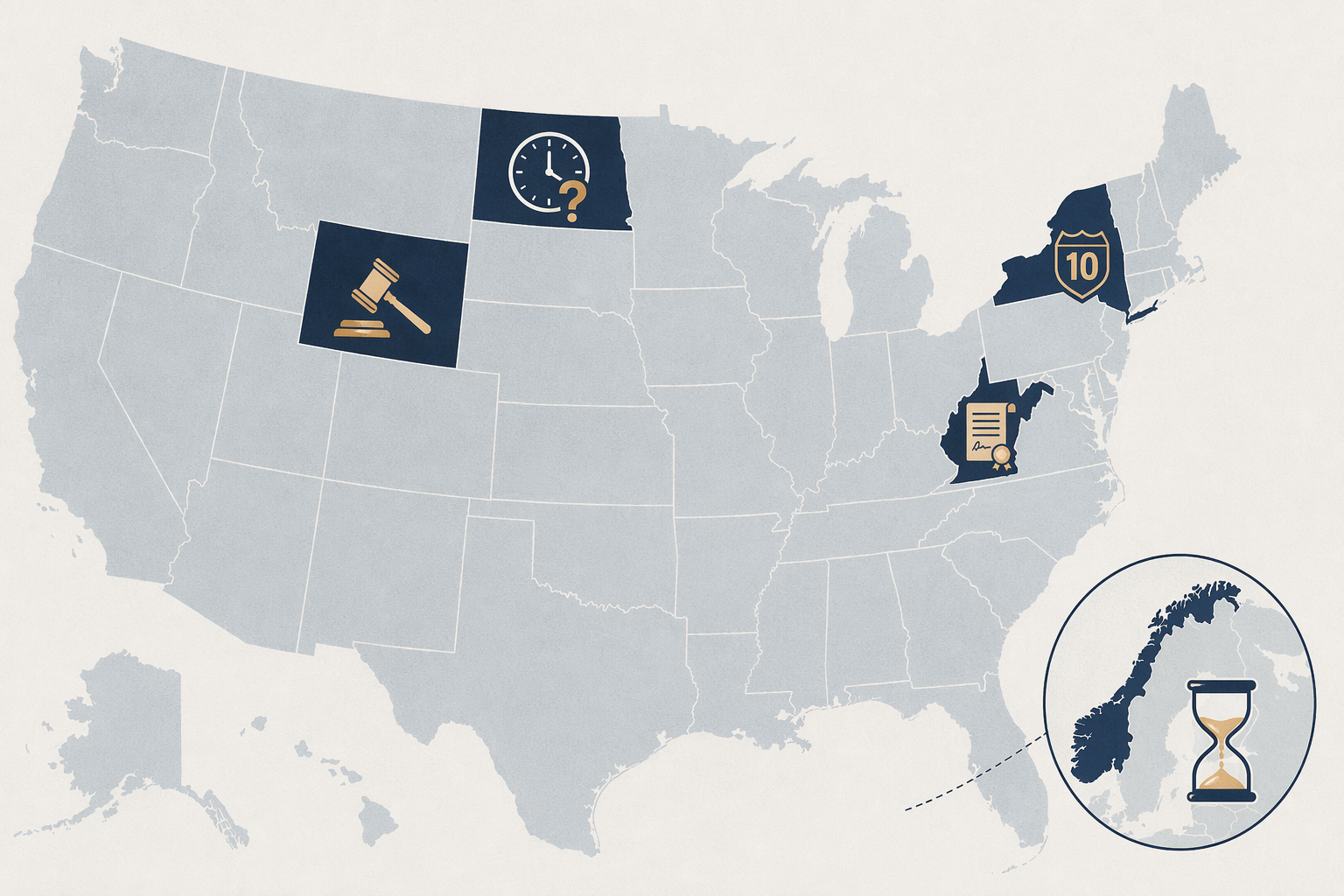
North Dakota therefore presents two calendars. One calendar begins in 1988, when the alleged switch occurred. The other begins in December 2023, when the families reportedly received genetic information that made the claim discoverable.[1] Plaintiffs need the second calendar to matter. The defense needs the first calendar, or any statutory cap attached to it, to control.
| Jurisdiction | Alleged birth year | Late-discovery mechanism | Limitations point the case illustrates |
|---|---|---|---|
| North Dakota | 1988 | December 2023 Ancestry.com testing | Unresolved answer-stage fight over medical-malpractice limitations and discovery language |
| West Virginia | 1942 | Discovery treated as occurring in 2019 under reported litigation history | State-specific statutory reform allowed the clock to run from discovery |
| New York | 1960 | Late DNA-related discovery reported in the Kevin McMahon/Jamaica Hospital matter | Infant tolling may help minors but CPLR § 208 imposes a hard cap |
| Wyoming | 1958 | Long-delayed switched-at-birth litigation reaching the state supreme court | Appellate merits ruling exists, but mainly on emotional damages |
West Virginia Shows the Strongest Survival Path, but Not a Portable Rule
The closest documented counterweight to the North Dakota defense is the West Virginia litigation involving an alleged 1942 switch. Reporting on the Carr/Spencer case describes a 2016 legislative change to West Virginia’s Medical Professional Liability Act that allowed the limitations clock to run from discovery rather than from the original birth injury, with discovery treated as occurring in 2019.[4]
That is the cleanest example in the available materials of a decades-late switched-at-birth claim surviving the usual instinct to measure time from the delivery room. It is also easy to overread. The case is powerful because the time gap is extraordinary and the legal system still had a path for the claim. It is weak as national guidance because the path came from a West Virginia statutory amendment, not from a broadly applicable common-law holding that every state must follow.
For a plaintiff in a newly filed case, West Virginia is useful pattern evidence: lawmakers and courts can decide that an undiscoverable medical error should not be barred before any reasonable person could know it existed. For defense counsel, it is just as useful as a boundary marker: when survival depends on state-specific legislative language, a plaintiff cannot simply cite the result and skip the statute in the forum where the new case is filed.
The Doctrines That Actually Do the Work
Switched-at-birth limitations disputes tend to be described emotionally, but they are won or lost through a small set of procedural doctrines. None is a universal solution. Each asks a different question, and the answer changes by jurisdiction.
Discovery Rule
The discovery rule is the obvious plaintiff-side doctrine in a DNA-discovered switched-at-birth case. It asks whether the limitations period should begin when the plaintiff knew or reasonably should have known of the injury and its possible cause, rather than when the negligent act occurred. In North Dakota, that question is sharpened by the reported statutory structure: a two-year medical-malpractice limitations period with discovery extension language and an outer period described in the available materials as six years from injury.[2]
The plaintiff’s best version is straightforward. Before DNA testing, ordinary family life gave no reason to suspect a hospital switch. After the December 2023 results, the families had reason to investigate, and they filed on July 7, 2026.[1] The defense answer is just as straightforward: discovery language does not necessarily erase an outer cap, and medical-malpractice statutes often reflect a legislative choice to end exposure even for claims that remain unknown.
That is why the North Dakota case is important if it reaches a limitations ruling. It could force a court to decide whether a switched-at-birth injury discovered through modern DNA testing fits within the discovery rule, and whether any repose-like cap still blocks the claim. Until that happens, it remains an argument, not an answer.
Minority Tolling
Minority tolling can look attractive in a newborn-switch case because every plaintiff injured at birth begins as a minor. New York shows why that instinct can mislead. CPLR § 208 tolls certain limitations periods during infancy, but the available sources identify a 10-year cap from the malpractice date in the medical-malpractice context.[5]
The Kevin McMahon/Jamaica Hospital matter, involving an alleged 1960 switch and a complaint reportedly filed in November 2021, is useful for that reason.[6] It is not useful as a published statute-of-limitations precedent, because no published SOL ruling has been verified from the available sources. Its value is more limited and more practical: in New York, infant tolling may extend time, but it does not necessarily preserve a claim into adulthood when the alleged malpractice occurred at birth.
That distinction matters for pleadings. A plaintiff cannot assume that because the injury occurred to an infant, the claim remains open until discovery many decades later. Counsel has to identify the tolling statute, the cap, and whether medical-malpractice-specific provisions displace more general tolling rules.
Repose-Style Caps
The hardest defense argument in these cases is not that the plaintiff waited too long after discovery. Often, the plaintiff did not. The harder argument is that the legislature has set an outside date after which the claim cannot be filed at all. North Dakota’s reported six-year-from-injury limit, if applied strictly to an alleged 1988 switch, would make the December 2023 discovery date legally irrelevant.[2]
That may sound harsh, but it is not irrational. The Unity Medical Center answer illustrates the institutional prejudice: missing records and deceased staff.[3] A hospital defending a 1988 delivery-room allegation is not merely inconvenienced. It may be unable to test staffing, protocols, charting, transfer procedures, nursery practices, or witness memory in any conventional way.
The plaintiff-side reply is that a strict outside cap assigns the full cost of non-discovery to the person least able to prevent it. That is the policy collision courts will have to confront if North Dakota moves beyond the pleadings.
Fraudulent Concealment
Fraudulent concealment is often mentioned in late-discovery cases, but the available switched-at-birth materials do not support treating it as a proven path. The doctrine generally requires more than the original error. A plaintiff must show concealment that prevented timely filing, often with particularized facts about who knew what, when, and what was done to hide it.
That is a demanding fit for decades-old hospital cases. If the allegation is negligent misidentification of newborns, fraudulent concealment may not follow. If the allegation is that the hospital later discovered the switch and suppressed it, the pleading burden changes, but so does the need for evidence. The available materials do not identify a documented switched-at-birth case that succeeded on fraudulent concealment.
Larsen Reached the Merits, but It Does Not Solve the DNA-Discovery Question
Larsen v. Banner Health System is the most important appellate switched-at-birth decision in the available U.S. set because it is a state supreme court decision and involved an alleged 1958 switch litigated decades later. The Wyoming Supreme Court’s 2003 decision addressed whether emotional distress damages could be pursued in the switched-at-birth context, after a 43-year gap from birth to litigation.[7]
Its significance should be kept in proportion. Larsen shows that a state high court did not treat the age of a switched-at-birth claim as an automatic reason to avoid merits-related analysis. But the decision is not a definitive modern discovery-rule ruling for a consumer-DNA case. It should not be made to carry more than it holds.
That limited value is still real. In a field with very few directly analogous appellate opinions, even a damages-focused decision helps show that courts have not uniformly refused to engage with old switched-at-birth claims. It just does not tell a North Dakota court how to read North Dakota’s medical-malpractice limitation statute.
What the Four U.S. Matters Actually Support
The current U.S. materials support a narrow pattern, not a national rule. North Dakota supplies an unresolved live dispute. West Virginia supplies a strong survival example built on state-specific legislative reform. New York supplies a warning that infant tolling can be capped. Wyoming supplies an appellate merits decision that is important but not controlling on the discovery rule.[1][4][5][7]
Those examples undercut both easy shortcuts. It is too broad to say that a 30-, 40-, or 80-year delay automatically kills every switched-at-birth lawsuit. It is also too broad to say that DNA discovery automatically restarts the clock. The decisive question is usually statutory: what the forum’s medical-malpractice limitations statute says about discovery, minority, repose, concealment, and any claim-specific reform.
- If the state has discovery language without a hard outer bar, plaintiffs have their cleanest argument.
- If the state has a repose-style cap measured from the medical event, defendants have their strongest limitations defense.
- If the plaintiff was an infant at injury, tolling must still be checked against medical-malpractice-specific caps.
- If the claim depends on concealment, the plaintiff needs facts showing concealment, not merely late discovery.
- If a favorable result comes from another state’s statutory amendment, it may help policy arguments but may not move the limitations deadline.
The International Contrast Is Familiar
Norway’s reported 1965 switched-at-birth case adds a useful contrast, mainly because it shows the same timing problem outside U.S. medical-malpractice doctrine. CBS News reported that the state argued claims were statute-barred even though the government had discovered the switch in 1985, a posture that raised human-rights concerns in addition to ordinary limitations questions.[8]
The comparison should not be stretched. Norway does not answer a North Dakota limitations question. It does show that switched-at-birth cases expose a recurring institutional problem: the state or hospital system may have had access to knowledge long before the affected family could meaningfully act on it, while the legal system still insists that claims arrive within administrable time limits.
North Dakota Is Now the Case to Watch
The Bylin/Morrison case is positioned to test how a conventional medical-malpractice statute handles a type of claim that modern DNA testing has made newly visible. The facts reported so far create the sharp version of the issue: alleged switch in 1988, DNA discovery in December 2023, complaint filed July 7, 2026, and an affirmative defense that the case is too late.[1]
A limitations ruling, if one comes, will need to do more than acknowledge sympathy or recite the injury date. It will have to decide which calendar the statute recognizes, whether any outer cap controls, and how much weight to give the practical prejudice created by missing records and deceased witnesses.[2][3]
For now, the safest conclusion is restrained. Courts and legislatures have shown some willingness to let late-discovered switched-at-birth claims proceed through case-specific doctrines or statutory changes. They have not created a stable national rule for DNA-discovered claims filed decades after birth. Every new switched-at-birth lawsuit remains jurisdiction-dependent, fact-sensitive, and procedurally fragile.
References
- North Dakota switched-at-birth lawsuit coverage, AP News, July 14, 2026
- N.D. Cent. Code § 28-01-18, North Dakota Century Code
- Unity Medical Center answer coverage in Bylin/Morrison switched-at-birth case, Valley News Live, 2026
- Carr/Spencer switched-at-birth litigation coverage, The Dominion Post, February 2024
- CPLR § 208, New York Civil Practice Law and Rules
- Kevin McMahon Jamaica Hospital switched-at-birth case coverage, New York Post, April 2025
- Larsen v. Banner Health System, 2003 WY 167, 81 P.3d 196, Wyoming Supreme Court, 2003
- Norway switched-at-birth case coverage, CBS News
Comments
Join the discussion with an anonymous comment.