
As of July 22, 2026, the live legal question is not whether Todd Blanche’s contempt fight makes for a sharp confirmation headline. It is whether Judge Emmet Sullivan will impose a coercive contempt remedy against Acting Attorney General Todd Blanche for an already identified violation of a court order before the Senate Judiciary Committee takes up Blanche’s nomination for permanent attorney general on July 23.
Katie Phang’s July 13 motion asks Sullivan to fine Blanche $1,000 per day, personally and not from Justice Department funds, until he complies with Sullivan’s June 2025 order requiring disclosure of Epstein Files materials under the Epstein Files Transparency Act.[1] Sullivan has not ruled on that request as of July 22. Blanche, in a July 21 reply, called the contempt push “absurd” and “outlandish” and asked for immediate appellate review.[2]

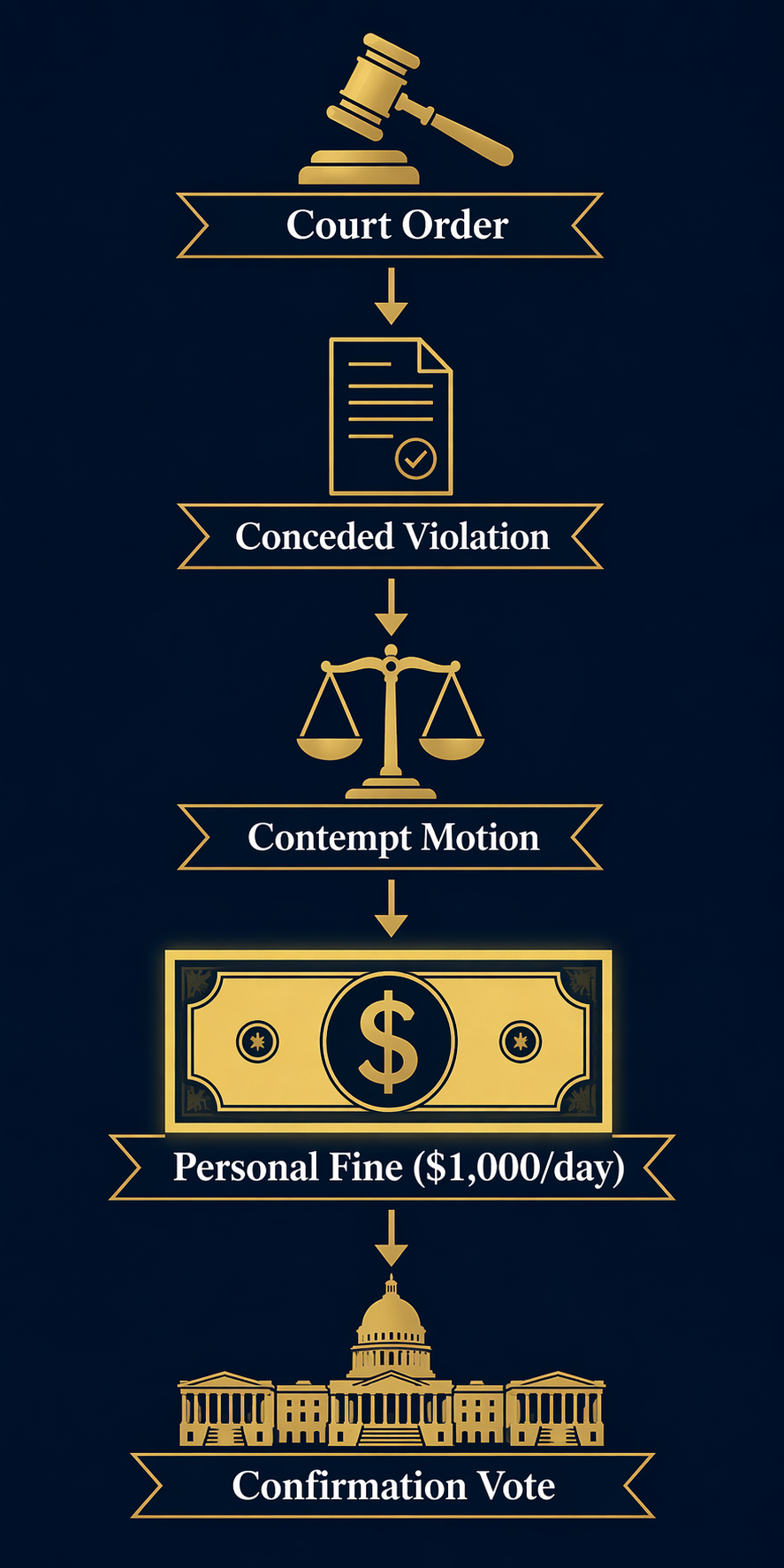
That sequence matters because contempt is not an all-purpose label for official misconduct. It is a court’s tool for preserving the force of its own orders. The operative chain here is unusually direct: Sullivan entered an order; Phang alleged noncompliance; Sullivan found that Blanche had conceded a violation by failing to dispute Phang’s factual allegations; Phang then sought a daily personal sanction to force compliance.[1]
The Pending Motion Is About Compliance, Not Symbolism
The proposed $1,000-per-day amount is not the most important feature of the motion. Courts have many ways to mark displeasure. What gives this filing its edge is the requested payor: Blanche himself. Phang’s team is not asking Sullivan to order the Department of Justice to absorb the cost as another institutional expense. The motion asks for a personal coercive fine, accruing day by day, until the order is obeyed.[1]
That distinction is easy to flatten in political coverage and hard to miss in court. A sanction payable from agency funds can become background noise inside a large department. A sanction against the named official asks a narrower question: who is responsible for the continuing failure to comply, and what pressure will actually move the file?
Phang’s motion also does not rest on a free-floating demand for transparency. It points back to the June 2025 order and to Sullivan’s finding that Blanche conceded violation of the Epstein Files Transparency Act by not disputing the factual allegations against him.[1] In contempt practice, that posture changes the center of gravity. The fight moves away from whether the order existed and toward whether a coercive remedy is now justified.
What Blanche Has Not Denied
Blanche’s July 21 reply is forceful on rhetoric and narrower on substance. Calling the contempt request “absurd” and “outlandish” is not the same thing as denying the underlying violation. According to the reported filing sequence, Blanche argues that the fine is unnecessary and seeks immediate appellate review; he does not erase Sullivan’s earlier finding that he conceded the violation by failing to contest Phang’s factual allegations.[1][2]
That difference is not clerical. A party can argue that contempt is premature, excessive, procedurally improper, or unnecessary even after a violation has been found or conceded. Those are arguments about remedy and review. They are not the same as saying the court’s order was obeyed.
For senators weighing the nomination, that distinction should keep the inquiry from drifting into pure messaging. The pending issue before Sullivan is not simply whether Blanche’s critics can use the Epstein Files dispute against him. It is whether the acting attorney general should face a personal daily sanction for continued noncompliance with a disclosure order.
The Withheld Records Are Concrete, Even If the Case Is Not an Epstein Explainer
The categories of records identified in the reporting are specific enough to explain why disclosure matters without turning the contempt dispute into a tour through every Epstein-related allegation. They include FBI interview notes from a woman alleging that Donald Trump sexually assaulted her as a minor, emails regarding a “torture video,” co-conspirator names, and foreign-language documents that Blanche concedes contain no victim information.[1][3]
Those categories do two things in the contempt analysis. First, they make the alleged noncompliance administrable. A judge can ask about specific groups of documents rather than supervise an atmospheric promise of transparency. Second, they sharpen the burden on the official resisting disclosure. If a category is withheld on victim-protection grounds, but the official concedes that certain foreign-language documents contain no victim information, the justification has to survive that narrower record-by-record scrutiny.[1][3]
None of that determines whether Sullivan will impose the requested fine. Civil contempt turns on present compliance pressure, available defenses, and the court’s judgment about what sanction is necessary. But it does explain why the motion cannot be dismissed as just another partisan filing. It identifies an order, an alleged failure, particular withheld materials, and a proposed coercive sanction.
The Confirmation Calendar Makes the Posture Harder to Ignore
The Senate Judiciary Committee has a July 23 executive business meeting scheduled for a confirmation vote on Blanche’s nomination for permanent attorney general.[4] That timing matters because the committee is not dealing with a dormant dispute. The contempt motion is pending on the eve of the vote.
If Sullivan rules before the meeting, senators will have to account for a live judicial ruling in a contempt proceeding involving the nominee’s compliance with a court order. If he does not, they still have the underlying posture: a requested personal daily fine, a conceded violation finding, and a pending request for appellate review.
That is a narrower question than whether senators approve of Blanche’s politics. It is also more useful. Confirmation hearings often sprawl into broad claims about independence, loyalty, and institutional norms. Here, the committee has a docket-linked compliance issue with dates, filings, and a requested remedy.
The Ethics Context Adds Pressure, But It Is Not the Contempt Claim
The contempt motion sits inside a wider ethics record that deserves attention, but the order matters first. In March 2025, DOJ ethics official Joseph Tirrell reportedly advised Blanche to recuse from Trump-related matters; Blanche signed an ethics pledge but did not recuse, and Tirrell was later fired.[5] Senator Adam Schiff followed with a May 19, 2026 inquiry into the episode.[5]
That pattern matters because compliance systems do not fail only when a statute is violated. They also weaken when ethics advice becomes disposable, recusal commitments become contestable, and internal reviewers lose institutional protection. The contempt motion is not proof of all those things. It is a separate proceeding. But it lands on a nomination already carrying questions about whether DOJ ethics infrastructure has been treated as binding guidance or as an obstacle.
Other disputes point in the same institutional direction. Reporting on a $1.776 billion settlement with Trump described a global release of tax liability negotiated in a period when ethics safeguards were already under challenge.[6] Separately, DOJ’s proposed effort to block state bar ethics investigations has raised its own professional-responsibility concerns; that issue is tracked in more detail in our analysis of DOJ and state bar investigations.
The department’s public posture has not been subtle. DOJ called a 101-judge complaint a “pathetic stunt,” language that may satisfy an audience looking for combat but does little work in a contempt analysis.[1] Courts do not resolve compliance by scoring adjectives. They look for the order, the violation, the defense, and the remedy.
What Sullivan Has to Decide
Sullivan’s immediate task is not to adjudicate the entire ethics record of the acting attorney general. It is to decide whether the June 2025 order has gone unenforced long enough, and clearly enough, to justify a daily personal coercive fine. The requested sanction is prospective: $1,000 per day until compliance.[1]
Blanche’s request for immediate appellate review is also significant. It signals that he is not merely asking Sullivan to deny the fine on ordinary remedial grounds; he wants the dispute moved up before the contempt mechanism does its work.[2] That may be a defensible procedural position depending on the arguments in the filing, but it should not be confused with compliance.
The Confirmation Question as of July 22
Senators are not being asked to vote on a hypothetical controversy. They are being asked to consider a nominee who, while serving as acting attorney general, faces a pending contempt motion tied to a court-order violation Sullivan has already identified as conceded.[1][4]
If Sullivan rules before or during the July 23 vote, the confirmation process must absorb a live judicial finding. If he does not, the unresolved motion still presents a concrete ethics-and-compliance question: whether the Senate is prepared to advance a nominee while a federal court is considering a personal $1,000-per-day sanction to compel him to obey an existing disclosure order.
References
- Raw Story reporting on Katie Phang’s contempt motion and Judge Sullivan’s June 2025 order, Raw Story, July 2026
- The New Republic reporting on Todd Blanche’s July 21 reply brief, The New Republic, July 2026
- NPR report on DOJ removal and withholding of Epstein files, NPR, February 24, 2026
- Senate Judiciary Committee executive business meeting materials and NYC Bar Association letter, Senate Judiciary Committee, July 2026
- CNN exclusive on Joseph Tirrell recusal advice and Senator Schiff May 19 inquiry, CNN and schiff.senate.gov, May 2026
- Justice Connection fact sheet and Democracy Docket reporting on the $1.776 billion Trump settlement, Justice Connection and Democracy Docket
Comments
Join the discussion with an anonymous comment.