
The practical problem with the Trump administration’s AI posture is not that Washington has produced another noisy technology agenda. It is that the July 2025 AI Action Plan gives the National Science Foundation a central role in leading AI research, building shared research infrastructure, and developing testbeds, while the same administration has pursued a 55% proposed cut to NSF funding and already moved through layoffs and grant cancellations that weaken the agency expected to carry that work.[1][2]
For legal professionals, the question is narrower than the politics: should the public AI research pipeline now be treated as a vendor risk factor when buying legal research tools? The answer is yes, but not because Westlaw, Lexis, CoCounsel, or Harvey will suddenly stop working. The risk is slower improvement, thinner independent evaluation, weaker talent formation, and more pressure toward consolidation over the next several contract cycles.
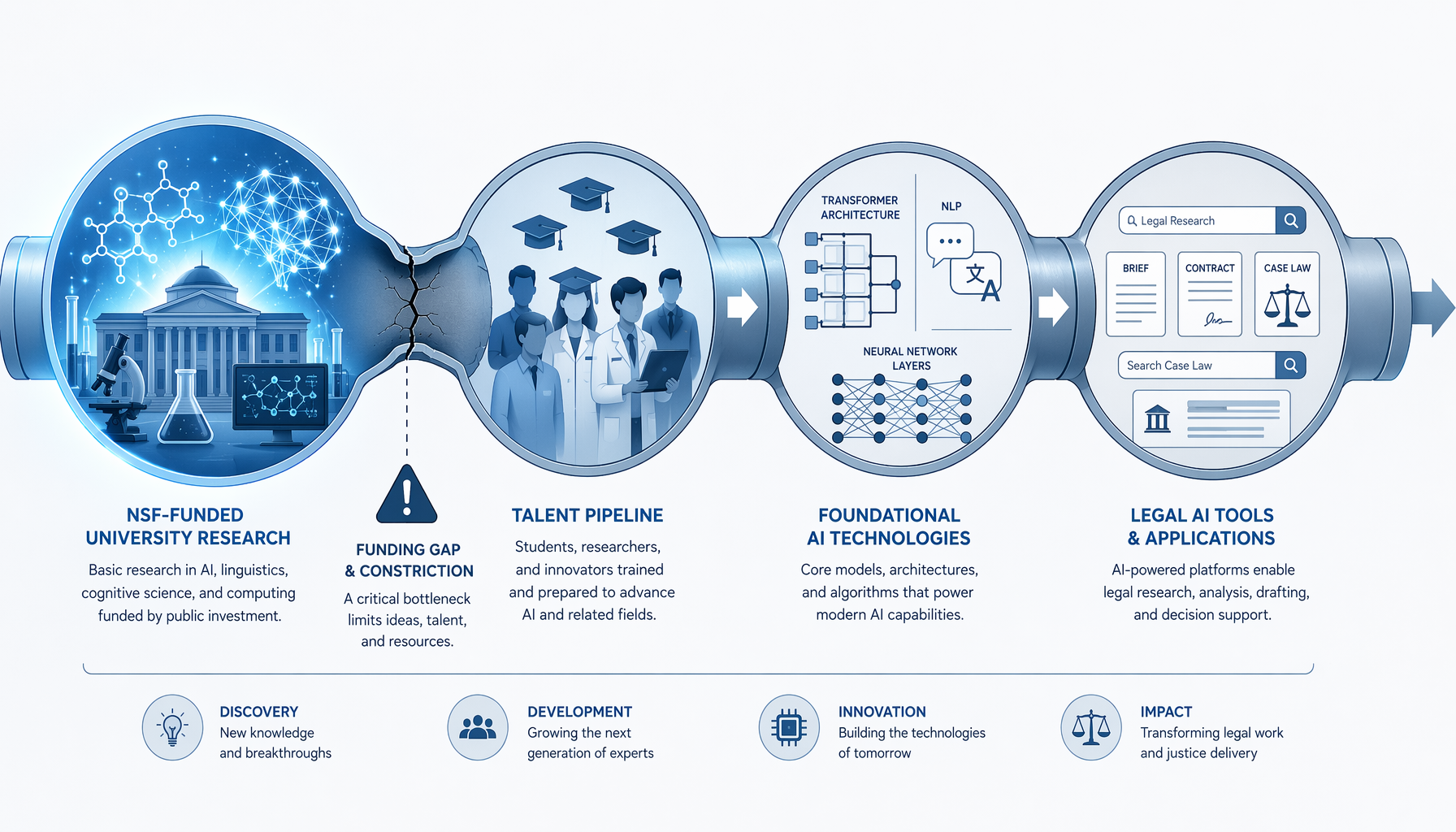
The contradiction matters because legal AI is downstream infrastructure
Legal research platforms now sell outputs that look productized: case summaries, draft research memos, citation checks, jurisdictional comparisons, litigation timelines, and natural-language search. But the capabilities behind those workflows did not originate inside legal vendors alone. They rest on decades of work in natural language processing, neural networks, transformer architectures, information retrieval, summarization, data curation, and evaluation methods.
That dependency chain is easy to miss in procurement because the buyer sees a polished interface and a security questionnaire. The more important question is what keeps the interface improving after the first contract year: better models, better retrieval, better benchmarks, better legal-domain training data, and enough researchers who understand both machine learning and the messy structure of law.
The implemented cuts are not hypothetical. More than 1,600 active NSF grants worth over $1 billion have been canceled, and basic AI research funding faces a 32% cut in FY2027 proposals.[3] Separately, Brookings has projected that the NSF grant success rate could fall from 26% to 7%, a change that would not merely trim marginal projects but alter what young researchers believe is fundable in the United States.[4]
There is an important distinction here. The 55% NSF cut is a presidential proposal, not enacted law, and Congress may reject the steepest reductions. The grant cancellations and staffing losses, however, are already part of the operating environment. A buyer assessing AI legal research tools by practice area does not need to predict the final appropriations bill to recognize that uncertainty itself changes incentives for labs, doctoral students, and vendors.
No canceled grant maps neatly to one missing legal research feature
The causal chain should not be oversold. No one can credibly say that one canceled NSF award will remove a specific feature from Westlaw Precision AI, Lexis+ AI, CoCounsel, or Harvey next quarter. Legal AI vendors do not disclose enough detail to let outside buyers calculate how much of their roadmap depends on publicly trained researchers, university collaborations, proprietary labs, acquisitions, or private model partnerships.
That caveat does not make the risk irrelevant. Procurement teams routinely evaluate indirect risks: cloud concentration, data residency, litigation exposure, model-provider dependency, and changes in licensing terms. The public research pipeline belongs in the same category. It is not the product. It is one of the conditions that determines how fast the product can become more reliable.
Brookings has connected attacks on research and development to broader risks for technological innovation, including the foundational AI work on which later commercial systems depend.[5] NPR has also reported the end of federal funding for an ambitious AI project, underscoring that the cuts are not limited to abstract budget lines but can halt shared infrastructure efforts.[6] For legal AI, shared infrastructure matters because law is a high-stakes domain where private demos are a poor substitute for independent tests, reproducible methods, and durable research communities.
Where the legal research stack depends on public AI work
The dependency shows up in ordinary legal workflows. A lawyer asks a system to summarize a line of cases. The system has to retrieve the right authorities, separate holdings from dicta, preserve procedural posture, identify conflicts, and avoid inventing citations. Those tasks use general AI techniques, but they also require legal-domain adaptation and evaluation.
Current products such as Westlaw Precision AI, Lexis+ AI, and CoCounsel compete on how well they embed those techniques inside defensible research workflows. Harvey occupies a related part of the market, especially for legal teams evaluating broader AI assistance across research and drafting; its value proposition also depends on the availability of highly trained AI and legal-domain talent, even when the product itself is privately built. Harvey AI legal research tool features are best understood in that broader ecosystem, not as proof that private firms can stand apart from it.
Large vendors can buffer themselves. Thomson Reuters said in an October 2025 press release that it invests more than $200 million annually in AI development.[7] LexisNexis announced a seven-year contract with the U.S. Federal Judiciary in 2025, strengthening its position in a market where institutional relationships and content access already matter.[8] Those facts are material for buyers; they suggest that the largest incumbents have resources, distribution, and data advantages that smaller vendors may not be able to match.
They are not proof that private R&D can replace the public research base. Vendor spending can improve a product, integrate models, acquire companies, and harden a workflow. It does not necessarily create the open academic work, independent benchmarks, doctoral training, court-data methods, and cross-institutional research that the next generation of legal AI systems may need.
The talent pipeline is the procurement issue hiding in plain sight
The most concrete downstream risk is talent. Nature reporting cited by The Guardian found that MIT and Duke cut PhD admissions by 20% because of funding uncertainty. The New York Times reported that NIH issued nearly 1,000 fewer early-career grants in 2025, that 85 top U.S. scientists relocated to China, that 32% more American scientists applied for jobs abroad in 2025 than in 2024, and that the European Union launched a €500 million package to attract displaced scientists.[9]
Those numbers do not describe legal AI directly, but they describe the pool from which legal AI hiring draws. Gregory Allen of the Center for Strategic and International Studies told Bloomberg that almost every employee with an advanced degree at every American AI firm participated in NSF-funded research at some point in their career.[10] If that observation is even directionally right, the issue is not whether a legal vendor has cash on hand this year. It is whether the market will keep producing the people who can solve the next hard reliability problem.
Legal AI has plenty of hard reliability problems left. Research systems still have to reduce hallucinated authorities, improve jurisdiction-specific reasoning, make retrieval more transparent, handle procedural nuance, and explain why one authority was surfaced ahead of another. Buyers comparing AI legal research accuracy benchmarks and hallucination rates are already looking at the visible layer of that problem. The funding question concerns whether the underlying research community continues to improve the methods available to solve it.
Why the impact is likely to compound over 3 to 5 years
The near-term product risk is limited. A firm renewing a legal research contract this quarter should still test present accuracy, workflow fit, privacy controls, security terms, integration burden, support quality, and cost. Existing tools have current capabilities that can be measured today. They do not become unusable because an agency budget line is in dispute.
The 3-to-5-year risk is different. Fewer funded projects mean fewer graduate students trained on frontier problems. Fewer testbeds mean fewer neutral places to evaluate whether a model performs consistently across institutions. Fewer independent benchmarks mean more reliance on vendor claims. More uncertainty means some researchers choose safer topics, private labs, or jobs outside the United States.
That compounding timeline aligns uncomfortably with legal procurement. Multi-year contracts, renewal cycles, platform migrations, training investments, and matter-data integrations often lock firms into a vendor relationship before the full consequences of upstream research weakness are visible. By the time a product’s innovation pace has slowed, the buyer may have already rebuilt workflows around it.
Smaller firms may feel that effect differently from large firms. If the strongest vendors can lean on proprietary labs, private model partnerships, and acquisition budgets while smaller vendors lose access to a broad public talent and research base, the market may narrow. For firms already weighing how to choose a legal AI tool for a small law firm, fewer credible alternatives can become a pricing and access problem, not just an innovation problem.
What legal buyers should ask vendors now
Research-pipeline risk should not replace ordinary product diligence. It should be added to it. The point is to separate current tool quality from future resilience, especially where the contract term, data migration cost, or training burden makes switching expensive.
| Procurement question | What the answer helps reveal |
|---|---|
| How does the vendor evaluate legal research accuracy over time? | Whether improvement is measured against stable benchmarks or described only through product claims. |
| Which model providers, academic collaborations, or internal research teams support the roadmap? | How exposed the product is to one model partner, one hiring channel, or one proprietary lab. |
| How are hallucinations, citation errors, and retrieval failures tracked after deployment? | Whether the vendor treats legal reliability as an operational process rather than a launch feature. |
| What changed in accuracy, latency, coverage, or explainability during the last two release cycles? | Whether the product is improving in ways that matter to lawyers, not merely adding interface features. |
| What happens if a model provider changes terms, access, or performance? | Whether the vendor has resilience beyond the current commercial partnership. |
The strongest vendors should be able to talk about accuracy baselines, regression testing, legal-domain evaluation, model governance, and the human review points built into the workflow. Buyers should be wary of answers that collapse all of that into a generic claim that the system uses advanced AI.
For in-house legal departments and firms with formal legal ops teams, the diligence memo should include a short section on research and roadmap resilience. It does not need to become a political document. It should identify the vendor’s dependencies, the contract term, switching costs, available benchmarks, and the evidence that the system is improving in legally meaningful ways.
The defensible position for legal teams
The impact of Trump’s AI funding cuts on legal research is best understood as a strategic risk, not an immediate product failure. Current legal AI tools can still be evaluated on their present performance. A careful buyer can run sample matters, compare citations, test privilege and privacy controls, review contract terms, and decide that a tool is worth adopting now.
But the public AI research pipeline should no longer sit outside the procurement frame. The federal plan asks NSF to help build national AI capacity while cuts, cancellations, and uncertainty weaken the same institution’s ability to do that work. Legal AI vendors may buffer the shock through private spending and partnerships, especially the largest incumbents. They cannot fully substitute for a healthy research ecosystem that trains researchers, produces foundational methods, and supports independent evaluation.
For buyers, the practical stance is simple: buy for today’s accuracy and workflow fit, but test for tomorrow’s research resilience. The firms that make that distinction will be better positioned when the consequences of today’s funding decisions show up not as a broken button, but as a slower roadmap, a thinner market, and fewer independent ways to prove that a legal AI answer can be trusted.
References
- Trump Administration Unveils “AI Action Plan”, Georgetown Law Institute for Technology Law & Policy
- Trump cuts to science research threaten his administration’s own AI action plan, The Guardian
- The Cost of the Trump Administration’s Attacks on Research Funding, Brennan Center for Justice
- Where does federal AI spending stand in 2026?, Brookings
- Attacks on research and development could hamper technological innovation, Brookings
- The federal government ends funding for an ambitious AI project, NPR
- Thomson Reuters press release on AI investment, Thomson Reuters, October 2025
- LexisNexis announces landmark seven-year contract with the U.S. Federal Judiciary, LexisNexis Newsroom, 2025
- Trump Slashed Science Funding. Now the U.S. Could Face a Brain Drain, The New York Times
- Trump’s Funding Cuts Threaten America’s AI Competitiveness, Bloomberg
Comments
Join the discussion with an anonymous comment.