
Start with the distinction that saves money: a refund is not the same thing as delay compensation, and neither is the same thing as reimbursement for expenses. For most domestic United passengers affected by the August 6 outage, there is still no federal rule that automatically pays cash just because a delay was controllable; the Department of Transportation withdrew its proposed cash-compensation rule in November 2025.[1] But that does not end the claim. It only tells you which lever not to pull first.
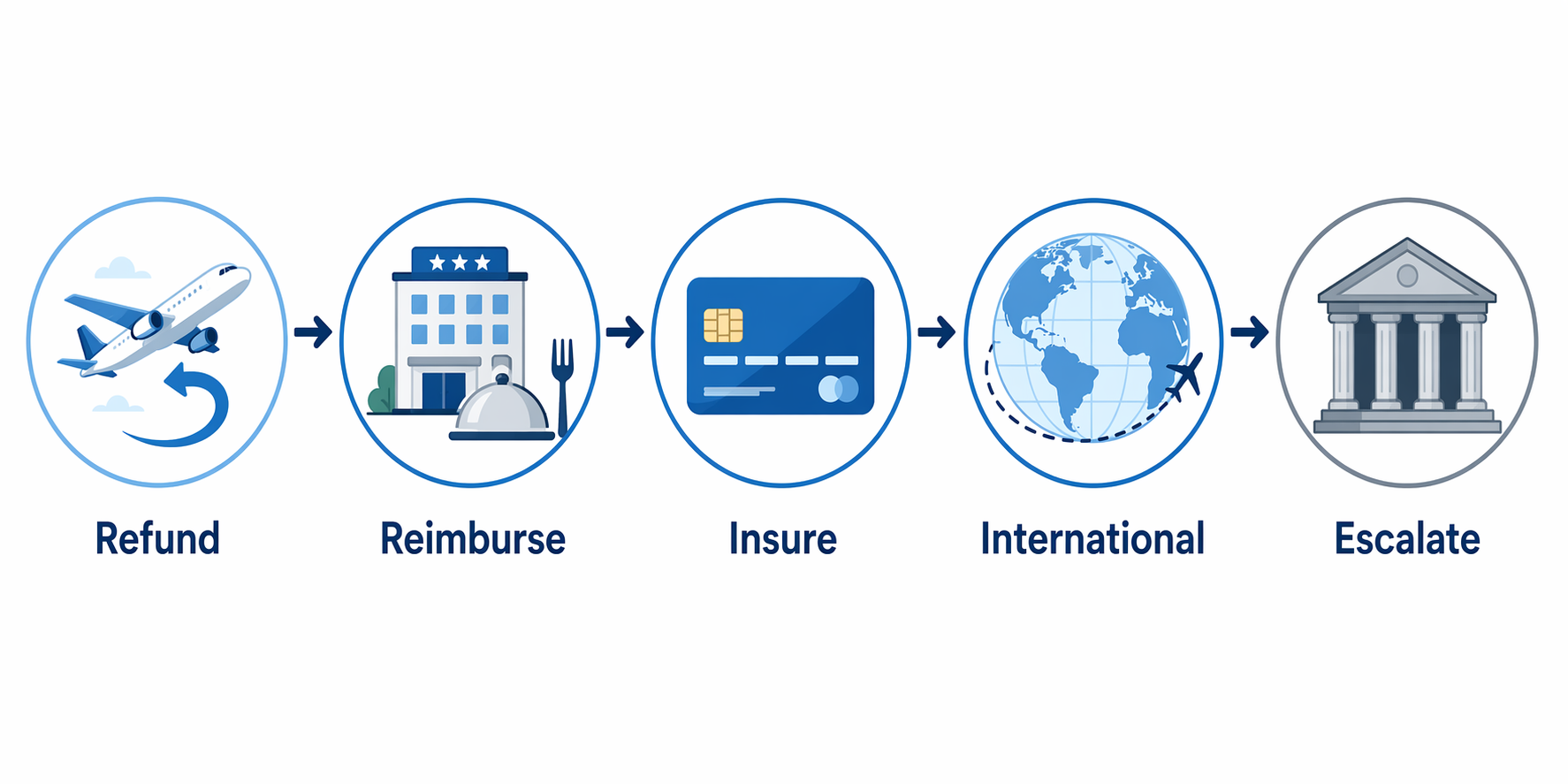
If your flight was canceled, substantially changed, or delayed long enough that you rejected the replacement itinerary, your first question is whether the DOT refund rule applies. If you kept traveling and paid for a hotel, meals, transportation, or a replacement leg, the next question is whether United’s controllable-delay commitments cover those receipts. After that come card benefits, international-law claims, and escalation.
The outage matters because it was not described as weather or air-traffic control. United’s Unimatic system failed around 6:12 pm ET on August 6, 2025, prompting ground stops at major hubs including Chicago O’Hare, Newark, Washington Dulles, San Francisco, and Denver. Reporting documented more than 1,000 delays and roughly 200 cancellations, affecting a substantial share of United’s network.[2] United also treated the disruption as controllable for at least some passenger-care purposes, a classification reflected in public reporting and in the DOT dashboard’s summary of airline commitments for controllable cancellations and delays.[3]
That classification does not turn every delay into a cash payout. It does change the paperwork posture. A passenger who bought dinner during an overnight operational delay is not merely asking United to be nice; they are asking United to honor the category of commitment that applies when the airline controls the disruption.
| Pathway | Use it when | What you are asking for |
|---|---|---|
| DOT refund | Your flight was canceled or significantly changed, and you declined rebooking or alternative transportation | Refund of the unused ticket or fee |
| United controllable-delay reimbursement | You traveled or waited through the disruption and paid for reasonable meals, hotel, or related costs | Reimbursement of out-of-pocket expenses |
| Credit card trip delay insurance | You paid for the trip with a card that includes delay coverage and meet the benefit trigger | Insurance payment for covered delay costs |
| EC 261 or Montreal Convention | Your itinerary has the required international connection to those rules | Statutory compensation or provable delay damages |
| DOT complaint or small claims | United refuses, ignores, or underpays a well-documented claim | Escalation based on the record you built |
First preserve the refund claim
If United canceled your flight and you did not accept rebooking, the refund claim should be handled before you argue about inconvenience. DOT’s refund rule says airlines must provide automatic refunds when a flight is canceled or significantly changed and the passenger does not accept alternative transportation or travel credits. A significant change includes a domestic itinerary changed by three hours or more, or an international itinerary changed by six hours or more.[4]
This is the cleanest money in the file because it is not a sympathy request. It is not a demand for “compensation” for the outage. It is a demand to return the price of transportation United did not provide and that you did not accept in substitute form.
The choice you made at the airport matters. If you accepted United’s rebooking and completed the trip, you usually are not asking for a full ticket refund for the flown transportation. If you declined the replacement itinerary, bought a separate ticket on another carrier, or abandoned the trip after a qualifying cancellation or schedule change, preserve the refund claim with language that matches the rule: canceled flight, qualifying change, alternative transportation declined, refund requested to the original form of payment.
- Keep the original confirmation, ticket receipt, boarding-pass screenshots, cancellation notice, and any United app messages showing the changed itinerary.
- If United offered a travel credit, do not spend it while you are still pursuing a cash refund for the same unused transportation.
- If only part of the itinerary was unused, identify the unused segment instead of demanding a refund for flights you actually took.
- Ask for the refund separately from meals, hotels, taxis, and other delay expenses so United cannot treat the whole submission as one vague complaint.
The practical mistake is accepting a voucher because it arrives faster and then trying to reopen the refund issue later. A voucher may still be useful if you knowingly choose it, but it is not the same as a refund to the original payment method. If the DOT rule applies, the claim should say refund, not goodwill credit.
Then file the controllable-delay reimbursement with United
For passengers who waited out the disruption, got stranded overnight, or had to spend money to continue the trip, the next file is reimbursement. This is where the controllable-delay label does real work. The DOT Airline Cancellation and Delay Dashboard identifies what each airline says it will provide for controllable cancellations and delays, including commitments around meals, hotels, ground transportation, and rebooking.[3]
Use the word reimbursement carefully. You are not asking United to pay a penalty because your plans were ruined. You are asking it to repay reasonable, documented costs caused by a controllable operational disruption. That phrasing fits the category better and avoids the dead-end response that U.S. law does not require general delay compensation.
The strongest United packet is boring: itinerary, disruption proof, itemized receipts, and a short timeline. A hotel folio is better than a credit-card line item. A meal receipt with date, airport, and amount is better than a bank screenshot. A rideshare receipt showing the pickup and destination is better than a statement that you “had to get a taxi.” When a family traveled together, separate the costs by passenger only if the receipt or policy requires it; otherwise, make clear which booking record the expense relates to.
| Expense | Usually easier to support | Usually harder to support |
|---|---|---|
| Hotel | One reasonable overnight hotel after a cancellation or missed connection | Luxury upgrades, extra nights, prepaid lodging at the destination |
| Meals | Moderate meals during the delay window | Alcohol, large group tabs, meals outside the disrupted travel period |
| Ground transport | Airport-hotel-airport rides caused by the delay | Unrelated city travel or destination sightseeing transport |
| Replacement travel | A necessary substitute flight or rail ticket after United could not timely rebook you | A voluntarily upgraded itinerary without showing why it was necessary |
There is no need to write a long airport diary. United needs to know what happened, why the expense was necessary, and what document proves it. A useful reimbursement request can be as direct as: “My United flight was canceled during the August 6 Unimatic outage. United did not provide a same-day replacement itinerary. I incurred the attached hotel and meal expenses while waiting for United’s rebooking. Because this was treated as a controllable delay, please reimburse the attached reasonable expenses.”
If United issued meal or hotel vouchers at the airport and you used them, do not also claim the same amount as a cash expense. If the voucher did not cover the full reasonable cost, claim the unreimbursed difference and attach both the voucher information and the receipt. Duplicate recovery is one of the fastest ways to make an otherwise good file look sloppy.
What not to combine
Do not bundle every loss into one number called “compensation.” A refund request belongs in one lane. Hotel and meal reimbursement belongs in another. Insurance is its own lane. Lost wages, missed events, and emotional distress are harder claims and usually need a different legal theory, if they are recoverable at all. The cleaner the categories, the less room there is for United or an insurer to deny the whole thing because one piece is unsupported.
Use card insurance without waiting too long
Credit card trip delay insurance is often the channel passengers remember too late. It is not a United legal right. It is a benefit under the card agreement, usually triggered only if the trip was paid for with that card and the delay meets the card’s time threshold. NerdWallet notes, for example, that some premium cards may cover eligible delay expenses up to a stated per-ticket limit when the delay exceeds the card’s required period.[5]
Treat insurance as parallel paperwork, not as a complaint letter. The insurer will want proof of payment method, proof of the delay or cancellation, the common carrier statement if available, receipts, and proof that no one else has already reimbursed the same expense. If United has not responded yet, say the airline claim is pending. If United denied the hotel, include the denial. If United paid part of the meal cost, claim only what remains covered under the card terms.
- Check the card used to buy the ticket, not the card used at the hotel.
- Look for the notice deadline; some benefits require prompt opening of a claim even if documents can follow.
- Ask United for written confirmation of the delay or cancellation if the insurer requires a carrier statement.
- Do not claim the same receipt twice as if both United and the insurer should pay it in full.
This channel is especially useful when United refuses a category the card covers, when the airline takes too long, or when the expense does not fit neatly inside United’s controllable-delay commitments but does fit the insurance certificate. The tradeoff is that card benefits are contract-specific. A friend’s premium card result does not prove your card will pay.
Check international rules only if your route actually qualifies
International rules can matter, but they are not a decoration to add to every claim. EC 261 is the clearest example. United flights departing from EU airports may be subject to EC 261, and eligible passengers can seek fixed compensation for arrival delays of three hours or more, with amounts commonly described in the €250 to €600 range depending on distance and circumstances.[6] That is compensation in the true statutory sense, not merely reimbursement of receipts.
The route is the gatekeeper. A United flight departing from Frankfurt to Newark is not the same as a domestic Denver-to-Newark delay. The fact that United is a U.S. airline does not by itself erase EC 261 on qualifying EU departures, but the fact that your trip involved United does not by itself create EC 261 rights either.
For broader international itineraries, the Montreal Convention may allow recovery of actual, provable monetary losses caused by delay. DOT’s Fly Rights guidance describes the delay-liability framework and notes that limits are expressed in Special Drawing Rights, with the practical dollar value changing over time.[7] This is not automatic distress money. It is a damages claim, and the documents have to show the loss, the causal connection to the delay, and why the expense was reasonable.
That difference matters in real files. A missed prepaid hotel night may be easier to frame as an actual loss than a ruined anniversary dinner with no receipt and no refund denial. A replacement train ticket after a missed onward connection is easier to evaluate than a broad demand for the inconvenience of arriving the next day. The Montreal Convention can be useful, but it rewards proof more than indignation.
Escalate only after the claim record is clean
A DOT complaint can help when an airline fails to provide a required refund or ignores a documented passenger-care issue, but it should not be the first document you write if you have not yet asked United for the specific thing you want. Regulators and judges read records. Give them a record worth reading.
Small claims court is the last practical lever, not the first emotional one. DOT’s consumer guidance, “Air Travelers: Tell It to the Judge,” points passengers toward small claims court when they cannot resolve a dispute directly with an airline and the amount fits the court’s limits.[8] That does not mean every outage complaint belongs in court. It means a passenger with a reasonable expense, a clear controllable-delay connection, a written request, and a denial or nonresponse may have a forum that does not require a federal lawsuit.
Before escalating, strip the file down to the part that is actually recoverable. If United refunded the unused ticket but refused the hotel, the dispute is the hotel. If the card insurer paid the meals but United refused the rideshare, the dispute is the rideshare. If the only remaining loss is disappointment, the claim may be real in human terms without being a strong reimbursement or damages claim.
- Send United one final concise demand identifying the amount, receipts, and prior claim number.
- Attach the cancellation or delay proof, not just a narrative.
- Give a reasonable response deadline and keep proof that the demand was submitted.
- Use DOT or small claims for the unresolved category, not for the whole trip unless the whole trip remains unpaid.
The filing order that protects the most value
The safest order is not the loudest order. First, decide whether the unused-ticket refund rule applies. Second, submit United reimbursement for reasonable controllable-delay expenses. Third, open any credit card trip delay claim before the notice deadline expires. Fourth, add EC 261 or Montreal Convention arguments only if the itinerary qualifies. Fifth, escalate with DOT or small claims only after United has refused, underpaid, or failed to answer a clean request.
Passengers affected by the August 6 United outage are not looking for one magic phrase. They are trying to avoid giving up a refund by taking a credit, missing a card-benefit deadline, or turning a reimbursable hotel receipt into a vague demand for pain and suffering. The useful file is organized around recoverability: who owes what, under which rule or promise, and what paper proves it.
For the broader legal analysis of why domestic U.S. delay rights remain narrower than many passengers expect, see our companion article, Compensation rights after United's technology outage. This guide is a practical recovery sequence, not individualized legal advice. If your facts involve a large unreimbursed loss, a complex international itinerary, disability accommodation issues, immigration-related threats, or another separate legal claim, the paperwork order may change. For a related United Airlines legal issue, see What Legal Claims Arise When an Airline Employee Threatens to Call ICE?.
Assemble the itinerary records, receipts, United communications, proof of the cancellation or delay, voucher records, and card-benefit documents. File the strongest direct claim first. Escalate only when the record shows a specific unpaid amount and a specific reason United, an insurer, or another responsible party should pay it.
References
- Airline Passenger Rights; Withdrawal, Federal Register, November 17, 2025.
- United Airlines outage reporting, Reuters.
- Airline Cancellation and Delay Dashboard, U.S. Department of Transportation.
- Refunds, U.S. Department of Transportation.
- Flight Delay Compensation: What United Passengers Need to Know, NerdWallet.
- United Airlines Compensation, AirHelp.
- Fly Rights, U.S. Department of Transportation.
- Air Travelers: Tell It to the Judge, U.S. Department of Transportation.
Comments
Join the discussion with an anonymous comment.