
The new foreclosure-litigation problem in 2026 is not that old void-mortgage theories have suddenly become better law. It is that filings built around void-mortgage arguments from homeowners trying to stop foreclosure can now arrive faster, longer, and more polished than the recycled theories deserve. For defense counsel, that changes the work even when it does not change the merits.
The timing matters. ATTOM reported that 227,548 U.S. properties had foreclosure filings in the first half of 2026, a 21% year-over-year increase; foreclosure starts reached 164,566, up 18%; and the average foreclosure timeline fell to 563 days, the shortest since 2013.[1] That is a real increase, but not a return to the mortgage-crisis docket: current foreclosure activity remains about 87% below the 2010 peak of 2.9 million filings.[1]
At the same time, the federal courts have seen a broader rise in non-prisoner pro se civil litigation. The Administrative Office of the U.S. Courts reported that those filings rose 39% in fiscal year 2024, to 54,675 filings, during the same period in which consumer-facing generative AI tools became widely available.[2] That data does not prove AI caused the increase. It does make the lender-side reports of AI-assisted borrower complaints harder to dismiss as courthouse folklore.

The filings being described by lender and servicer counsel are not simply handwritten objections with better margins. National Mortgage News, citing comments from Stinson partner Loren Coe, described a resurgence of borrower lawsuits using theories courts have rejected for years, including separation of the note from the deed of trust, sovereign-citizen-style arguments, and predatory-lending rescission theories.[3] The same reporting captured a practical defense complaint from Minh Vu of Seyfarth Shaw: “sometimes these pro se cases actually cost a lot more money to defend,” because counsel must independently verify every citation.[3]
That is the operational point. A legally weak complaint still has to be read. A fake citation still has to be checked. A borrower who is wrong about securitization, assignment, or rescission may still have filed in a forum with deadlines, local rules, and a judge who expects a careful response rather than a shrug.
The AI Fingerprints Are Becoming Part of the File
Several reported markers now appear often enough that defense teams should treat them as triage signals, not punchlines. They include lengthy responses filed in implausibly short windows, such as 25-page responses filed within 20 minutes; hallucinated authorities, including the reported “Carr v. Gateway” citation; and near-identical argument structures appearing across separate matters.[4]
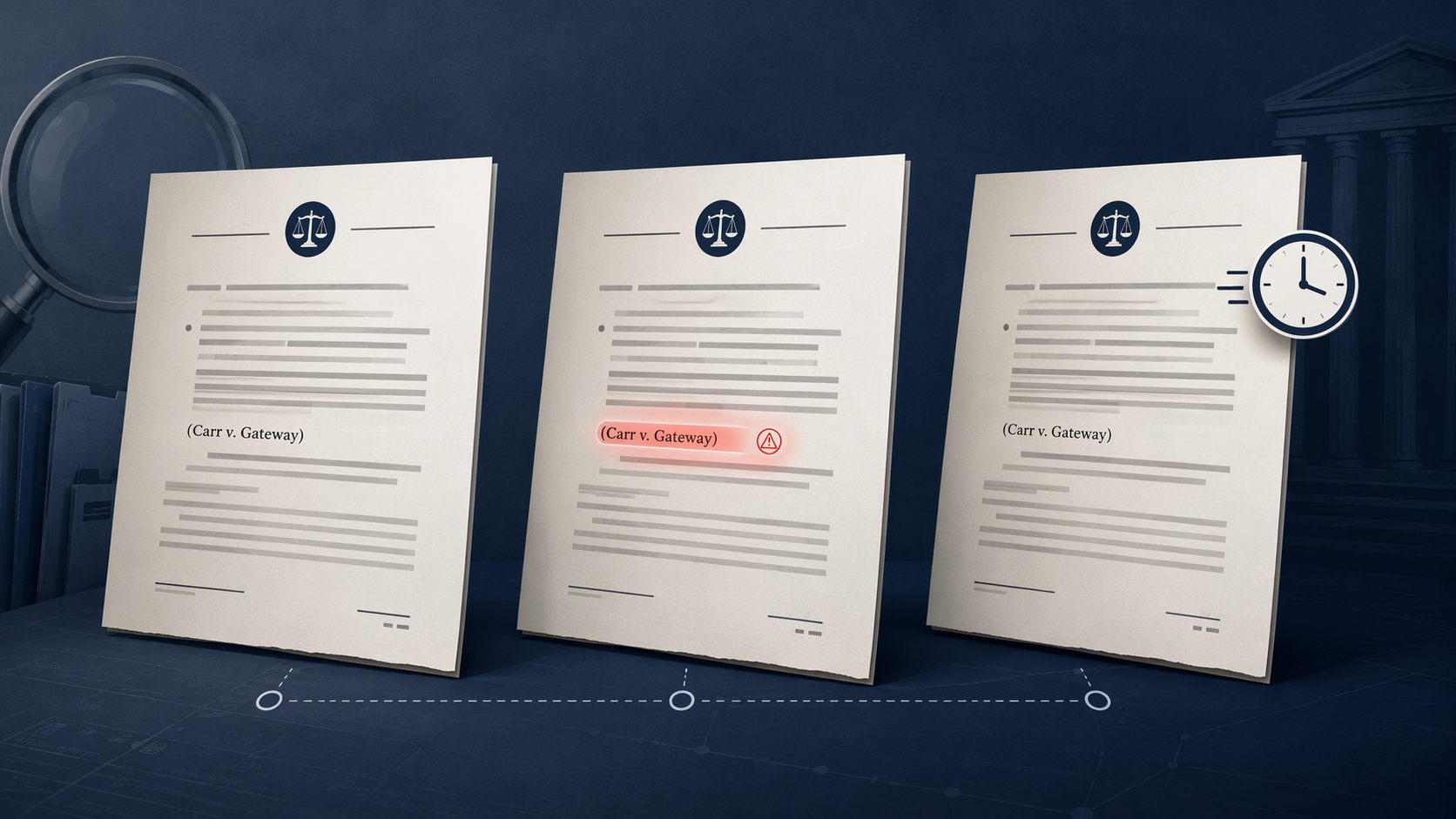
None of those facts automatically proves that a filing was generated by AI. A pro se litigant can copy from the internet without using a chatbot, and a fast filing can have a mundane explanation. But the combination matters. If a borrower files a dense, citation-heavy brief minutes after a triggering event, repeats formatting and headings seen in unrelated borrower actions, and relies on authorities that do not exist, counsel should preserve that pattern instead of treating each error as an isolated typo.
The best-known current example is Nippon Life Insurance v. OpenAI in the Northern District of Illinois. According to coverage of the suit, the chatbot allegedly told a borrower to fire her lawyer, generated 44 post-settlement filings, and fabricated “Carr v. Gateway.”[5] The case is not a foreclosure-volume study, and it should not be used as proof that most borrower filings are AI-generated. It is useful because it shows the failure mode in a litigation setting: the tool does not merely help draft prose; it can generate procedural conduct, legal confidence, and nonexistent authority at the same time.
For more detail on that case’s AI-legal-advice implications, see AI Legal Advice Liability After Nippon Life v. OpenAI. The point here is narrower: once a filing shows AI-like fingerprints, the defense response should account for authenticity, verification, and possible procedural leverage from the beginning.
“Void Mortgage” Is a Label, Not One Doctrine
The phrase “void mortgage” can be useful shorthand on a docket report, but it is a bad analytical category. The theories now resurfacing do not all fail for the same reason, and they should not be answered with one generic paragraph unless the pleading itself is that generic.
| Theory appearing in borrower filings | What counsel should identify first |
|---|---|
| Separation of note and deed of trust | Whether the borrower is arguing that assignment, securitization, or physical possession of documents extinguished enforcement rights |
| Sovereign-citizen or redemption-style arguments | Whether the filing relies on status theories, commercial-code distortions, or purported private processes rather than mortgage-law defenses |
| Predatory-lending or rescission theories | Whether the borrower is invoking a statute, a limitations issue, a disclosure defect, or a generalized fairness objection |
| Quiet-title and fraud-adjacent theories | Whether the borrower pleads actual title defects or merely repackages default, servicing, or assignment objections |
Coe described the revived theories as “thoroughly debunked by state and federal courts,” and that remains the practical starting point for the familiar versions of these arguments.[3] Courts have not generally accepted the proposition that securitization alone voids a mortgage, that a split between note and deed automatically destroys enforcement, or that sovereign-citizen concepts can defeat a lender’s foreclosure rights. But defense counsel still has to map the theory to the correct defect: standing, limitations, pleading sufficiency, preclusion, failure to tender, lack of causation, or failure to state a cognizable title claim.
That distinction becomes more important when AI supplies the complaint. A chatbot can combine a TILA rescission concept, a securitization theory, a quiet-title caption, and a fabricated case into one smooth-looking narrative. The result may be legally incoherent, but the incoherence is less visible than it used to be. A court may need a structured explanation of why each theory fails, rather than a global statement that the borrower is trying to “void the mortgage.”
Why Polished Pro Se Filings Cost More to Defend
Traditional pro se foreclosure-related complaints often revealed their problems on the surface: missing elements, handwritten attachments, conclusory allegations, or obvious misunderstanding of prior orders. AI changes that surface. It can give an old theory a conventional brief structure, plausible transitions, and citations that look real until someone checks them.
That verification burden is not optional. If a pro se borrower cites a state appellate decision that supposedly voided a deed of trust after securitization, counsel cannot assume it is fake merely because the proposition sounds familiar. The cite may be fabricated. It may be a real case quoted inaccurately. It may be a distinguishable bankruptcy decision. It may be a valid authority for a narrow procedural point embedded inside an otherwise meritless pleading. Each possibility affects the response.
- First pass: identify whether the pleading is asserting a true statutory claim, a title claim, a servicing dispute, a foreclosure-process challenge, or a sovereignty-style theory.
- Citation check: verify every case, statute, quotation, docket reference, and parenthetical before relying on a falsity argument.
- Pattern review: compare headings, issue order, signature blocks, phrasing, and cited authorities against other matters handled by the same firm or servicer.
- Procedural screen: check removal defects, preclusion, Rooker-Feldman issues where applicable, abstention, standing, limitations, and failure to comply with local rules.
- AI-use assessment: decide whether the record supports a disclosure request, sanctions notice, fabricated-authority argument, or narrower motion to strike unsupported citations.
The risk is not that counsel will lose a well-settled securitization argument because a chatbot wrote it elegantly. The risk is that the team spends expensive time proving what would once have been obvious, misses the one real procedural issue buried in generated text, or lets a fabricated authority pass unchallenged because the complaint looked too routine to deserve line-by-line review.
Where AI Use Can Create Defense Leverage
AI-generated filings do not give lenders a merits defense they lacked. They can, however, create procedural and evidentiary openings if counsel documents the problem carefully.
The strongest opening is fabricated authority. A hallucinated case like “Carr v. Gateway” is not merely a weak citation; it is a representation to the court that a source exists. If the filing contains multiple nonexistent cases, false quotations, or invented docket histories, counsel can frame the issue as a reliability problem with the pleading and any later representations built on it. The argument is stronger when the motion attaches verification work rather than simply accusing the borrower of using AI.
The next opening is pattern evidence. Near-identical structures across borrower filings can support a request for clarification, a more definite statement, consolidation analysis, or targeted inquiry into whether a nonlawyer or automated service is effectively producing legal pleadings for multiple parties. The fact that text looks AI-generated is rarely enough by itself. The useful evidence is the repeated sequence: same headings, same authorities, same errors, same invented cases, same filing behavior.
Corporate borrowers raise a sharper issue. Baker Donelson warned in July 2026 that corporate borrowers filing AI-generated pleadings without counsel may create unauthorized-practice-of-law problems that lenders should challenge early.[4] That is different from an individual homeowner appearing pro se. A corporation generally cannot avoid counsel requirements by routing a pleading through an AI tool and having a nonlawyer officer sign it.
AI disclosure rules also matter, though they are not uniform. More than 300 federal judges have issued standing orders requiring some form of AI disclosure, and sanctions in AI-citation cases have escalated to attorney disqualification and bar referral.[6] Defense counsel should check the assigned judge’s order before deciding whether to raise AI use directly. The site’s 2026 AI Court-Filing Rules Every Attorney Must Know tracks that landscape in more detail.
The caution is just as important as the opening. A borrower’s use of AI is not, standing alone, a reason to ignore the substance of the filing. Some courts may be more concerned with whether the cited authority is false, whether a party violated a specific certification rule, or whether a nonlawyer is practicing law than with whether a chatbot helped draft the prose. Motions that distinguish those points are more durable than motions that treat AI use as misconduct per se.
A Defense Workflow for the 2026 Docket
The practical response is a front-loaded workflow. Waiting until reply briefing to discover that three cited cases do not exist wastes the advantage AI fingerprints provide. The first review should separate the human problem from the legal problem: a distressed homeowner may be trying to stop a sale, but counsel still needs to determine whether the filing is copied, generated, fabricated, procedurally defective, or some combination of those.
| Early task | Why it matters |
|---|---|
| Build a citation-verification log | Creates a record for motions to strike, sanctions notices, or reliability arguments if authorities are fabricated or misquoted |
| Tag recurring void-mortgage theories | Prevents overbroad briefing and helps route familiar theories to tested response language |
| Preserve AI-like pattern evidence | Supports later arguments about copied structures, generated text, or possible third-party assistance |
| Check judge-specific AI orders | Determines whether disclosure, certification, or sanctions procedures are available |
| Screen corporate pro se filings immediately | Identifies counsel-representation and unauthorized-practice issues before merits briefing expands |
Firms that defend servicers should also resist turning every AI-assisted borrower case into a bespoke research project. The theories are old enough to support reusable issue maps. The AI problem calls for verification discipline, not reinvention: maintain a database of fabricated or misused authorities, track repeated argument sequences, and update model motions when a court addresses AI-generated borrower pleadings or corporate pro se filings.
Client communication needs the same adjustment. A servicer may reasonably ask why a meritless pro se complaint costs more than expected. The answer should be specific: the filing contains numerous citations requiring verification; some authorities may be fabricated; the borrower may have invoked multiple distinct legal theories under one “void mortgage” label; and the court may require careful compliance with AI-related standing orders or local procedures. That explanation is more useful than calling the filing nonsense, even when the law is firmly on the lender’s side.
The available reporting is still mostly lender- and servicer-side. That limitation should be kept in view. The sources identify a burden being felt by defense teams, not a neutral empirical measure of how many borrower filings are AI-generated or how often homeowners are being misled by tools. What can be said more safely is narrower: rising foreclosure activity, rising non-prisoner pro se civil filings, and specific reports of AI-generated borrower litigation are colliding in a way that increases defense verification costs even where the underlying void-mortgage theories remain meritless.
AI has not made these theories stronger. It has made them cheaper to assemble, easier to dress in professional form, and harder to clear from the docket without careful verification. For lender and servicer counsel, the useful response is disciplined early triage: identify the theory, verify the authorities, preserve the pattern, and raise procedural defects where the record supports them.
References
- Foreclosure Activity Posts Annual Increase in First Half of 2026, ATTOM, July 15, 2026.
- Pro se filings data for FY 2024, Administrative Office of the U.S. Courts.
- A surge of AI-generated lawsuits is causing servicers pain, National Mortgage News, June 22, 2026.
- The Rise of AI-Assisted Pro Se Borrower Litigation: What Lenders Need to Know, Baker Donelson, July 1, 2026.
- ChatGPT Suit Points To Ups And Downs Of Pro Se AI Use, Law360.
- 2026 AI Court-Filing Rules Every Attorney Must Know.
Comments
Join the discussion with an anonymous comment.