
For anyone evaluating Walmart’s legal liability after the Cyclospora lettuce recall, the first useful fact is narrow: Walmart sold recalled Marketside iceberg lettuce products, but the available public facts point upstream to Taylor Farms as the processor-supplier. That distinction does not remove Walmart from a complaint. It does decide what kind of complaint has a chance of surviving.
The recall covered four Marketside iceberg lettuce products distributed through Walmart in 27 states, with product-specific UPCs and best-by dates running from July 18 through Aug. 3, 2026.[1][2] Those UPCs and dates are not mere consumer-service clutter. In a foodborne-illness case, they help tie a purchaser to a particular product run, a retailer, a supplier, and a recall window. They are the bridge between “I bought lettuce at Walmart” and “I bought this recalled lettuce during the implicated period.”
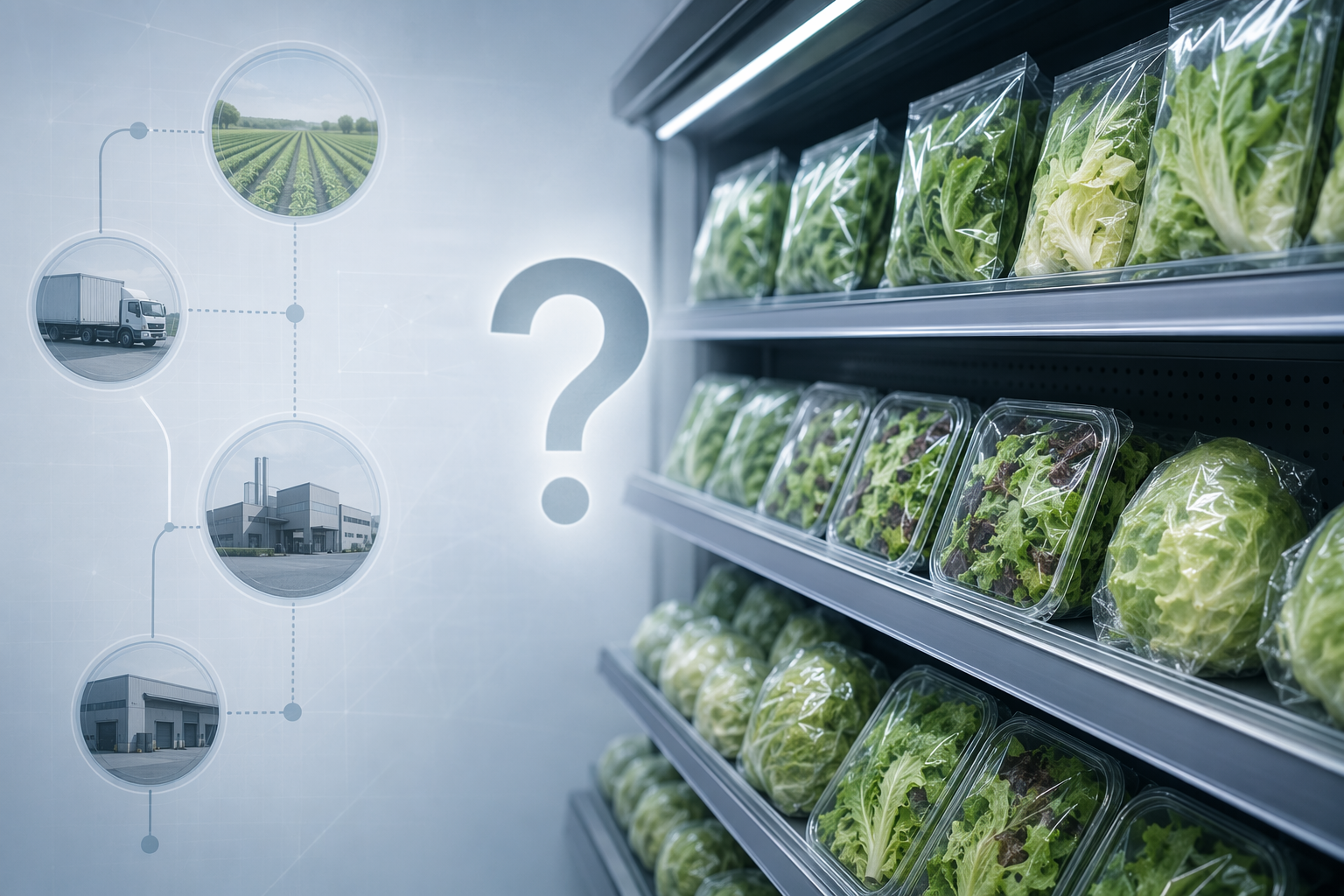
That bridge matters because food-liability pleading is not the same exercise as recall reporting. A public-health notice can name a retailer because the product was sold there. A lawsuit has to explain why that retailer is legally responsible for the injury.
The sealed-product problem for strict liability
The cleanest theory in contaminated-food litigation is strict liability: the plaintiff does not have to prove that the defendant acted carelessly, only that the defendant sold a defective food product that caused injury. In food cases, contamination is the defect. But when the defendant is a retailer that sold a sealed, unaltered product, most states do not treat the retailer the same way they treat the manufacturer or processor. Marler Clark’s general product-liability framework describes the majority rule this way: retail sellers of sealed products are commonly protected from strict liability when they did not manufacture, alter, or control the product defect.[3]
That rule is why “sold at Walmart” cannot be shortened into “strictly liable Walmart” in many jurisdictions. If the lettuce was sealed when Walmart received it, remained unaltered on the shelf, and was contaminated before it entered Walmart’s hands, the strict-liability claim often belongs against the entity that grew, processed, packed, or distributed the contaminated product, not against the retailer that passed along the package.
There is, however, a material exception. Some states impose strict liability on all sellers in the chain of distribution, even when the seller is a nonmanufacturing retailer. Under that minority approach, Walmart’s lack of direct contamination control may be relevant to indemnity or comparative responsibility, but it does not necessarily keep Walmart out of the case at the pleading stage.[3]
| Retailer-liability posture | What it means for Walmart |
|---|---|
| Majority sealed-product rule | A strict-liability claim against Walmart is harder if Walmart sold a sealed, unaltered product contaminated upstream. |
| Minority chain-of-distribution rule | Walmart may face strict-liability exposure simply because it was a seller in the distribution chain. |
| Negligence theory | The issue shifts from who contaminated the lettuce to what Walmart knew or should have known about supplier risk. |
| Recall-response theory | The focus moves to whether post-recall communication was adequate for ordinary consumers. |
This is also where a national recall becomes legally uneven. The recalled lettuce moved through Walmart stores across 27 states, but product-liability doctrine is not nationally uniform.[1][2] A plaintiff in a chain-of-distribution state may have a materially different strict-liability path than a plaintiff in a state that shields sealed-product retailers. A serious case assessment would require jurisdiction-specific statutory and case-law review, not a generic 50-state assumption.
Negligence is the more fact-hungry theory
Negligence asks a different question. It does not require Walmart to be the entity that introduced Cyclospora into the lettuce. It asks whether Walmart acted reasonably in sourcing, approving, monitoring, continuing to buy from, and responding to a supplier whose food-safety history was not blank.
That is where Taylor Farms’ prior outbreak history becomes legally interesting, without becoming automatic proof. Marler Blog connects Taylor Farms to a 2013 Cyclospora outbreak involving 631 reported illnesses across 25 states, and to a 2018 E. coli romaine outbreak in which 149 people were reported sick.[4] CNN’s 2026 recall coverage also linked Taylor Farms to the 2024 McDonald’s Quarter Pounder onion outbreak, reporting 104 illnesses, one death, and FDA poor-sanitation findings.[5]
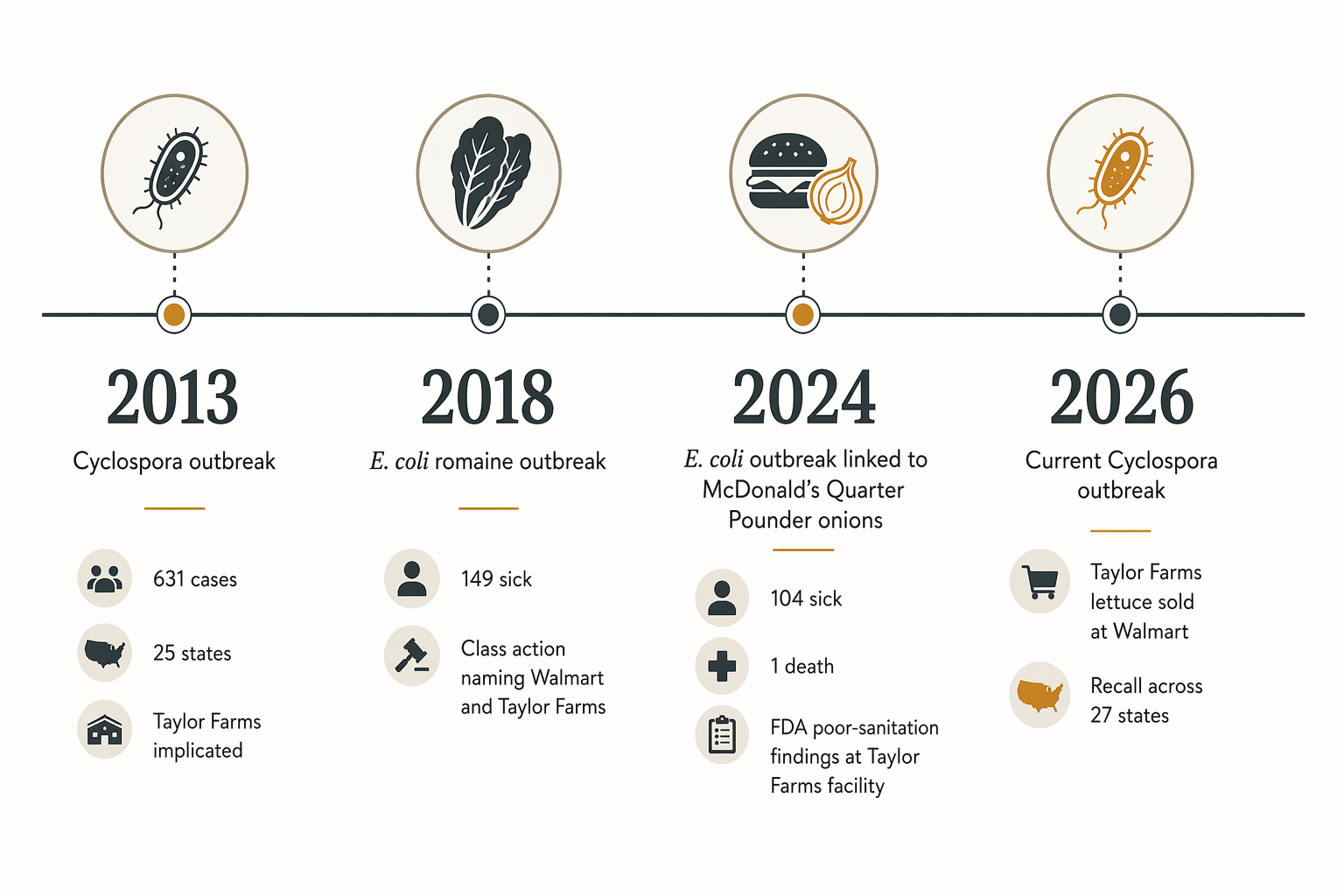
A plaintiff would likely use that history to argue constructive notice: Walmart did not need to know that this particular bag of lettuce was contaminated if the supplier’s prior outbreak record made heightened review, stronger contractual controls, additional auditing, or different sourcing decisions reasonably necessary. The argument would be less “Walmart caused Cyclospora” than “Walmart had enough information to treat this supplier relationship as higher risk.”
The defense response is equally predictable. Prior outbreaks do not prove the same pathogen, product, facility, field, grower, handling step, or failure mode in 2026. A retailer can argue that it relied on supplier certifications, audits, regulatory oversight, and ordinary commercial food-safety systems unless plaintiffs can identify a concrete warning that Walmart ignored. Constructive notice is not a doctrine for turning every past supplier incident into present negligence; it depends on similarity, timing, access to information, and what a reasonable retailer would have done with that information.
The 2018 litigation matters because this route has been attempted before. Courthouse News Service reported a class action naming both Walmart and Taylor Farms over E. coli-tainted romaine lettuce.[6] That filing does not establish liability in the 2026 Cyclospora outbreak. It does show that plaintiffs have previously treated Walmart as more than a passive storefront when Taylor Farms produce was implicated.
For a deeper supplier-side treatment of how repeated outbreaks may affect Taylor Farms’ own exposure, see How Taylor Farms' Repeat Outbreaks Affect Lettuce Recall Liability. The Walmart question is narrower: whether a large retailer’s supplier-management duties become sharper when the supplier’s public record includes multiple serious foodborne-illness events.
Traceback uncertainty cuts both ways
As of July 21, 2026, the Cyclospora investigation remains ongoing. CDC identifies the outbreak investigation as active, and FDA’s traceback work remains part of the public record rather than a completed litigation-grade causation finding.[7][8] That matters because the public-health system can act on epidemiological signals before every evidentiary dispute has been resolved in the way a court may later require.
The FDA’s handling of a reported positive Cyclospora result, later treated as a false positive, is a caution against overstating traceability language.[8] It is not a reason to pretend the recall had no basis. Lab uncertainty and epidemiological association are different evidentiary categories. Plaintiffs will try to assemble purchase records, product identifiers, illness timing, public-health findings, and supply-chain documents into causation. Defendants will test each link.
For Walmart, that uncertainty may be useful on causation and supplier-identification issues, especially before discovery. It does not eliminate the retailer’s litigation cost. A named retailer in a multi-state outbreak still has to preserve records, coordinate indemnity positions, answer complaints where filed, and decide whether early dismissal is realistic under the governing state law.
Recall notice is a separate exposure point
Recall adequacy should not be used as a shortcut around product-liability doctrine. A confusing notice does not prove Walmart contaminated lettuce. But recall communication can matter if plaintiffs argue that consumers were not given a practical chance to identify and discard the implicated product.
Bill Marler criticized the recall notice for using unreadable brand abbreviations, writing that it was “not very helpful to the average consumer.”[4] That criticism is more than a stylistic complaint. In a retail recall, the legally relevant question is whether the notice reaches the person who actually has the product in the refrigerator and gives that person enough usable information to act.
UPCs, lot codes, best-by dates, and product abbreviations are necessary for precision. They can also fail as consumer communication if the ordinary buyer cannot translate them into a purchase decision. A retailer with point-of-sale data, loyalty-account records, online-order histories, store signage, app notifications, and return channels may face questions not only about what the formal recall said, but about how hard it tried to make the warning intelligible.
That theory is narrower than a contamination claim. It would likely depend on timing, notice content, available customer-contact tools, and whether any plaintiff’s illness plausibly occurred after a recall warning should have reached them. Still, it is the kind of issue that keeps a retailer in the litigation conversation even when the farm or processor remains the more obvious contamination defendant.
Where Walmart's exposure stands now
On the public facts available now, Walmart is not the central contamination defendant. The stronger first-line product case points to the entities that grew, processed, packed, or supplied the lettuce before it reached Walmart shelves. But Walmart is not legally invisible simply because contamination appears to have happened upstream.
Its exposure is real in three places: states that impose strict liability on all sellers in the distribution chain; negligence claims built around what Walmart knew or should have known about Taylor Farms’ outbreak history; and recall-response claims arguing that the warning was too difficult for ordinary consumers to use. Each theory requires different evidence. None is proved by the recall alone.
That is the practical liability posture as of July 21, 2026: constrained, jurisdiction-dependent, and still developing with the investigation. The recall puts Walmart in the factual chain. State law, supplier-risk evidence, and post-recall conduct will decide whether that factual role becomes legal responsibility.
References
- Walmart pulls lettuce linked to cyclospora outbreak, USA Today
- Cyclospora-Linked Lettuce Sent to 27 States, Consumer Reports
- Strict Liability and Negligence, Marler Clark
- The Cyclospora Outbreak Now Has Two Names on It, Marler Blog
- Iceberg lettuce recalled in 27 states, CNN
- Walmart, Farmers Face Lawsuit Over Tainted Lettuce, Courthouse News Service
- Cyclospora Outbreak page, CDC
- Investigation page, FDA
Comments
Join the discussion with an anonymous comment.