
A legal AI buying meeting in Q3 2026 can look unusually confident on the surface. The vendor has a polished workflow demo, the pilot team wants relief from repetitive review, and the budget owner has market data showing that legal AI is not some speculative side category anymore. New Market Pitch reports $1.414 billion in pure-play legal AI funding year to date across 31 deals, up 59% year over year in capital deployed.[1]
Law firms are not sitting still either. The 2026 Report on the State of the US Legal Market from Thomson Reuters and Georgetown Law’s Center on Ethics and the Legal Profession says law firm technology spending rose 39.3% from 2021 to 2025, and firms with a clear AI strategy were four times more likely to see return on investment.[2] That is exactly the kind of fact procurement teams cite when they want to move beyond one-off experimentation.
The weak point is not always whether there is money for legal AI. There plainly is. The more uncomfortable question is whether buyers will still have enough neutral evidence to decide which claims deserve trust. That is where the White House AI funding redirect begins to matter for legal tech: not as an immediate freeze on product development, but as an upstream pressure on the research, benchmarks, and talent that make vendor promises testable.

The Boom Is Real, But It Is Not Evenly Distributed
The legal AI market is attracting capital, but the distribution of that capital matters. New Market Pitch’s 2026 data uses a pure-play legal AI filter, meaning companies must dedicate at least 80% of their activity to legal AI software. Within that narrower category, 82.5% of year-to-date capital went to Series B or later companies, while first financings captured only 8.1%.[1]
That combination should make buyers pause. A market can show rising deal count and still become harder for early entrants. New Market Pitch also reports legal AI deal count up 82% year over year, so the problem is not a lack of company formation by itself.[1] The problem is that the capital center of gravity has moved toward better-funded platforms at the same time the public research base behind many AI methods is under strain.
For procurement teams, this distinction is practical. Later-stage vendors can afford larger sales teams, better-looking evaluation portals, and more sophisticated claims about accuracy, speed, and risk reduction. Smaller entrants may still have strong ideas, but less access to research talent, fewer resources for independent evaluation, and a harder time building evidence that survives a risk committee.
| Market Signal | What It Actually Tells A Buyer |
|---|---|
| $1.414B in pure-play legal AI funding YTD 2026 | Legal AI is attracting serious capital, not disappearing. |
| 82.5% of capital to Series B+ companies | The funding advantage is concentrated among more mature platforms. |
| 8.1% of capital to first financings | Early-stage formation may be more exposed to weaker research and talent pipelines. |
| 39.3% rise in law firm tech spending from 2021-2025 | Buyers are already increasing spend before the validation infrastructure is settled. |
The $200B Redirect Lands Upstream From The Vendor Demo
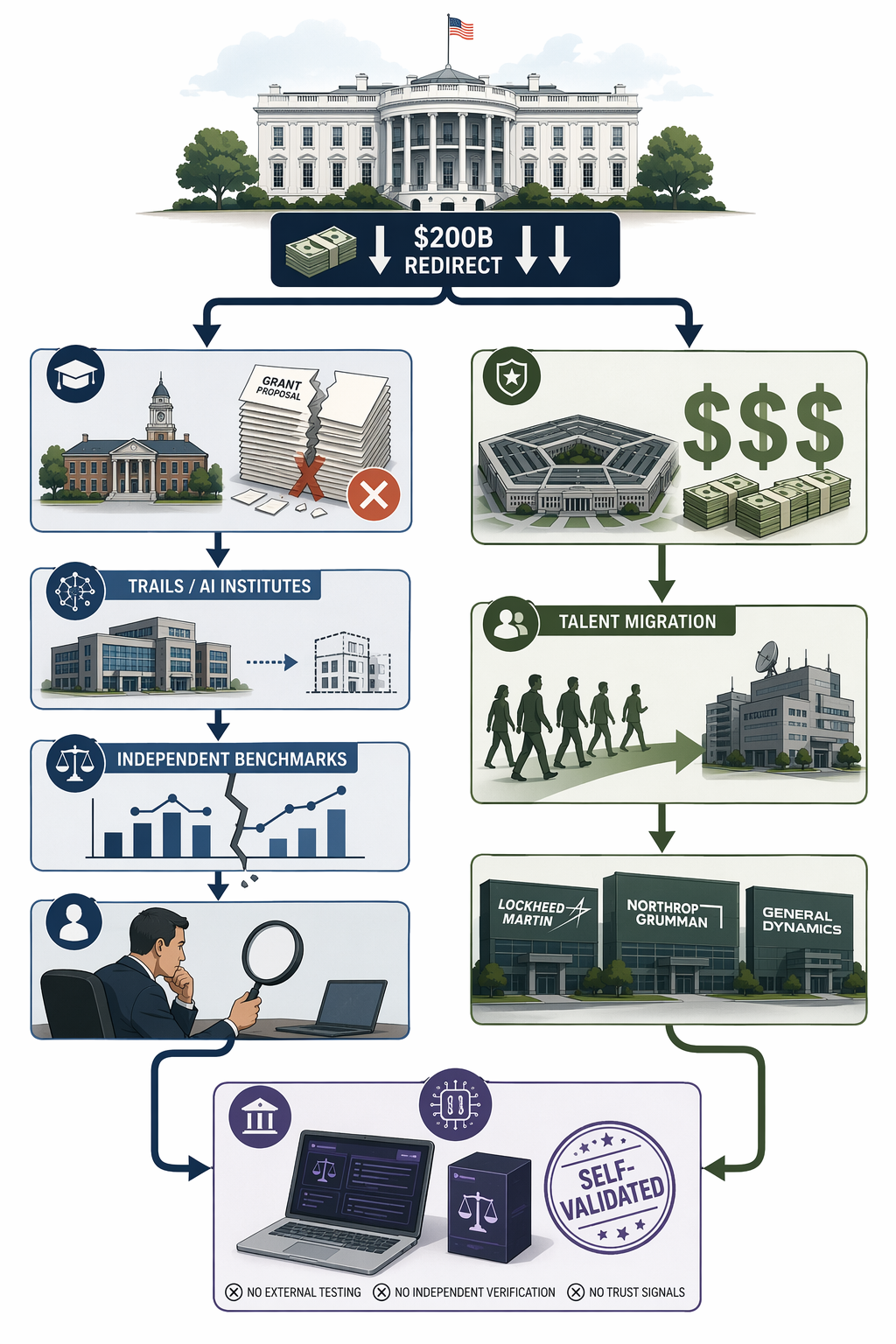
The July 2026 policy move has been described in secondary summaries of a Wall Street Journal report as a White House Office of Science and Technology Policy plan to redirect roughly $200 billion a year in federal research and development funding away from universities and toward individual scientists and AI-related priorities.[3] The original Journal article is paywalled, so the implementation mechanics should be treated with some caution. That caveat matters. A procurement team should not build a risk memo on a caricature of a memo it has not seen.
Even with that uncertainty, the broader funding pullback around university research is not theoretical. Just Security has tracked more than 1,600 National Science Foundation grant cancellations worth more than $1 billion.[4] The Urban Institute has reported more than $3 billion in terminated National Institutes of Health grants.[5] Those figures are not legal-AI-specific, and there is no public count in the provided materials showing exactly how many computational-law, legal NLP, or legal benchmarking projects have been cancelled. The narrower conclusion is enough: the public research environment that supports AI evaluation is becoming less stable.
Legal AI depends on work that often does not carry a legal tech label when it starts. Retrieval evaluation, natural language processing, human annotation methods, model robustness, hallucination detection, benchmark design, privacy-preserving data use, and trustworthy AI research can all later appear inside a contract review tool, litigation research assistant, or compliance workflow. When university labs lose grant support, the effect does not arrive as a simple missing feature in next quarter’s release. It shows up later as fewer independent comparisons, thinner methodological debate, and a smaller pool of researchers trained outside a vendor’s own incentive structure.
Trustworthy AI Research Is Part Of Legal Tech Infrastructure
Legal buyers tend to ask vendors for accuracy numbers as though those numbers are ordinary product specifications. They are not. An accuracy claim only becomes useful when the buyer understands the task, the data set, the baseline, the human review standard, the failure definition, and whether the evaluation was run by anyone with independence from the sale.
That is why institutes such as Trustworthy AI in Law & Society, known as TRAILS, matter beyond academia. TRAILS is an NSF AI Research Institute at the University of Maryland focused on trustworthy AI in law and society. Brookings has identified uncertainty around NSF AI Research Institutes as the NSF faces a proposed 57% budget cut.[6] The provided materials do not establish that TRAILS has lost a specific grant or that a particular legal AI benchmark has been cancelled. The risk is structural: the kinds of institutions that can test legal AI claims without needing to close a software deal are facing a less predictable funding environment.
That distinction is more than academic housekeeping. A legal research assistant can perform well on a vendor-selected sample and still behave poorly on messy jurisdictional edge cases. A contract tool can extract clauses quickly and still miss business meaning when provisions are cross-referenced across schedules. A compliance assistant can summarize a policy correctly and still fail when asked to apply it to a borderline fact pattern. Independent evaluation does not eliminate those problems, but it gives buyers a better way to see them before deployment.
Without that layer, procurement starts to drift toward theater. The vendor brings its own benchmark. The buyer supplies a small pilot set under time pressure. The legal team reviews the outputs after normal work hours. Everyone agrees the tool is promising, but no one can say whether it outperformed a cheaper workflow, whether its failures are tolerable, or whether its test set resembles the work that will actually be delegated after rollout.
Defense Pull Matters Because Talent Follows Funded Problems
The defense-sector piece should not be overstated into a claim that legal AI talent will simply vanish into military contracting. The supportable point is narrower. Brookings reports that federal AI contract value surged to $91.8 billion in 2026, with the Department of Defense commanding 98.9% of federal AI spend and $90.7 billion in potential value.[6] That is a powerful signal about where federal AI dollars are concentrating.
Talent markets respond to that signal. Doctoral students, postdocs, applied researchers, and technical founders do not choose projects in a vacuum. They look for funded labs, available compute, stable grants, hiring managers, and problems that can support a career. If federal AI spending becomes more concentrated around defense contractors while university grants become less reliable, legal AI vendors will compete for people in a market shaped by actors with deeper and more durable public funding relationships.
Brookings also reports that 87% of federal AI vendors hold only one or two contracts, while women-owned businesses received 0.05% of federal AI contract value.[6] Those figures are not about legal tech adoption. They do, however, show that the federal AI market can become highly uneven even while total spending rises. Legal AI buyers should recognize the pattern: aggregate funding can look abundant while access to it narrows.
Europe’s Share Is A Warning About Geography, Not A Victory Lap
New Market Pitch reports that Europe captured 64.3% of pure-play legal AI capital year to date in 2026, or $908.8 million, driven by companies including Legora, Orbital, Wordsmith, and Lexroom. Legora alone accounted for a $550 million Series D.[1] That does not mean European legal AI has solved evaluation, trust, or procurement risk. It does suggest that innovation geography is not fixed.
If U.S. university pipelines weaken while European companies attract larger rounds, U.S. buyers may see a more international vendor slate. That can be healthy. It can also complicate diligence. Data residency, privilege assumptions, professional responsibility rules, regulatory posture, model-hosting arrangements, and training-data disclosures all become harder to compare when vendors mature in different legal and research environments.
The procurement issue is not whether a tool is American or European. It is whether the buyer can understand who tested it, under what conditions, against which legal tasks, and with what independence from the company’s revenue plan.
University Spinouts Cannot Fully Replace Public Research
Universities are not passive in this shift. Global Venturing has reported that U.S. universities are ramping up spinout fund creation as government funding is cut.[7] That response makes sense. If public grants become less dependable, universities will try to move more research into commercial channels and capture more value from intellectual property.
Spinout activity can help legal AI. Some of the best procurement conversations happen when a vendor has a real research lineage, not just a marketing slide with “AI-powered” attached to every noun. But commercialization changes incentives. A university lab can publish negative findings, compare competing approaches, or build a benchmark that makes several vendors uncomfortable. A venture-backed spinout has stronger reasons to emphasize its own method, protect its data advantage, and prioritize evidence that supports sales.
Both forms of work are useful. They are not interchangeable. Legal tech needs companies that ship products, but buyers also need institutions that can say a product did not perform well, or only performed well on a narrow task, without worrying that the finding will damage next quarter’s pipeline.
What Changes At The Buyer’s Desk
The White House AI funding redirect will not necessarily appear as fewer vendor emails or slower product launches. Buyers may experience the opposite: more polished tools, better-capitalized platforms, and more confident sales claims. The strain appears in the evidence layer.
- More reliance on vendor self-validation: Buyers may receive impressive task-performance claims without an independent benchmark behind them.
- Harder tool-to-tool comparisons: If vendors test on different data sets, define errors differently, and report different metrics, procurement teams cannot compare products cleanly.
- Wider gaps between large platforms and smaller entrants: Later-stage companies can fund their own evaluations and sales engineering, while early-stage teams may struggle to prove quality.
- More pressure on internal pilots: Legal teams will need stronger in-house test design if external benchmarks become thinner.
- More opaque talent dependencies: Vendors may rely on research advances, contractors, or academic collaborations that are not visible in ordinary security and procurement questionnaires.
This is where AI strategy stops being a slogan. A firm or legal department that wants ROI from AI cannot treat evaluation as an afterthought. The same Thomson Reuters and Georgetown report that found a 39.3% increase in law firm tech spending also found that firms with clear AI strategy were four times more likely to see ROI.[2] Strategy, in this context, includes knowing what evidence is acceptable before the vendor enters the room.
For more on how infrastructure cost and firm economics are already shaping legal AI adoption, see the analysis of law firm tech spending and legal AI costs. The financial-pressure side of the same problem also shows up in AI jitters and law firm financial strategy, where the risk is not simply whether firms buy AI, but whether they buy it with a defensible operating model.
A Better Q3 2026 Diligence Standard
Legal AI buyers do not need to wait for perfect public benchmarks. They do need to stop accepting evaluation language that collapses under basic questioning. In current conditions, diligence should separate product capability from proof quality.
- Ask where the benchmark came from: vendor-created, customer-created, academic, third-party lab, bar association, court data, or internal buyer sample.
- Ask what the number measures: retrieval accuracy, answer correctness, citation validity, extraction precision, review speed, human agreement, or downstream legal outcome.
- Ask who reviewed failures: vendor staff, buyer lawyers, outside experts, trained annotators, or no human reviewer at all.
- Ask whether the test set resembles the buyer’s work: jurisdiction, document type, language, privilege sensitivity, matter size, and edge-case frequency.
- Ask what research dependencies the vendor can disclose: academic collaborations, licensed models, open-source components, third-party evaluators, and staff with relevant research backgrounds.
- Ask how the tool is retested after model updates: static annual review is not enough for systems whose behavior can change with model, retrieval, or instruction updates.
Those questions will not make every answer comparable. They will reveal which vendors understand evaluation as an operational discipline and which vendors are using benchmark language as a sales prop.
The funding redirect is not starving legal AI of money today. The market data does not support that claim. It is starving, or at least destabilizing, part of the ecosystem that helps legal professionals know which AI claims to trust tomorrow. In Q3 2026, the safer buyer is not the one who refuses legal AI. It is the one who treats independent validation, research provenance, and benchmark quality as procurement requirements rather than post-demo paperwork.
References
- Legal AI funding data, New Market Pitch, 2026, link
- 2026 Report on the State of the US Legal Market, Thomson Reuters and Georgetown Law Center on Ethics and the Legal Profession, 2026, link
- Trump administration to redirect federal research funding toward AI, CryptoBriefing, 2026, link
- Tracking the Trump Administration’s Attacks on Science, Just Security, 2026, link
- Federal Grant Terminations Tracker, Urban Institute, 2026, link
- The state of federal AI contracting, Brookings, 2026, link
- US universities ramp up spinout funds as government funding is cut, Global Venturing, 2026, link
Comments
Join the discussion with an anonymous comment.