
US law lags behind AI fugitive searches
- Authority
- U.S. Congress and state legislatures
- Rule type
- statute
- Jurisdiction scope
- US federal, US state
- Source text
- Read primary rule text ↗
Prohibit sole reliance on an AI facial-recognition match for probable cause; require independent human-verified corroboration.
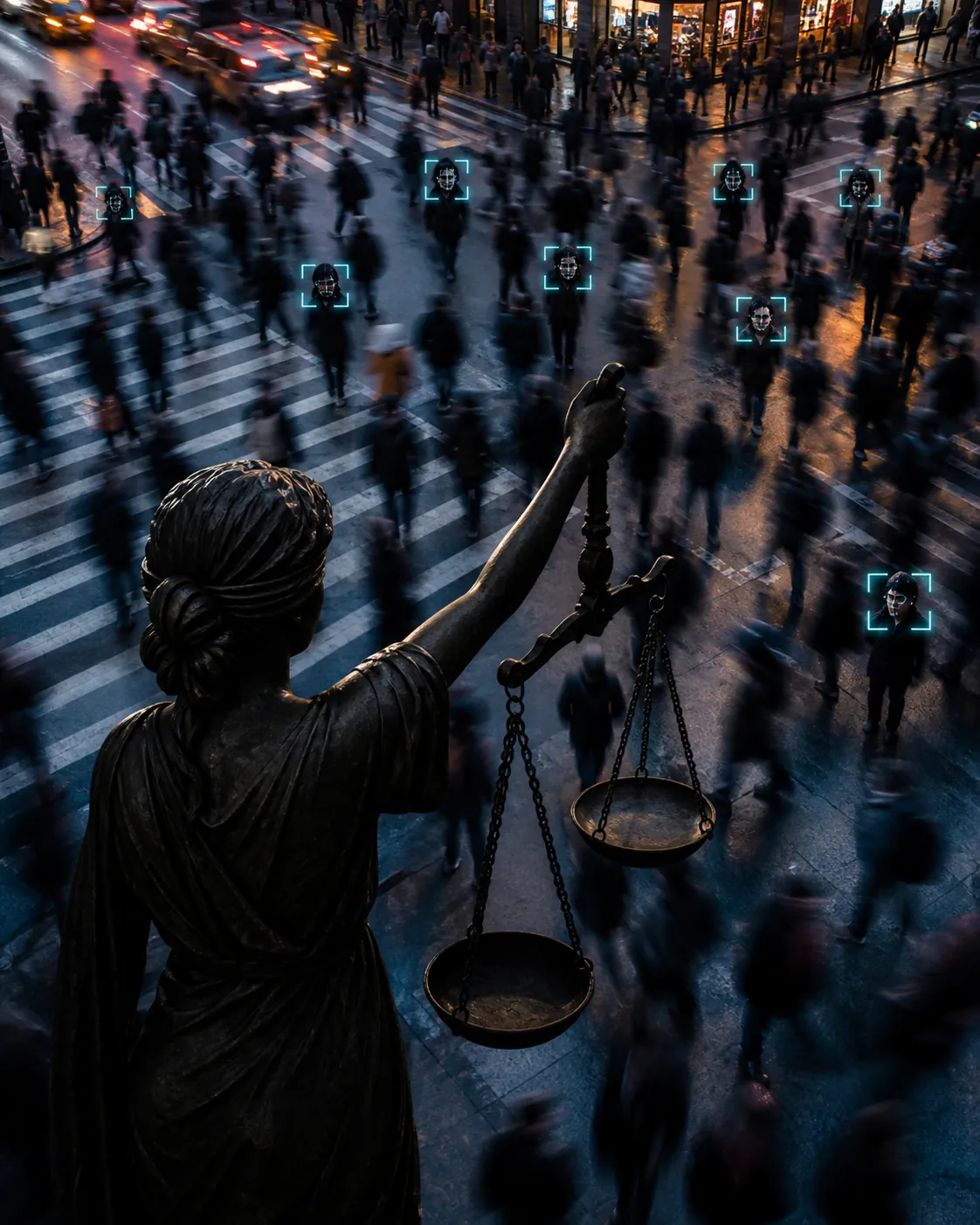
“Fugitive search” has no single United States statute or standard technology behind it. In this article, the term refers specifically to using AI facial recognition to identify wanted or suspected people while officers are trying to locate them. The legal problem is easiest to see when the search is urgent, the target is dangerous, and the technology appears to work.
That was the setting in New Orleans in May 2025, after 10 inmates escaped from the Orleans Justice Center. Project NOLA, a nonprofit organization operating a private network of roughly 5,000 cameras, used live facial-recognition technology to help locate at least one of the escapees. ABC News reported that five of the 10 inmates had been recaptured as of May 23, 2025. [1]
The public-safety rationale is not difficult to understand. A live camera network can put more eyes across a city while officers are searching for people who have already escaped custody. But the urgency of the search does not answer the evidentiary question that follows: what exactly did the system produce, who reviewed it, and when did that result become a reason to stop, search, or arrest someone?
That question became more complicated because New Orleans reportedly had a rule stating that a facial-recognition result alone could not establish probable cause. Yet the lead in the escape search came through Project NOLA’s private camera network rather than a police-operated system. The ordinance may constrain how city agencies use facial recognition; it does not necessarily reach every private network whose information is passed to those agencies.
The timing of the police technology also matters. WWL-TV reported that NOPD Superintendent Anne Kirkpatrick had paused real-time Project NOLA alerts weeks before the escape while the department reviewed its policy, the city ordinance, and constitutional standards. [2] That report does not establish whether the pause was still in effect during every stage of the manhunt, or whether the private network’s information reached officers through a different channel. It does establish why a later reviewer would need a precise account of the system, the alert path, and the decision-maker at each stage.

The oversight boundary breaks at the camera source
The New Orleans example exposes a distinction that broad statements about facial-recognition law tend to hide. There is the police department’s tool, the city’s rules for that tool, the vendor or nonprofit operating the camera network, and the officer who receives and acts on the result. Those may be different legal actors, using different systems, under different obligations.
The state landscape does not close that gap. A Center for Democracy & Technology survey reported that 15 states had enacted limits on facial-recognition surveillance by the end of 2024. Montana and Utah were the only states identified as requiring a warrant, while seven states had rules providing that a facial-recognition result could not be the sole basis for an arrest or other specified action. The same survey identified no state law regulating private camera networks. [3]
Those figures are a snapshot as of the cited cutoff, not a current 2026 census of every legislative change. They nevertheless show why “the law allows it” and “the law bans it” are both inadequate conclusions. The answer depends on the state, the agency, the camera owner, the kind of search, and what officers do after receiving the match.
For counsel, the first review question should therefore be factual rather than doctrinal: identify the camera source and the legal relationship between that source and the investigating agency. A municipal facial-recognition ordinance may regulate a police alert while leaving a private live-feed arrangement largely untouched. The same image can then move from a private system into an official investigation without carrying the same audit trail that would have accompanied a police-generated alert.
Federal use adds scale, not a uniform rule
Federal agencies demonstrate how widely the technology can be deployed without resolving the underlying warrant question. The Immigration Policy Tracking Project documented a $9.2 million Clearview AI contract involving ICE Homeland Security Investigations in September 2025 and a $225,000 Customs and Border Protection contract in February 2026. [4] These contracts show agency access and procurement scale; they do not, by themselves, establish how a particular facial-recognition result was used in an arrest or search.
DHS’s AI use-case inventory lists several ICE facial-recognition uses as high-impact and states that no arrest, search, or enforcement action rests solely on an AI lead. [5] That is an agency representation about its intended or asserted workflow, not an independently verified finding about every field decision. A diligence review should ask what documentation demonstrates compliance: the original alert, analyst notes, human verification, the independent evidence relied upon, and the point at which the AI result was disclosed to decision-makers.
The site’s police-surveillance AI legal-issues record provides broader issue-spotting context. The fugitive-search question is narrower: whether an alert from a public or private system was allowed to harden into the factual basis for government action.
An alert needs an evidentiary handoff
The central legal risk is not simply that a system may produce an inaccurate match. It is that the uncertainty may disappear as the result travels through an organization. “The system flagged him” can become “an officer identified him,” and then appear in a report as though the two statements carried the same evidentiary weight.
Williams v. City of Detroit illustrates why a warning attached to a facial-recognition result is not enough. The settlement arising from the wrongful arrest of Robert Williams included policy terms centered on corroboration before enforcement action. [6] The ACLU of Minnesota has likewise argued that telling officers a facial-recognition result is only an investigative lead does not, by itself, prevent a wrongful arrest. [7]
The operational requirement is more demanding than a label. Before an AI lead becomes part of probable-cause reasoning, the record should show independent human verification and evidence that does not merely repeat the same automated output. Depending on the investigation, that may include confirming identity through records, location information, witness evidence, physical observations, or other facts developed independently of the face search. The point is not to prescribe one universal checklist. It is to prevent the AI result from being both the source of the suspicion and the supposed confirmation of that suspicion.
Georgetown Law’s analysis frames the issue as a due-process problem as well as an accuracy problem: defendants need a meaningful way to understand and challenge the forensic process used against them. [8] That makes disclosure material. Counsel should seek the identity of the tool, the source and quality of the image, the search configuration, the candidate list or match output, the reviewer’s role, and the non-AI evidence that supported the subsequent action.
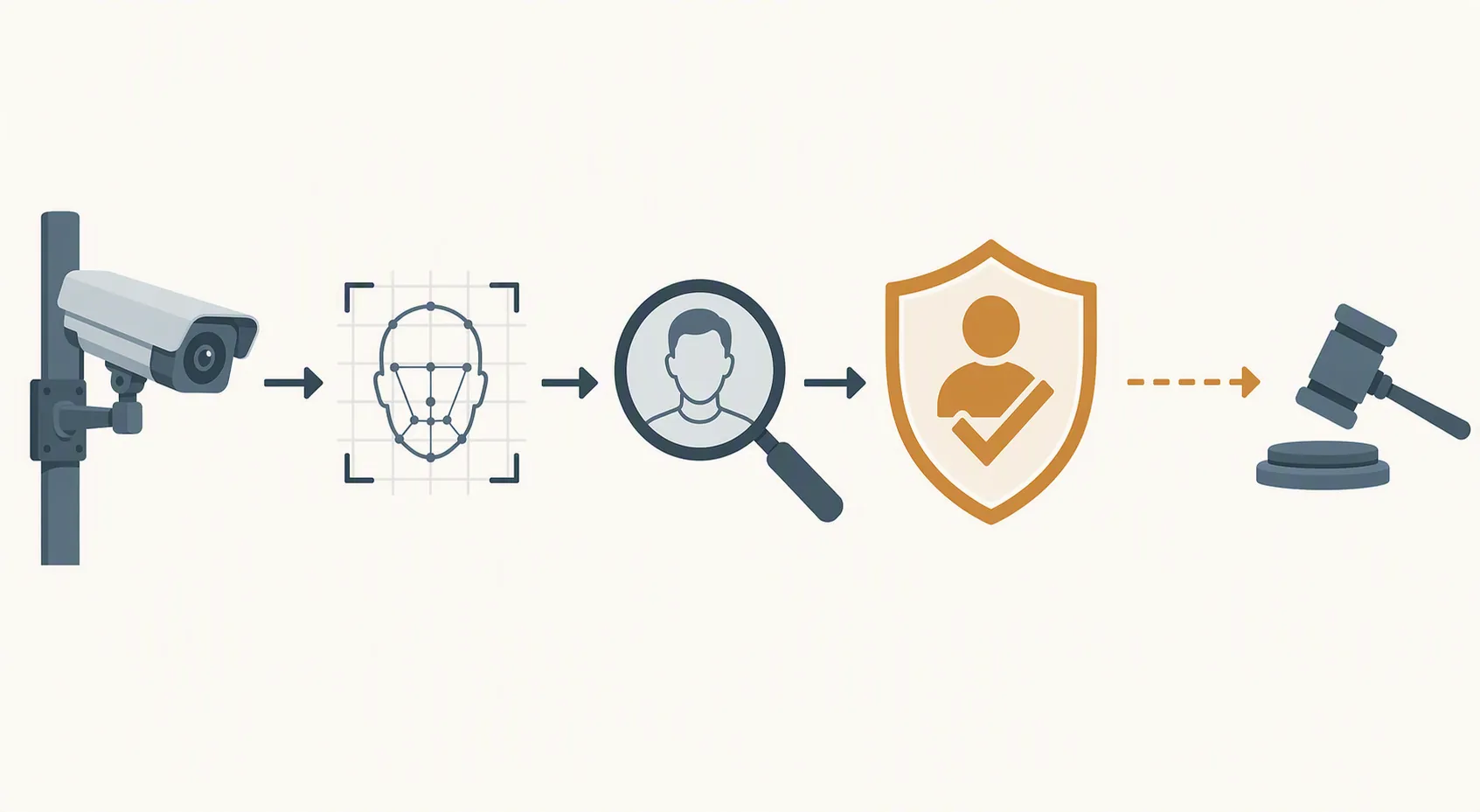
Accuracy information belongs in that record, but it should not be mistaken for the record itself. NIST’s facial-recognition evaluations distinguish among search settings and performance measures for one-to-many identification. [9] A result is not self-authenticating simply because the vendor reports a match score or because the system performs well under a particular test condition. The image, population, camera conditions, threshold, database, and review process all affect what the output means.
This is also why facial-recognition output should not silently become the image used in a lineup or other supposedly independent identification procedure. The later procedure is not independent if the officer or witness has already been steered toward the same candidate by the AI result. A reviewer should ask whether the face-search output was kept separate from subsequent identification decisions and whether the defense can reconstruct that separation.
What counsel should demand
A practical review of an AI-assisted fugitive search should establish at least these points:
- Which facial-recognition tool produced the alert, and who owned or operated the camera that supplied the image?
- Was the actor using a public police system, a contractor, a nonprofit network, or information obtained from another agency?
- Which jurisdiction’s warrant, authorization, or no-sole-basis rule applied at the time of the search and the later enforcement action?
- Who independently verified the candidate, what facts supported that verification, and when did those facts arise?
- What error-rate and search-condition information was available, and was it disclosed to the officers, prosecutor, court, and defense?
- Was the AI result used to influence a lineup, witness identification, stop, warrant application, or arrest report?
These questions are useful whether the result helped locate a genuinely wanted person or produced a mistaken identification. They separate the legitimacy of the search objective from the reliability and legality of the steps taken to reach a particular person. The site’s Flock-alert verification record addresses a closely related principle: an automated alert is a lead, not the stop itself. The same discipline applies here, with the additional need to account for biometric search conditions and the private infrastructure that may have generated the lead.
Congress is considering whether to impose a federal version of the no-sole-basis rule. H.R. 4695 would be relevant to that discussion, but it is proposed legislation, not current law, and its operative text should be checked against the current congressional version before relying on its details. [10]
Fugitive searches are likely to be the use case that makes facial recognition feel most reasonable: the person is already wanted, time matters, and officers need information quickly. That is precisely when the evidentiary handoff deserves scrutiny. The search objective may justify looking for a lead. It does not supply the independent facts needed to treat that lead as probable cause.
This is a research and issue-spotting framework, not legal advice. In a live matter, counsel should identify the tool and camera source, determine whether the relevant actor was public or private, apply the jurisdiction’s warrant or no-sole-basis rule, require human verification and error-rate context, and challenge any record in which the AI match quietly becomes the reason for the arrest.
References
- Facial recognition technology helps search for escaped New Orleans inmates — ABC News, May 23, 2025. Source
- NOPD facial recognition alerts paused before inmate escape — WWL-TV. Source
- Status of State Laws on Facial Recognition Surveillance: Continued Progress and Smart Innovations — TechPolicy.Press / Center for Democracy & Technology. Source
- Reported ICE Contracts with Clearview AI for Facial Recognition Technology — Immigration Policy Tracking Project. Source
- ICE AI Use-Case Inventory — U.S. Department of Homeland Security, updated July 15, 2026. Source
- Williams v. City of Detroit: Face Recognition False Arrest — American Civil Liberties Union. Source
- Police Say a Simple Warning Will Prevent Face Recognition Wrongful Arrests. That’s Just Not True — ACLU of Minnesota. Source
- A Forensic Without the Science: Face Recognition in U.S. Criminal Investigations — Georgetown Law Privacy & Technology Center. Source
- Face Recognition Technology Evaluation: Face Recognition Vendor Test (FRVT) 1:1 and 1:N — National Institute of Standards and Technology. Source
- H.R. 4695, 119th Congress — Congress.gov. Source
Operationalizing workflow
No workflow has been explicitly linked to this obligation yet. See Workflows generally.
Illustrative cases
No illustrative case is currently tracked for this obligation. See Risk Digest for documented incidents generally.
← Back to RegulationReport a correction or tip
Spotted an outdated figure, a misstated fact, or a ruling this regulation entry should reflect? Public comments are disabled for this content given the professional cost of a misreported case outcome, penalty amount, or rule text — use the structured correction channel instead.
Report a correction or tip for this record →