
Can police stop a car on a Flock camera theft alert alone?
Flock plate misreads have produced wrongful theft stops, taxpayer settlements, and dropped charges—and a hot-list ping alone is not probable cause. Under Washington SB 6002, officers must support an ALPR stop with independent suspicion or immediate visual-plus-database confirmation, and the documented failures show why that verification step matters.
- Jurisdiction
- US-WA
- Court
- Washington State Legislature
- AI tool named
- Flock Safety
- Ruling date
- Mar 30, 2026
- Source document
- View primary court order ↗
- Last verified
- Aug 5, 2026
Lex Machina Review is an independent risk-tracking and reference resource. Nothing on this site is legal advice, and using it does not create an attorney-client relationship. Every record is reviewed against primary sources but may not reflect the most current status of a matter — always verify directly against the cited court order, rule text, or a licensed attorney before relying on it.
Companion explanation — secondary to the source document above
A Flock theft alert is a lead, not the stop
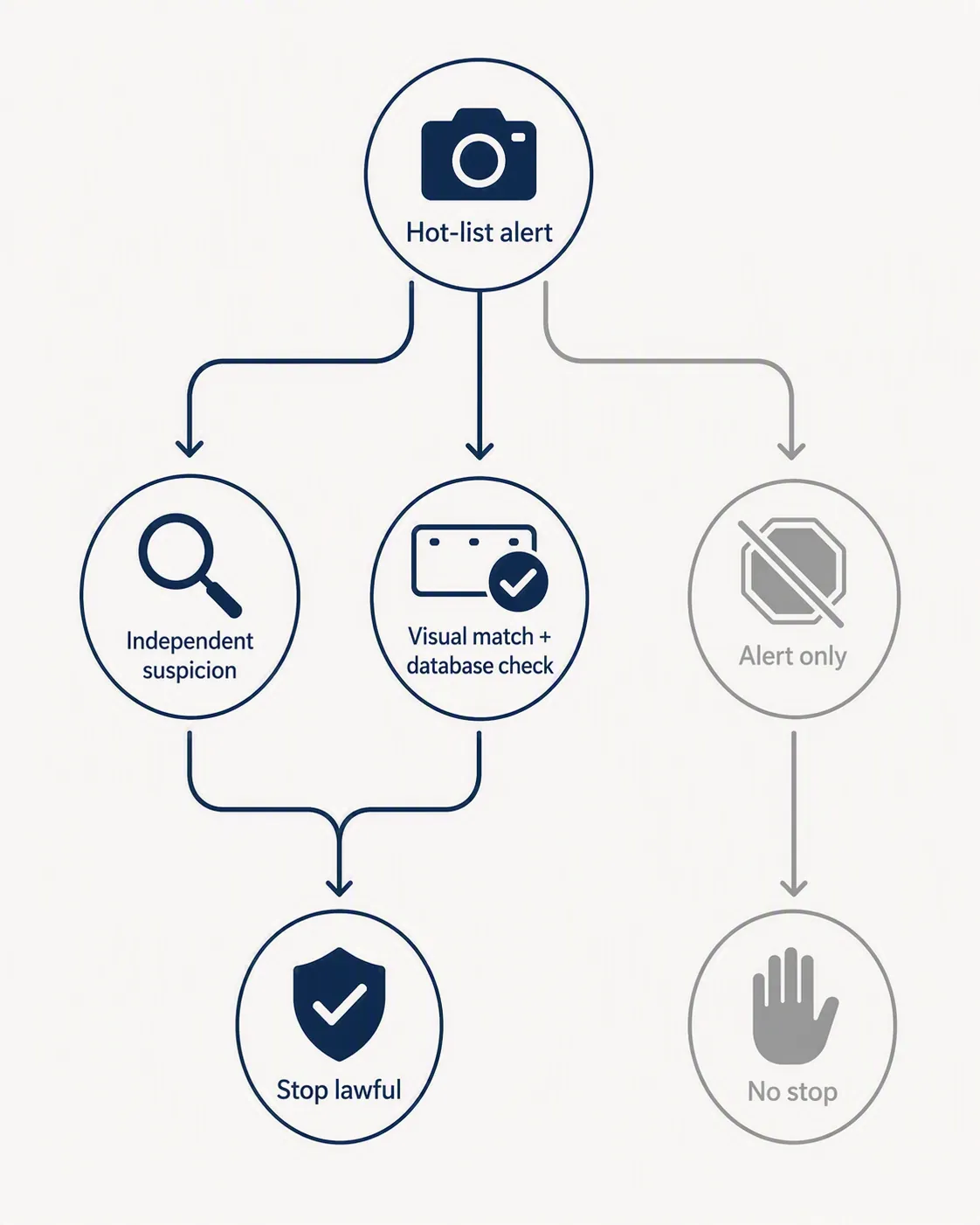
If a Flock camera flags a passing plate as stolen, the safer legal answer is plain: the alert alone should not be treated as the basis for putting lights on the car. In Washington, that is now an express statutory rule. SB 6002, effective March 30, 2026, bars a traffic stop based only on an automated license plate reader match unless the officer also has independent reasonable suspicion under Terry principles, or immediately confirms both the plate visually and the database status of the vehicle before the stop. [1]
That rule does not make every Flock-derived stop unconstitutional, and it does not say stolen-vehicle alerts are useless. It answers a narrower and more practical question: when the machine says “stolen,” what did the officer verify before the driver became a suspect in the street? This article is a legal-risk analysis, not legal advice for any specific case or jurisdiction.
What Washington SB 6002 changes at the roadside
Washington’s rule matters because it separates three events that are too often collapsed in police reports: the camera captured a plate, the system matched that read to a hot list, and an officer decided to stop a human being. SB 6002 does not allow the second event to substitute for the third. An ALPR match may prompt the officer to look, query, and compare. It may not, by itself, carry the stop.
| Roadside event | What it can support | What is still missing |
|---|---|---|
| Flock or another ALPR sends a stolen-vehicle or hot-list alert | A reason to investigate the alert promptly | A verified basis to stop the vehicle |
| Officer observes facts apart from the alert | Potential independent Terry suspicion if the facts are specific and articulable | Documentation tying those facts to the decision to stop |
| Officer visually confirms the actual plate and checks the current database status | The statutory confirmation path described for Washington ALPR stops | Preserved image, query, time, and officer notes showing the sequence |
| Officer stops first and sorts out the plate after contact | A litigation problem, especially where the alert was the only stated reason | The pre-stop confirmation the rule is designed to require |
For defense counsel, that sequence is not a formatting issue. It is the suppression question. For procurement counsel, it is the operational control the agency must be able to train, audit, and prove. If the only contemporaneous fact is “Flock hit stolen,” the file has a gap where the lawful stop rationale should be.
The Washington statute also sits inside a broader state-law map of ALPR limits, retention rules, and audit obligations. Those issues matter, but they are not the same as the roadside stop question. For the broader regulatory landscape, see the site’s Flock camera privacy law map.
Why stolen-vehicle alerts are attractive to police
There is an obvious reason agencies buy these systems: stolen vehicles are tangible, common, and hard to recover through ordinary patrol alone. Flock’s own 2025 Impact Census says that, among roughly 700 responding agencies, 42% reported that Flock was involved in recovering more than half of their stolen vehicles. Flock also compares that claimed recovery role with the FBI NIBRS 2024 motor-vehicle-theft clearance rate of 9.2%. [2]
Those are vendor-reported figures, not independent proof that any specific alert is correct. They do explain the pressure point. If a system is marketed and adopted as a stolen-vehicle recovery tool, officers will see hot-list hits as urgent. The legal risk concentrates there, because the consequences of a false theft alert do not wait for a later audit. They arrive as a traffic stop, a command to exit, a citation, an arrest, or a file the driver must then unwind.
The errors are often one character wide
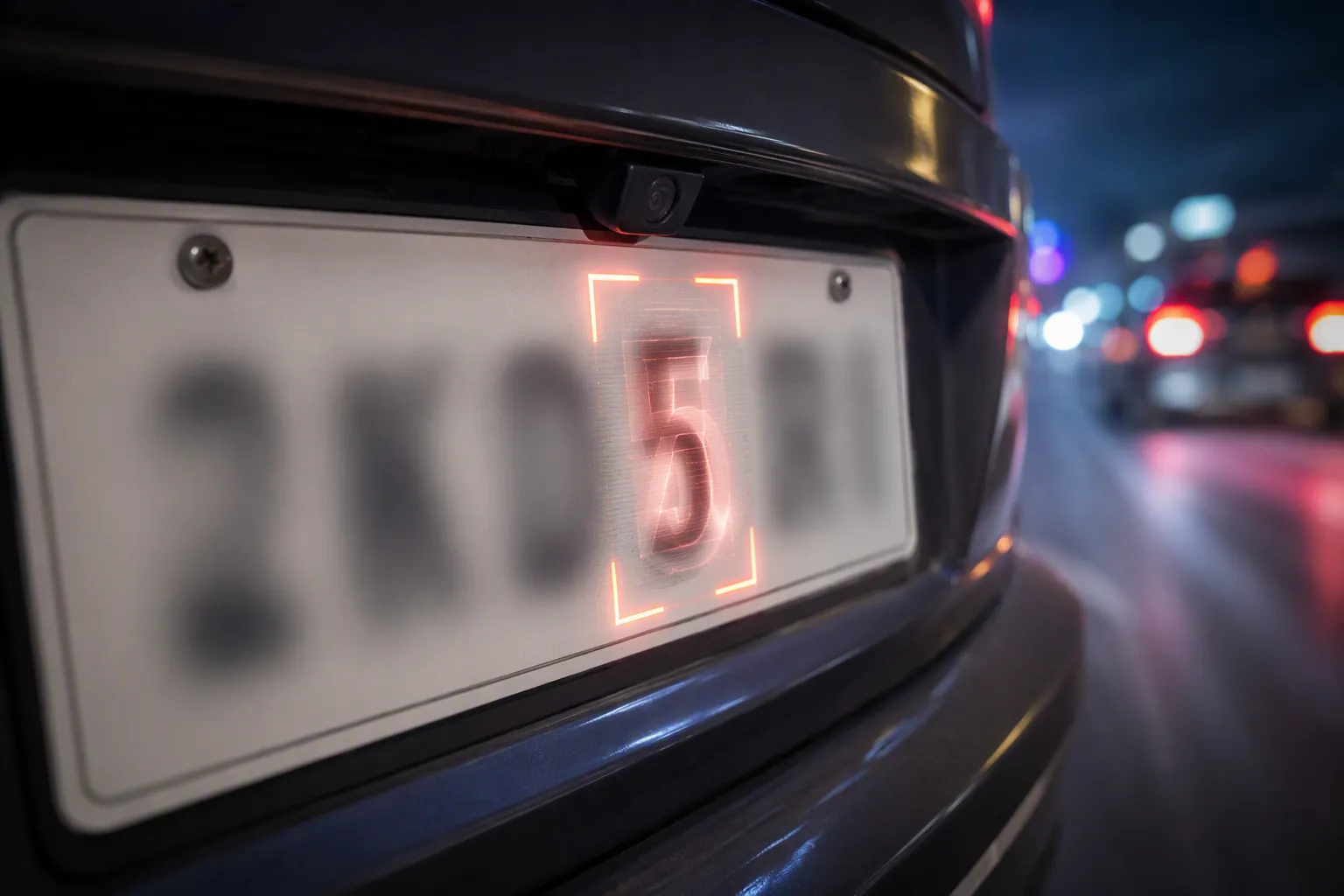
The documented false-stop cases are not hard to understand. They do not require a grand theory of AI surveillance. They usually turn on a small mechanical fact: one character was read as another, or a hot-list status was stale, and the officer acted before resolving the mismatch.
Business Insider reported more than a dozen documented instances in which Flock plate misreads or related errors contributed to stops of innocent people, including incidents involving gunpoint stops, jail time, and police-dog bites. The same reporting notes that Flock publishes no single overall accuracy figure, while a company spokesperson has described performance in the “high 90 percentiles.” [3]
Toledo: a 7 became a 2
In Toledo, Business Insider reported that a Flock system misread a plate character, treating a 7 as a 2, and the resulting stolen-vehicle stop led to a $35,000 settlement. In court, the judge’s summary was blunt: “Flock Flocked up.” [3]
That quote gets attention, but the more useful lesson is procedural. A one-character read error is exactly the kind of defect an officer can sometimes catch before the stop by looking at the plate image, looking at the vehicle in front of the cruiser, and checking the current database return. If the record does not show that sequence, the machine’s error becomes the driver’s emergency.
Atherton: H became M
Atherton presents the same pattern with a different character. Business Insider reported that a Flock read treated an H as an M, contributing to a wrongful stop that ended in a $45,000 settlement. [3]
No accuracy percentage answers that case. Even a system that is usually right can be wrong in the only moment that matters to the stopped driver. The question in the file is whether someone compared the actual plate, the captured image, and the hot-list record before seizing the car’s occupants.
Morristown: LOVEY, L0VEY, and a recovered vehicle
In Morristown, Tennessee, Business Insider reported a one-character difference between LOVEY and L0VEY, with the target vehicle already recovered. The reporting also described a deputy chief’s emailed instruction that Flock “will occasionally misread plates” and that officers must verify before stopping. [3]
That departmental instruction is the Washington rule in everyday police language. It does not ask officers to ignore the alert. It asks them to confirm it before turning the alert into a stop. The recovered-vehicle detail is just as important as the character substitution: a camera can read the plate correctly and still point to a hot-list record that no longer justifies the same response.
Columbine Valley: the summons was dropped, but the burden stayed with the driver
CBS Colorado reported that Flock cameras led Columbine Valley police to the wrong suspect and that the summons was later dropped. The driver described the experience this way: “It became my job to prove my innocence.” [4]
That is the remedial burden that tends to disappear when the debate stays at the level of camera accuracy. A dismissed summons is not the same thing as no harm. The driver has already spent time, attention, and usually money responding to an accusation that began as an automated theft signal.
Accuracy arguments are too blunt for the stop question
Flock’s recovery numbers help explain adoption. Advocacy critiques and reported tests help explain caution. Neither category decides whether a particular theft stop was lawful. The stop turns on the officer’s facts at the time: what the alert said, what the plate actually showed, what the current database query returned, and whether anything independent of the ALPR match supported suspicion.
Business Insider reported an IPVM 2021 test finding roughly a one-in-ten state misidentification rate, while also reporting Flock’s contrary high-accuracy position. Because the underlying accuracy record is contested and Flock does not publish one universal accuracy number, broad reliability rhetoric is a poor substitute for the image and query trail in the actual case. [3]
The ACLU has also pointed to inconsistent vendor accuracy descriptions, including a reported Coralville statement around 90%, adjustable confidence levels, and language that a human should always manually verify a plate read. [5] That is useful impeachment and procurement material. It still should not be inflated into a universal constitutional holding that every Flock alert is invalid.
The broader Fourth Amendment and civil-litigation record is more complicated than a single slogan allows. The site’s Flock misuse and Fourth Amendment docket and Flock civil litigation docket track those disputes separately. For a stolen-vehicle stop, the cleaner first issue remains pre-stop verification.
What the file should show after a theft-alert stop
A defensible ALPR stop file should let a reviewer reconstruct the sequence without guessing. The order matters. Confirmation after the stop may explain why charges were dropped or why a citation was dismissed; it does not supply the missing basis for the seizure if the officer had already acted on the alert alone.
- The original ALPR image or video frame, not merely the text of the alert.
- The machine-read plate string and the hot-list plate string, preserved in a way that exposes single-character differences.
- The officer’s visual comparison of the plate on the vehicle before the stop, including any mismatch or uncertainty.
- The database query used to confirm that the vehicle was still stolen, wanted, or otherwise hot-listed at that moment.
- Any independent facts supporting reasonable suspicion apart from the ALPR hit.
- Dispatch audio, CAD notes, body-camera timing, and report language showing whether confirmation happened before or after the seizure.
- Retention and audit records showing who accessed, downloaded, shared, or deleted the ALPR evidence.
Preservation cannot be an afterthought. Flock’s Evidence Policy describes a 30-day default hard-delete period, self-certifying image affidavits, and an Evidence Validator for files downloaded after July 1, 2025. [6] In a disputed theft stop, that means counsel should move quickly for the underlying image, alert metadata, database-query trail, and audit records before the system’s ordinary retention period becomes the agency’s practical answer.
Access logs also matter because ALPR risk is not limited to false theft hits. Unauthorized records access is a separate pattern, tracked in the site’s police records access docket. For this article’s narrower question, the audit trail helps answer who saw the alert, who confirmed it, and when.
The practical answer
A Flock camera theft alert is a risk signal. It may be useful. It may be urgent. It may even be correct most of the time. But the legal question is not whether Flock is accurate in the abstract; it is whether the officer verified the alert before stopping the car.
Washington has now made that verification duty explicit: no ALPR-only stop without independent suspicion or immediate visual-plus-database confirmation. The documented misread cases show why that is not paperwork for its own sake. A 7 read as a 2, an H read as an M, a zero read as a letter, or a recovered car left on a hot list can turn an innocent driver into a theft suspect before anyone has done the simplest comparison.
References
- What to Know About the New Restrictions on Flock and Similar Camera Systems (WA SB 6002) — MRSC, April 2026
- How Effective Is Flock? 2025 Impact Census — Flock Safety
- Flock Safety's AI Cameras Misread Plates. Innocent People Pay. — Business Insider
- Flock cameras lead Colorado police to wrong suspect — CBS Colorado
- Flock Safety Credibility Lost as It Repeatedly Lies to City Councils, Police Departments, and Public Across the Country — ACLU
- Flock Evidence Policy — Flock Safety
Related records
Tool profile
Browse tool evaluations →Governing regulation
Browse the obligations tracker →Preventive workflow
Browse verification workflows →
Report a correction or tip
Spotted an outdated figure, a misstated fact, or a ruling this case record should reflect? Public comments are disabled for this content given the professional cost of a misreported case outcome, penalty amount, or rule text — use the structured correction channel instead.
Report a correction or tip for this record →