
Can AI Tracking Prove Space Debris Liability in Court?
- Authority
- United Nations
- Rule type
- statute
- Jurisdiction scope
- US federal
- Effective date
- Jan 1, 1972
- Source text
- Read primary rule text ↗
Prove fault under Article III for in-space debris damage; absolute liability for surface damage under Article II.
For more than half a century, space debris liability has had a treaty structure and a missing evidentiary middle. The Liability Convention can tell a claimant which liability rule might apply, but it has not solved the harder factual problem: proving that a particular fragment came from a particular space object, operator, or launching state. That gap matters more now because AI-enhanced space situational awareness systems may finally make attribution technically plausible. The legal problem is that plausibility is not proof.
The phrase space debris liability and AI tracking sounds like a future-facing compliance topic until an object lands in someone’s home. In June 2024, a Florida family sued NASA after debris from an International Space Station battery pallet crashed through their home; NPR described it as the first debris-damage claim of its kind.[1] That case does not test AI attribution. It concerns surface damage, where the Liability Convention’s Article II absolute-liability framework is far more claimant-friendly than the in-space rule. But it changes the procedural temperature. Debris harm is no longer only a conference-panel hypothetical.
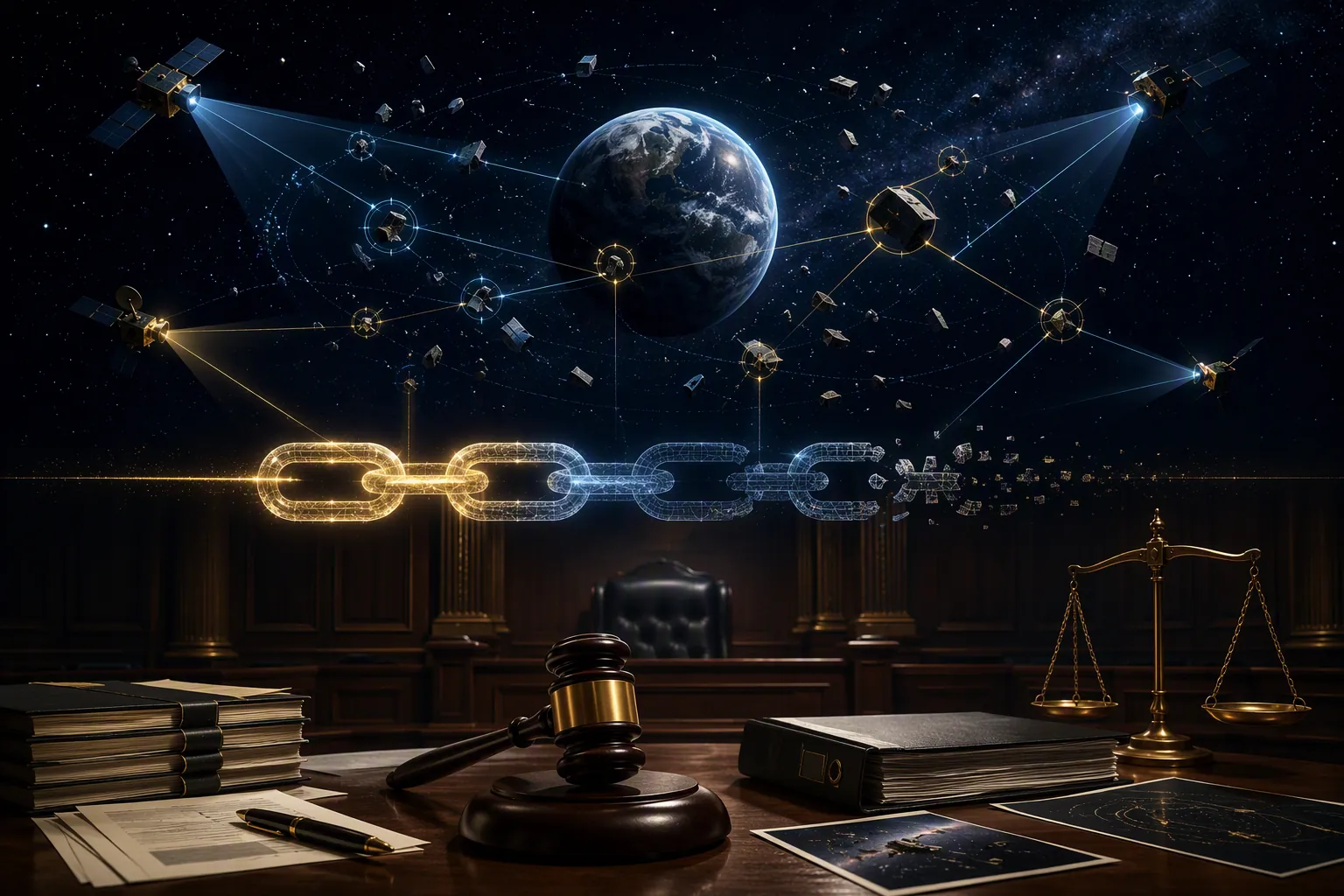
The harder claim is the one that happens in orbit. No party has ever been held liable for a space debris collision in space. The 1972 Liability Convention distinguishes between absolute liability for damage on Earth or to aircraft in flight under Article II and fault-based liability for damage elsewhere under Article III, but Article III does not define fault and has never been adjudicated in this setting.[2] That leaves litigants with two unsettled questions at once: what conduct counts as fault, and what evidence can reliably connect the damaging object to the party accused of that fault.
The Missing Link Is Attribution, Not Liability Theory
The treaty framework is old enough to have acquired a deceptive air of completeness. Article II, Article III, launching state, fault, compensation: the nouns are all there. What has been missing is the evidentiary chain between an observed fragment and a responsible actor. If a functioning satellite is struck by untracked debris, a claimant cannot sue a concept. It needs an object history, a source, a launch connection, and an explanation of why alternative origins are less likely.
That is where the tracking problem becomes a litigation problem. The orbital environment contains more than 100 million debris objects larger than 1 millimeter, while fewer than 1% of mission-ending debris objects are currently tracked.[3] Those numbers are useful not because they are dramatic, but because they explain why conventional proof has been thin. If the object that caused damage was never continuously observed, then legal attribution begins after a break in the record.
The traffic load compounds the evidentiary pressure. As of 2026, there are about 11,000 active satellites, with projections of 30,000 to 60,000 by 2030. In 2023, operators received more than 600,000 daily Conjunction Data Messages, a reported 200% increase from 2020.[2] Those alerts are operational warnings, not pleadings. But once the same data environment is used to assign source, motive, preventability, or fault, every assumption in the tracking chain becomes fair ground for discovery.
What AI Tracking Actually Adds
AI tracking does not magically turn debris into labeled evidence. Its value is more specific: it can help process sensor streams too large, noisy, and intermittent for human-scale analysis. Programs such as IARPA’s SINTRA are designed to explore tracking of sub-10-centimeter space debris through AI-enhanced sensor fusion; the program’s Broad Agency Announcement closed in November 2022, and the effort remains research-phase rather than an operational attribution system.[3] That distinction is not a footnote. It is the first sentence of cross-examination.
A litigation-grade attribution chain would have to move through several layers before anyone could responsibly say “this debris came from that object.” It would begin with observation: radar, optical telescopes, or other sensors detect an object or possible object. It would then proceed to data association: the system decides whether repeated detections refer to the same object, whether a track has fragmented, and whether apparent movement is consistent with orbital mechanics rather than sensor artifact. Then comes fusion, where multiple sources are combined into a single track estimate. Only after that would a model compare the object’s path, timing, physical characteristics, and candidate source histories to generate an attribution hypothesis.
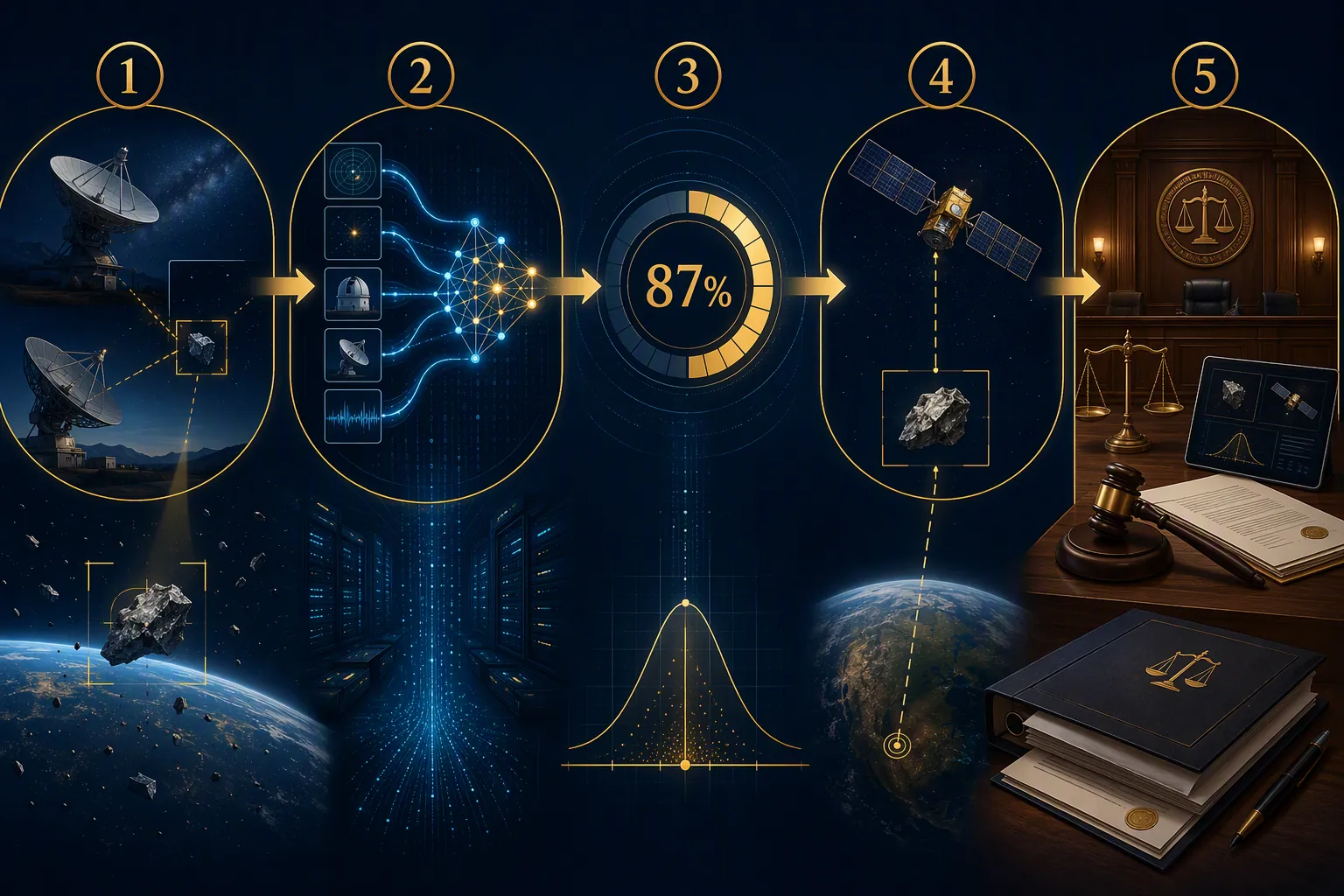
Uncertainty enters at every stage. A faint detection may be thermal noise. Atmospheric interference may distort observations. A model may be oversensitive to a feature that correlates with one class of objects but does not uniquely identify a source. The final output may be a confidence score or ranked set of candidate origins, not a deterministic answer. Neuraspace materials describe collision-probability models using ensembled CNN-LSTM architectures that produce probabilistic outputs; those models may be valuable for avoidance decisions, but that is not the same as proving legal attribution after damage occurs.[4]
| Tracking Stage | Litigation Question |
|---|---|
| Sensor detection | Was the object actually observed, and can the raw data be authenticated? |
| Track formation | Were separate observations correctly associated with the same debris object? |
| Sensor fusion | How were conflicting or incomplete inputs weighted? |
| Model inference | What assumptions produced the probability score or source ranking? |
| Legal attribution | Does the output identify a responsible actor, or only support further investigation? |
That last line is where many technical claims start to slide. A system built to support collision avoidance may be optimized to reduce operational risk, not to allocate legal responsibility. In avoidance, a false positive may be tolerable if maneuver costs are acceptable. In liability, a false positive can name the wrong defendant. A model that is useful at 3 a.m. in an operations center may still be too poorly explained, too weakly validated, or too dependent on proprietary assumptions to carry a damages claim.
Article III Makes the AI Evidence Problem Sharper
For surface damage, attribution can still be contested, but Article II gives the claimant a cleaner liability rule once the responsible space object is identified. The Florida claim against NASA illustrates that kind of dispute. In-space damage is different. Article III requires fault, so AI tracking evidence would not merely identify a source; it would likely sit beside arguments about whether an operator failed to maneuver, failed to share data, operated with inadequate avoidance systems, ignored warnings, or created debris through negligent conduct.
The treaty does not define that fault standard.[2] That means counsel would have to build fault from conduct evidence and norms: tracking records, maneuver opportunities, warnings received, accepted operational practices, regulatory duties, licensing materials, and expert testimony. AI attribution could supply the object history that makes such arguments possible, but it would not by itself answer whether the defendant breached a legal duty.
Article IV adds a further complication in cascading events. Taylor Wessing has noted that Article IV 1(b) assigns liability for secondary debris to the party responsible for the initial collision, but if the initial collision cannot be definitively attributed, AI outputs risk becoming circular: the model points to an initial event because of the debris pattern, and the debris pattern is then used to assign responsibility for later damage.[5] That may be a sensible investigative loop. It is a dangerous proof loop unless each link can be independently tested.
The Courtroom Fight Starts Before the Confidence Score
A party offering AI tracking evidence would be tempted to lead with the final probability: an object is 82% likely to have originated from a particular satellite, booster, or fragmentation event. A careful evidentiary record would not begin there. It would begin with source traceability. Who collected the sensor data? What instruments were used? Were clocks synchronized? Were raw observations preserved? Were any detections discarded? Were preprocessing steps logged? Could an opposing expert reproduce the track using the same inputs?
Authentication is not a ceremonial hurdle. AI evidence often fails, or becomes vulnerable, because the proponent treats the output as the evidence and the underlying chain as technical housekeeping. In debris litigation, the chain may be the case. Counsel would need to authenticate not only the final report but also the sensor feeds, data transformations, model version, training or calibration materials, human review, and any manual overrides. The authentication gaps are not conceptually different from other algorithmic-evidence disputes; the difference is that the physical object may be unrecoverable, long gone, or too small ever to have been directly inspected. That makes the chain of digital custody more important, not less. The same lesson appears in other AI evidence contexts, including courtroom disputes over AI evidence authentication.
Under Daubert-style reliability analysis, the questions write themselves. Has the method been tested? Has it been peer reviewed or operationally validated? What is the known or knowable error rate? Are there standards controlling the technique’s operation? Is the relevant expert community prepared to accept the method for attribution, not merely for collision avoidance? Those questions become sharper when the system uses neural-network components, ensembles multiple inputs, or produces results that even its developers may explain only at a high level.
That does not make AI tracking inadmissible by definition. Courts regularly admit technical evidence that ordinary jurors cannot independently verify. But the proponent needs a bridge between specialized method and legal use. A collision-risk model answers one question: how likely is a conjunction or harmful encounter, given current data and uncertainty? A liability-attribution model answers a different question: which actor should bear legal responsibility for damage that has already occurred? Repurposing the first for the second may be possible, but it is not self-authenticating.
The closer analogy is not a photograph. It is a layered expert opinion built on instrument readings, preprocessing choices, model architecture, validation studies, and inferential judgment. Counsel thinking through Daubert challenges to algorithmic evidence should expect the same pressure points here, with a less familiar factual substrate and higher uncertainty around the physical event.
What the Proponent Would Need to Build
A claimant or cross-claimant offering AI tracking evidence should expect to prove the method in layers rather than announce the result. The foundation would likely need to include the system’s intended use, the data sources it ingests, the quality controls applied to those inputs, the model version used for the disputed analysis, the validation record, and the expert’s explanation of why the system is reliable for this particular attribution.
- Raw-data preservation: sensor observations, timestamps, calibration records, and data-quality flags.
- Processing history: filtering, normalization, rejected detections, and any manual interventions.
- Model documentation: architecture, training or calibration sources, version control, and changes after deployment.
- Validation evidence: test scenarios, historical back-testing, operational performance, and known failure modes.
- Use-case fit: an explanation of why a system designed for tracking or avoidance can support legal attribution.
The expert witness problem sits inside that foundation. A space situational awareness engineer may understand the tracking system but not the legal attribution question. A machine-learning expert may understand model behavior but not orbital dynamics. A space-law expert may understand the treaty but not the instrument chain. The offering party may need a team, but a team creates its own seams: each expert must know where her opinion begins and ends, and no witness should smuggle an untested attribution conclusion through someone else’s expertise.
What the Opponent Would Attack
The opposing party’s best challenge may not be “AI is unreliable.” That is too broad and too easy to dismiss. The sharper attack is that this model, using these inputs, under these conditions, has not been shown reliable for this legal conclusion.
- Opacity: whether the proponent can explain why the model selected one origin over plausible alternatives.
- False positives: whether noise, atmospheric interference, or oversensitivity could produce a misleading match.
- Confidence thresholds: whether the chosen threshold was scientifically justified or litigation-driven.
- Circular attribution: whether the model uses consequences of the alleged event to prove the event’s source.
- Domain mismatch: whether a collision-avoidance tool is being repurposed as a fault-allocation tool.
- Alternative origins: whether the analysis adequately excludes other debris sources or fragmentation histories.
Discovery would matter. The defense will want training and calibration materials, test results, logs showing model changes, records of prior false positives, documentation of sensor outages, and communications about confidence thresholds. If the system is proprietary, the proponent will ask for protective-order treatment; the opponent will argue that trade secrecy cannot become an evidentiary shield. That fight is familiar from other AI disputes, including cases where alleged model error or hallucination becomes defense leverage. The space setting changes the science, not the adversarial instinct.
Regulation May Require Avoidance Without Solving Compensation
Regulators are not waiting for the first fully litigated debris-collision case. The proposed EU Space Act, introduced on June 25, 2025, is projected for full applicability in January 2030 and would require mandatory collision-avoidance systems for constellations of 10 or more satellites.[6][7] That kind of rule may help define what responsible operations look like. It may also generate records — warnings, maneuvers, non-maneuvers, system logs — that litigators can later use.
But a compliance obligation is not a compensation mechanism. Taylor Wessing’s analysis of space debris liability emphasizes the gap between operational requirements and remedies when avoidance fails.[5] A satellite operator may comply with a mandated system and still suffer damage. Another operator may use an AI system and still make a bad call. The existence of collision-avoidance technology does not automatically answer who pays, especially when fault depends on what the operator knew, what the system said, how reliable that output was, and whether a different decision was reasonably available.
Regulatory investigations can still reshape the evidentiary record. Logs created for compliance, audits, incident reports, and post-event technical reviews may become the documents that prove or undermine fault. Litigators watching autonomous-system investigations in other industries have already seen how technical records migrate from regulator files into civil litigation strategy; space operators should assume the same migration will occur here.
The Evidence Record Should Be Built Before the First Claim
The most practical preparation is not a prediction about whether a court will admit AI tracking evidence. No court has ruled on AI-generated tracking evidence in a space debris liability claim, and the Liability Convention’s claims-commission machinery has never been used for a debris collision. The PCA Optional Rules for Arbitration of Disputes Relating to Outer Space Activities have existed since 2011, but they also have not produced a debris-claim precedent.[8] There is no safe doctrinal shortcut.
Operators and counsel should instead prepare the record they would want if they were both offering and attacking the same evidence. That means preserving raw sensor data where possible, maintaining source logs, documenting model versions, recording human review, collecting validation materials, and separating operational collision-risk outputs from legal attribution opinions. It also means identifying attack points early: opacity, circular inference, insufficient validation, unexamined alternatives, and confidence scores that look more precise than the underlying data deserves.
AI tracking may make debris liability litigable before it becomes legally settled. That is the uncomfortable middle. The technology can strengthen the attribution chain that space law has lacked for decades, but the same chain will have to survive authentication, expert qualification, reliability testing, and adversarial pressure. The record built now will decide whether an AI-generated attribution becomes admissible proof, useful investigation, or an expensive exhibit that never reaches the factfinder.
References
- Florida NASA debris lawsuit, NPR, June 23, 2024
- Who Takes Out the Trash in Space?, Stanford Law School, August 2025
- SINTRA program page, IARPA
- Neuraspace company materials on CNN-LSTM collision models, Neuraspace
- From orbit to courtroom: the legal black hole of space debris liability, Taylor Wessing, 2025
- EU Space Act, European Commission, June 25, 2025
- The Proposed EU Space Act: 10 Key Implications, Cooley LLP, July 24, 2025
- PCA Optional Rules for Arbitration of Disputes Relating to Outer Space Activities, Permanent Court of Arbitration, 2011
Operationalizing workflow
No workflow has been explicitly linked to this obligation yet. See Workflows generally.
Illustrative cases
No illustrative case is currently tracked for this obligation. See Risk Digest for documented incidents generally.
← Back to RegulationReport a correction or tip
Spotted an outdated figure, a misstated fact, or a ruling this regulation entry should reflect? Public comments are disabled for this content given the professional cost of a misreported case outcome, penalty amount, or rule text — use the structured correction channel instead.
Report a correction or tip for this record →