
Andrew Tate's Extradition Bail Hearing, Explained
- Authority
- U.S. Department of Justice
- Rule type
- regulation
- Jurisdiction scope
- US federal
- Source text
- Read primary rule text ↗
Bail ordinarily denied absent special circumstances; DOJ policy opposes bond in every extradition case.
The question before Magistrate Judge Lauren F. Louis in Miami on August 27 was whether Andrew and Tristan Tate should remain in federal custody while the United Kingdom pursues extradition—not whether they committed the offenses alleged in Britain, and not whether the eventual extradition request should succeed. The brothers appeared shackled and dressed in dark suits at the C. Clyde Atkins U.S. Courthouse as prosecutors and defense lawyers argued over flight risk and the unusually demanding standard for bail in an international extradition case, according to the Associated Press account of the hearing.[1]
Last verified: August 28, 2026 (UTC). No ruling by Judge Louis was available in the sources reviewed by that date. What follows therefore reports the parties’ arguments and the procedural posture, not a bail result.

The hearing followed the brothers’ provisional arrest on July 18 under a UK warrant. A provisional arrest allows the requested country to hold someone while the requesting country prepares and transmits its formal extradition papers. In this case, the United Kingdom has until September 16 to submit its formal request through the prescribed diplomatic process, NPR reported.[2]
That timing explains why the bail hearing cannot sensibly be treated as a miniature trial. The complete UK submission had not yet reached the later certification stage. Judge Louis was being asked whether the brothers could be released during the process, under a standard designed to make release exceptional.
What each side said about flight risk
Prosecutors built much of their flight-risk argument from the brothers’ own public image and statements. They alleged that the men had talked about possessing seven passports and 15 driver’s licenses and emphasized their access to wealth and private aircraft. Those assertions were offered to show both the means and a professed ability to move across borders, not as proof of the underlying UK offenses.[2]
The defense disputed both the meaning and the practical significance of that material. Lawyers characterized the passport and license claims as satire or online role-play rather than literal admissions. They said a $2.1 million Aston Martin shown as part of the brothers’ lifestyle was rented, that a superyacht associated with them was not theirs, and that they did not own the aircraft invoked by prosecutors. The defense also pointed to their compliance with pretrial restrictions in Romania and argued that men who continued to appear publicly were not behaving like fugitives, The Guardian reported.[3]
The distinctions matter. A claim to own an aircraft is different from documented ownership; having rented luxury property is different from controlling it; public visibility may make disappearance harder without making it impossible. Conversely, describing a statement as satire does not by itself settle how a judge should interpret it. At this stage, all of those propositions remained part of an evidentiary contest.
| Material presented | Prosecution use | Defense response | What had not been established |
|---|---|---|---|
| Statements about seven passports and 15 driver’s licenses | Evidence of mobility and possible preparation to cross borders | Satirical role-play rather than literal fact | The reported statements were allegations offered at the hearing, not judicial findings |
| Private aircraft, a superyacht and an expensive car | Evidence of resources and access useful for flight | The car was rented; the yacht and aircraft were not owned by the brothers | Ownership, present access and operational control remained disputed |
| Prior conduct in Romania | Considered against the broader claim that the brothers could leave | Evidence that they complied with restrictions during earlier proceedings | Past compliance did not conclusively resolve future flight risk |
| Continued public appearances | Compatible with maintaining a highly visible public profile | Evidence that they were not hiding and intended to remain visible | Visibility alone did not guarantee appearance in court |
Prosecutors also raised danger to the community, while the defense sought release under restrictive conditions.[1] That argument belonged to the custody question. It did not convert the hearing into a determination that the brothers were dangerous, much less that the UK allegations were true.
Why extradition bail is so difficult to obtain
Ordinary federal criminal cases begin from a statutory bail system that asks whether conditions can reasonably address nonappearance and community danger. International extradition follows a different tradition. Section 1631.3 of the State Department’s 7 FAM 1630 describes the governing approach: bail is ordinarily denied unless the person can demonstrate “special circumstances,” alongside the court’s consideration of flight risk and danger.[4]
The Foreign Affairs Manual is executive-branch guidance. It is useful as a procedural map, but it is not itself a statute or a judicial decision. The phrase “special circumstances” comes from extradition case law and is applied case by case; it is not a checklist that turns one favorable personal fact into an entitlement to release. Expert commentary cited by NPR described release in these proceedings as highly unusual.[2]
The government’s institutional position is equally clear. The Justice Manual’s international extradition section states that prosecutors should oppose bond in every international extradition case. That is a Department of Justice policy, not a rule compelling the judge to deny release, but it means a person arrested for extradition should expect the government to contest bail rather than negotiate it as a routine matter.[5]
This restrictive approach reflects the function of extradition detention. The United States has taken custody of someone sought by another country and must be able to carry out its legal and diplomatic obligations if the process ends in surrender. A release decision that results in flight would frustrate more than a domestic prosecution; it could prevent the United States from completing the extradition process at all.
Why the hearing did not look like a conventional trial
Two procedural exclusions help explain the hearing’s texture. Federal Rule of Evidence 1101(d)(3) provides that the evidence rules do not apply to miscellaneous proceedings including extradition or rendition. Federal Rule of Criminal Procedure 1(a)(5)(A) likewise excludes extradition and rendition from the criminal rules’ general coverage. The Justice Manual identifies both exclusions in its discussion of international extradition.[5]
That does not make disputed claims automatically reliable, nor does it prevent a judge from testing what they show. It means the court is not conducting the tightly structured evidentiary trial familiar from a domestic criminal prosecution. Public statements, descriptions of assets and information conveyed through extradition materials may be considered for the limited procedural question before the court, with the parties free to dispute meaning, authenticity and weight.
For the Tates, this produced a hearing in which online claims could be important without becoming established facts. Prosecutors wanted the statements read literally as evidence of resources and mobility. The defense wanted them read in the context of a deliberately exaggerated public performance. Judge Louis’s custody task was to evaluate what the competing presentations meant for release, not to issue a definitive account of the brothers’ finances or public presentation.
The UK allegations remain allegations
The criminal accusations supply the reason for the extradition request, but they were not being tried in Miami. In its July 19 announcement, the Crown Prosecution Service distinguished 21 original charges from 38 additional sexual-offense charges.[6] NPR described the combined matter as involving 59 charges and seven alleged victims.[2] Those counts are accusations to be addressed through the relevant UK proceedings; neither their number nor their seriousness proves guilt.
The Miami custody hearing had already been delayed once. A hearing scheduled for August 13 was postponed, leaving the brothers detained until the later proceeding.[7] That history explains the timing of the August 27 arguments but does not change the legal distinction between continued custody and extraditability.
What happens after provisional arrest
The useful way to read the case is forward, from the provisional arrest through several decisions made by different officials for different purposes. No single Miami ruling completes that sequence.
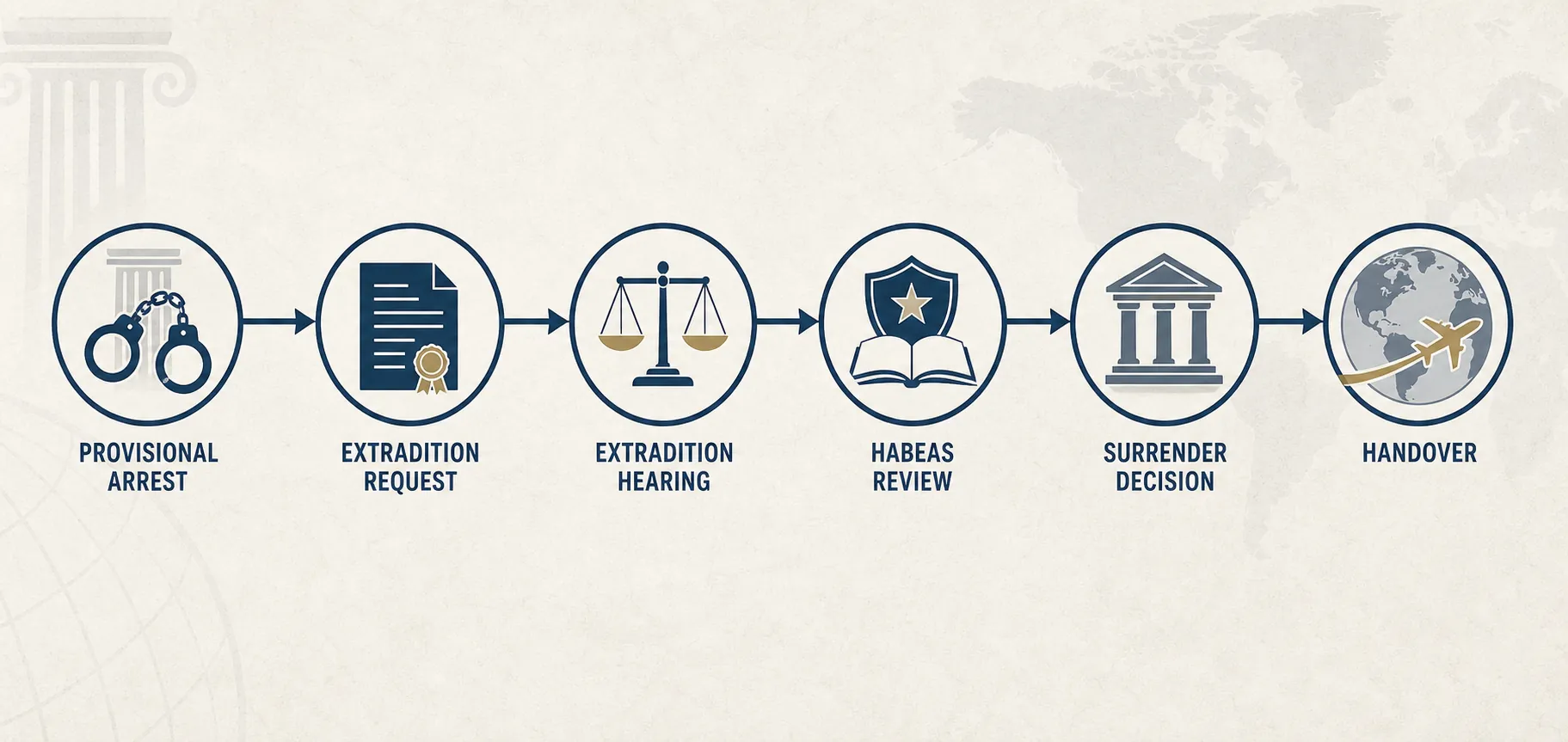
| Stage | Who acts | What the stage decides | What it does not decide |
|---|---|---|---|
| Provisional arrest | US authorities act on the foreign request and warrant through the applicable process | Whether the person can be taken into temporary custody while formal papers are prepared | Guilt, final extraditability or surrender |
| Formal extradition request | The United Kingdom transmits the required materials through diplomatic channels; the State Department and Justice Department process them | Whether a complete request will be presented for judicial proceedings | Whether the evidence ultimately satisfies the certification standard |
| Extradition hearing under 18 U.S.C. § 3184 | A federal judge or magistrate judge authorized by the statute | Whether the legal and evidentiary requirements for certification are met | Criminal guilt or the executive decision to surrender |
| Habeas review under 28 U.S.C. § 2241 | A federal district court, if the detained person files a petition | A limited review of the legal basis for detention and certification | A full retrial of the foreign criminal case |
| Surrender decision under 18 U.S.C. § 3186 | The Secretary of State | Whether the United States will surrender the person after judicial certification | A judicial verdict on guilt |
| Handover and the timing rule in 18 U.S.C. § 3188 | Executive authorities arrange surrender; a court may consider a discharge application if the statutory period is exceeded | Whether custody may continue when surrender has not occurred within the post-commitment period, subject to sufficient cause | An automatic release deadline measured from the provisional arrest |
1. The September 16 formal-request deadline
The July 18 arrest began the temporary-custody phase. The next required event is the United Kingdom’s formal submission by September 16.[2] The State Department receives extradition requests through diplomatic channels and, if the request proceeds, the Department of Justice presents the matter in federal court. The Foreign Affairs Manual describes this interagency route, although the governing authority ultimately comes from the applicable treaty and federal law rather than from the manual itself.[4][5]
The formal request matters because it supplies the materials on which the later extradition hearing will operate. The provisional warrant secured custody; it did not substitute for the complete request and did not resolve whether the British submission satisfies the governing requirements.
2. The § 3184 hearing and certification
Once the request reaches court, 18 U.S.C. § 3184 authorizes the extradition judge to hear the matter and decide whether the evidence and legal requirements support certification. If the standard is met, the judge certifies the case and transmits the record for executive consideration.[4]
Certification is judicial, but its function is limited. The judge does not conduct the British trial, decide guilt beyond a reasonable doubt or impose punishment. Nor does the judge personally order the final international handover. A certification says the legal conditions for the executive branch to consider surrender have been met.
The distinction also runs in the other direction: a bail denial would not establish that certification must follow. The custody court can find release inappropriate because of flight risk without deciding whether the later formal request contains what § 3184 requires.
3. Habeas review under § 2241
After certification, the principal route for judicial review is a petition for habeas corpus under 28 U.S.C. § 2241. The Foreign Affairs Manual and NPR’s process account describe habeas as an intervening stage before surrender may be completed.[2][4] Its scope is limited; it is not a conventional appeal that reopens every factual dispute or tries the UK allegations.
The practical effect is that certification can be tested for legal defects while the extradition court’s restricted role remains intact. How long that takes depends on the claims raised and the resulting litigation. The existence of habeas review therefore does not supply a fixed prediction for when the matter will reach the Secretary of State.
4. The Secretary of State decides whether surrender occurs
If judicial certification survives any review, 18 U.S.C. § 3186 places the surrender decision with the Secretary of State. This is a separate executive judgment. The Secretary may consider matters appropriate to the executive role that were outside the extradition judge’s certification inquiry, and certification does not itself place the person on an aircraft.[4]
That allocation of authority is why reports saying a judge has “approved extradition” can be imprecise. A judge can certify extraditability; the Secretary decides whether the United States will surrender the person. The two acts occur at different stages and answer different questions.
5. The two-month rule is not a clock running from July 18
Section 3188 addresses what happens if a person committed for surrender is not delivered up and conveyed out of the United States within two calendar months. The person may apply for discharge, but the court may continue custody upon a showing of sufficient cause. The rule belongs near the end of the process, after commitment; it is not an automatic two-month release deadline measured from the original provisional arrest.[4]
What the eventual bail ruling will—and will not—mean
A decision to detain would mean that Judge Louis was not satisfied that release was warranted under that custody framework. A decision to release would mean the judge found the demanding standard met and conditions adequate in this case. Neither outcome would adjudicate the UK charges, determine that the formal request satisfies § 3184 or dictate the Secretary of State’s later decision.
The procedural assignments remain separate: the custody judge decides detention, the extradition judge decides certification, a habeas court can conduct limited legal review, and the Secretary of State decides surrender. The courtroom image may be dramatic, but the authority at each stage is deliberately narrower than the whole case.
Related comparative reading
- Daniel Kinahan Loses Final Appeal in Extradition to Ireland — a comparison involving the executive-approval and surrender stage.
- CCJ dismisses Guyana opposition leader extradition appeal — a contrast with appellate review in another common-law system.
- Pannun’s Khalistan Referendum: Legal Status in Five Forums — a forum-by-forum treatment of overlapping cross-border legal questions.
- Why the Pan Am 103 Lockerbie case needed five forums — a broader example of why multi-jurisdiction cases must be separated by institution and procedural role.
References
- Shackled Tate brothers in court asking to be released from jail during extradition fight — Associated Press, August 27, 2026.
- Andrew Tate is seeking bail in his extradition fight. Here’s why that’s unlikely — NPR, August 27, 2026.
- Tate brothers urge release on bail in Miami as they fight extradition to UK — The Guardian, August 27, 2026.
- 7 FAM 1630 — U.S. Department of State Foreign Affairs Manual.
- Justice Manual 9-15.000 — International Extradition and Related Matters — U.S. Department of Justice.
- CPS decides to prosecute Tate brothers with additional sexual offences — Crown Prosecution Service, July 19, 2026.
- Judge postpones hearing over whether Tate brothers should stay in custody as they fight extradition — PBS NewsHour and Associated Press.
Operationalizing workflow
No workflow has been explicitly linked to this obligation yet. See Workflows generally.
Illustrative cases
No illustrative case is currently tracked for this obligation. See Risk Digest for documented incidents generally.
← Back to RegulationReport a correction or tip
Spotted an outdated figure, a misstated fact, or a ruling this regulation entry should reflect? Public comments are disabled for this content given the professional cost of a misreported case outcome, penalty amount, or rule text — use the structured correction channel instead.
Report a correction or tip for this record →