
Are FDA food recalls increasing, or just the headlines?
- Authority
- U.S. Food and Drug Administration (FDA)
- Rule type
- regulation
- Jurisdiction scope
- US federal
- Source text
- Read primary rule text ↗
Maintain written recall plans and verify recall effectiveness under 21 CFR 117.139; avoid receiving or delivering adulterated food under FD&C Act §301(c).
Editorial note: This is an out-of-lane food-regulatory verification article published in the Regulation & Ethics tracker because recall enforcement, liability exposure, and source discipline overlap with this site’s risk-tracking function. It is not legal advice. Verification status: current as of August 25, 2026; 2026 figures are partial-year figures unless stated otherwise; article-specific named legal reviewer was not supplied in the source packet.
A person trying to answer whether FDA food recalls are increasing in 2026 can land on two defensible headlines within minutes. One says recalls are surging. Another says the numbers are roughly normal. The problem is not only media tone. It is that “recalls” can mean announcement counts, affected units or pounds, illness-linked outbreaks, warning letters, retail compliance checks, or a vendor’s category-specific dataset. Those are not interchangeable measures.
For a compliance lead briefing a general counsel, the safe answer is narrower: FDA food recall announcement counts in 2026 do not, by themselves, prove a count-based explosion. Recall severity signals and FDA enforcement signals, however, are meaningfully harder to dismiss. The question is not “are recalls up?” in the abstract. It is “up by which measure, under which jurisdiction, during which time window, and safe to cite for which claim?”
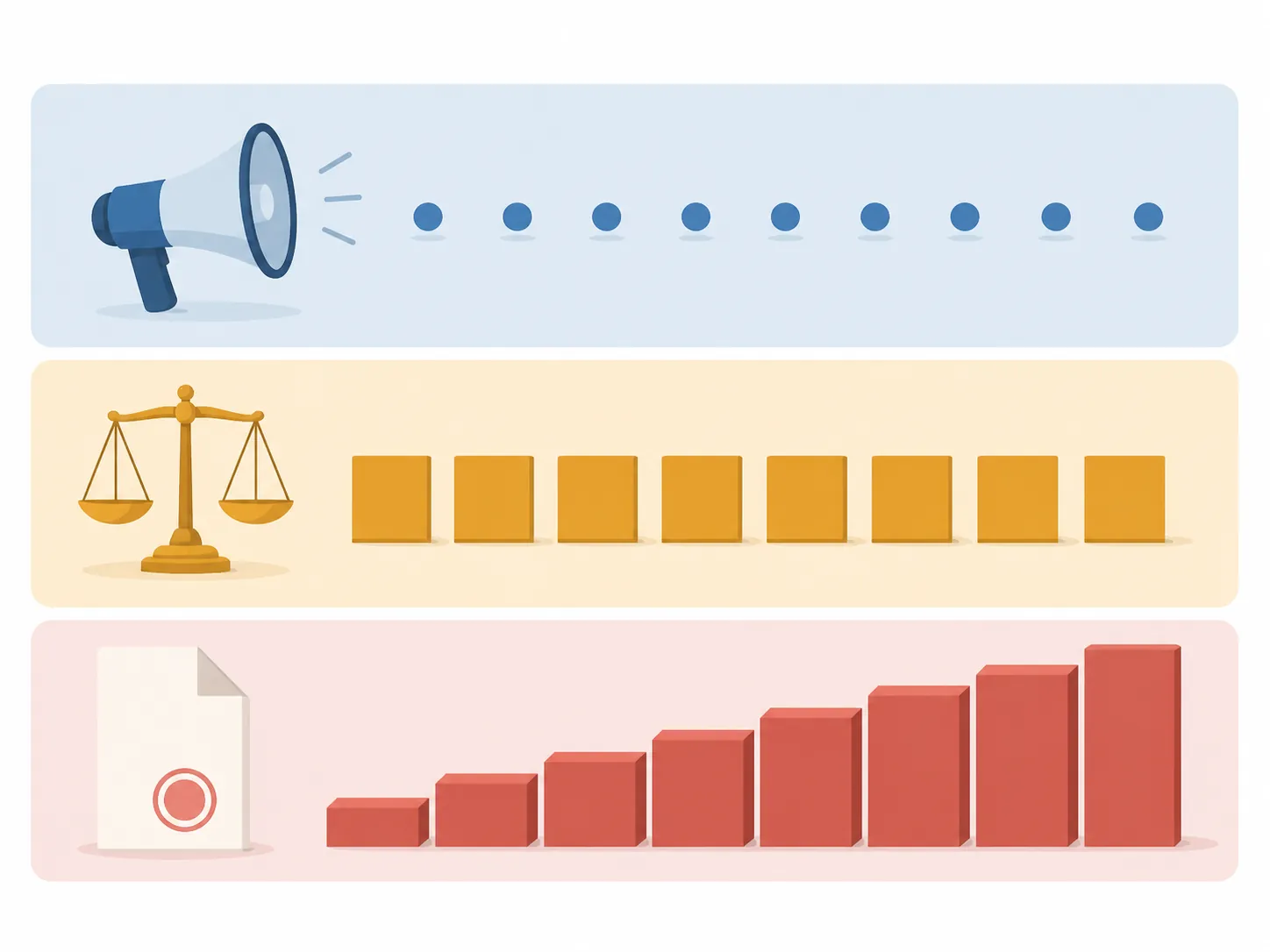
The first cleanup: one recall number cannot carry five meanings
The cleanest public count series in the current consumer coverage is the PIRG-linked FDA-plus-USDA announcement series: 162 food recalls announced year-to-date in 2026, 320 in 2025, and roughly 400 in 2018. On that combined-agency basis, the 2026 pace is not enough to support a simple “recall counts are exploding” claim, especially because the year is incomplete as of August 25, 2026.[1][2][3]
That does not make every larger or smaller figure wrong. It means the figure has to stay attached to its scope. A 237 count in the 2026 discussion refers to a Truli/Food Institute analysis of FDA food recalls tracked year-to-date, not a combined FDA-plus-USDA PIRG count.[4] A 320 count can be the 2025 combined FDA-plus-USDA total in the PIRG-linked series, not a 2026 FDA-only figure.[1] A 251 figure circulating in vendor materials should be treated as a food-and-beverage definition with its own inclusions and exclusions, not casually merged with FDA-only or FDA-plus-USDA counts. A 523 figure for 2025 should not be relied on here as a citable number because the underlying Food Safety Magazine page surfaced only through an authentication-walled snippet in the research packet and was not re-verified against the original article.
| Figure | What it can support | What it cannot support |
|---|---|---|
| 162 year-to-date 2026 | A partial-year FDA+USDA announcement pace in PIRG-linked reporting | A finding that food is more dangerous in 2026 |
| 237 year-to-date 2026 | An attributed FDA food-recall count in the Truli/Food Institute analysis | A combined FDA+USDA comparison unless the scope is rebuilt |
| 251 | A vendor-defined food-and-beverage count only if the underlying methodology is in hand | A general FDA recall total without checking inclusions such as pet food or supplements |
| 320 in 2025 | The PIRG-linked FDA+USDA annual count for 2025 | A 2026 count or an FDA-only count |
| 523 in 2025 | Not safe to cite from the materials available here | Any primary-source claim without re-verification |
PIRG’s Teresa Murray supplies the necessary brake on both the panic headline and the easy debunking. The count alone does not tell readers whether regulators are enforcing more aggressively, companies are disclosing more, surveillance is catching more problems, or the food supply is becoming more hazardous.[2] That is not a rhetorical nicety. It is the boundary between a usable compliance briefing and a number collage.
Announcement counts look calmer than the operational exposure
Announcement counts are event counts. They do not measure how many packages left the facility, how long the product stayed on shelves, whether the recall involved a Class I hazard, how many retailers needed to remove inventory, or whether recalled product was still available after notice. A year can look unremarkable by count and still be difficult operationally if more units, pounds, customers, or states are involved.
That is why the Sedgwick severity series, as reported by Food Safety News, matters even though it is vendor-derived rather than a government-certified hazard rate. In Q3 2025, FDA recall events increased only 1.4% quarter over quarter, to 145 events, while affected units rose 75.8% to 25.17 million. Year-to-date 2025, the same reporting described 415 FDA recalls involving 109.74 million units, compared with 363 recalls and 45.02 million units in 2024.[5]

The FSIS side of the same Food Safety News report makes the count-versus-volume problem more obvious: pounds affected by FSIS recalls rose 5,511.8% in the cited period. The report also noted that Q1 2025 food units rose 232%.[5] Those figures should not be laundered into FDA statistics, and they should not be treated as a direct measure of consumer illness. They are still highly relevant for operations, insurance, logistics, retailer chargebacks, customer notification, and litigation posture.
A lawyer does not advise the same way when the fact pattern is “more notices” as when it is “roughly similar notice volume, materially more affected product.” The second version changes document preservation, retailer communications, recall-effectiveness testing, and the likely questions from insurers and plaintiffs’ counsel. It also explains why consumer anxiety can be real even when a narrow announcement-count chart looks ordinary.
The enforcement signal is stronger than the count signal
The most consequential 2026 regulatory-enforcement statistic is not the 162 recall-announcement count. It is the warning-letter trend. A Truli analysis reported by Food Institute counted 363 FDA warning letters through late July 2026, compared with 354, 321, and 293 in comparable year-to-date windows in 2025, 2024, and 2023. In the same analysis, Foreign Supplier Verification Program warning letters rose to 42 from 18.[4]
That is still an attributed vendor analysis, not an FDA dashboard output. The correct phrasing is therefore “Truli’s analysis reported an increase,” not “FDA officially found an enforcement surge.” But the direction matters because the windows are comparable and the categories are tied to formal warning-letter activity. For companies importing food or relying on foreign suppliers, the FSVP change is the harder number to ignore.

The December 15, 2025 FDA recall-compliance letter gives that enforcement discussion a primary-source anchor. FDA said it conducted more than 4,000 retail checks and found recalled product still for sale at more than 175 locations across 36 states. The agency also pointed firms to recall-plan elements under 21 CFR 117.139 and cited the FD&C Act Section 301(c) prohibition on receiving or delivering adulterated food in interstate commerce.[6]
That letter does not prove that every food category became more dangerous. It does something more specific and more useful: it shows FDA telling industry leaders that recall execution failed at the retail end often enough to warrant a public compliance message. For counsel, that changes the question from “did we issue the recall?” to “can we prove the recall worked?”
The operational checklist embedded in that letter is familiar but unforgiving: identify affected product, notify direct consignees, verify that consignees acted, account for product disposition, and maintain a written recall plan where required. Related recall-liability issues, including FDA classification and allocation between manufacturer and retailer, are treated in this site’s Walmart bakery glass-contamination recall analysis; refund and mandatory-recall context is covered separately in the food recall refund obligations guide.
Cause mix helps, but only if it stays modest
The cause-mix data is useful mainly because it stops vague “contamination surge” language from doing too much work. In the Truli/Food Institute tracking, undeclared allergens led the FDA food recalls counted year-to-date in 2026, with 85 of 237 recalls attributed to that category. Milk accounted for 20 and soy for 19. Salmonella accounted for 44 year-to-date recalls compared with 53 for all of 2025, while Listeria fell from 55 to 8 in the same comparison described by the analysis.[4]
Those figures support a careful sentence: allergen controls and supplier or label verification remain central recall drivers in the tracked FDA food-recall dataset, and Salmonella is elevated against the cited prior full-year comparison. They do not support a broader claim that all contamination categories are rising together. They also do not replace the FDA Recalls Data Dashboard when the task is to verify a specific recall record, firm, classification, product, or date.[7]
Capacity constraints complicate the enforcement story
More warning letters should not be read as proof of a smoothly expanding FDA enforcement machine. GAO’s WatchBlog described FDA oversight capacity pressure, including inspector vacancy rates rising from 9% to 16%, a 2-to-3-year training cycle for inspectors, and a proposed reduction of about 3,500 staff.[8] Those facts do not establish why recall or warning-letter figures moved in any particular direction. They do warn against a lazy causal story in either direction.
A resource-constrained agency can still issue more warning letters in a given category. A better surveillance system can produce more notices without a proportional rise in underlying hazard. A severe recall can dominate unit or pound totals without implying that every manufacturer is failing at the same rate. These distinctions are not academic; they decide whether a client memo says “recall counts are up,” “enforcement letters are up,” “affected volume is up,” or “we cannot support that claim from this source.”
If you have to cite one statistic by noon
Use PIRG-style FDA-plus-USDA counts for announcement pace only. They are appropriate for saying that the 2026 combined-agency announcement count is tracking within recent-year context, not for saying food is safer or more dangerous.[1][2][3]
Use Sedgwick-style figures, as reported by Food Safety News, for severity signals only. They are appropriate for describing affected units, pounds, and operational scale; they should remain attributed vendor data and should not be converted into government-certified hazard rates.[5]
Use Truli/Food Institute figures for attributed enforcement analysis. They support a measured claim that warning-letter activity, including FSVP letters, rose across comparable year-to-date windows in the cited analysis; they do not substitute for downloading primary FDA warning-letter records when a filing, board deck, or enforcement chronology depends on exact agency action.[4]
Use the FDA Recalls Data Dashboard and FDA letters when making a primary-source claim. That is the safer source for verifying a specific recall, classification, product, firm, date, or agency statement.[6][7] The same verification pattern appears in this site’s Midwest Poultry egg-recall record, where product-level recall facts are kept separate from consumer-facing shorthand.
The citation rule is simple enough to survive a rushed call: announcement counts answer announcement questions; severity figures answer scale questions; warning letters answer enforcement questions; FDA source records answer primary-source questions. Once those lanes are separated, the 2026 picture is no longer contradictory. Count-based surge claims are overstated, count-based dismissals are too thin, and the strongest supported statement is that recall severity and enforcement signals deserve attention even though announcement counts alone do not prove a food-safety explosion.
References
- Food for Thought 2026, PIRG Education Fund.
- US food recalls trend analysis, WBAL.
- Food recalls numbers 2026 previous years, NewsNation.
- How Food Brands Can Get Ahead of 2026’s Regulatory Enforcement Surge, Food Institute.
- Volumes of recalled food at both the FDA and FSIS have increased dramatically, Food Safety News, December 2025.
- FDA Calls on Food Industry Leaders to Strengthen Recall Compliance and Ensure Recall Effectiveness, U.S. Food and Drug Administration, December 15, 2025.
- FDA Recalls Data Dashboard, U.S. Food and Drug Administration.
- Overseeing Food and Drug Safety Is Getting Harder for FDA, GAO WatchBlog.
Operationalizing workflow
No workflow has been explicitly linked to this obligation yet. See Workflows generally.
Illustrative cases
No illustrative case is currently tracked for this obligation. See Risk Digest for documented incidents generally.
← Back to RegulationReport a correction or tip
Spotted an outdated figure, a misstated fact, or a ruling this regulation entry should reflect? Public comments are disabled for this content given the professional cost of a misreported case outcome, penalty amount, or rule text — use the structured correction channel instead.
Report a correction or tip for this record →