
Cornell's Austin Franco case is a referral, not a finding
- Authority
- Cornell University
- Rule type
- regulation
- Jurisdiction scope
- US federal
- Source text
- Read primary rule text ↗
FERPA bars disclosure of student disciplinary records; Policy 6.4 referrals are an intake step, not a finding.
For anyone looking for an Austin Franco Cornell antisemitism case update, the first correction is procedural: as of Aug. 3, 2026, the public record shows a Cornell Policy 6.4 bias-incident referral, not a university finding. Cornell confirmed that the matter was referred to its Office of Civil Rights after Franco reportedly wrote that he was “not interested in working for a Jew” on Handshake; Cornell later condemned the remarks, cited FERPA in declining to disclose student-discipline information, and separately confirmed that Franco would return to campus. [1][2][3]
That leaves a narrow but important gap. There is no public court order, no published Office of Civil Rights outcome, and no Cornell-confirmed disciplinary disposition. The student’s reported claim that he faced no disciplinary action may be relevant to the public story, but it is not the same thing as a university-confirmed result or a legal finding.

What Cornell has actually confirmed
The cleanest way to read the record is to separate who said what and what authority each statement carries. Cornell’s June position, as reported by The Cornell Daily Sun, was that the incident had been referred to the university’s Office of Civil Rights under Policy 6.4. [1] That is an institutional fact about intake or routing. It is not, by itself, an institutional finding that the policy was violated.
President Michael Kotlikoff’s July 29 statement did two different things at once. It condemned the remarks as inconsistent with Cornell’s values and with the university’s commitment to a community free from antisemitism; it also said federal privacy law limits what Cornell can say about any individual student disciplinary matter. [2] Both parts matter. Condemnation is part of the public record. FERPA silence is not an outcome.
The New York Post later reported Cornell’s confirmation that Franco would return to campus. [3] A return-to-campus statement narrows the practical picture, but it still does not disclose whether Cornell opened a formal investigation, imposed an educational measure, took no action, or reached some other student-specific disposition that Cornell will not publicly describe.
| Public claim | What the cited record supports | What it does not establish |
|---|---|---|
| Cornell referred the matter to the Office of Civil Rights | A Policy 6.4 bias-incident referral was publicly confirmed | A finding of discrimination, harassment, retaliation, or misconduct |
| Cornell condemned the remarks | The president publicly denounced the remarks and addressed antisemitism | A disclosed disciplinary sanction |
| Cornell cited FERPA | Cornell declined to disclose student-discipline details | That the university punished, cleared, or ignored the student |
| Franco will return to campus | Cornell confirmed a return-to-campus fact | A university-confirmed no-action disposition |
A bias report is an intake category, not a verdict
Cornell’s own bias-reporting FAQ is the key procedural document because it explains what a report usually does before anyone reaches for the language of discipline. The FAQ says bias reports “do not typically result in formal investigations unless there are facts that allege discrimination, harassment, or retaliation,” and describes common responses such as accountability conversations, conflict coaching, mediation, and other educational steps. [4]
That language does a lot of work. It means the public phrase “reported as a bias incident” should not be collapsed into “charged,” “found responsible,” or “disciplined.” A bias report can be serious, and it can be institutionally significant, without becoming a formal adjudication. The referral tells us Cornell routed the matter into a civil-rights review channel. It does not tell us what the review concluded.
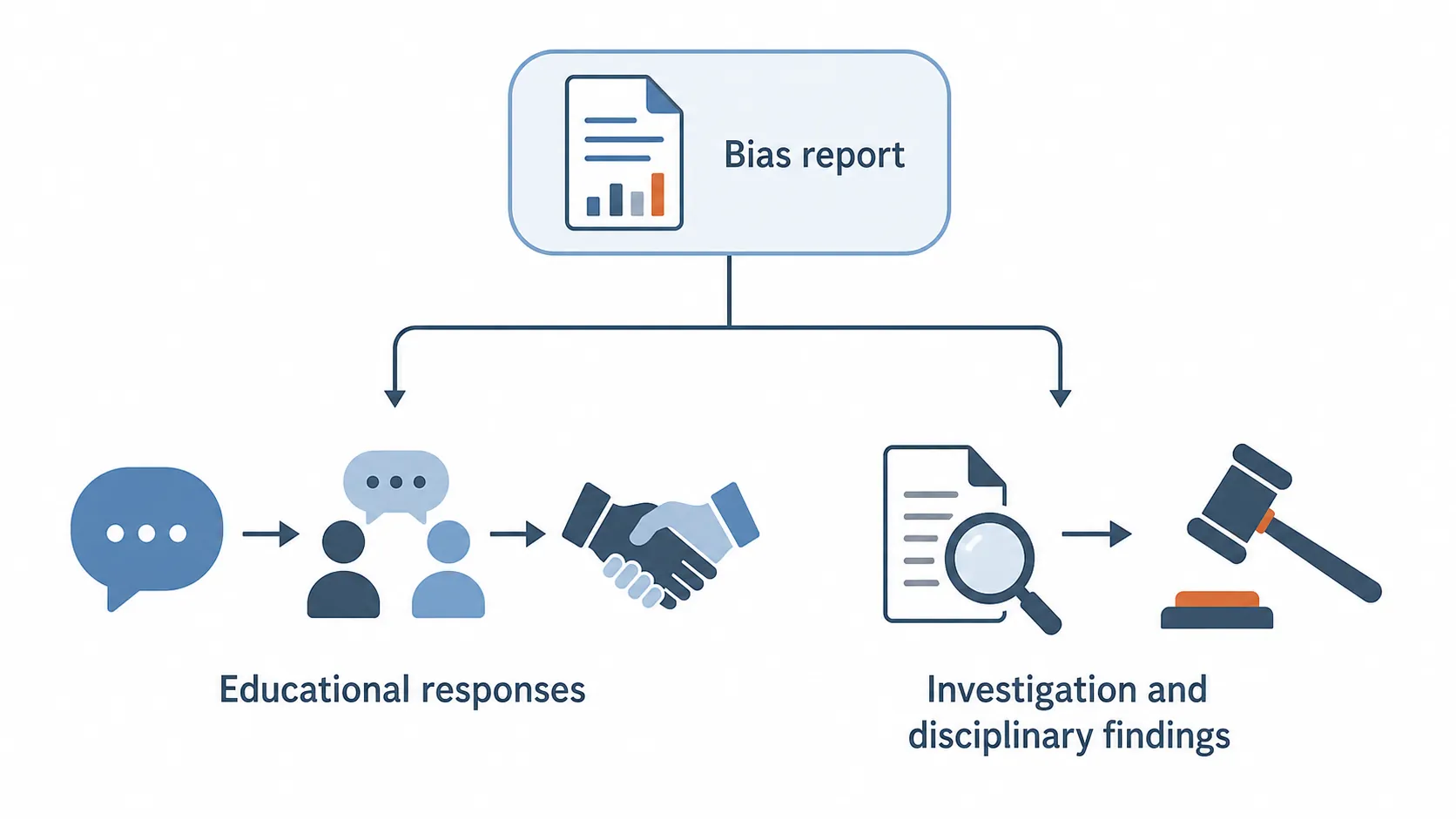
Policy 6.4 itself is broader than a press shorthand can comfortably hold. Cornell’s policy covers prohibited bias, discrimination, harassment, and sexual and related misconduct; the current procedures describe how reports can move through assessment, supportive or educational measures, alternative resolution, investigation, and other procedural routes depending on what facts are alleged and what policy provisions are implicated. [5][6]
For a lawyer or compliance reviewer, the relevant distinction is not cosmetic. A report may generate outreach. Outreach may generate an educational conversation. A complaint may or may not become a formal investigation. An investigation may or may not produce a finding. A finding may or may not produce discipline. Public reporting often skips from the first noun to the last, but Cornell’s procedures do not.
The offensive character of the remark does not fill the procedural gap
The reported statement was antisemitic in ordinary meaning, and Cornell’s condemnation is not a side issue. It is part of what Cornell chose to make public. But the offensive character of a statement does not answer the separate record question: did Cornell find a policy violation, impose discipline, decline to proceed, or resolve the matter in some confidential educational way?
The current public materials do not answer that question. They show referral, condemnation, FERPA-based nondisclosure, and return to campus. They do not disclose the disposition.
FERPA makes the silence predictable, not evidentiary
When Cornell invoked FERPA in the July 29 statement, it was not making a merits claim about Franco. It was giving the reason the university would not publicly discuss student-discipline details. [2] That creates an information asymmetry that is easy to misuse. Observers who want punishment can treat silence as a coverup. Observers who want exoneration can treat silence as proof that nothing happened. Neither move is supported by the record.
The student’s own reported statements sit in a different category. They may explain why “no action” language appears in public discussion, but they do not carry the same authority as a university disposition letter, a published OCR outcome, or a court order. If Cornell is legally constrained from confirming a discipline result, then the absence of a Cornell confirmation is not itself confirmation of the student’s account.
FIRE’s challenge is about speech and chilling effect
FIRE’s June 18 letter to Cornell argued that Franco’s reported statement was protected expression and that referring him to the Office of Civil Rights over the statement would chill protected speech. [7] FIRE’s case page frames the matter the same way: a student was reported to Cornell’s civil-rights office for alleged antisemitic expression, and FIRE viewed the university’s response as a free-speech problem. [8]
That argument should be read for what it is. FIRE is not the tribunal deciding Cornell’s Policy 6.4 process. Its letter is an advocacy document pressing Cornell not to punish protected expression and warning that even the referral mechanism can deter speech. It may be persuasive on free-speech policy and contract-based campus-speech expectations. It does not establish what Cornell ultimately did.
FIRE’s broader Cornell ranking adds context but not a disposition. FIRE’s 2026 campus-speech ranking gave Cornell a score of 51.7 out of 100, ranked it 227th out of 257 institutions, assigned an F grade, and reported that 45 percent of surveyed Cornell students said they self-censor at least monthly. [9] Those figures are relevant to FIRE’s institutional critique. They do not prove that this particular referral became discipline.
Private universities are not public universities, but their promises still matter
The legal frame is more constrained for Cornell than for a public university, but not empty. NYCLU’s higher-education First Amendment guidance explains that private colleges are generally not bound by the First Amendment in the same way public institutions are, while also noting that they may be held to their own rules, policies, and basic fairness obligations. [10]
That distinction matters for the common question, “Can Cornell discipline a student for off-campus offensive speech?” The safer answer is conditional. Cornell is a private university, so the analysis is not the same as a direct First Amendment claim against a state institution. But Cornell still has to operate within the promises it makes in its policies, the procedures it publishes, and the fairness constraints that apply to private educational discipline. FIRE’s letter presses the speech-protection side of that argument; Cornell’s Policy 6.4 materials show the internal path any report would have to travel. [5][6][7][10]
This is also where the word “protected” can mislead if it is used too quickly. In a public-university case, the First Amendment analysis would sit closer to the center. In a private-university case, speech protection may come from institutional commitments, student handbooks, state-law theories, or fairness principles rather than direct constitutional restraint. The practical briefing question is therefore not simply whether the speech was offensive or whether FIRE called it protected. It is whether Cornell’s own rules allowed the step Cornell actually took, and whether any later undisclosed step substantially complied with those rules.
What the side reports can and cannot carry
The New York Post report helps explain why the case traveled beyond campus: it reported Cornell’s return-to-campus confirmation and also described Franco’s public fundraising and family-conflict claims. [3] Those details may explain search interest. They are not the basis for determining whether Cornell made a disciplinary finding.
The Cornell Daily Sun’s report is useful for the university’s referral confirmation and for contemporaneous campus context. [1] It remains student press, not a court record or Cornell’s disciplinary docket. The same caution applies to advocacy-group pages, social-media video claims, and fundraising materials: they may be sources for who said what publicly, but they do not substitute for the missing institutional disposition.
A separate question is whether Cornell’s handling of the matter could create Title VI, employment, or civil-rights enforcement exposure in a broader campus-antisemitism environment. That is not resolved by this record. For that risk track, see the companion analysis, Was Cornell’s No-Action on Antisemitic Remarks Lawful?, and the related enforcement-context pieces on the UPenn EEOC antisemitism probe and Title IX enforcement-structure changes. This article is narrower: it asks what the Austin Franco record currently proves.
The usable vocabulary as of Aug. 3, 2026
The most accurate public description is spare: Cornell confirmed a Policy 6.4 referral to the Office of Civil Rights; Cornell condemned the reported antisemitic remarks; Cornell cited FERPA in declining to discuss student-discipline details; Cornell confirmed Franco will return to campus. [1][2][3]
Those facts support neither “Cornell punished him” nor “Cornell cleared him.” They support a narrower update: the matter remains publicly incomplete because the confirmed record does not disclose a disciplinary outcome.
References
- Student Writes ‘Not Interested in Working for a Jew’ on Handshake, Cornell Reports Bias Incident, The Cornell Daily Sun
- Statement on student statements, Cornell University, July 29, 2026
- Antisemitic Cornell student Austin Franco begs for cash after parent boot, New York Post
- Bias Reporting FAQs, Cornell Office of Civil Rights
- Prohibited Bias, Discrimination, Harassment, and Sexual and Related Misconduct, Cornell University Policy Library
- Current Policy 6.4 Procedures, Cornell Office of Civil Rights
- FIRE Letter to Cornell University, June 18, 2026, Foundation for Individual Rights and Expression, June 18, 2026
- Cornell University: Student reported to university Office of Civil Rights for alleged antisemitic comments, Foundation for Individual Rights and Expression
- Cornell University, FIRE College Free Speech Rankings
- Know Your Rights: Students in Higher Education & the First Amendment, New York Civil Liberties Union
Operationalizing workflow
No workflow has been explicitly linked to this obligation yet. See Workflows generally.
Illustrative cases
No illustrative case is currently tracked for this obligation. See Risk Digest for documented incidents generally.
← Back to RegulationReport a correction or tip
Spotted an outdated figure, a misstated fact, or a ruling this regulation entry should reflect? Public comments are disabled for this content given the professional cost of a misreported case outcome, penalty amount, or rule text — use the structured correction channel instead.
Report a correction or tip for this record →