
Why the Brij Bhushan Acquittal Tests AI News Verification
- Authority
- Rouse Avenue Court
- Rule type
- court order
- Jurisdiction scope
- India (Delhi)
- Effective date
- Aug 3, 2026
- Source text
- Read primary rule text ↗
Verify AI-assisted legal news against primary court records before relying on it
The line that makes The Quint’s breaking verdict story worth testing is not hidden. It reads: “This article is produced using AI-assisted tools and is based on publicly available information. It has been reviewed by The Quint's editorial team before publishing.” The article concerned the 3 Aug 2026 acquittal of Brij Bhushan Sharan Singh and Vinod Tomar in the women wrestlers’ sexual harassment case, and it carried that disclosure beside the kind of legal update that gets copied into newsroom notes, client alerts, risk logs, and executive briefings before anyone has the court order in hand. [1]
For anyone searching for a brij bhushan sharan singh acquittal case update, the question is not whether an AI-assisted article is automatically accurate or automatically suspect. That binary is too easy. The harder question is narrower: when the reasoned order is not yet public, what can a legal news story safely say, and which record-level facts must remain provisional until checked against the court file?

The disclosure is useful. It tells the reader that a tool helped produce the article and that an editorial team reviewed it. That is better than leaving readers to guess whether a rushed rewrite, a wire aggregation, or a summarization tool shaped the copy. But the disclosure does not answer the professional reliance question: which claims have been checked against the FIR, the chargesheet, the order, and other official case materials, and which claims are still traveling through secondary reports?
The chargesheet page count is the cleanest warning sign
The most useful discrepancy in the early coverage is not an emotional one. It is a page count. The Hindu described the Delhi Police chargesheet as running to “around 1,000 pages.” The Times of India described it as a “nearly 1,500-page chargesheet.” [2][3]

That difference does not prove that either outlet is wrong. It may reflect different counting conventions, annexures, electronic pagination, supplementary materials, or a shorthand description supplied in court reporting. But it is exactly the kind of fact that should stop a downstream user from treating a polished secondary account as a verified record. A chargesheet is not atmosphere. Its length is a record-level descriptor. If two credible secondary reports differ by roughly hundreds of pages, the right response is not to average them, choose the more common figure, or let the smoother sentence win. The right response is to mark the page count as unresolved until the chargesheet or an official case record can be inspected.
This is why the disclosure line matters but does not carry the load. An AI-assisted process can summarize public material quickly. An editor can review the resulting copy for readability, obvious errors, and house style. Neither step necessarily means someone compared the page count to the court file. The gap is not about machine versus human prose; it is about whether the fact was verified at the level where the fact lives.
| Published claim type | Current status for professional use | What resolves it |
|---|---|---|
| Chargesheet length | Divergent secondary reporting: around 1,000 pages versus nearly 1,500 pages | Chargesheet, court record, or official case material |
| Grounds for acquittal | Reported through defence counsel statements and press summaries while the reasoned order remains unavailable in the checked public record | Reasoned order from the court |
| Hostile complainants | Single-chain claim reported by The Quint as sourced to Indian Express | Trial record, deposition record, or court order discussion |
| POCSO closure detail | Differently phrased in secondary accounts | Closure report and relevant court order |
What the early reports do establish
The stable anchors are still important. Multiple reports place the verdict at Delhi’s Rouse Avenue Court, before ACJM Ashwini Panwar, and identify the 3 Aug 2026 acquittal of Brij Bhushan Sharan Singh and Vinod Tomar in the case arising from FIR No. 78/2023 registered at Connaught Place police station. Reports also describe the May 2024 framing of charges and refer to 32 prosecution witnesses. [4][5][6][7]
Those anchors are the checklist, not the conclusion. A legal journalist or in-house lawyer trying to brief the verdict should preserve them as fields to verify: court, judge, FIR number, parties, charge-framing date, witness count, and disposition. If one of those fields later shifts when the order or case file is obtained, the briefing should shift with it.
For U.S. readers, the jurisdictional frame also needs to stay explicit. This is an Indian criminal proceeding under the IPC-era framework, not a U.S. criminal-law template. The term “acquittal” should not be flattened into an Americanized assumption about procedure, proof, or post-verdict options.
Brut’s framing is a useful guardrail here: an acquittal means the prosecution failed to establish guilt beyond reasonable doubt; it does not mean the court has declared the allegations false. [8]
The reported grounds are not yet the order
Early reports have circulated phrases such as unexplained delay, inconsistencies, contradiction on major issues, and post-incident conduct. Those phrases may ultimately appear in the court’s reasoning, may be paraphrases of oral observations, or may remain descriptions attributed to counsel after the verdict. Until the reasoned order is available, they should not be written as settled judicial holdings.
That distinction matters in both directions. Overstating the grounds can injure complainants by making a defence characterization look like a judicial finding. Understating the acquittal can injure acquitted defendants by leaving readers with a sense that the verdict was procedural noise rather than the operative result of a criminal trial. The safe form is plain: the accused were acquitted; the reported grounds currently trace to counsel statements and press summaries; the reasoned order must be checked before the grounds are treated as the court’s final reasoning.
Hostile witnesses and the POCSO closure need the same labeling
The Quint reported, citing Indian Express, that two complainants turned hostile. That should be handled as a single-chain claim unless and until the relevant deposition material, trial record, or order language is available. [1]
The POCSO-related closure account also should not be smoothed over. ThePrint describes the father as having sought withdrawal, while The Quint’s chain phrases the account as the minor and father having retracted. Those formulations may point to the same procedural history, but they are not identical words and should not be merged into a cleaner narrative without checking the closure report and related court order. [5][1]
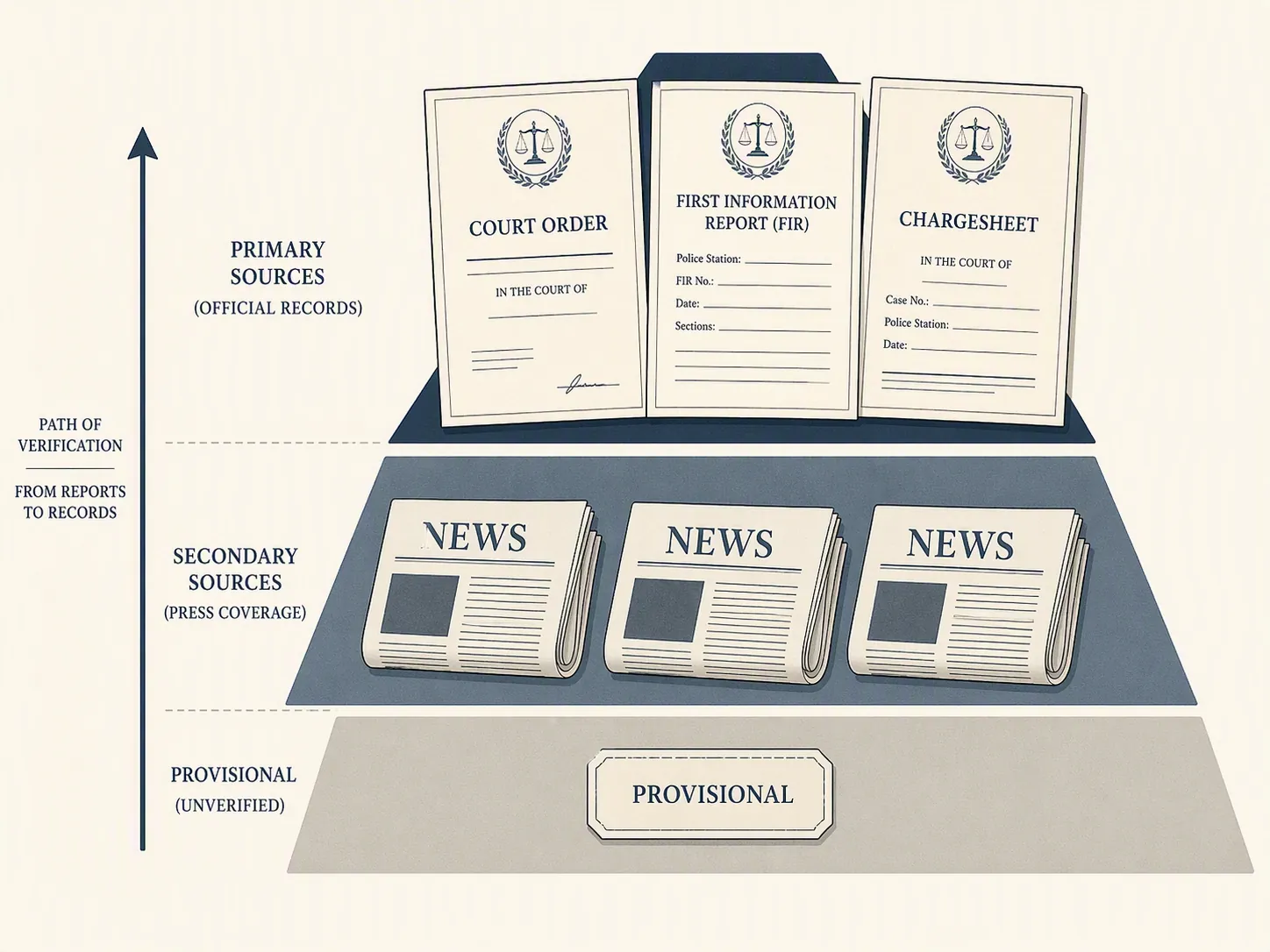
A verification path for this case update
The practical sequence is short, but it has to be followed in the right order. Start with the case identifiers, then move upward to primary records. The site’s verified case chronology is maintained separately at the Brij Bhushan harassment case timeline; that record is the better place for the protest and allegation timeline than a hurried re-narration inside this verification note.
| Verification step | Record to check | Do not treat as settled until |
|---|---|---|
| Confirm the case identity | FIR No. 78/2023, Connaught Place; parties; Rouse Avenue Court listing | The identifiers match across court materials and official case documents |
| Confirm the verdict | 3 Aug 2026 order or certified court record before ACJM Ashwini Panwar | The court record confirms the acquittal and disposition for both Brij Bhushan Sharan Singh and Vinod Tomar |
| Confirm the chargesheet descriptor | Chargesheet and annexures or official filing record | The page count and scope are visible in the official material |
| Confirm the reasons | Reasoned acquittal order | The cited grounds appear in the court’s own language or are accurately paraphrased from it |
| Confirm POCSO closure phrasing | Closure report and order on closure | The record shows who made which statement and how the court treated it |
| Confirm appeal posture | Filed appeal, revision, or official court docket entry | A filing exists, not merely a stated intention |
This is also the point where legal-tech teams should be careful about benchmarking AI summarization tools. A model that extracts the phrase “nearly 1,500-page chargesheet” from one source and another model that extracts “around 1,000 pages” from another source may both be faithfully summarizing their inputs. The tool has not solved the record conflict merely by producing a fluent answer. The conflict has to be carried forward as a conflict.
The same verification habit appears in other public-record stress tests. The site’s note on AI legal research pitfalls from the Fauci hearing is a useful companion for source-chain problems, and the SSA status tracker verification workflow shows the same basic discipline in a non-criminal-record setting: label the source level before relying on the output.
Appeal status is still a stated intention, not a confirmed filing
BBC reported that the complainants intended to challenge the acquittal, and that public prosecutor Manish Rawat said the prosecution would appeal. That is an important litigation signal, but it is not the same as a confirmed filing. As of the record-level verification for this article, appeal status should be described as intended or stated, not filed, unless a docket entry or court record is later located. [9]
How to use the coverage now
The safe professional use of the current coverage is to tag every material claim by source level. “Acquitted on 3 Aug 2026 by ACJM Ashwini Panwar at Rouse Avenue Court” can be carried as a reported verdict anchor, subject to court-record confirmation. “The chargesheet was around 1,000 pages” and “the chargesheet was nearly 1,500 pages” should be logged as a documented discrepancy. “The court found unexplained delay and contradictions” should be downgraded until the order is available, unless the sentence is expressly attributed to defence counsel or a named report.
That is the difference between transparency and verification. The Quint’s AI-assistance disclosure tells readers something real about production. It does not tell them that the court file has been checked. For legal journalists, counsel, risk teams, and legal-tech reviewers, the operating rule is not to choose the most polished secondary account. It is to preserve the chain: primary court order over counsel statement, FIR and chargesheet over article-to-article repetition, unresolved discrepancy over tidy synthesis.
This article is for legal-information and verification-risk purposes only and is not legal advice. Any litigation, appeal, employment, compliance, or reputational-risk decision should be reviewed by licensed counsel in the relevant jurisdiction. Record-level last verification: 4 Aug 2026 UTC, against the cited public reports and the absence of a located public reasoned order in the checked materials.
References
- Delhi Court Acquits Brij Bhushan Singh In Sexual Harassment Case, The Quint, 3 Aug 2026.
- Brij Bhushan Sharan Singh, Vinod Tomar acquitted in women wrestler sexual harassment case, The Hindu.
- Would have hanged myself if guilty: Brij Bhushan after acquittal in wrestlers’ sexual harassment case, Times of India.
- Brij Bhushan Sharan Singh Acquitted In Wrestlers’ Sexual Harassment Case, LiveLaw.
- Brij Bhushan case verdict today: From allegations and protests of wrestlers to defence arguments, ThePrint.
- WFI ex-chief Brij Bhushan Sharan Singh acquitted in women wrestlers’ sexual harassment case, India Today, 3 Aug 2026.
- Brij Bhushan Sharan Singh acquitted in wrestlers’ sexual harassment case: Timeline, Firstpost.
- Why did the Delhi court acquit Brij Bhushan Singh? What was the wrestlers’ sexual harassment case, Brut.
- BBC report on complainants’ stated appeal intentions, BBC.
Operationalizing workflow
No workflow has been explicitly linked to this obligation yet. See Workflows generally.
Illustrative cases
No illustrative case is currently tracked for this obligation. See Risk Digest for documented incidents generally.
← Back to RegulationReport a correction or tip
Spotted an outdated figure, a misstated fact, or a ruling this regulation entry should reflect? Public comments are disabled for this content given the professional cost of a misreported case outcome, penalty amount, or rule text — use the structured correction channel instead.
Report a correction or tip for this record →