
Fauci hearing exposes AI legal research pitfalls
The Fauci Fifth Amendment hearing creates a fact-pattern where AI legal research tools commonly fabricate or conflate details, as demonstrated by the 11th Circuit's July 2026 rebuke of attorney Anthony Sabatini. This record provides a primary-source verification checklist for auditing AI-generated summaries of the hearing before relying on them.
- Jurisdiction
- US Federal
- Court
- U.S. Court of Appeals for the Eleventh Circuit
- AI tool named
- No named AI tool
- Ruling date
- Jul 10, 2026
- Source document
- View primary court order ↗
- Last verified
- Aug 4, 2026
Lex Machina Review is an independent risk-tracking and reference resource. Nothing on this site is legal advice, and using it does not create an attorney-client relationship. Every record is reviewed against primary sources but may not reflect the most current status of a matter — always verify directly against the cited court order, rule text, or a licensed attorney before relying on it.
Companion explanation — secondary to the source document above
Risk Digest status: last verified August 4, 2026, 00:00 UTC
This record is not legal advice. It is a reliability record for AI-assisted legal research and news summarization, focused on what must be verified before a lawyer, KM reviewer, or legal-tech buyer relies on an AI-generated account of the Fauci Fifth Amendment Senate hearing legal issues.
The risk anchor is not the Fauci hearing itself. It is the Eleventh Circuit’s July 10, 2026 rebuke in Akerlund v. Atlas Air, No. 24-11033. Reuters reported that the court faulted attorney Anthony Sabatini over briefs containing citations to non-existent cases, referred the matter to the court’s Committee on Lawyer Qualifications and Conduct, and warned that AI “is no substitute for actual intelligence.” [1]
That is the filing-risk lesson. A lawyer can use AI to move faster through a dense record. The professional problem begins when the output leaves the sandbox and enters a brief, memo, policy note, client alert, procurement review, or litigation filing without the human work that would have caught the defect.
Why the Fauci hearing is a bad place to trust a clean AI summary
No source in this record documents a named AI tool misreporting the Fauci hearing. That limitation matters. The hearing should be treated as a stress test for legal-research reliability, not as proof that a particular product hallucinated a particular answer.
The fact pattern is still exactly the kind that corrupts summaries. It has a fast congressional setting, overlapping political coverage, a prior Fauci appearance that can be confused with the later Senate event, different outlet counts for the same conduct, a pardon whose wording is legally material, and Supreme Court cases that are easy to flatten into a misleading rule.
The count alone is enough to slow down. The Hill reported that Fauci invoked the Fifth Amendment 111 times. The New York Times described him as invoking it more than 100 times. Reuters framed the confrontation around questions from Senator Rand Paul, with a 15-question count tied to that framing. Those are not interchangeable measurements unless the writer explains what is being counted: invocations, questions, answers, or exchanges. [2][3][4]
That distinction is not pedantry. “More than 100,” “111,” and “15 questions” can all appear in a source environment without meaning the same thing. A reliable AI summary has to preserve the attribution and the unit of measurement. A lawyer does not get to convert them into one rounded fact because the sentence reads better.
The Sabatini order is the professional-duty warning
The Sabatini order matters here because it turns a familiar AI warning into a court-facing consequence. The alleged error was not that an AI answer sounded awkward. It was that case citations in filed appellate work allegedly did not exist, which is the kind of defect that a primary-source check is supposed to catch before filing. [1]
Reuters’ account supplies the practical sequence: briefs carried suspect authority, the appellate court responded, the matter was referred to a lawyer-conduct committee, and the court used unusually direct language about the limits of AI. For legal-tech buyers, the lesson is not simply “avoid hallucinations.” It is to ask where the product’s workflow forces source inspection before output can be reused in a formal setting. [1]
For law-firm risk teams, the same order is a documentation problem. If a memo later becomes the basis for litigation strategy, government-relations advice, or a client alert, someone should be able to reconstruct which claims were generated, which claims were verified, which source controlled, and who signed off. A general “AI was used” note is not enough if the final work contains a false case, wrong date, or unsupported count.
What has to be verified before relying on an AI summary
A useful AI answer should be decomposed before it is trusted. The reviewer should not ask whether the summary sounds plausible. The reviewer should isolate each legally material claim and attach it to a source that actually supports that claim.
| Claim type | Verification question | Source discipline |
|---|---|---|
| Forum and date | Which committee, which chamber, and which hearing date does the statement describe? | Check the committee record or other primary record before merging the July 2026 Senate event with any earlier Fauci appearance. |
| Invocation count | Is the source counting invocations, questions, answers, or exchanges? | Keep The Hill’s 111 count separate from “more than 100” formulations and from question-count framing. |
| Pardon scope | What conduct and time period does the pardon cover? | Use the DOJ pardon document, not a paraphrase, when the scope affects Fifth Amendment analysis. |
| Doctrine | Is the summary relying on Brown, Burdick, or a secondary explanation of both? | Check the primary opinions before stating a rule about immunity, pardons, acceptance, or compulsion. |
| Contempt exposure | Is the summary describing a possible route or a completed legal consequence? | Separate committee procedure, House or Senate action, referral, prosecution discretion, and actual adjudication. |
Start with the forum and date
The first audit point is deceptively simple: identify the proceeding. An AI summary that says “Fauci testified before Congress” may be serviceable for casual reading and still be unsafe for legal use. The reviewer needs the chamber, committee, date, and procedural posture.
This is where the prior-appearance problem enters. The available record flags a June 3, 2024 House Select Subcommittee appearance as a lookalike event that behaved differently from the July 2026 Senate event. A filing-ready version should verify the 2024 appearance against the primary committee record before using it as a contrast. Until then, the safe phrasing is procedural: do not merge the two events.
Preserve the count and its attribution
The invocation count is a classic AI-compression trap. The Hill’s 111 figure can be cited as The Hill’s count. The New York Times’ “more than 100” language can be cited as the Times’ formulation. Reuters’ question framing should not be rewritten as an invocation total unless Reuters itself supplies that total. [2][3][4]
Al Jazeera may also have used a “more than 100” formulation, but this record does not include a retrieved Al Jazeera URL. That means it should not appear in a filing-ready citation set until the article is separately pulled and checked. The point is not that Al Jazeera is unreliable. The point is that a source not actually retrieved is not a source that can carry a legal assertion.
Use the pardon document for the pardon
The pardon is the place where a summary can become legally misleading while sounding careful. The DOJ document is dated January 19, 2025, and the relevant scope identified here is federal offenses related to Fauci’s government service from 2014 through January 19, 2025; it does not cover post-pardon conduct or state crimes. The New York Times also reported on the Biden pardon in connection with the COVID hearing coverage. [5][6]
For a legal memo, that should not be paraphrased from memory. The reviewer should open the DOJ document and test every material statement against the document’s words: whose conduct, what offices or service, what dates, what sovereign, and what is outside the instrument. A pardon-scope sentence that is wrong by one phrase can distort the Fifth Amendment analysis that follows.
The site has already covered the underlying pardon-and-privilege question elsewhere, including what Fauci’s Fifth Amendment testimony means legally, whether the pardon negates the privilege, and why the pardon leaves the Fifth Amendment issue unresolved. This record uses that issue only to identify where AI-generated summaries are likely to overstate.
Do not turn Brown and Burdick into a slogan
Brown v. Walker and Burdick v. United States are useful precisely because they tempt shortcuts. Brown is commonly cited for the proposition that sufficiently protective immunity can remove the risk that supports a Fifth Amendment refusal. Burdick is commonly cited for the proposition that a pardon has consequences tied to acceptance and cannot be treated as a frictionless instrument that automatically erases every privilege problem. [7][8]
That is enough to identify the verification hazard. It is not enough to write the legal rule in a filing. The reviewer should check the primary opinions before making any statement about compulsion, immunity, pardon acceptance, or the remaining risk of prosecution. The National Constitution Center’s discussion of presidential pardons and Fifth Amendment rights is useful as a warning that the issue is easy to oversimplify, but a secondary explainer should not substitute for the cases when the doctrine carries weight. [9]
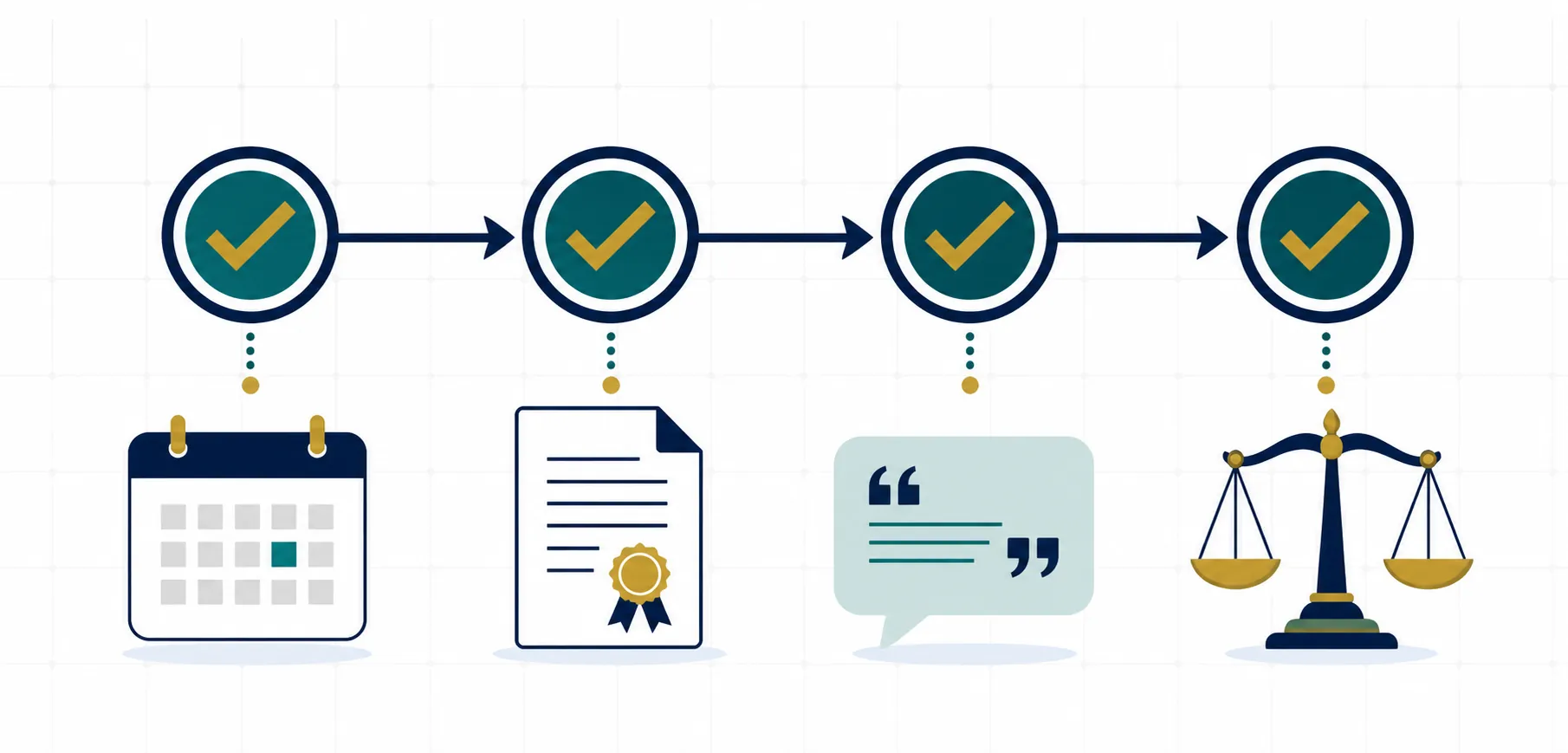
Keep contempt separate from exposure
Contempt is another compression point. A summary may slide from “a committee is considering contempt” to “Fauci faces contempt liability” to “Fauci committed contempt.” Those are different claims. Cornell’s Wex entry describes contempt of Congress as a legal mechanism, but a case-specific statement still has to track the actual committee action, any chamber vote, any referral, prosecutorial discretion, and any adjudication. [10]
For current site background on that route, use the separate contempt coverage, including the Fauci contempt vote record and the analysis of whether the contempt vote creates real legal exposure. This record does not need to relitigate that path; it needs to prevent an AI summary from collapsing the path into a finished consequence.
A defensible AI workflow for this hearing
The safer workflow is not complicated, but it is slower than copy-and-paste. It treats the AI output as a claim inventory.
- Generate the summary, then strip it into individual factual and legal claims.
- Label each claim by type: date, forum, count, quotation, pardon scope, procedural status, doctrine, or legal conclusion.
- Attach a controlling source to each legally material claim. Use primary sources where the wording matters.
- Preserve attribution when outlets measure different things. Do not reconcile counts unless the source record allows it.
- Mark unresolved items as unresolved. A missing primary committee record, unavailable article link, or unverified docket document should remain visible.
- Only then reuse the summary in a memo, client note, procurement evaluation, or filing draft.
That workflow would have caught the most obvious risks in this record. It would have forced the reviewer to separate the July 2026 Senate event from earlier Fauci testimony, keep the invocation counts tied to their outlets, pull the pardon text from DOJ, and distinguish Brown from Burdick instead of turning both into a one-sentence answer about whether a pardon eliminates the Fifth Amendment.
It would also have forced a Sabatini-style citation check. If the AI output names a case, the reviewer opens the case. If it quotes a court, the reviewer finds the opinion or order. If it describes a docket event, the reviewer checks the docket or a reliable report that actually says so. That is the part of the process that protects the person whose name appears on the final work.
What this record does and does not prove
The Sabatini order does not prove that AI tools hallucinated the Fauci hearing. It proves something narrower and more useful: when unverified AI-assisted legal work reaches a court-facing context, the consequences can move from embarrassment to professional discipline. [1]
The Fauci hearing supplies the kind of unstable source environment where the same verification duty becomes practical rather than theoretical. The defensible use of AI here is to ask, isolate claims, and verify each legally material fact against the primary record before it travels further.
References
- US appeals court rebukes lawyer over fake, hallucinated case citations — Reuters, July 10, 2026
- Anthony Fauci Fifth Amendment pardon contempt vote legal exposure — The Hill
- Fauci Testifies Before Rand Paul — The New York Times, July 29, 2026
- Fauci to face Rand Paul’s US Senate committee after diary release — Reuters, July 29, 2026
- Pardon document — U.S. Department of Justice, January 19, 2025
- Fauci Biden Pardon Covid Hearing — The New York Times, July 29, 2026
- Brown v. Walker, 161 U.S. 591 (1896) — Justia, 1896
- Burdick v. United States, 236 U.S. 79 (1915) — Justia, 1915
- Do presidential pardons remove the Fifth Amendment rights of recipients? — National Constitution Center
- Contempt of Congress — Cornell Wex
Related records
Tool profile
How Meta's AI Spending Reshapes Law Firm ProfitabilityGoverning regulation
Browse the obligations tracker →Preventive workflow
Browse verification workflows →
Report a correction or tip
Spotted an outdated figure, a misstated fact, or a ruling this case record should reflect? Public comments are disabled for this content given the professional cost of a misreported case outcome, penalty amount, or rule text — use the structured correction channel instead.
Report a correction or tip for this record →