
Buffett's $140B philanthropy rests on two legal structures
- Authority
- Internal Revenue Service
- Rule type
- statute
- Jurisdiction scope
- US federal
- Effective date
- Jul 14, 2026
- Source text
- Read primary rule text ↗
Minimum-distribution and excise-tax compliance, Form 990-PF filing, and disposal of all Berkshire shares by Dec. 31, 2034.
Last verified: August 2, 2026 UTC. This record is for legal-structure analysis, not legal or tax advice. It belongs with the site’s Regulation & Ethics obligations trackers, alongside records such as the Georgia gas tax tracker and the AI literacy schools tracker.
The legal answer to “Warren Buffett $140 billion philanthropy trust legal structure” starts with a correction: the July 2026 transaction was not the creation of one $140 billion trust. It was a disclosed stock gift to four existing private foundations, sitting beside a separate testamentary charitable trust that is expected to receive nearly all of Buffett’s remaining estate.
The two layers are now tied together by one deadline. In Berkshire Hathaway’s July 14, 2026 release, Buffett said he had converted 8,000 Class A shares into 12,000,000 Class B shares, donated those Class B shares to four foundations, and directed that all of his Berkshire shares be disposed of by December 31, 2034.[1]

Record frame: two vehicles, one disposal deadline
| Item | Record point |
|---|---|
| Announcement date | July 14, 2026 |
| Lifetime layer | Direct gifts of Berkshire Hathaway Class B shares to four existing private foundations |
| Share conversion | 8,000 Berkshire Class A shares converted into 12,000,000 Class B shares |
| Foundation allocation | 9,000,000 Class B shares to the Susan Thompson Buffett Foundation; 1,000,000 each to the Sherwood Foundation, Howard G. Buffett Foundation, and NoVo Foundation |
| Post-transfer Berkshire position | 188,290 Class A shares and 1,162 Class B shares reported after the transaction |
| Estate layer | A testamentary charitable trust described in secondary reporting on Buffett’s 2024 will revision |
| Trust governance | Buffett’s three children as co-trustees, with unanimous consent reported as required |
| Estate commitment | Approximately 99.5% of Buffett’s remaining wealth reported as committed to the testamentary charitable trust |
| Common endpoint | All Berkshire shares to be disposed of by December 31, 2034 |
The post-transfer ownership figure matters because it keeps the story from floating away into a generalized “giving pledge” account. Berkshire’s amended Schedule 13D/A reported that, after the July 2026 transfer, Buffett owned 188,290 Class A shares and 1,162 Class B shares.[2] Using July 13, 2026 closing prices, Motley Fool calculated the retained Berkshire stake at approximately $140.25 billion and the July 2026 gift at about $5.96 billion.[3]
The lifetime layer: a stock conversion followed by four foundation gifts
The lifetime transaction is mechanically plain. Buffett did not need to put the July 2026 shares into a new trust for the public record to become significant. He used Berkshire’s Class A-to-Class B conversion feature, then moved the resulting Class B shares directly into four private foundations.
That sequence does legal work. The conversion turns a smaller number of high-value Class A shares into a much larger number of Class B shares, making the allocations administratively cleaner. The gifts then land in charitable entities that already have boards, exempt-purpose limits, annual filing obligations, investment oversight, and payout calculations. In the July 2026 release, the allocation was exact: 9,000,000 Class B shares to the Susan Thompson Buffett Foundation and 1,000,000 Class B shares each to the Sherwood Foundation, Howard G. Buffett Foundation, and NoVo Foundation.[1]
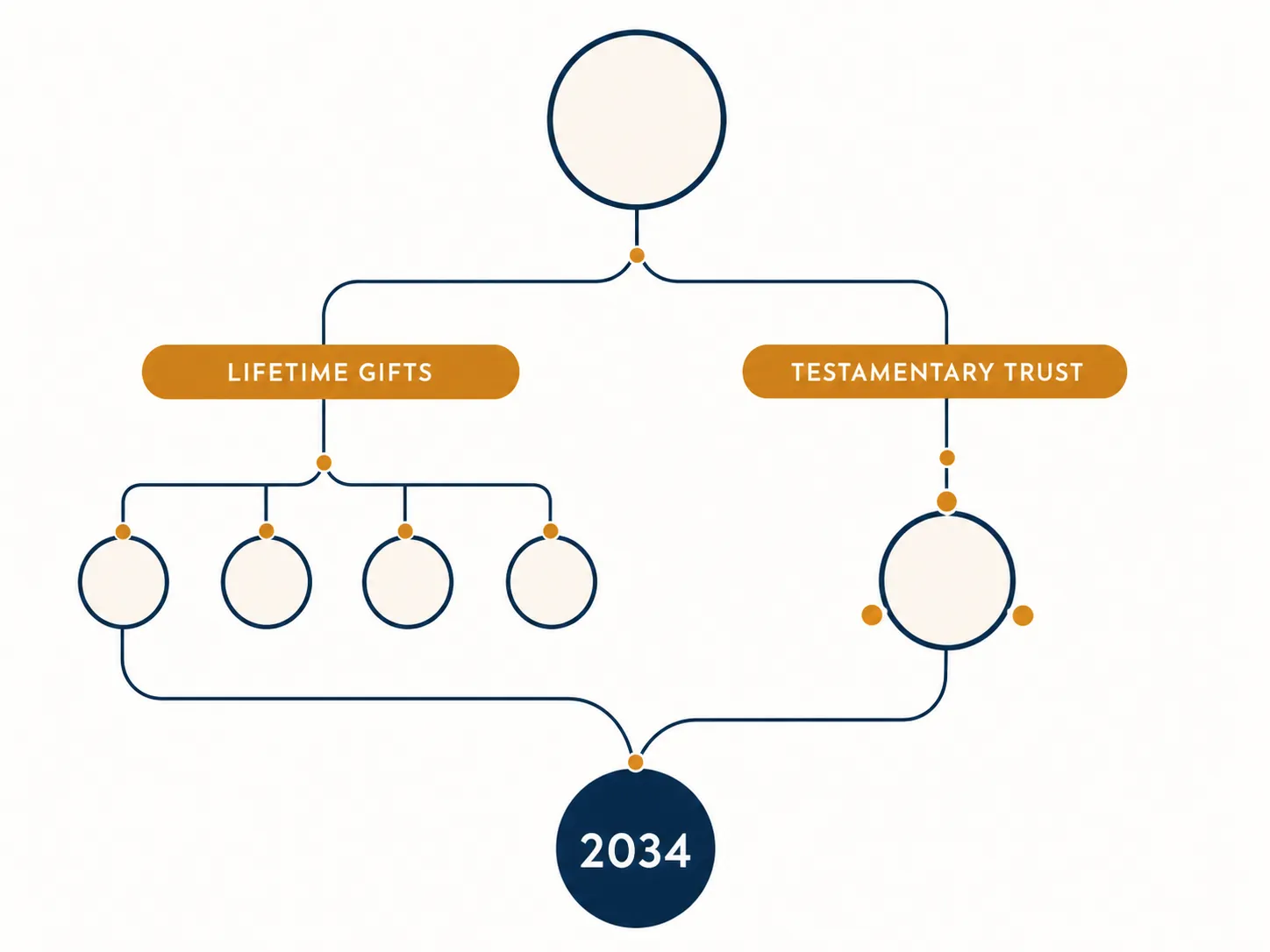
The four-recipient structure is also where the “trust” shorthand starts doing damage. A private foundation is not merely a sentimental family label. It is a regulated charitable vehicle. It must determine distributable amounts, make qualifying distributions, account for investment income, avoid private-benefit and self-dealing problems, and file publicly. The duties attach to the foundation form whether the gift is praised, criticized, or ignored.
CNBC described the July 2026 move as an acceleration of Buffett’s plan to give away Berkshire wealth by 2034, while Reuters framed the same announcement in part through the discontinuation of donations to the Gates Foundation and the shift toward the four foundations associated with Buffett’s family.[7][8] Those are useful context points, but they are not the operative legal form. The operative form is the transfer of appreciated public-company stock into existing private foundations.
What the foundation form forces after the press release
For private foundations, the first recurring obligation is the minimum distribution regime, commonly summarized as a 5% annual payout requirement. IRS guidance on Section 4942 states that a private foundation faces a 30% excise tax on undistributed income and an additional 100% tax if the failure is not corrected.[5] That is not a statement about Buffett’s motives. It is the compliance price of using private foundations rather than simply leaving property outright to public charities.
The second recurring obligation is the excise tax on net investment income. McGuireWoods describes the current private-foundation tax as a flat 1.39% excise tax on net investment income.[6] A foundation holding Berkshire shares or reinvesting sale proceeds has to account for that tax as part of its annual administration.

The third obligation is public visibility. Private foundations file Form 990-PF. That does not make their judgment perfect, their grants immune from criticism, or their payout policies automatically aggressive. It does mean the legal form produces a public record of assets, grants, investment income, excise tax, compensation, and related compliance information. For counsel and compliance staff, that record is where the announcement becomes annual work.
The testamentary layer: the 2024 will revision and unanimous co-trustee control
The estate layer is different in kind. It is not the July 2026 gift itself. It is the reported testamentary charitable trust created through Buffett’s 2024 will revision, intended to receive approximately 99.5% of his remaining wealth after death. WealthManagement.com, citing the Blum Firm and reporting on the Wall Street Journal interview, described the trust as naming Buffett’s three children as co-trustees and requiring unanimous consent.[4]
That unanimity term should not be treated as family color. It is a governance constraint. If a charitable trust holds a concentrated Berkshire position and must dispose of shares within a fixed window, a unanimity requirement changes who can act, how quickly a sale plan can be approved, and what happens when trustees disagree. It may protect against unilateral action; it may also slow action when timing matters.
Secondary reporting describes a 10-year window for the children to distribute the trust assets after Buffett’s death.[4] The July 2026 Berkshire release then adds a calendar endpoint for Berkshire shares: dispose of all of Buffett’s Berkshire shares by December 31, 2034.[1] Those two time concepts are related, but they should not be collapsed casually. One is the reported estate-plan administration window; the other is the public Berkshire-share disposal deadline stated in the July 2026 announcement.
The original Wall Street Journal interview underlying much of the will-and-trust reporting was not directly reviewed for this record. The trust details therefore rest on secondary sources. That does not make them unusable; it does mean the article should not pretend to quote or parse trust language that is not in the available record.
How July 2026 ties the two layers together
The July 2026 announcement did not create the reported testamentary trust, and it did not create the four private foundations. Its legal significance is the way it connects the lifetime and estate layers through Berkshire stock. Buffett reduced his holdings through a lifetime transfer, left a very large retained position, and stated a hard outside date for disposing of all remaining Berkshire shares.
That makes December 31, 2034 the practical hinge of the structure. For the foundations, the July 2026 Class B shares are already inside private-foundation administration. For the testamentary trust, the retained Berkshire shares are the asset base that later trustees are expected to manage, sell or otherwise dispose of, and distribute under the governing documents and charitable purpose constraints.
The retained position is not a rounding error. The amended Schedule 13D/A reported 188,290 Class A shares and 1,162 Class B shares after the transfer.[2] Motley Fool’s July 2026 calculation placed that retained position at roughly $140.25 billion using July 13 closing prices.[3] If the testamentary trust receives that scale of wealth, the trustees’ decisions will not be ceremonial. They will involve market execution, fiduciary documentation, tax accounting, grant or distribution review, and public scrutiny where private foundations are the downstream recipients.
Why the chosen form is not the same as a DAF, CRT, or single foundation
The structure is not exotic. That is part of its importance. A donor-advised fund, charitable remainder trust, single mega-foundation, outright public-charity bequest, or family-foundation network can all sit inside sophisticated charitable planning. They do not impose the same mix of control, disclosure, payout pressure, fiduciary governance, and public reporting.
| Route | Why it would change the obligations map |
|---|---|
| Donor-advised fund | Would generally move assets to a sponsoring public charity with advisory privileges for the donor or advisers, rather than placing the assets in family-associated private foundations with Form 990-PF visibility. |
| Charitable remainder trust | Would be built around split interests and noncharitable income beneficiaries before the charitable remainder, which is not the structure described in the July 2026 foundation gifts. |
| Single private foundation | Would concentrate governance and grantmaking in one entity; the July 2026 gifts instead split shares among four existing foundations. |
| Outright public-charity bequest | Would avoid the same ongoing family-foundation administration, but would also give up the private-foundation control and reporting architecture. |
| Private foundations plus testamentary trust | Keeps charitable control in existing foundation structures during life, then places the remaining estate into a reported charitable trust with co-trustee governance and a share-disposal deadline. |
This comparison should not be overread as a claim that one route is always more accountable than another. A donor-advised fund can be housed at a regulated public charity. A private foundation can satisfy minimum legal requirements while still drawing criticism for pacing or priorities. The point is narrower: the chosen foundation-and-testamentary-trust form creates identifiable parties who must file, pay, distribute, vote, sell, and explain.
Tax-avoidance and payout-rate claims: useful, but not determinations
The tax question sits beside the structure; it does not replace it. Fortune reported Allison Tait’s estimate that Buffett’s plan could avoid approximately $33 billion to $56 billion in taxes, depending on when and how shares are sold.[10] That is a forward-looking estimate by one commentator, not an IRS determination, court finding, or full transaction model available in the record.
Payout-rate comparisons also need careful handling. Inside Philanthropy reported five-year average payout rates for 2020 through 2024 of about 41% for the Susan Thompson Buffett Foundation, 59% for the Howard G. Buffett Foundation, 87% for the Sherwood Foundation, and 47% for the NoVo Foundation.[9] Those figures are relevant because they suggest the recipient foundations have historically distributed far above the statutory minimum. They still come from a secondary analysis of Form 990-PF data, and the methodology was not fully reproduced in the materials reviewed here.
The discontinued Gates Foundation donations raise a separate legal question only at the margins of this structure record. Reuters reported commentary from Ray Madoff on whether Buffett’s earlier pledge to the Gates Foundation might have reliance or consideration implications, while also framing the issue as unsettled rather than resolved law.[8] Without the underlying pledge documents and a live claim, that point belongs in the uncertainty column, not in the architecture of the 2026 foundation gifts or the reported testamentary trust.
Source posture
| Point | Source posture |
|---|---|
| July 2026 share conversion, four-foundation allocation, and Dec. 31, 2034 disposal statement | Anchored to Berkshire Hathaway’s July 14, 2026 release, with BusinessWire syndication available for the same release. |
| Post-transfer share count | Anchored to Berkshire Hathaway’s amended Schedule 13D/A as reproduced by StockTitan. |
| Approximate dollar value of July 2026 gift and retained Berkshire position | Attributed to Motley Fool’s calculation using July 13, 2026 closing prices; other outlets describe the totals with slightly different rounded figures. |
| 2024 will revision, approximate 99.5% estate commitment, co-trustees, unanimity, and 10-year window | Based on secondary reporting from WealthManagement.com and the Blum Firm on the Wall Street Journal interview; the WSJ original was not directly reviewed for this record. |
| Private-foundation payout and excise-tax obligations | Verified against IRS guidance for Section 4942 and McGuireWoods’ client alert on the 1.39% net-investment-income excise tax. |
| Foundation payout-rate comparisons | Attributed to Inside Philanthropy’s analysis of Form 990-PF data for 2020–2024; useful as a benchmark, not as a legal conclusion. |
| Avoided-tax estimate | Attributed to Allison Tait as reported by Fortune; forward-looking and dependent on sale timing and transaction details. |
No new legal vehicle appears to have been created by the July 14, 2026 announcement. The importance of the plan is almost the opposite: ordinary private foundations and an ordinary testamentary charitable trust, used at this scale, produce an unusually visible obligations map. Some shares have already been converted and transferred; the remaining position still has to be reported, invested, taxed, distributed, voted or sold, and ultimately disposed of by the stated deadline.
References
- Berkshire Hathaway Inc. News Release. Berkshire Hathaway. July 14, 2026.
- Schedule 13D/A - Berkshire Hathaway Inc. Amended Major Shareholder Report. StockTitan. July 15, 2026.
- Warren Buffett Will Give Away His Entire $140 Billion Fortune by 2034 -- 2 Stocks He'll Leave Behind. The Motley Fool. July 20, 2026.
- Warren Buffett’s Charitable Trust Requires His Kids’ Unanimous Consent. WealthManagement.com. November 6, 2024.
- Taxes on Failure to Distribute Income - Private Foundations. Internal Revenue Service.
- Reminder: Private Foundations Subject to 1.39 Percent Excise Tax on Net Investment Income. McGuireWoods. August 2023.
- Warren Buffett is accelerating his charitable donations with aim to give away Berkshire wealth by 2034. CNBC. July 14, 2026.
- Warren Buffett stops Gates Foundation donations following Epstein revelations. Reuters. July 14, 2026.
- Buffett Drops Gates, Goes All-In on Children’s Foundations: Three Takeaways. Inside Philanthropy.
- Is Warren Buffett avoiding taxes by giving $140 billion to family foundations?. Fortune. July 30, 2026.
Operationalizing workflow
No workflow has been explicitly linked to this obligation yet. See Workflows generally.
Illustrative cases
No illustrative case is currently tracked for this obligation. See Risk Digest for documented incidents generally.
← Back to RegulationReport a correction or tip
Spotted an outdated figure, a misstated fact, or a ruling this regulation entry should reflect? Public comments are disabled for this content given the professional cost of a misreported case outcome, penalty amount, or rule text — use the structured correction channel instead.
Report a correction or tip for this record →