
Cook Islands Deep Sea Minerals Under International Law
- Authority
- Cook Islands Seabed Minerals Authority
- Rule type
- statute
- Jurisdiction scope
- Cook Islands domestic and international
- Effective date
- Jan 1, 2019
- Source text
- Read primary rule text ↗
License holders must comply with the Seabed Minerals Act 2019, 2024 Mining Regulations, and Marae Moana restrictions.
Regulation & Ethics. Verification date: July 28, 2026. This article is not legal advice. It addresses Cook Islands deep sea minerals under international law by separating activities in the Cook Islands exclusive economic zone from activities in the Area beyond national jurisdiction. That separation is not cosmetic: the Seabed Minerals Act 2019 supplies the domestic framework for Cook Islands seabed minerals, while UNCLOS Part XI and the ISA regime govern minerals in the Area under a different legal theory and institutional structure.[1][2]
- Jurisdictional scope: Cook Islands EEZ activities, Cook Islands marine-park restrictions, and Area activities are treated separately.
- Instrument scope: domestic statutes and regulations, UNCLOS/ISA materials, and bilateral seabed-minerals arrangements are not treated as interchangeable.
- Compliance focus: the relevant question is what a license holder, sponsoring state, lender, offtaker, or government reviewer can safely conclude before the international regime is complete.
- Source caution: summaries of the August 2025 U.S.-Cook Islands joint statement are used where available, but the primary State Department page should be checked directly before relying on the instrument text.
The regime map before the legal argument
| Legal layer | Where it operates | Operative obligation or constraint | Compliance consequence |
|---|---|---|---|
| Cook Islands Seabed Minerals Act 2019 | Primarily the Cook Islands’ domestic seabed-minerals framework | Creates the national licensing and administration structure for seabed minerals.[1] | A Cook Islands license analysis starts here, but cannot end here. |
| UNCLOS Part XI and ISA regime | The Area beyond national jurisdiction | Treats Area mineral resources through the international seabed regime, including Article 137 issues discussed in current legal analysis.[2] | Area sponsorship and contractor obligations cannot be solved by Cook Islands domestic licensing alone. |
| Marae Moana marine-park restrictions | Cook Islands marine space, including protected zones | Government materials identify seabed-mining restrictions in Marae Moana, including the marine-park zoning structure.[3] | A project can be lawful under a minerals statute yet still face spatial restrictions under the marine-park regime. |
| Cook Islands 2024 Mining Regulations and evaluation criteria | Cook Islands domestic exploration and future mining administration | Pacific regulatory-capacity analysis identifies the Cook Islands framework, including evaluation criteria and the 50-nautical-mile no-industrial-activity issue.[4] | Domestic approvals require a technical and environmental showing, not merely a title to minerals. |
| Current Cook Islands exploration licenses | Cook Islands EEZ exploration phase | RNZ reported that CIC Ltd, CSR Ltd, and Moana Minerals Ltd had exploration permits expiring in February 2027, while the Cook Islands delayed a mining decision and extended exploration to 2032.[5] | The legal questions are live now, even without commercial exploitation. |
| Unfinished ISA exploitation rules | Area exploitation applications and contractor compliance | The ISA Council had not finalized exploitation regulations after the July 2023 deadline, a March 2025 failure, and a July 2025 move to a thematic approach without a new deadline.[6] | This is the narrow sense in which a regulatory vacuum matters: final exploitation rules for the Area are still absent. |
| U.S.-Cook Islands and China-Cook Islands arrangements | Reportedly EEZ-focused bilateral cooperation | CSIS summarized the August 2025 U.S.-Cook Islands joint statement and the February 2025 China-Cook Islands MOU in a setting where the United States is not a UNCLOS party.[7] | These instruments should not be mistaken for ISA sponsorship arrangements or Area exploitation authority. |
| U.S.-Japan memorandum of cooperation | A parallel bilateral model outside the Cook Islands file | Gibson Dunn reported the March 2026 U.S.-Japan memorandum of cooperation on deep-sea mining ties.[8] | It helps show why U.S.-linked seabed-minerals instruments require a separate UNCLOS-status check. |
| Moratorium and precautionary-pause politics | International negotiating environment | Impossible Metals, a company source, reported a tally of 38 countries supporting a moratorium or precautionary pause.[9] | The tally is useful background, not proof that exploitation is legally prohibited. |
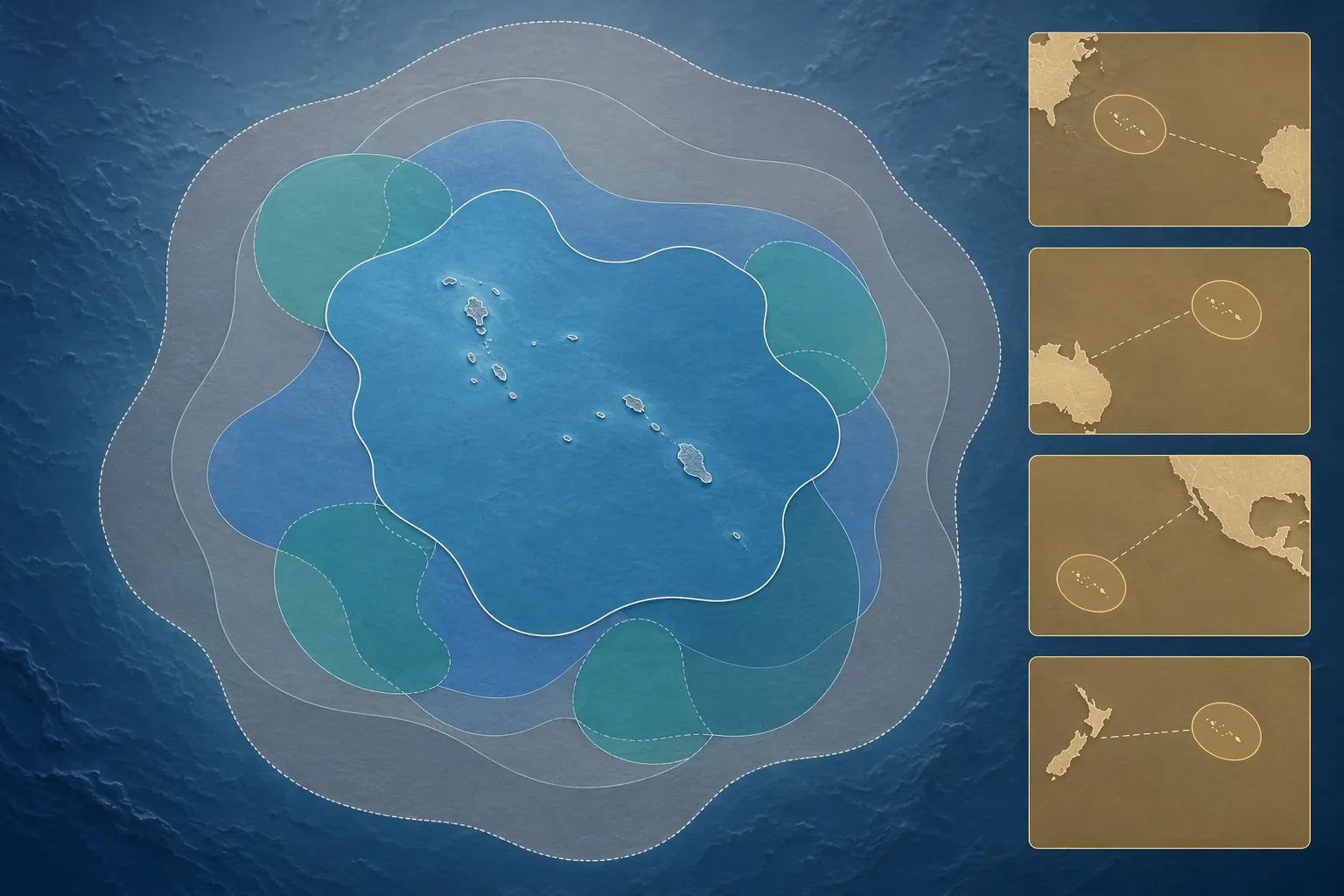
Most errors in this subject begin by collapsing the rows of that table. A Cook Islands EEZ license, an Area exploration contract, a protected-zone restriction, and a bilateral cooperation statement may all concern polymetallic nodules, but they do not draw legal authority from the same place. The legal question is therefore not whether the Cook Islands has a deep-sea minerals law. It plainly does. The harder question is what that law can settle when the project touches regimes that the Cook Islands does not control.
The EEZ/Area line does most of the legal work

For legal analysis of Cook Islands deep sea minerals, the first classification is geographical. Inside the Cook Islands EEZ, the starting point is the Cook Islands’ coastal-state position and its domestic seabed-minerals framework. Beyond national jurisdiction, the relevant seabed is the Area, and the legal starting point changes to UNCLOS Part XI, the 1994 Implementation Agreement, ISA rules, and the still-unfinished exploitation regulations.[1][2]
That distinction is why a Cook Islands exploration license should not be described as if it were an ISA Area contract. It is also why an ISA-sponsored contractor’s Area strategy should not be described as if it could be regularized by a Cook Islands domestic permit. Domestic licensing capacity and international seabed authority are different legal machines.
The Seabed Minerals Act 2019 is the domestic anchor. It establishes the Cook Islands seabed-minerals framework and provides the national legal route through which the government can administer seabed-mineral activities.[1] That is a significant legal-capacity achievement for a small island state; it is not a minor policy note attached to a regional mining story. But a statute written for national administration does not, by itself, resolve the international seabed regime or the meaning of obligations still being negotiated through the ISA.
The Marae Moana layer complicates even the domestic side. Official Marae Moana materials identify seabed mining as a regulated activity within the marine-park framework.[3] Devpolicy’s discussion of Pacific regulatory capacity highlights the Cook Islands’ 50-nautical-mile no-industrial-activity zones and the possibility that those zones may overlap with future mining license areas.[4] That is a practical constraint, not a branding exercise. It means a project file needs both a minerals-law analysis and a protected-area spatial analysis before anyone reaches the ISA question.
The current license timeline gives this problem immediate force. RNZ reported in November 2025 that the Cook Islands delayed a seabed-mining decision, extended the exploration phase to 2032, and identified three license holders: CIC Ltd, CSR Ltd, and Moana Minerals Ltd, with exploration permits expiring in February 2027.[5] The extension does not make exploitation lawful or unlawful. It gives license holders more time to produce information while the government, investors, and communities face a moving international rulebook.
| If the activity is... | Primary legal question | Immediate review file |
|---|---|---|
| Inside the Cook Islands EEZ | Does Cook Islands law authorize and constrain the activity, and how do UNCLOS coastal-state rights frame that authority? | Seabed Minerals Act, regulations, license terms, environmental evaluation, and domestic administrative decisions |
| Inside a Marae Moana no-industrial-activity zone | Does the spatial protection regime restrict the proposed activity regardless of minerals-law eligibility? | Marine-park zoning, activity restrictions, and project coordinates |
| Beyond national jurisdiction in the Area | Is the activity governed through ISA authority and sponsorship rather than Cook Islands domestic licensing? | ISA contract status, sponsoring-state obligations, UNCLOS Part XI position, and draft exploitation rules |
| A bilateral cooperation project | Does the instrument concern EEZ cooperation, Area sponsorship, technology access, data sharing, or something else? | Primary bilateral text, parties’ UNCLOS status, implementing instruments, and project location |
A developed domestic framework still leaves decisions exposed
The Cook Islands is not waiting with no domestic law on the shelf. The better description is more exact: it has a relatively developed domestic framework operating next to an incomplete international exploitation code and a marine-park regime that may narrow where industrial activity can occur. Devpolicy’s analysis treats the Cook Islands as a serious Pacific regulatory example, including the interaction between seabed-mining evaluation and marine protection.[4]
That matters for compliance because a license holder cannot answer the risk question by saying only that the Cook Islands has a law. A reviewer will want to know which authority granted the right, which waters are covered, which environmental and technical standards apply, whether the project crosses a protected zone, and whether any future exploitation approval will depend on standards still being completed internationally.
The 2032 exploration extension is therefore not a quiet administrative detail. It is a bridge period. Exploration can continue while exploitation remains politically and legally unsettled. The extension also means that investment decisions, environmental baselines, technology selection, and offtake conversations may be made years before the final shape of exploitation obligations is clear.[5]
The unfinished ISA Mining Code is a narrow but serious regulatory gap

The phrase “regulatory vacuum” is often used too broadly in deep-sea mining. For the Cook Islands, it should be used only in a narrow sense. There is no vacuum in Cook Islands domestic law. There is, however, no finalized ISA exploitation code for the Area, and that absence affects contractors, sponsoring states, and investors who need to know what exploitation compliance will require.
Ocean Vision Legal’s account of the July 2025 ISA Council session describes a sequence that now defines the compliance problem: the July 2023 deadline associated with the two-year rule had passed without final exploitation regulations; the ISA again failed in March 2025 to complete the rules; and in July 2025 the Council moved toward a thematic approach without setting a new deadline.[6] Völkerrechtsblog’s July 2025 legal analysis places that delay within the broader Part XI and Article 137 debate, including the legal consequences of the two-year rule triggered through Nauru’s sponsorship setting.[2]
For an Area contractor, the problem is not merely delay as a political fact. The missing rules affect the content of an application, the environmental-management showing, the financial model, the expected monitoring burden, the degree of sponsoring-state supervision, and the risk that obligations change after capital has been committed. For a Cook Islands EEZ project, the ISA code does not directly license the activity, but it can still influence expectations about environmental standards, investor diligence, and what “responsible” exploitation is supposed to look like.
Contractor-compliance uncertainty is no longer theoretical
Ocean Vision Legal also identifies the ISA Council’s ISBA/30/C/19 directive concerning contractor-compliance investigation issues.[6] That kind of procedural development matters because uncertainty about the final Mining Code does not suspend the need to assess existing contractor behavior. A contractor may be operating under exploration terms while the Council, Secretariat, sponsoring state, and objecting states disagree about what should happen next.
That is also where the 2026 ITLOS proceedings belong in the compliance file, not as courtroom theater but as part of the chain of risk allocation. For a focused discussion of the July 2026 Seabed Disputes Chamber provisional-measures orders in NORI v. ISA and TOML v. ISA, see ITLOS Orders Reshape Deep Sea Mining Regulation in 2026. The point for a Cook Islands-facing review is simpler: a domestic license holder, an Area contractor, and a sponsoring state do not carry the same obligations, and procedural orders or investigation directives may affect one without automatically rewriting the others.
Best available techniques may not mean the same thing in every instrument
The “best available techniques” issue is important because it is a possible alignment problem, not because the phrase is technologically elegant. The research materials identify the standard in both ISA draft regulations and Cook Islands Schedule 9, but the operative question is whether the domestic and ISA formulations would demand the same evidence, the same technology choices, the same monitoring thresholds, and the same update obligations.[4][6]
A company could, in principle, design equipment and procedures to satisfy a Cook Islands domestic expectation during exploration, only to face a different ISA understanding if it later pursues or finances an Area-linked project. The same issue can also run in the other direction: an investor accustomed to ISA draft language may assume that satisfying it answers the Cook Islands domestic standard. That assumption needs text-by-text verification. A phrase shared across instruments is not the same as a harmonized obligation.
Bilateral arrangements depend on the jurisdictional line
The U.S. and China arrangements can be assessed only after the EEZ/Area line is fixed. CSIS summarized an August 2025 U.S.-Cook Islands seabed-minerals announcement and a February 2025 China-Cook Islands MOU, while noting the distinctive legal posture created by the United States’ non-party status under UNCLOS.[7] Those arrangements concern Cook Islands EEZ activities as summarized in the available materials. They should not be described as if they were ISA Area sponsorship instruments.
The U.S. position is distinctive because it does not simply sit inside the UNCLOS/ISA architecture. CSIS describes the United States as arguing that Part XI does not reflect customary international law, while the ISA Secretary-General, Germany, and numerous member states take the opposite view.[7] Völkerrechtsblog’s discussion of Article 137 and Area resources shows why that disagreement is not academic for companies: if the legal status of the common heritage regime is contested, a contractor’s risk analysis depends on the state, the area of operation, and the claimed source of authority.[2]
China’s reported MOU sits more naturally within the UNCLOS/ISA frame because China is operating from within that treaty architecture as summarized by CSIS.[7] That does not make the China arrangement legally simple or commercially determinative. It means the assumptions behind the instrument differ from a U.S.-linked arrangement involving a non-UNCLOS party. The same Cook Islands officials may be dealing with counterparties whose legal theories of seabed authority are not identical.
The U.S.-Japan memorandum of cooperation, reported by Gibson Dunn in March 2026, is not a Cook Islands instrument, but it helps explain why seabed-minerals agreements involving the United States should be read with attention to UNCLOS status, domestic implementation, and the project’s maritime location.[8] For a comparable EEZ-focused discussion, see How Japan’s Lawful Rare Earth Mining Tests UNCLOS. The comparison is useful only if it stays jurisdiction-specific; it should not be used to imply that every Pacific seabed-minerals project faces the same legal pathway.
What a compliance review should not assume
A Cook Islands deep-sea minerals review should resist three shortcuts. First, it should not treat the EEZ and the Area as one seabed category. Second, it should not treat domestic legal development as proof that international exploitation risk has been cured. Third, it should not treat bilateral cooperation as a substitute for the legal authority needed in the relevant maritime zone.
- For a Cook Islands EEZ license: confirm the domestic statutory basis, the applicable 2024 regulatory requirements, the coordinates, any Marae Moana restriction, and the license timeline.
- For an Area-linked contractor or sponsor: confirm ISA contract status, sponsoring-state obligations, the effect of the unfinished exploitation code, and any current Council or ITLOS-linked procedural risk.
- For a bilateral arrangement: obtain the primary text, identify whether it concerns EEZ cooperation or Area activity, and test the parties’ assumptions about UNCLOS and customary international law.
- For investors and offtakers: avoid treating “best available techniques,” environmental baseline work, or exploration extensions as if they automatically satisfy a future exploitation standard.
The Cook Islands framework is unusually developed, and that should be recognized. But license holders, sponsoring states, and investors still face legal risks that domestic legislation cannot cure while UNCLOS interpretation, ISA exploitation rules, protected-zone constraints, and bilateral regime assumptions remain unsettled.
References
- Seabed Minerals Act 2019, Seabed Minerals Authority
- The Long Road to Exploit Deep-Sea Minerals, Völkerrechtsblog, July 2025
- Seabed Mining, Marae Moana
- Can Pacific nations regulate the risks of deep sea mining?, Devpolicy Blog, May 8, 2025
- Cook Islands delays seabed mining decision, extends exploration to 2032, RNZ, November 2025
- Deep Seabed Mining: Key Take-Aways from the International Seabed Authority’s July 2025 Council Session, Ocean Vision Legal
- Does U.S.-Cook Islands Seabed Minerals Announcement Signal New Front in Great Power Competition?, CSIS
- U.S. and Japan Move to Strengthen Deep-Sea Mining Ties Through Memorandum of Cooperation, Gibson Dunn, March 2026
- Current Status of Deep-Sea Mining Regulations, Impossible Metals
Operationalizing workflow
No workflow has been explicitly linked to this obligation yet. See Workflows generally.
Illustrative cases
No illustrative case is currently tracked for this obligation. See Risk Digest for documented incidents generally.
← Back to RegulationReport a correction or tip
Spotted an outdated figure, a misstated fact, or a ruling this regulation entry should reflect? Public comments are disabled for this content given the professional cost of a misreported case outcome, penalty amount, or rule text — use the structured correction channel instead.
Report a correction or tip for this record →