
When a DACA Deportation Counts as Unauthorized Travel
- Authority
- U.S. Department of Homeland Security (USCIS)
- Rule type
- regulation
- Jurisdiction scope
- US federal
- Source text
- Read primary rule text ↗
DACA termination under 8 CFR 236.23(d)(2) requires departure without advance parole and reentry without inspection; a DHS-executed removal should not automatically be treated as unauthorized beneficiary travel.
The difficult part of the Treviño record is not hidden in a footnote. Jessica Treviño’s DACA was reported as valid through April 2027; she was reported to have no criminal record; DHS deported her to Mexico on or about March 25, 2026; and USCIS later issued a notice of intent to terminate her DACA citing “unauthorized travel outside of the United States on or about March 25, 2026.” [1]
That sequence is the legal problem behind cases where a DACA beneficiary is deported and then accused of unauthorized travel. If the government removes a DACA beneficiary and then treats the removal as the beneficiary’s disqualifying travel, the termination notice is no longer just a warning before status is lost. It becomes a paper mechanism for confirming an enforcement act that has already happened.

The record is contested. DHS told the Associated Press that Treviño “knowingly accepted voluntary departure and waived appeal.” Treviño denied signing forms, and the reported chronology includes an immigration judge’s voluntary-departure order in February 2026 while she was in ICE custody. Those details matter because “voluntary departure,” “waiver,” and “departure” do not answer the same procedural question: what did the beneficiary actually agree to, when, and under what custodial circumstances? [1]
The termination theory depends on the order of events
A notice of intent to terminate DACA ordinarily invites a beneficiary to respond before the agency ends deferred action. In Treviño’s case, as reported, the relevant act USCIS identified was the same March 2026 departure produced by DHS’s own deportation. The practical burden had already shifted: the person who would need to answer the notice was outside the United States.
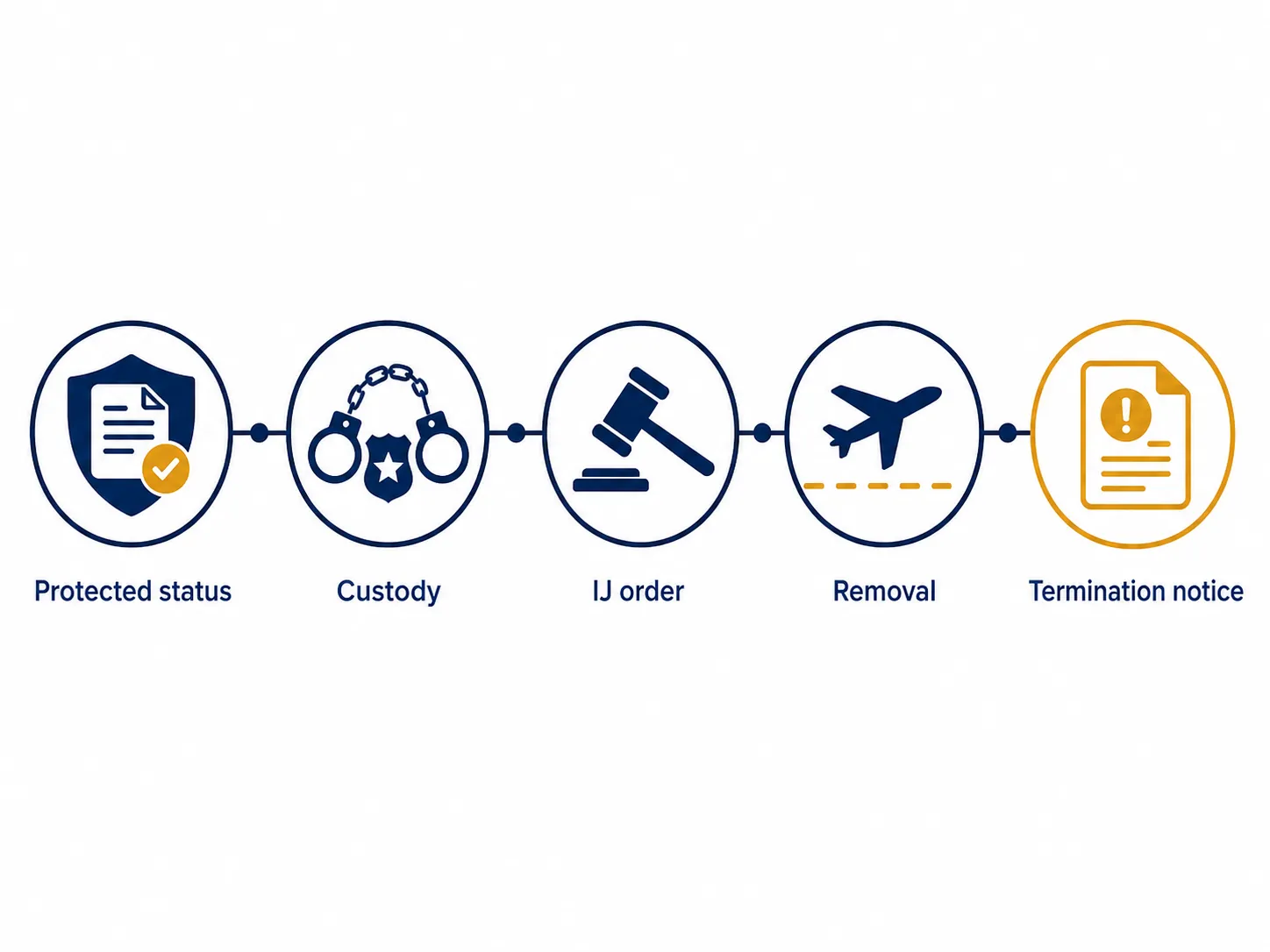
| Reported point in the Treviño sequence | Why it matters procedurally |
|---|---|
| DACA valid through April 2027; no criminal record reported. [1] | The reported status baseline was active DACA, not an expired grant. |
| Immigration judge issued a voluntary-departure order in February 2026 while Treviño was in ICE custody. [1] | The government’s later account depends on the effect of a custodial voluntary-departure record. |
| DHS deported Treviño to Mexico on or about March 25, 2026. [1] | The departure was not merely a beneficiary-initiated trip described in isolation. |
| USCIS notice cited “unauthorized travel outside of the United States on or about March 25, 2026.” [1] | The cited travel date appears to track the removal date itself. |
The regulation most directly in view is 8 CFR 236.23(d)(2), which addresses termination after departure from the United States without advance parole followed by entry into the United States without inspection. USCIS’s own DACA FAQ separately recognizes that “accidental or involuntary border crossings” may present exigent circumstances in which DHS may choose to continue exercising prosecutorial discretion. [2]
That FAQ language does not decide Treviño’s case. It also does not say every involuntary or disputed crossing preserves DACA. Its importance is narrower: USCIS has not always treated the mere fact of crossing a border as self-executing proof that discretion must end. Where the government itself supplies the physical removal, a termination notice that labels the resulting absence as unauthorized travel raises a different question than a recipient leaving, returning without inspection, and then asking USCIS to overlook it.
Estrada Juarez shows the judicial checkpoint, but only after removal
The closest judicial checkpoint in the current record is Estrada Juarez v. Noem. On March 23, 2026, Judge Dena Coggins of the Eastern District of California granted a temporary restraining order after a DACA recipient had already been removed. The court found that the removal occurred “in flagrant violation of the regulatory protections afforded to her under DACA” and the Due Process Clause, and ordered the government to facilitate her return within seven days and restore her DACA protections. [3]
That order is important because it treated active DACA protections as legally meaningful even when DHS had moved first. It is also unsatisfying in the way post-removal relief often is: the order came after the airplane, after separation, after counsel had to assemble an emergency record, and after the court had to be persuaded to tell the government to undo what had been done. The docket confirms the federal case posture; it does not turn the temporary order into a final merits judgment on every DACA-removal scenario. [4]
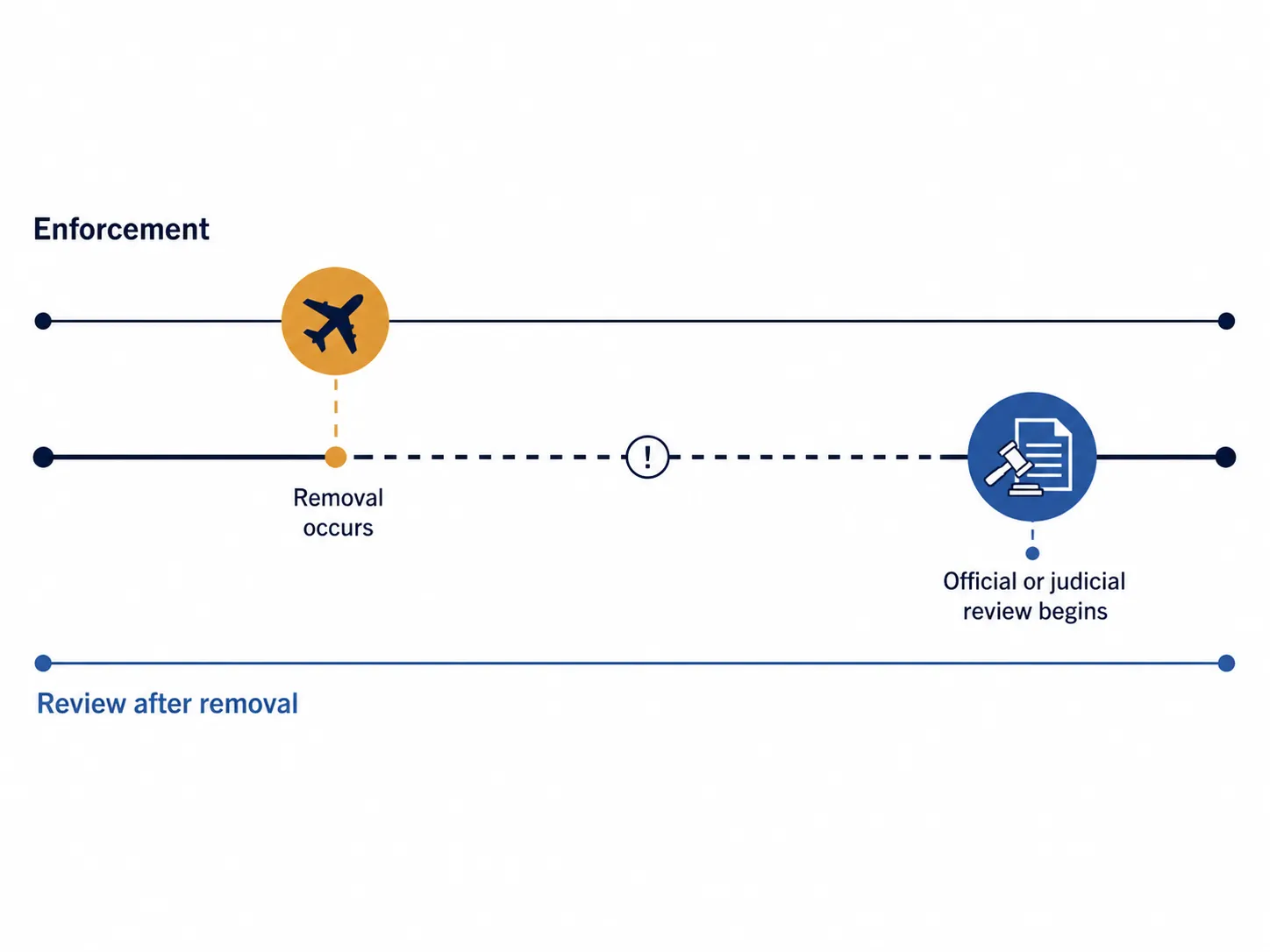
Estrada Juarez and Treviño should not be collapsed into one case. Estrada Juarez produced a federal TRO ordering return and restoration of protections. Treviño, as reported, centers on a later USCIS notice that uses the removal date as the alleged unauthorized-travel date. One case shows a court willing to intervene after removal; the other shows how the agency may try to characterize the removal afterward.
The reinstatement layer in Estrada Juarez also explains why labels can be doing more work than they first appear to do. Secondary litigation accounts describe a prior 1998 removal order, a December 28, 2014 advance-parole reentry, and arguments over the validity or signature of the old order. Those are not decorative facts. They are the sort of record fragments that determine whether DHS says it is executing an old order, whether the beneficiary says DACA and due process protections still apply, and whether a federal judge sees a removal as procedurally intolerable. [5]
The 2025 enforcement data does not need exaggeration
The 2025 numbers should be read as scale evidence, not as a single clean denominator. In a February 11, 2026 letter to Senator Richard Durbin, DHS reported that 261 DACA beneficiaries were arrested and 86 were deported from January 1 through November 19, 2025. The same letter stated that 241 of the arrested beneficiaries had “criminal histories.” [6]
Those figures establish a limited but important point: removal of DACA beneficiaries was not theoretical by 2025. They do not establish that every arrest was legally comparable to Treviño’s case, that every deportation involved active DACA, or that every case involved the unauthorized-travel theory later reported in 2026.
Coverage of the Durbin letter reported the same 261 arrests and 86 deportations and framed them as part of the Trump administration’s immigration-enforcement record involving DACA recipients. [7] The 74 also reported the 261-arrest and 86-deportation figures, emphasizing the tension between protected status and actual enforcement exposure. [8]
Other agency and secondary figures use different windows and populations. The available materials include a separate Ramirez-letter count framed around DACA renewal applicants, and later secondary reporting through immigration-policy tracking materials described larger custody counts in 2026. Those numbers should not be added to the Durbin figures as if they measured the same thing. The safer conclusion is narrower: by the time the Treviño notice surfaced, DACA beneficiaries had already been arrested and removed in documented numbers, and counsel could no longer treat execution of a removal order as a merely abstract risk. [9]
What the 2025–2026 legal background changes, and what it does not
The surrounding legal background matters, but it should be kept in its lane. The January 2025 Fifth Circuit decision in Texas v. United States, the June 2025 Supreme Court decision in Trump v. CASA, an April 2026 BIA precedent on DACA and removal proceedings, and USCIS’s May 8, 2026 deferred-action policy rewrite changed the operating environment around DACA. None of those markers, on the materials available here, directly decided whether a government-executed removal can be treated as the beneficiary’s unauthorized travel for DACA termination purposes.
That distinction is not academic. A background rule that DACA does not automatically end removal proceedings is different from a rule allowing DHS to remove an active beneficiary first and then have USCIS cite that removal as the event that justifies termination. The first proposition concerns the limits of deferred action as a shield in immigration court. The second concerns whether the agency can manufacture the predicate for termination through its own enforcement act.
USCIS’s public FAQ still matters because it describes DACA as an exercise of prosecutorial discretion and preserves discretionary language around certain accidental or involuntary border-crossing circumstances. [2] That language does not bind every later enforcement decision in the beneficiary’s favor. It does, however, make the mechanical use of a removal date as an unauthorized-travel date harder to treat as routine administration.
Legal implications counsel can actually use
The current record supports three practical legal implications, each narrower than the public argument sometimes made around DACA removals.
- Active DACA is no longer a reliable practical shield against execution of a removal order. The Durbin-letter statistics show DACA beneficiaries were arrested and deported in 2025, and Estrada Juarez shows a federal court intervening only after removal had occurred. [3][6]
- A post-removal TRO can restore protections, but it cannot prevent the initial removal once the government has already acted. Estrada Juarez is powerful for return-and-restoration relief; it is also a record of how late judicial review may arrive. [3]
- The forced-removal-as-travel theory remains an open procedural and legal question on this record. Treviño has not, based on the available reporting, produced a final ruling that DHS’s theory is unlawful. It has produced a chronology that counsel should not let be blurred. [1]
For a beneficiary facing a notice of intent to terminate after removal, the first task is record reconstruction. The file should separate the status grant, any advance-parole history, custody events, IJ orders, waiver forms, appeal advisals, removal logistics, and the exact USCIS termination language. A government statement that someone “accepted voluntary departure” answers less than it appears to answer unless the record shows the form, the advisal, the interpreter or language circumstances if relevant, the deadline, the waiver, and the custody setting.
The Treviño materials make that especially important because the reported notice did not merely say she became ineligible sometime after leaving. It identified “unauthorized travel outside of the United States on or about March 25, 2026,” the reported removal date. [1] If DHS’s act supplies the predicate, the response cannot be limited to whether the person lacked advance parole in the abstract. It has to contest the premise that a coerced or government-executed departure is the same event the regulation treats as beneficiary travel.
The due-process gap is the timing gap
The open questions now sit in a narrow channel. Can forced removal be treated as “travel” for DACA termination? Does a notice-of-intent process provide meaningful due process when the beneficiary is already outside the United States because DHS removed her? May DHS execute removal first and have USCIS terminate DACA second? Estrada Juarez gives one federal court’s emergency answer to a removal despite DACA protections. Treviño shows the next administrative move: recasting the removal as the violation.
That is why the issue belongs in a dated obligations-and-risk record rather than a broad DACA history. The same source-linked discipline appears in this regulation-ethics format and this school-law obligations tracker. The enforcement-data discipline is closer to a statutory-elements risk record like this Super Speeder analysis: dates, elements, agency action, and consequences have to stay separated.
This article is a legal-information record, not legal advice. DACA recipients, families, attorneys, and accredited representatives should verify the current regulation, agency guidance, court docket, and individual A-file before relying on any procedural conclusion. Record last verified: August 2, 2026, UTC.
References
- U.S. cites ‘unauthorized travel’ to end DACA status for a mother of 3 deported to Mexico, AP via Los Angeles Times, July 31, 2026.
- Frequently Asked Questions, USCIS.
- Order Granting TRO - Estrada Juarez v. Noem, U.S. District Court for the Eastern District of California, March 23, 2026.
- Estrada Juarez v. Noem, CourtListener.
- ‘Flagrant Violation’: Judge Orders Return of Mother Deported Despite DACA, Mother Jones, March 2026.
- DHS letter on DACA arrests and deportations, DHS, February 11, 2026.
- DACA recipients ICE arrested 2025 Trump administration, CBS News, February 25, 2026.
- Despite protected status, 261 DACA recipients have been arrested and 86 deported, The 74, March 3, 2026.
- Detentions of DACA recipients show they’re not shielded from Trump’s mass deportations, Immigration Policy Tracking Project.
Operationalizing workflow
No workflow has been explicitly linked to this obligation yet. See Workflows generally.
Illustrative cases
No illustrative case is currently tracked for this obligation. See Risk Digest for documented incidents generally.
← Back to RegulationReport a correction or tip
Spotted an outdated figure, a misstated fact, or a ruling this regulation entry should reflect? Public comments are disabled for this content given the professional cost of a misreported case outcome, penalty amount, or rule text — use the structured correction channel instead.
Report a correction or tip for this record →