
Is the DHS 60-Day H-1B Grace Period Proposal in Effect?
- Authority
- DHS/USCIS
- Rule type
- regulation
- Jurisdiction scope
- US federal
- Source text
- Read primary rule text ↗
Existing 60-day grace period remains in force under 8 CFR 214.1(l)(2), capped by I-94 validity and with no work authorization; the DHS proposal to end it is not yet final.
As of August 25, 2026, the DHS proposal to eliminate the 60-day nonimmigrant grace period is real, but it is not in effect. The public primary record is an OIRA entry for RIN 1615-AD22, titled “Eliminating the Discretionary 60-day Grace Period,” received on August 6, 2026, at the proposed-rule stage; no proposed rule text has been published in the Federal Register yet.[1] The current 60-day grace-period regulation remains in force under 8 CFR 214.1(l)(2).[2]
That distinction is not cosmetic. Until proposed text is published, an H-1B worker deciding whether to file a transfer, a spouse depending on H-4 status, or an HR team drafting a layoff notice should treat the existing rule as the operative rule and treat category-by-category descriptions of the pending DHS plan as reported, not confirmed.

Current status: confirmed, unchanged, reported, pending
| Status item | What can be said now | Source level |
|---|---|---|
| Rulemaking exists | Confirmed. OIRA lists RIN 1615-AD22, “Eliminating the Discretionary 60-day Grace Period,” from DHS/USCIS, received August 6, 2026, at the proposed-rule stage.[1] | Primary OIRA docket |
| Proposal is in effect | No. An OIRA review entry is not a final rule, and no Federal Register proposed rule text has been published as of August 25, 2026.[1] | Primary docket plus absence of published NPRM |
| Current 60-day rule | Unchanged. 8 CFR 214.1(l)(2) still provides the current grace-period framework for listed nonimmigrant categories, subject to its limits.[2] | Current eCFR regulation |
| Who the proposal would cover | Reported, not yet confirmed in rule text. Law-firm and press accounts report coverage of E-1, E-2, E-3, H-1B, H-1B1, L-1, O-1, and TN workers and dependents.[5][6][7][8][9] | Secondary reporting pending NPRM |
| Immediate-departure framing | Reported, not yet confirmed in rule text. Several accounts say terminated workers would generally have to depart unless USCIS grants a change of employer or change of status through favorable discretion.[5][6][7][8][9] | Secondary reporting pending NPRM |
| Next operative milestone | Federal Register publication of the notice of proposed rulemaking. That is where the public should be able to read the actual proposed amendments, affected categories, rationale, and comment instructions. | Future primary rule text |
For this issue, the useful approach is a current-status tracker, not a prediction market. Readers who follow other obligation records in Regulation & Ethics will recognize the same split used in records such as the Georgia gas tax suspension tracker and pending-law ledgers such as the Taiwan public insult rulings record: the operative rule is separated from the thing being proposed.
What the current 60-day rule actually does
The current rule is not a general right to remain in the United States for 60 days after any job loss. It is a limited grace-period mechanism for specified employment-based nonimmigrant categories. The regulation covers E-1, E-2, E-3, H-1B, H-1B1, L-1, O-1, and TN classifications, and it permits an eligible worker to be considered as maintaining status after employment ends for up to 60 consecutive days or until the end of the authorized validity period, whichever is shorter.[2]

USCIS guidance supplies the mechanics that matter in real cases: the grace period begins the day after employment is terminated; it is limited to the shorter of 60 consecutive days or the end of the I-94 authorized validity period; it is available only once during each authorized validity period; it does not permit work; and departure from the United States ends the grace period.[3]
- The clock starts after termination, not after the worker feels ready to start looking.
- The I-94 date can shorten the window. If the authorized stay ends before day 60, the worker does not get the balance.
- The worker may use the period to seek a new employer petition, change status, or otherwise pursue an available filing option, but the grace period itself is not employment authorization.
- Leaving the United States ends the grace period; it is not a banked remainder that can be used later.
- Dependents’ practical position turns on the principal worker’s ability to maintain or obtain status; USCIS guidance addresses eligible workers and their dependents together.[3]
The 60-day rule entered the regulations through the 2016 high-skilled worker final rule, which DHS described as part of a set of measures affecting retention of EB-1, EB-2, and EB-3 immigrant workers and improvements for high-skilled nonimmigrant workers.[4] That origin explains why the rule often appears in H-1B discussions, but the current regulatory text is not H-1B-only.
What is being reported about the DHS proposal
Public shorthand often calls this the “H-1B grace period,” and that is understandable: H-1B layoffs are where many readers first encounter the rule. But the reported DHS proposal is broader. Fragomen, Ogletree Deakins, Goel & Anderson, Jackson Lewis, and Bloomberg Law have all described the forthcoming proposal as targeting the 60-day grace period for multiple nonimmigrant categories, commonly listing E-1, E-2, E-3, H-1B, H-1B1, L-1, O-1, and TN, with dependents also implicated.[5][6][7][8][9]
Those accounts are useful warning signals, but they are not a substitute for the NPRM. The OIRA entry does not publish the proposed regulatory text, does not list the affected categories, and does not state the exact replacement procedure for a worker whose employment ends.[1] Until the Federal Register notice appears, the reported eight-category scope and the reported “immediate departure unless favorable discretion” approach should be read as reported details awaiting confirmation.
That caution cuts both ways. It would be wrong to tell workers the proposal is imaginary; RIN 1615-AD22 is a real DHS/USCIS proposed rule under OIRA review.[1] It would also be wrong to tell them DHS has already ended the grace period, because the current regulation remains in force and no final rule has displaced it.[2]
The rulemaking path from here
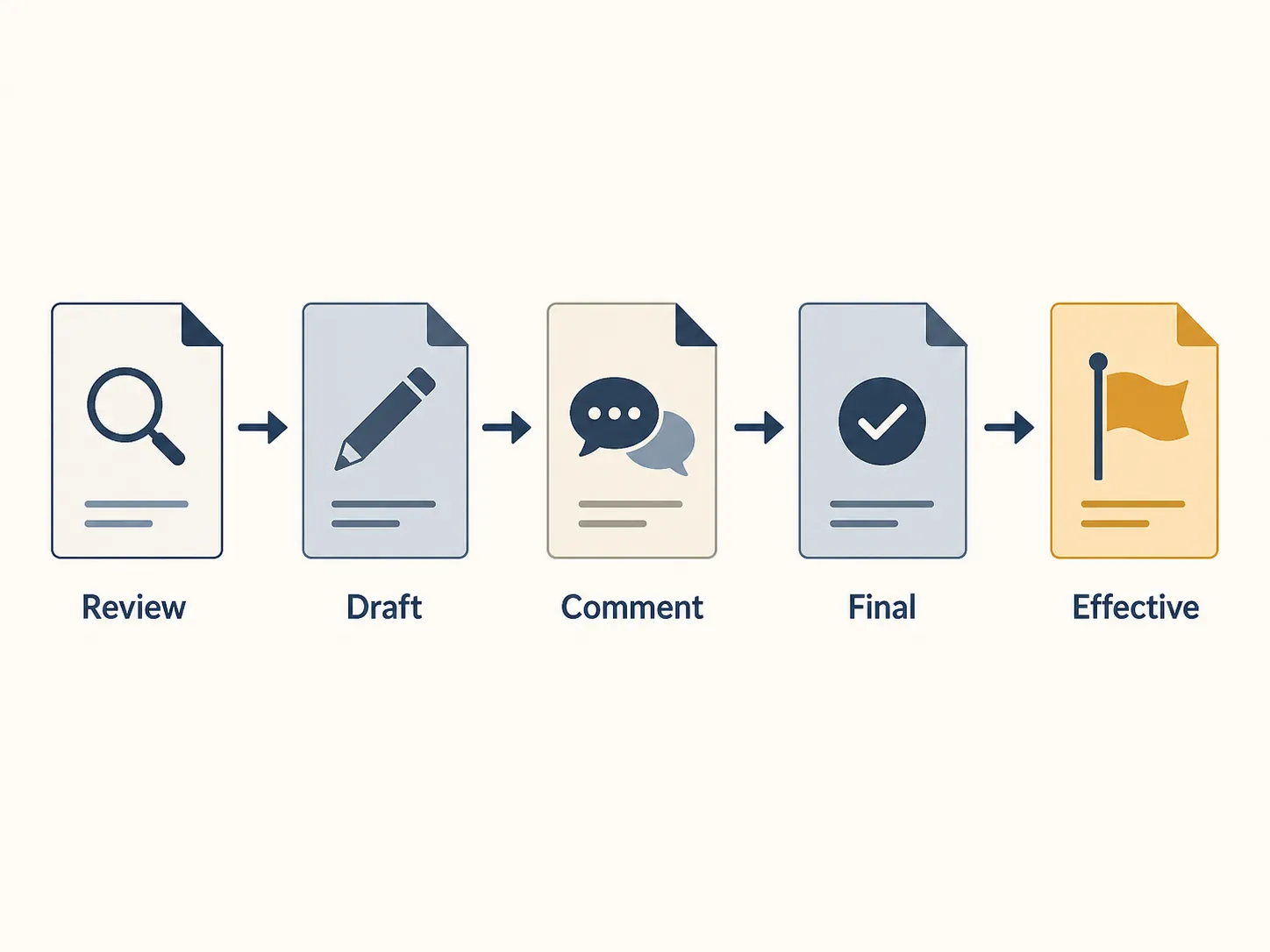
An OIRA entry is an early checkpoint. It means a proposed rule is under executive review before publication, not that the public has the operative proposal or that affected workers have a new legal obligation. The practical sequence still has several steps.
| Stage | What it would mean for this issue |
|---|---|
| OIRA review | Current stage shown by the public docket. The proposal is real, but the operative text is not public yet.[1] |
| NPRM publication | The Federal Register notice would reveal the proposed amendments, affected categories, agency explanation, and instructions for public comment. |
| Comment period | The public, employers, universities, attorneys, workers, and trade groups could submit comments. Law-firm estimates commonly describe 30- to 60-day comment windows as ordinary practice, but that is not a DHS commitment for this rule.[5][6] |
| Final rule | DHS would have to publish a final rule before the current regulation could be changed. |
| Effective date | Even after a final rule, the legal change would depend on the effective date stated in that final rule. |
The only safe timeline statement is procedural: OIRA review comes before the NPRM; the NPRM comes before a final rule; and a final rule must state when it takes effect. Estimates that OIRA review can take roughly up to 90 days and that finalization can take months are estimates of ordinary rulemaking practice reported by outside commentators, not promises in the OIRA docket.[5][6][7]
Why the difference matters for workers and employers
For a worker whose employment ended this week, the current rule is the rule that matters. The worker should be measuring from the day after termination, checking the I-94 end date, and understanding that the grace period permits time to pursue a filing option but does not authorize continued work.[2][3]
For employers, the communication problem is almost as serious as the legal problem. A layoff memo that says “DHS ended the grace period” is inaccurate as of August 25, 2026. A memo that says “DHS has initiated a proposed rule that could eliminate the grace period, but the current rule remains in effect unless and until changed by final rule” is closer to the record.
The consequences of getting the timing wrong can be severe. Secondary coverage of the proposal has focused on the risk that workers who remain beyond authorized stay could face unlawful-presence consequences, including three-year and 10-year reentry bars in some circumstances.[11][12] That consequence does not make the unpublished proposal effective today, but it does explain why loose wording is not harmless.
Do not conflate this with the separate F-1/J-1 final rule
There is a separate 2026 DHS final rule for F-1 and J-1 duration of status. Published on July 17, 2026, it establishes fixed periods of admission and, among other changes, reduces the F-1 post-completion departure period from 60 days to 30 days effective September 15, 2026.[10]
That final rule is relevant only as context for a broader grace-period compression theme. It is not the H-1B/nonimmigrant employment grace-period proposal, and it does not by itself amend 8 CFR 214.1(l)(2) for H-1B, L-1, O-1, TN, or the other employment categories reported in the pending DHS proposal.[2][10]
The next fact that can change the answer
The next legally meaningful public document is the Federal Register notice of proposed rulemaking for RIN 1615-AD22. That document should show the actual proposed amendments, the categories DHS proposes to cover, whether dependents are expressly included, what discretion DHS proposes to retain, and how DHS describes transition or effective-date issues.
Until then, the answer remains fixed: the proposal is real, the 60-day grace period has not been ended, and the current rule under 8 CFR 214.1(l)(2) remains in force.
References
- Eliminating the Discretionary 60-day Grace Period — reginfo.gov/OIRA, received Aug. 6, 2026
- 8 CFR 214.1 — Requirements for admission, extension, and maintenance of status — eCFR
- Options for Nonimmigrant Workers Following Termination of Employment — USCIS
- Retention of EB-1, EB-2, and EB-3 Immigrant Workers and Program Improvements Affecting High-Skilled Nonimmigrant Workers — Federal Register, Nov. 18, 2016
- United States: DHS to Propose Elimination of 60-Day Nonimmigrant Grace Period — Fragomen, Aug. 7, 2026
- DHS Proposes Rule to Eliminate 60-Day Grace Period for Certain Nonimmigrants — Ogletree Deakins, Aug. 11, 2026
- GA Client Alert: DHS Proposes Elimination of the 60-Day Nonimmigrant Grace Period — What You Need to Know — Goel & Anderson, Aug. 10, 2026
- H-1B Workers Could Lose 60-Day Grace Period Under DHS Proposal — Jackson Lewis Global Immigration Blog
- H-1B Workers Would Lose 60-Day Job-Loss Grace Period in DHS Plan — Bloomberg Law, Aug. 7, 2026
- Establishing a Fixed Time Period of Admission and an Extension of Stay Procedure for Nonimmigrant — Federal Register, July 17, 2026
- DHS to propose end of 60-day grace period for H-1B visa holders — Higher Ed Dive, Aug. 17, 2026
- H1B Grace Period — Manifest Law
Operationalizing workflow
No workflow has been explicitly linked to this obligation yet. See Workflows generally.
Illustrative cases
No illustrative case is currently tracked for this obligation. See Risk Digest for documented incidents generally.
← Back to RegulationReport a correction or tip
Spotted an outdated figure, a misstated fact, or a ruling this regulation entry should reflect? Public comments are disabled for this content given the professional cost of a misreported case outcome, penalty amount, or rule text — use the structured correction channel instead.
Report a correction or tip for this record →