
H-1B Green Card Pathway Bills 2025–2026: A Legal Status Map
- Authority
- 119th U.S. Congress
- Rule type
- proposed legislation
- Jurisdiction scope
- US federal
- Source text
- Read primary rule text ↗
No enacted green-card pathway change as of July 31, 2026; four bills remain introduced and not in effect.
Legal information only, not legal advice. This tracker is for issue-spotting and source verification; it does not substitute for advice from immigration counsel on any specific H-1B, PERM, I-140, I-485, extension, transfer, or travel decision. Legal-background review: Mara Velez, J.D. Verification stamp: bill records and cited secondary summaries last checked July 31, 2026; re-check Congress.gov at publish time before relying on any status line.
Short answer for anyone looking for a 2025 legal update on H-1B holders’ green-card pathway bills: none of the four 119th-Congress proposals below has become law as of July 31, 2026. They remain proposals, and they point in different directions.
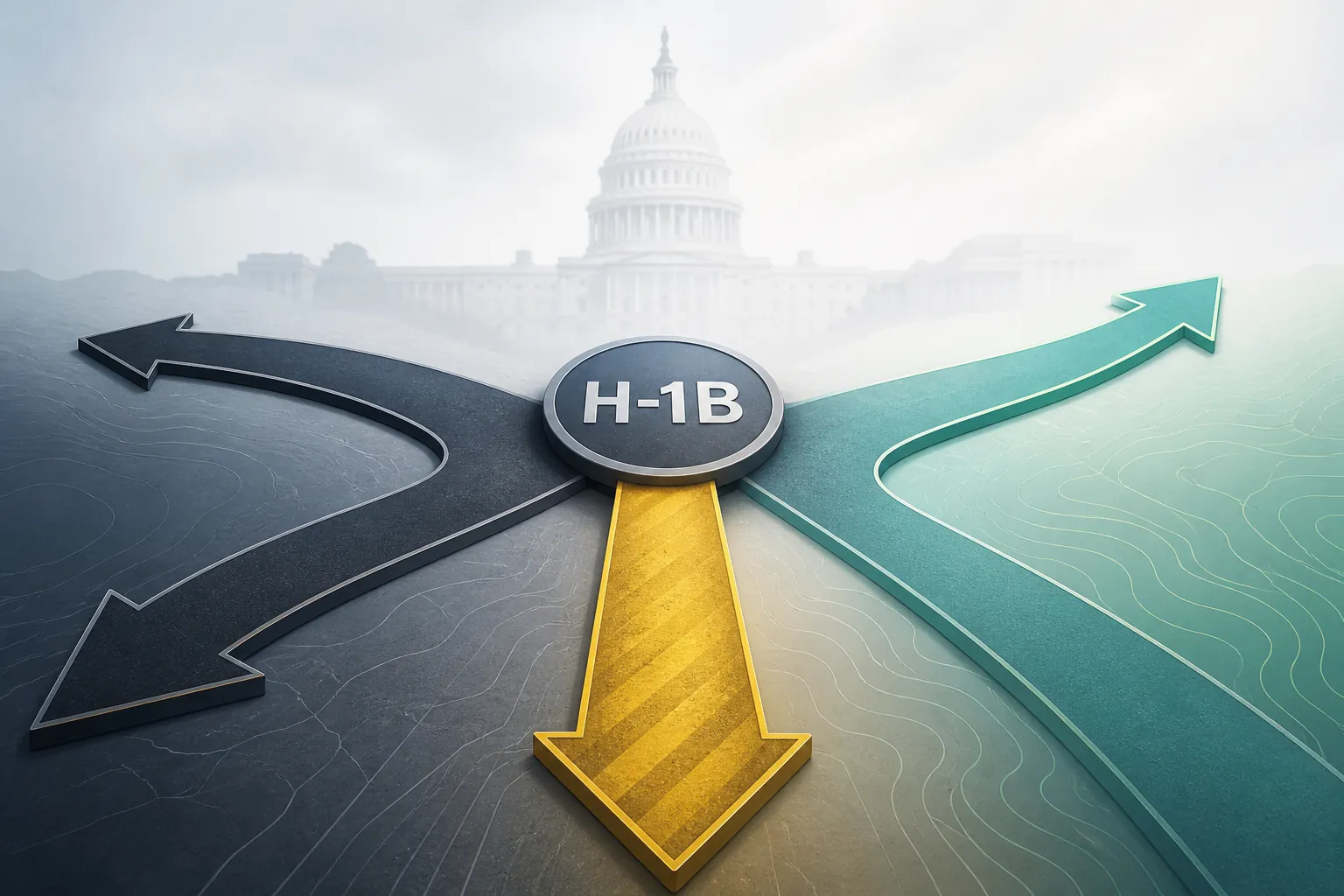
Status map: four bills, no enacted H-1B green-card-pathway change
This is the working map. “Introduced” means introduced; it does not mean USCIS is applying the proposal, that employers must plan as though it passed, or that a pending adjustment filing is governed by it.
| Bill | Sponsor / introduced date | Current status | Directional effect | Permanent-residence or pathway provision to watch |
|---|---|---|---|---|
| S.2928, H-1B and L-1 Visa Reform Act of 2025 | Sens. Chuck Grassley and Dick Durbin; introduced September 29, 2025, with Sens. Tommy Tuberville and Bernie Sanders listed as original cosponsors. | Introduced stage; last verified July 31, 2026. Re-check Congress.gov before publish. [1][2][3] | Restrictive for H-1B planning. | Would cut the H-1B maximum stay from six years to three years and condition remaining in H-1B status beyond that period on having an approved I-140 immigrant petition. [2][3] |
| H.R.8443, End H-1B Visa Abuse Act of 2026 | Rep. Eli Crane; introduced April 22, 2026. | Introduced; last verified July 31, 2026. Re-check Congress.gov before publish. [4][5] | Restrictive, and the most direct break in the H-1B-to-green-card route. | Would impose a three-year H-1B pause and prohibit H-1B nonimmigrants from adjusting status to lawful permanent residence; coverage of the bill has correctly flagged this as an attempt to end H-1B use as a green-card route. [5][6] |
| S.2821, American Tech Workforce Act of 2025 | Sen. Jim Banks; introduced September 2025. | Introduced; last verified July 31, 2026, based on available secondary tracking. Re-check Congress.gov before publish. | Restrictive or pause-oriented for hiring pipelines, with indirect green-card-pathway effects. | Would set a $150,000 H-1B wage floor, end OPT, and move H-1B selection toward salary-based allocation; the bill does not appear in the available summary as a direct I-485 bar, but it would affect who enters and remains in the H-1B pipeline long enough to pursue employer sponsorship. [7] |
| H.R.4393, DIGNIDAD / Dignity Act of 2025 | Introduced in the 119th Congress; sponsor and exact introduced date should be re-verified on Congress.gov before publish. | Introduced; last verified July 31, 2026. Re-check Congress.gov before publish. [8] | Expansionary for backlogged employment-based green-card applicants. | Would amend INA section 202(a)(2) to raise the per-country cap from 7% to 15% and would create an optional $20,000 premium green-card-issuance fee for certain applicants waiting 10 years or more. [8][9] |
The practical point is not that all four bills are equally likely, equally drafted, or equally relevant to every case. The point is that they cannot be collapsed into “the 2025 H-1B green card bill.” One would shorten H-1B runway time, one would bar adjustment from H-1B status, one would reshape entry into the H-1B labor pool, and one would ease a piece of the employment-based backlog problem.
Where the pathway would actually change
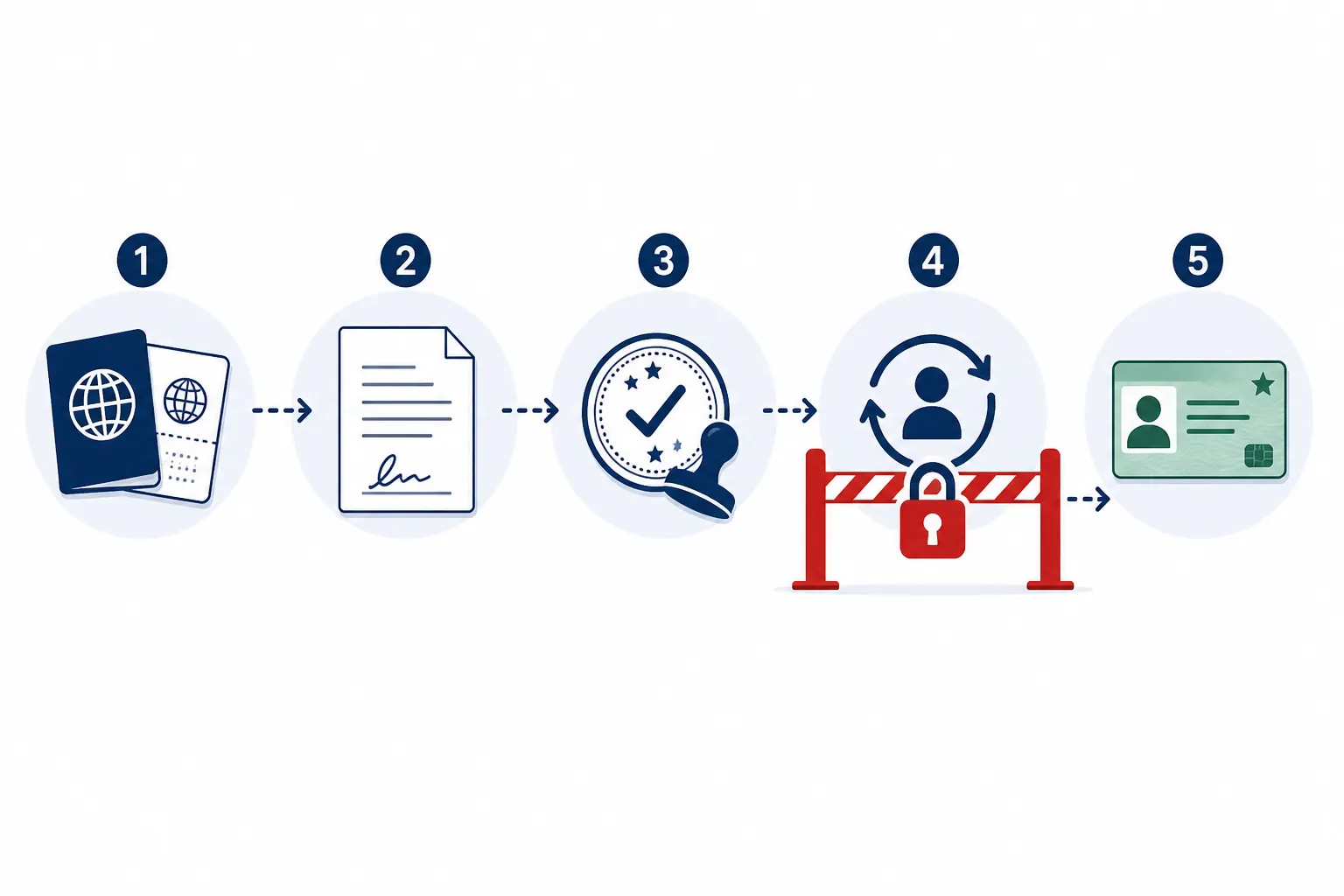
For case teams, the relevant pathway is not abstract. An employer starts sponsorship, a PERM or other immigrant classification strategy is selected, an I-140 is filed and—if approved—may support later adjustment of status or consular processing when a visa number is available. The bills matter only where they would alter that sequence, the time available to stay in H-1B status, or the queue mechanics behind visa-number availability.
S.2928 would make I-140 timing more central to H-1B stay planning
S.2928 is easy to misread if it is described only as an H-1B and L-1 reform bill. For green-card planning, its consequential move is the proposed compression of the H-1B maximum stay from six years to three years, paired with an approved-I-140 condition for remaining in H-1B status beyond that shorter period. [2][3]
That would change the timing pressure around sponsorship. A worker who currently has several years of H-1B runway while an employer decides whether to start PERM, waits through recruitment, files the I-140, and then watches the visa bulletin would be operating on a much narrower clock if the proposal became law in that form. The risk is not merely a shorter visa term; it is a shorter period before the immigration benefit that keeps the H-1B strategy viable would need to be in place.
The same bill contains other labor-market and enforcement provisions, including a median-wage requirement for skill level 2, a 30-day Department of Labor internet posting requirement, a non-displacement period extension from 90 to 180 days, a concentration cap for certain employers with at least 50 workers and a 50% H-1B/L-1 workforce concentration, and penalties reported up to $150,000 per violation. [2][3] Those provisions matter to employer sponsorship decisions, but the clean green-card-pathway issue is the H-1B runway and I-140 condition.
H.R.8443 contains the direct adjustment-of-status break
H.R.8443 is the row that should stop a reader from treating all H-1B bills as variations on wage reform. The sponsor release describes a three-year pause on the H-1B program, a reduction of the annual cap from 65,000 to 25,000, elimination of cap exemptions, a $200,000 minimum wage, wage-based selection in place of the lottery, dependent and third-party staffing restrictions, OPT termination, and a prohibition on H-1B adjustment of status to permanent residence. [5]
The adjustment provision is the narrow point that makes the bill different for an H-1B holder already thinking past temporary status. If enacted as described, it would not simply make sponsorship more expensive or selection less favorable; it would block a familiar domestic transition from H-1B status into permanent residence. For employer-impact and passage-likelihood analysis, see How the H-1B Pause Bill Would Affect Legal Employers.
S.2821 is mostly a pipeline bill for green-card purposes
S.2821, as summarized by Reddy Neumann Brown, is not the clearest permanent-residence bill in this group. Its listed provisions—$150,000 wage floor, OPT termination, and salary-based H-1B selection—bear on the front end of the employment-based pathway rather than directly rewriting adjustment of status or per-country cap rules. [7]
That still matters in planning, but in a different way. If fewer foreign graduates can use OPT, fewer workers may bridge from study to H-1B. If H-1B selection turns on salary, entry-level or lower-paid roles may become less reliable sponsorship candidates. Those are pathway effects, not green-card adjudication changes. They should be labeled that way.
H.R.4393 points in the opposite direction for backlogged applicants
H.R.4393 belongs in the same map precisely because it does not share the restrictive premise of the other proposals. Its employment-based significance is the proposed increase of the per-country cap under INA section 202(a)(2) from 7% to 15%, plus an optional $20,000 premium fee route for certain long-waiting applicants. [8][9]
For H-1B workers from heavily backlogged countries, that is not a cosmetic change. A per-country cap does not decide whether an employer may file an I-140, but it strongly affects how long an approved worker may wait before a visa number is available. FWD.us has described per-country cap reform as a priority issue because the cap structure can keep applicants from high-demand countries waiting far longer than similarly situated applicants from other countries. [10]
The optional premium-fee provision should be treated carefully. It is a proposed mechanism, not a currently available green-card acceleration tool. NPZ Law’s explainer describes it as a $20,000 fast-lane concept for immigrants waiting 10 years or more, but that is a description of what the bill would create if enacted, not a filing option today. [9]
What is law today is separate from these bills
Current H-1B extension, transfer, I-140, and adjustment planning is not governed by any of the four introduced bills in the status map. Until a bill is enacted and implemented, it is a monitoring item, not a filing rule.
Do not mix this congressional map with the separate September 2025 executive-action fight over the $100,000 H-1B payment. That proclamation sits in a different legal bucket. The site’s current litigation records track the Massachusetts and D.C. split, including the Massachusetts vacatur on June 8, 2026, the June 12 stay, the D.C. summary-judgment ruling on December 23, 2025, and the July 28, 2026 USCIS FAQ posture treating the fee as blocked nationally: What the Three H-1B Visa Ban Challenges Mean for Employers, Why the $100K H-1B Fee Lost in Massachusetts But Survived in D.C., and Court blocks $100,000 H-1B visa fee, appeal pending.
The near-term watch dates for that executive-action track are different as well: the proclamation’s stated 12-month expiry on September 21, 2026, and the statutory recommendation deadline after the next H-1B lottery. Those dates should not be read as congressional deadlines for S.2928, H.R.8443, S.2821, or H.R.4393.
For visa-bulletin reality, the separate question is whether a worker can actually move from approved immigrant petition to adjustment filing or final action under the current bulletin. For one current example of how that plays out, see the site’s tracker on EB-2 India being unavailable through the fiscal year. That is the kind of backlog pressure H.R.4393’s per-country-cap provision is aimed at, but the bill has not changed the bulletin.
Naming traps: EAGLE, IVES, and SKILLS
A recurring source of bad planning memos is bill-name reuse. The old EAGLE Act / IVES Act per-country-cap immigration vehicle from the 118th Congress should not be treated as a current 119th-Congress immigration bill under those names. In this 119th-Congress map, the active per-country-cap proposal to watch is H.R.4393, not a reintroduced EAGLE or IVES vehicle.
The same caution applies to the SKILLS Visa Act label. That name belongs to a 2013 bill, not to a current 2025–2026 proposal in this tracker. If a 2025 blog post uses the name loosely, verify the bill number, Congress, sponsor, and current status before putting it in front of a client or employee population.
Source caveat and planning posture as of July 31, 2026
Congress.gov remains the first place to verify bill text, sponsor, and status. For this update, Congress.gov pages were not fully accessible, so the table uses Congress.gov bill records where available together with attributed summaries, law-firm analysis, sponsor materials, and immigration-news coverage for provision detail. That is enough for a tracker, not enough to skip final record checks.
As of July 31, 2026, counsel and H-1B holders cannot plan around an enacted 2025 green-card-pathway bill. They can, however, track four incompatible proposals: S.2928 for H-1B maximum-stay and I-140 timing risk; H.R.8443 for a direct adjustment-of-status bar; S.2821 for H-1B pipeline restrictions; and H.R.4393 for per-country-cap and long-wait premium-fee concepts. That is the status map—not a change in governing law.
References
- S.2928 - H-1B and L-1 Visa Reform Act of 2025, Congress.gov.
- Bill Summary: H-1B and L-1 Visa Reform Act of 2025, National Immigration Forum.
- H-1B & L-1 Visa Reforms Bill Reintroduced in Senate, Clark Hill.
- H.R.8443 - End H-1B Visa Abuse Act of 2026, Congress.gov.
- Rep. Crane Introduces Legislation to Pause and Reform the Broken H-1B Visa Process, Office of Rep. Eli Crane, April 22, 2026.
- Bill in US Congress seeks to end H-1B visa as route to green card, The Hindu.
- High-Skilled Immigration Reform Efforts in the 119th Congress, Reddy Neumann Brown.
- H.R.4393 - Dignity Act of 2025, Congress.gov.
- Dignity Act of 2025: A New $20,000 Fast Lane to Green Cards for Long-Waiting Immigrants, NPZ Law.
- Per-country cap reform priority bill spotlight, FWD.us.
Operationalizing workflow
No workflow has been explicitly linked to this obligation yet. See Workflows generally.
Illustrative cases
No illustrative case is currently tracked for this obligation. See Risk Digest for documented incidents generally.
← Back to RegulationReport a correction or tip
Spotted an outdated figure, a misstated fact, or a ruling this regulation entry should reflect? Public comments are disabled for this content given the professional cost of a misreported case outcome, penalty amount, or rule text — use the structured correction channel instead.
Report a correction or tip for this record →