
Why the Iran War Powers Resolution Exposes AI Hallucination Risk
- Effective date
- Jan 1, 2026
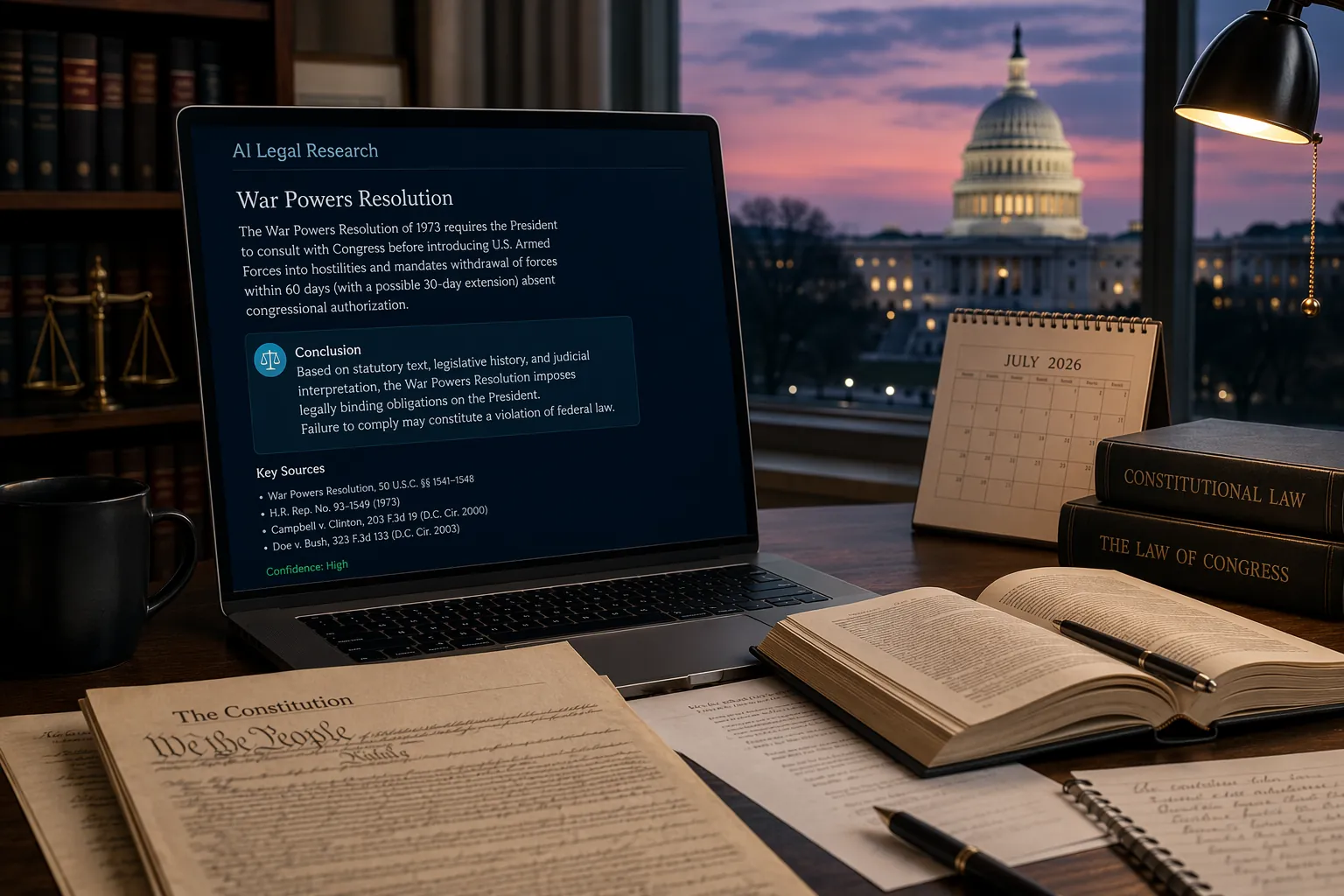
Ask an AI legal research tool in July 2026 whether the Iran War Powers Resolution legally constrained the President, and the dangerous answer is not necessarily a fake case. The more dangerous answer is a polished one: a few real citations, a confident nod to INS v. Chadha, a quick placement in the Youngstown framework, and a conclusion that sounds finished. That is exactly the wrong posture for this issue.
For lawyers searching “iran war powers resolution explained,” the first point is that this is not a settled-law lookup problem. It is a current constitutional-law problem built out of an unusual congressional procedure, unresolved doctrine, and events that occurred after many models’ training cutoffs. AI can help an attorney map the terrain. It cannot be treated as having resolved the terrain.
The Trap Is Procedural, Not Just Political
The core legal question is not whether a lawyer personally approves of the President’s Iran policy. It is whether Congress’s use of the War Powers Resolution mechanism, particularly section 5(c), produced a legally operative constraint after hostilities began. Lawfare’s analysis identifies the hard parts: whether a concurrent resolution can have binding legal effect after INS v. Chadha, whether the 60-day clock was affected by the April ceasefire, and whether a court would reach the merits at all given justiciability concerns.[1]
That matters because a system trained to produce a useful answer may smooth over the very features a lawyer must preserve. The question is not simply “what does the War Powers Resolution say?” It is “what legal effect follows when Congress uses a mechanism whose constitutionality, application, and judicial enforceability remain unresolved in this posture?”
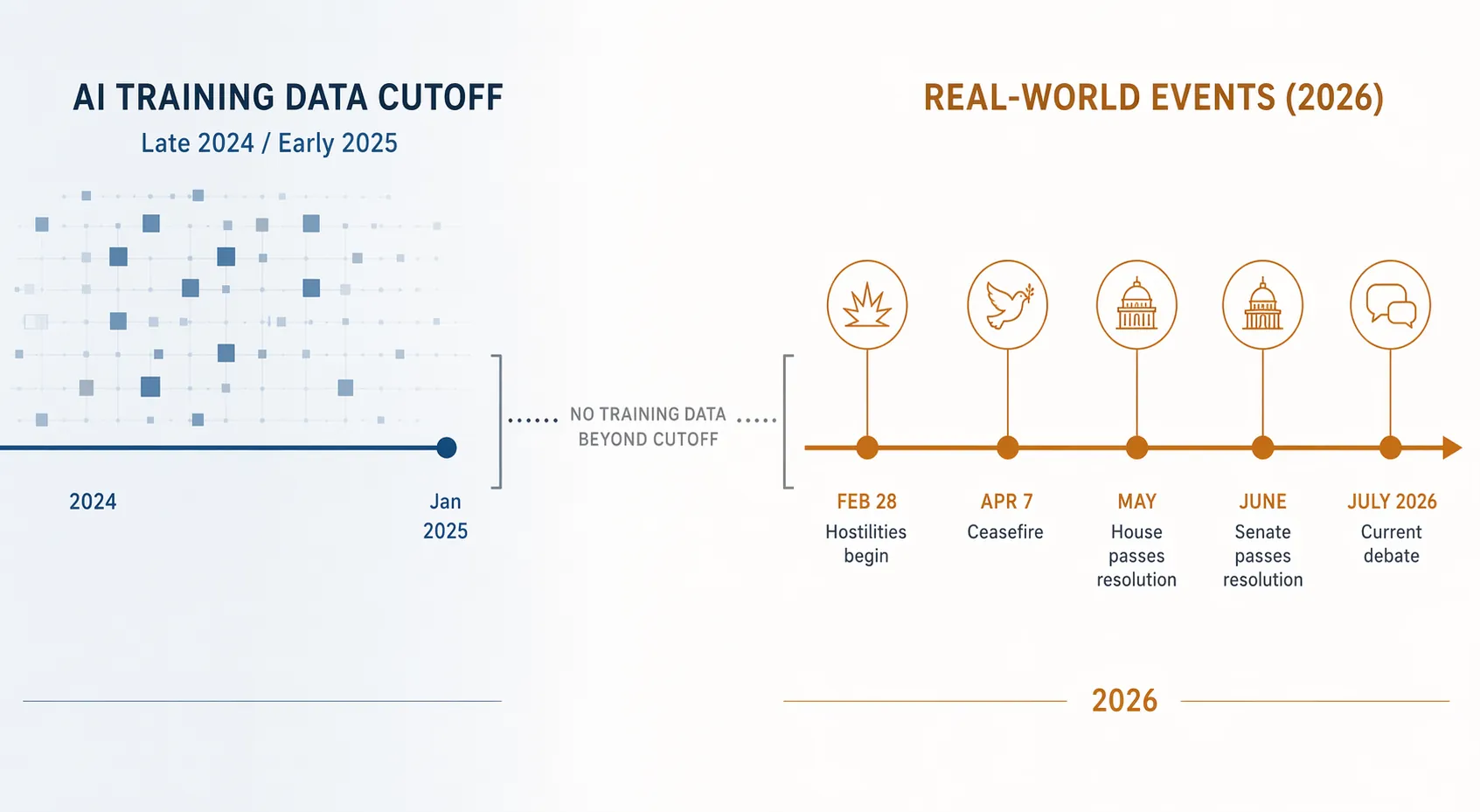
Reuters places the sequence in 2026: hostilities on February 28, a ceasefire on April 7, House passage in May, and Senate passage in June.[2] Those dates are not background color. They are part of the risk analysis. A model with training data ending before these events can still generate fluent prose about the War Powers Resolution, Iran, and separation of powers. What it cannot do from training alone is know the operative 2026 procedural record.
Why Chadha Does Not Fit Into a One-Sentence Answer
The War Powers Resolution’s section 5(c) mechanism matters because it contemplates congressional direction through a concurrent resolution. A concurrent resolution is not presented to the President for signature or veto. After INS v. Chadha, that raises the obvious constitutional problem: can Congress impose a binding legal consequence without bicameralism plus presentment in the constitutional sense? Lawfare’s analysis treats that as unresolved for this context, not as a question already answered by a neat Supreme Court holding on section 5(c).[1]
This is where AI systems are especially apt to become over-helpful. They may correctly identify Chadha as the leading legislative-veto case, then incorrectly imply that courts have already applied it to the Iran resolution’s section 5(c) path. They may cite real separation-of-powers authorities while inventing the relationship among them. A citation checker will not necessarily catch that error, because the cited cases may exist. The falsehood lives in the synthesis.
A reliable research memo would keep the propositions separate. First: Chadha casts serious doubt on one-house and legislative-veto-style mechanisms that bypass presentment. Second: section 5(c) remains text in the War Powers Resolution. Third: no federal court has resolved the precise question of Chadha’s applicability to section 5(c) in this Iran-resolution posture, according to the cited analysis.[1] Collapsing those three propositions into “the resolution is unconstitutional” or “the resolution is binding” is not explanation. It is risk.
The Youngstown Problem: Real Framework, Unsettled Placement
The Youngstown framework is another place where a tool can sound more certain than the law permits. If Congress validly directed the termination of hostilities, presidential action contrary to that direction might be described as falling into Justice Jackson’s lowest category. If the concurrent resolution lacks binding legal effect after Chadha, the category analysis changes. If courts view the dispute as nonjusticiable, a court may never assign the clean category the researcher wants.
The failure mode is not that AI has never heard of Youngstown. The failure mode is that it may use Youngstown as a sorting hat. In a filing, that can turn into a sentence asserting that the President is plainly in Category Three, or plainly not, without first proving the legal status of the congressional action that supposedly creates the conflict.
| Research Node | What Must Be Verified | AI Failure Mode |
|---|---|---|
| Section 5(c) concurrent resolution | Whether the mechanism has binding legal effect without presentment | Treating a contested constitutional issue as settled |
| Chadha | Whether any court has applied it to section 5(c) in the relevant posture | Citing real doctrine while inventing the dispositive holding |
| Youngstown | Which category follows only after the congressional action’s legal effect is established | Assigning a category before resolving the predicate |
| 60-day clock | Whether the April 7 ceasefire affected the statutory timing analysis | Assuming the clock restarted, stopped, or expired without source support |
| Justiciability | Whether a court would reach the merits under political-question and related doctrines | Writing as if judicial enforcement is automatic |
The 60-Day Clock Is Not a Calendar Exercise
The War Powers Resolution’s timing provisions invite another deceptively simple AI answer. If hostilities began on February 28, one might expect a straightforward calculation. But the April 7 ceasefire complicates the analysis. Lawfare flags the dispute over the 60-day clock after the ceasefire; Reuters supplies the relevant February 28 and April 7 dates.[1][2]
A competent answer has to say what is being counted and why. Did the ceasefire end the relevant hostilities for statutory purposes? Did later conduct restart a period? Did Congress’s subsequent passage of the resolution depend on a view of continuing hostilities? The cited sources do not support pretending those questions have a single judicially blessed answer.
This is also where post-cutoff facts become more than a technical annoyance. A model can know the War Powers Resolution’s general timing structure and still miss the 2026 sequence. Retrieval-augmented tools may do better if they actually retrieve current primary materials. But the attorney still has to test whether the retrieved document is current, whether the tool has read it correctly, and whether it has distinguished statutory text from contested application.
Known Hallucination Rates Are the Floor, Not the Whole Risk
The broader legal-AI evidence does not prove that any particular platform will hallucinate on the Iran War Powers Resolution. It does show why attorneys should not treat legal AI fluency as reliability. A Stanford RegLab and Yale ISPS study reported that leading AI legal research tools hallucinated 17% to 33% of the time on standard legal queries involving areas such as contract, tort, and civil procedure.[3] Those are not exotic, fast-moving constitutional disputes.
Damien Charlotin’s AI hallucination database identified 1,782 hallucination cases globally, including 1,228 in the United States, as of July 18, 2026.[4] The database is not a denominator for all AI-assisted legal work, and it should not be cited as if it measures the probability that a specific tool will fail in a specific matter. Its value is different: it documents the recurring ways legal professionals have been caught relying on fabricated or distorted AI output.
The Iran War Powers Resolution adds risk factors those benchmarks do not fully capture. The doctrine is unresolved. The procedure is unusual. The relevant facts are recent. The answer may require admitting that no court has resolved the key issue. That last point is particularly uncomfortable for a system optimized to satisfy a user’s request for an answer.
What a Bad AI Answer May Look Like
A bad answer on this topic will not always announce itself with a nonexistent citation. It may look usable. It may contain Chadha, Youngstown, the War Powers Resolution, and a Reuters timeline. The lawyer’s job is to identify whether the answer has performed a legal operation the sources do not support.
- Hallucinated Chadha resolution: the tool states that the Supreme Court has held section 5(c) unconstitutional, or has upheld it, when the cited materials support only an unresolved question.
- Invented procedural effect: the tool treats a concurrent resolution as automatically binding, or automatically symbolic, without showing the presentment analysis.
- Premature Youngstown placement: the tool assigns the President to a category before establishing whether Congress’s action had legal force.
- Clock simplification: the tool counts days from February 28 while ignoring the April 7 ceasefire dispute, or asserts a restart rule without authority.
- Justiciability erasure: the tool writes as though a court would necessarily decide the merits, despite unresolved questions about whether the dispute is judicially manageable.
For firms already thinking about AI in unsettled public-law domains, the same pattern appears outside war powers. Prior analysis of AI tools for Trump tariff legal analysis raises a similar problem: fast-moving legal disputes punish tools that convert uncertainty into confident synthesis. Vendor stability and governance also matter, but they are separate questions from whether a particular answer is legally supported.
Sanctions Make Verification a Professional Obligation
The sanctions record should not be used as theater. It should be read as a warning about responsibility. Reuters reported that in the Ninth Circuit’s Sethi/Rounds matter, the court imposed a $2,500 fine per attorney, a six-month suspension, and a two-year mandatory AI-use disclosure requirement; the court also treated the source of the errors as “ultimately irrelevant.”[5] That is the sentence lawyers should remember when tempted to say the platform was reputable.
Charlotin’s database also lists In re Rosslyn2016, LLC from the Southern District of Texas, dated July 14, 2026, describing three fabricated cases, two misrepresented holdings, and a $29,877 contempt sanction, while marking the vendor issue as disputed.[4] That caveat matters. The point is not to adjudicate the vendor dispute in a secondary article. The point is that vendor credentialing alone is not a substitute for checking the authorities and the propositions for which they are cited.
The ABA’s 2026 practical checklist frames AI as comparable to a junior colleague whose work must be independently verified.[6] That analogy is useful if it is taken seriously. A junior lawyer who returned a memo saying “the concurrent resolution is binding” would be asked for the statutory text, the presentment analysis, the controlling cases, and the contrary authority. An AI answer deserves no lighter review because it arrived in better prose.
A Verification Workflow for This Issue
For the Iran War Powers Resolution, ordinary citation checking is necessary and insufficient. The error may not be a fake case. It may be an unsupported bridge between real materials. The verification task should therefore track propositions, not just authorities.
- Start with current primary materials: verify the text and procedural status of the relevant House and Senate measures from official congressional sources, rather than relying on an AI summary of the measures.
- Separate text from legal effect: identify what section 5(c) says, then separately analyze whether that mechanism is constitutionally operative after Chadha.
- Write the negative research result: if no court has resolved Chadha’s applicability to section 5(c), say so expressly rather than implying a settled rule.
- Validate the timeline: confirm the February 28 hostilities, April 7 ceasefire, and congressional passage dates before performing any 60-day analysis.
- Check every synthesis sentence: for each sentence that says “therefore,” “as a result,” or “under Youngstown,” require a source-supported predicate.
- Preserve justiciability uncertainty: do not draft as though judicial enforcement is inevitable unless the cited authority actually supports that step.
This workflow is slower than pasting an AI answer into a memo. It is still faster than reconstructing the research trail after a partner, court, or opposing counsel asks which authority supports the dispositive sentence. Firms building broader AI-use policies can connect this matter-specific workflow to governance controls such as disclosure rules, review tiers, and matter-risk classification, including the kinds of controls discussed in AI governance in law firms.
The Bounded Judgment
AI tools can be useful at the beginning of research on the Iran War Powers Resolution. They can suggest the relevant doctrines, surface terms to search, and help a lawyer see that the issue touches Chadha, Youngstown, the War Powers Resolution, timing, and justiciability. That is orientation.
Reliance begins only after current primary-source review, procedural validation, and explicit confirmation that no court has resolved the key Chadha and section 5(c) questions in this posture. For this issue, the safest answer may be the least AI-like one: the law has not yet supplied the clean conclusion the query asks for.
References
- What Congressional Resolutions Mean for the War in Iran, Lawfare
- Explainer: Congress backed an Iran war powers resolution. Now what?, Reuters, 2026-06-25
- Hallucination-Free? Assessing the Reliability of Leading AI Legal Research Tools, Stanford RegLab / Yale ISPS
- AI Hallucination Cases Database, Damien Charlotin
- US appeals court sanctions lawyers over AI 'hallucinations,' lack of candor, Reuters, 2026-06-03
- A Practical Checklist for Using AI Responsibly in Your Law Firm, ABA, 2026
Operationalizing workflow
No workflow has been explicitly linked to this obligation yet. See Workflows generally.
Illustrative cases
No illustrative case is currently tracked for this obligation. See Risk Digest for documented incidents generally.
← Back to RegulationReport a correction or tip
Spotted an outdated figure, a misstated fact, or a ruling this regulation entry should reflect? Public comments are disabled for this content given the professional cost of a misreported case outcome, penalty amount, or rule text — use the structured correction channel instead.
Report a correction or tip for this record →