
Why 'Italy Suspends Spain From Schengen' Is Legally Wrong
- Authority
- European Union
- Rule type
- regulation
- Jurisdiction scope
- EU
- Source text
- Read primary rule text ↗
Temporary internal border checks under Article 25a must be notified and meet necessity and proportionality; no member state may suspend another from Schengen.
Italy has not “suspended Spain from Schengen.” EU law gives Italy no such switch to pull. The legally meaningful question is narrower and more useful: whether Italy has lawfully reintroduced its own temporary internal border checks under the Schengen Borders Code, and whether it has completed the procedural steps that make that measure legible to the Commission, the Council, the Parliament, other member states, carriers, employers, and travelers.
The relevant instrument is Article 25a of Regulation (EU) 2016/399, the Schengen Borders Code, as amended by Regulation (EU) 2024/1717. The Commission’s Schengen page describes that route as the temporary reintroduction of border control at internal borders where a serious threat to public policy or internal security exists, including an unforeseeable serious-threat route with an initial period of up to one month and a maximum total period of three months.[1] That is a power over Italy’s own borders. It is not a power over Spain’s Schengen membership.
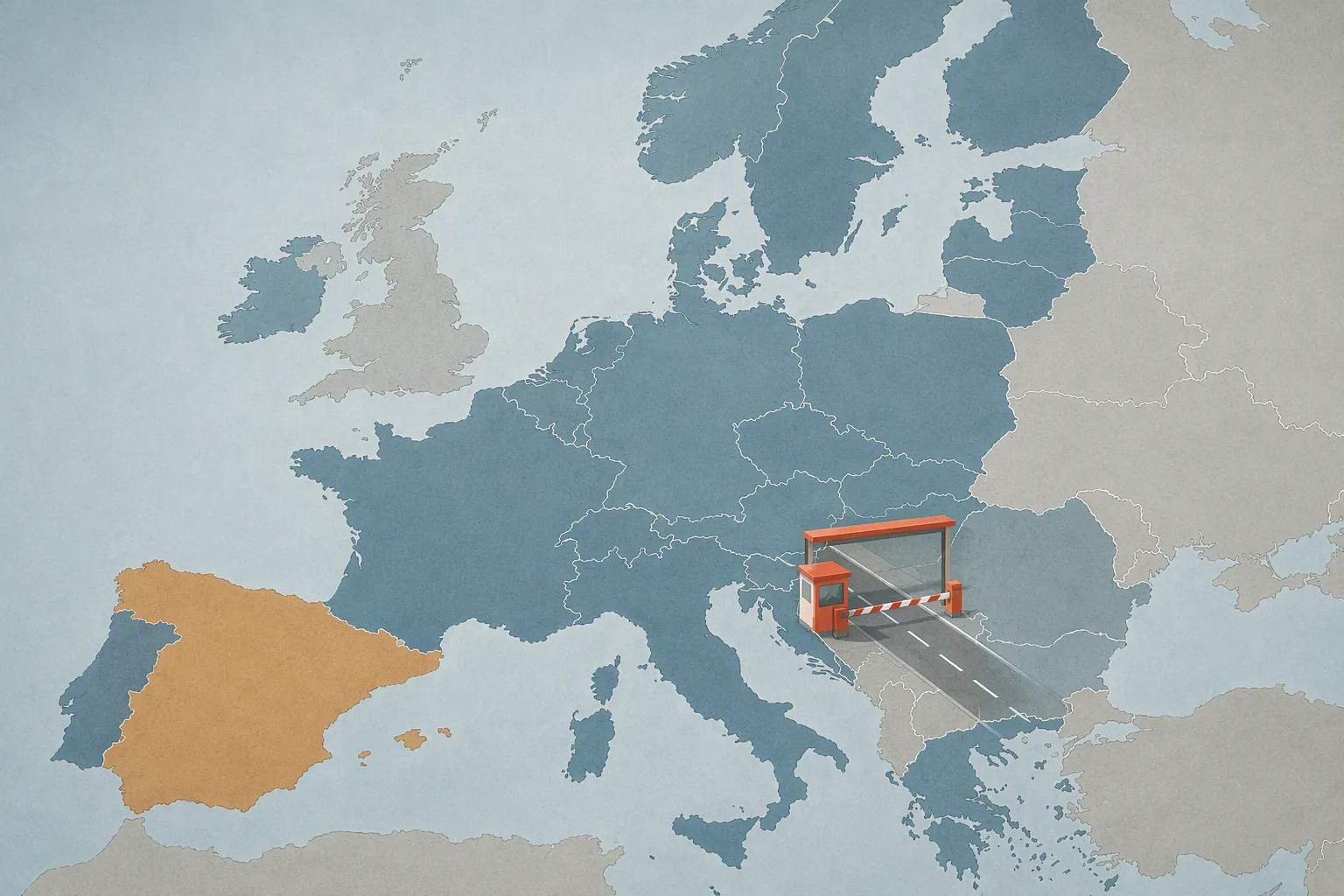
Reuters reported Italy’s July 31 announcement as targeted or selective checks on third-country nationals at air and sea borders with Spain, for one month and renewable, with EU citizens outside the stated scope.[2] That description matters. It points to an Italian control measure applied at Italian entry points, not to the legal exclusion of Spain from the Schengen Area.
What the Schengen Borders Code actually permits
The Schengen system abolished routine internal border checks between participating states. It did not abolish every form of temporary control. The Code preserves a carefully bounded emergency mechanism because public policy and internal security threats can arise inside a border-free area.
Article 25a is the relevant post-2024 numbering for the general temporary reintroduction mechanism. On the Commission’s account, where a serious threat to public policy or internal security is unforeseeable and requires immediate action, a member state may reintroduce border control at internal borders immediately, for a limited period not exceeding one month. If the threat persists, that period may be prolonged, but the total period under that unforeseeable-threat route must not exceed three months.[1]

That mechanism has several consequences that the “Italy suspends Spain” phrase obscures:
- The acting state is Italy, not the Schengen Area as a whole.
- The object of the measure is border control at Italy’s own internal borders, not Spain’s status in Schengen.
- The legal test is not political displeasure with Spain. It is a serious threat to public policy or internal security, assessed under the Code.
- The measure is temporary by design. Under the unforeseeable-threat route described by the Commission, the initial period is one month and the outer limit is three months.[1]
- The measure must be notified. The Code does not treat internal border control as a private bilateral signal between two governments.
For a client-facing answer, that is already most of the legal implication. Spain remains a Schengen member. Movement from Spain to other Schengen states is not disabled by Italy. Italy may, if the Code’s conditions are met, impose checks at the Italian side of internal air or sea connections covered by its measure.
The notification record is not a formality
Article 25a’s emergency route is fast, but it is not informal. The Commission’s description of the mechanism includes notification to the Commission and the other member states when a state reintroduces internal border control.[1] The point is not bureaucratic tidiness. Notification is what lets the rest of the Schengen system see the legal basis, the affected borders, the expected duration, and the reasons being invoked.
That is why the live record matters more than the press line. The Guardian reported on July 31 that there had not yet been formal notification of Italy’s Spain-related measure.[3] As last checked on August 2, 2026, the Commission’s public table of temporary reintroductions still listed Italy only for border control concerning Slovenia, from 19/06/2026 to 18/12/2026; it did not yet show a confirmed Italy-Spain entry in the materials identified for this record.[1]
| Question | Record as last verified on August 2, 2026 |
|---|---|
| Did Italy announce a Spain-related measure? | Yes. Reuters reported targeted or selective checks on third-country nationals at Italian air and sea borders with Spain, for one month and renewable.[2] |
| Was the measure legally a suspension of Spain from Schengen? | No. The available legal characterization is Italy’s own temporary reintroduction of internal border checks under the Schengen Borders Code.[1] |
| Was formal notification confirmed in the Commission materials reviewed? | No confirmed Italy-Spain entry appeared in the Commission table reviewed for this record; the table still showed Italy’s Slovenia-border control entry.[1] |
| What earlier reporting said about notification | The Guardian reported on July 31 that no formal notification had yet been made.[3] |
| What time limit governs the emergency route being discussed | Under the Commission’s description of the unforeseeable serious-threat route, up to one month initially and three months total.[1] |
The notification point is a moving fact. A notice can be filed after an initial report and then appear later in the Commission table. But until that record changes, the legally careful formulation is that Italy announced a measure whose formal notification status remained unconfirmed in the Commission materials reviewed as of August 2.
Necessity and proportionality are the exposed flank
A notice, if and when it appears, would not end the legal analysis. Article 26 of the Schengen Borders Code requires a member state to assess the necessity and proportionality of reintroduced internal border control. In practical terms, the state must be able to explain why the threat justifies this tool, why the measure is suitable for the stated objective, and why its scope and duration do not exceed what the situation requires.[1]
This is where the Ceuta facts matter, but only in their proper legal role. The crisis at Ceuta may supply the factual predicate Italy invokes. It does not itself answer whether checks at Italian air and sea borders with Spain are necessary or proportionate.
The most legally damaging fact in the present record is the Commission’s contrary factual assessment. Commissioner Magnus Brunner was reported as saying that the Commission had detected “no movements towards mainland Europe or other member states.”[3] If Italy’s justification depends on a risk of onward movement from Ceuta through Spain into the wider Schengen Area, that finding goes directly to the measure’s necessity and proportionality. It does not automatically make the Italian measure unlawful; it does mean Italy would need a tighter evidentiary explanation than a general reference to a border emergency.
The distinction is easy to lose because the humanitarian and administrative pressure at Ceuta is real enough to dominate headlines. But Article 26 is not satisfied by emotional force. It asks whether the control chosen by the member state is a necessary and proportionate response to the threat identified. A serious situation at one external-edge location does not mechanically establish a serious threat at Italian internal air and sea borders.
Ceuta is not legally ordinary Schengen territory
Ceuta’s position also needs precision. Treating Ceuta as just another point inside the Schengen travel map makes the legal analysis worse, not better. Spain’s Foreign Ministry describes special Schengen arrangements for Ceuta and Melilla, including a regime under Article 41 of the Schengen Borders Code and the 1991 accession Declaration, with exit checks for persons traveling from Ceuta or Melilla to the rest of the Schengen Area.[4]
That special position cuts both ways. It helps explain why a Ceuta crisis can become a Schengen-law question. It also weakens any automatic inference that arrivals in Ceuta have already become uncontrolled movement into mainland Spain, Italy, or other member states. The more the legal regime already distinguishes Ceuta from ordinary internal Schengen movement, the more carefully Italy must connect the facts at Ceuta to the controls it has chosen at Italian points of entry.
For a deeper account of that local regime, the better place to start is the companion analysis of Ceuta’s border and asylum rules. For present purposes, the point is narrower: Ceuta’s exceptional arrangements are part of the necessity analysis, not a substitute for it.
The outer limits after NW
The Court of Justice’s Grand Chamber judgment in NW, delivered on April 26, 2022, is useful here because it rejects the habit of treating internal border controls as endlessly renewable security theatre. In the commentary cited in this record, the judgment is analyzed as imposing a strict limit on successive extensions under the then-applicable Code and as refusing to let member states evade Schengen limits by invoking Article 72 TFEU as a general national-security escape route.[5][6]
The exact article numbering has changed after Regulation (EU) 2024/1717, so NW should not be cited lazily as if it answered every post-2024 timing question. Its more durable point is institutional: internal border control is an exception inside a common legal order, and the exception is bounded by the Code. A member state does not convert a temporary power into an open-ended one by repeating the word “security.”
That matters for Italy’s announced one-month, renewable measure. Renewal is not illegitimate merely because it is possible. But each extension would have to remain inside the applicable Article 25a route and be supported by the continuing threat analysis. Under the unforeseeable-threat route described by the Commission, the hard stop is three months total.[1]
What changes for travelers, carriers, and employers
The practical consequence is not that Spain has left, lost, or been suspended from Schengen. The consequence is that some journeys from Spain into Italy may face Italian checks if the announced measure is implemented at the relevant air or sea border. Reuters’ report framed the measure as targeted or selective checks on third-country nationals, with EU citizens outside the stated scope.[2]
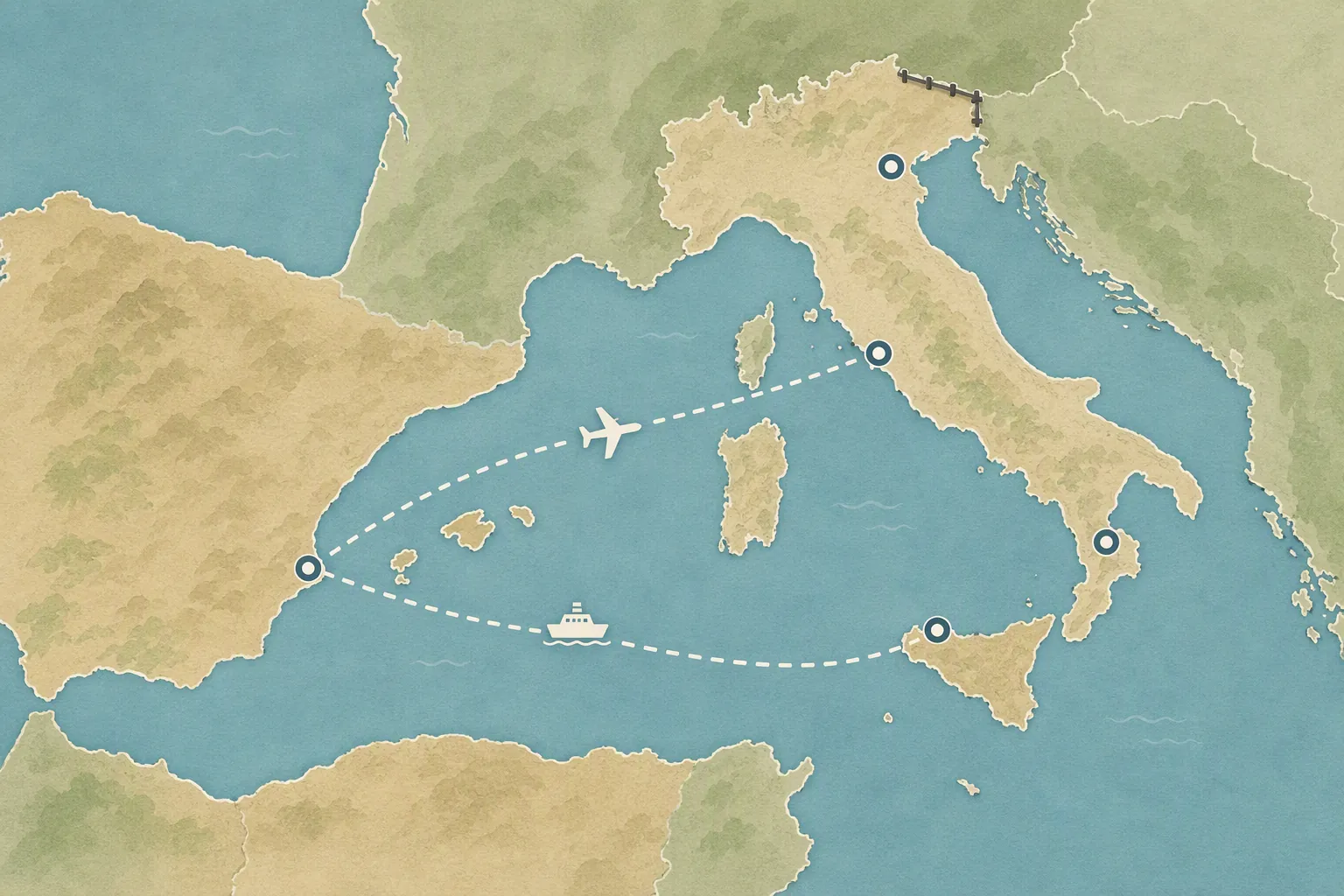
For compliance work, the operative questions are therefore concrete:
- Is the traveler entering Italy from Spain through an airport or port covered by the announced Italian checks?
- Is the traveler a third-country national within the stated target category, or an EU citizen outside the announced scope?
- Has Italy’s formal notification appeared in the Commission’s temporary reintroduction table, and what borders, dates, and grounds does it list?
- If the measure is renewed, does the renewal remain within the one-month initial period and three-month total limit applicable to the unforeseeable-threat route?
- Does the stated justification address the Commission’s reported finding that no movements toward mainland Europe or other member states had been detected?
Traveler logistics are dealt with separately in the companion piece on what Italy’s Schengen suspension means for travel to Spain. The legal characterization here is simpler: a person may encounter an Italian border check without Spain having been suspended from Schengen.
Political pressure is context, not the legal basis
Reuters placed the Italian announcement in a domestic political context, including pressure from Roberto Vannacci and the far-right side of Giorgia Meloni’s coalition.[2] That may explain the timing or public presentation. It does not supply the legal power. The power, if used lawfully, comes from the Schengen Borders Code.
Nor does a broader story about the erosion of Schengen decide this particular measure. Chatham House has described a wider pattern of more than 400 reintroductions of border controls in Europe since 2015.[7] That background is relevant to normalization risk. It does not prove that Italy’s July 31 measure is unlawful, and it does not cure defects if the measure lacks notification, necessity, or proportionality.
For the general statutory framework, see the site’s separate guide to Schengen suspension rules and conditions. The measure-specific point remains that Italy’s legal lever is self-applied temporary internal border control, not a unilateral sanction against Spain’s Schengen status.
The legal implications as of August 2, 2026
The correct legal label is decisive. “Italy suspends Spain from Schengen” describes a power EU law does not give to Italy. The legally plausible description is that Italy announced temporary internal border checks at its own borders under Article 25a of the Schengen Borders Code, aimed at certain Spain-to-Italy routes and, according to Reuters, at third-country nationals rather than EU citizens.[1][2]
That mechanism is available only inside its conditions. The immediate unresolved points are procedural completeness and proportionality. Procedurally, the Commission materials reviewed as of August 2 did not confirm a Spain-related Italian notification, and the public table still showed only Italy’s Slovenia-border entry.[1] Substantively, the Commission’s reported finding that no movements toward mainland Europe or other member states had been detected creates an obvious Article 26 problem for any justification based on onward movement risk.[3]
That is as far as the present record safely goes. It does not support a prediction that the measure will be annulled, withdrawn, or accepted. It supports a narrower conclusion: Italy may reintroduce its own temporary internal border checks if the Schengen Borders Code conditions are satisfied; it may not suspend Spain from Schengen; and, as last verified on August 2, 2026, the measure’s notification status and proportionality remained the pressure points to watch.
References
- Temporary Reintroduction of Border Control, European Commission
- Italy reimposes border controls on Spain after Ceuta migrant surge, Reuters, July 31, 2026
- Ceuta Spain Morocco Italy migration Schengen Europe latest news updates, The Guardian, July 31, 2026
- Ceuta, Melilla and the integrity of the Schengen Area, Spanish Ministry of Foreign Affairs
- Schengen Restored, Verfassungsblog
- For a wiser and effective management of reintroducing internal border controls: comments on the NW judgment, EU Immigration and Asylum Law and Policy Blog
- Border controls in Europe undermine the Schengen Area and the EU itself, Chatham House, September 2025
Operationalizing workflow
No workflow has been explicitly linked to this obligation yet. See Workflows generally.
Illustrative cases
No illustrative case is currently tracked for this obligation. See Risk Digest for documented incidents generally.
← Back to RegulationReport a correction or tip
Spotted an outdated figure, a misstated fact, or a ruling this regulation entry should reflect? Public comments are disabled for this content given the professional cost of a misreported case outcome, penalty amount, or rule text — use the structured correction channel instead.
Report a correction or tip for this record →