
James Lankford's SAVE America Act argument, explained
- Authority
- U.S. Senate
- Rule type
- proposed statute
- Jurisdiction scope
- US federal
- Source text
- Read primary rule text ↗
Requires documentary proof of citizenship for federal voter registration.
Last verified: August 3, 2026. Legal-background note: this article is an election-law briefing record, not legal advice. It focuses on Senator James Lankford’s stated case for the SAVE America Act, the companion license proposal he introduced, and the measurable record counsel would need before treating the bill as either a routine verification measure or an unjustified burden.
The shortest fair version of James Lankford’s SAVE America Act argument is in his own floor framing: “We trust you that you’re an American citizen,” followed by the operational question, “How about we just check?” He paired that with Oklahoma’s experience, saying the state has required voter ID “for years” and that voters have adjusted to presenting proof at the polls.[1]
That is the point to start from, because it is narrower than much of the surrounding rhetoric. Lankford is not claiming that federal law permits noncitizens to vote in federal elections. His claim is that a registration system that relies heavily on attestation has a verification gap. The policy fight is over how to close that gap, who should supply the proof, and how often a rare illegality can justify a broad compliance screen.
First, do not merge the bills
Here, “SAVE America Act” refers to the 2026 proposal identified as H.R. 7296 / S. 3752 and related vehicle activity. It should not be collapsed into the original SAVE Act, H.R. 22 / S. 128, or the separate MEGA Act, H.R. 7300.[2] That distinction matters when a partner asks whether a cited vote, amendment, or litigation argument belongs to the same legislative track.
As of August 3, 2026, the Act remains pending. For roll-call and vehicle detail, use the site’s SAVE America Act Senate vote status record and the separate Senate reconciliation package tracker. The Senate record also requires care because two different 48-50 votes have appeared in the debate: the Kennedy amendment on DHS appropriations and the Graham amendment rejected on June 4, 2026.[9][10] Treat them as separate events unless the source you are briefing from expressly ties a statement to one vote.
Lankford’s verification theory is coherent on its own terms
Federal law already bars noncitizens from voting in federal elections.[3] That makes the statutory premise easy to state: citizenship is already the eligibility rule. Lankford’s added premise is administrative, not substantive. In his telling, the problem is not that Congress forgot to require citizenship; it is that the registration process trusts a statement of citizenship without requiring documentary confirmation at the front end.
That framing deserves more credit than a caricature gives it. “Trust, but verify” identifies the legal rule, the verification gap, and the proposed fix. It also explains why Lankford keeps returning to Oklahoma voter ID. He is analogizing from an accepted election-administration requirement at the polling place to an additional proof requirement at registration. The analogy is contestable, but it is not random.
The contest starts when the front-end proof requirement moves from slogan to workflow. A poll-place ID rule asks a voter to present a document at a defined moment. A documentary-proof-of-citizenship rule asks an applicant to produce an accepted citizenship record, align that record with current name and registration data, and cure problems before the registration can take effect. The burden shifts from a state’s ability to check government records to the citizen’s ability to assemble them.
The Citizenship Documented License Act is not a side note
Lankford’s April 2026 Citizenship Documented License Act matters because it answers one of the SAVE America Act’s cleanest operational objections. The bill would require a citizenship marker on the face of every REAL ID, so that a license could function as citizenship-confirming documentation rather than merely identity-confirming documentation.[4]
That is a real repair attempt. The Bipartisan Policy Center identifies the existing gap plainly: only five states issue REAL IDs that indicate citizenship.[3] Without a citizenship marker, a REAL ID can show that a person satisfied identity and lawful-presence requirements for licensing purposes, but it does not necessarily prove the person is a citizen eligible to vote. Lankford’s license bill is his answer to that problem.

The license proposal also clarifies the stakes. If every state-issued REAL ID carried a reliable citizenship marker, the documentary burden would be easier to administer for future applicants who already have compliant licenses. It would not, by itself, resolve transitional issues for citizens without ready access to underlying documents, citizens whose names no longer match source records, or counties that must decide what to do when a document, database result, and voter attestation do not line up.
The measured noncitizen-voting record is very small
The empirical record does not show a large federal-election problem hiding behind the attestation system. It shows scattered instances, database flags that require review, and a recurring risk that verification systems will initially identify some eligible citizens as suspect.
| Record | What it measures | Why it matters for the SAVE America Act argument |
|---|---|---|
| Utah review, April 2025-May 2026 window | More than 2 million registrants reviewed; 27 confirmed noncitizen registrations, as summarized by BPC.[3] | This is the larger Utah window in the research record. It supports concern about unlawful registrations, but at a very small rate. |
| Utah review, April 2025-January 2026 window | One confirmed noncitizen registration in the shorter window cited by Erwin Chemerinsky.[5] | This should not be treated as a contradiction to the longer window without matching the time period and methodology. |
| USCIS SAVE voter-case checks | BPC reports that SAVE verification flags 0.04% of voter cases as noncitizens.[3] | A flag is not the same as a final adjudication. It is a prompt for review. |
| Travis County correction context | BPC reports that 25% of USCIS-flagged voters in Travis County had already proved citizenship.[3] | This is the error-context problem: the person who bears the immediate burden may be an eligible citizen. |
| Heritage and Brennan figures as discussed by Chemerinsky | Chemerinsky cites Heritage’s 68 documented noncitizen-voting instances since the 1980s out of more than a billion ballots, and Brennan’s 0.0001% figure.[5] | These figures support a near-zero incidence frame, while still acknowledging that documented unlawful voting is not literally zero. |
The distinction between “flag,” “registration,” and “vote” is not pedantry. A registration system can contain an unlawful registration that never produces a ballot. A database can flag a person who later proves citizenship. A documented noncitizen vote is a narrower and more serious fact. The stronger the remedy, the more important it is to keep those categories separate.
Kansas is the cautionary administrative record
Kansas is the state record that most directly tests the compliance theory. Its documentary-proof law prevented roughly 31,000 eligible citizens from registering over two years, about 12% of applicants, and about 99% of blocked applicants were citizens; the pre-law noncitizen registration rate was about 0.002%, and the law was later struck down.[3][6][2]
That does not prove every federal proof-of-citizenship bill would replicate Kansas. It does prove that the burden is not speculative. If a front-end documentary rule is poorly matched to ordinary citizens’ records, the people delayed or excluded are not mainly unlawful voters. They are eligible applicants who must locate a document, correct a mismatch, return to an office, or wait while a county tries to cure the file.
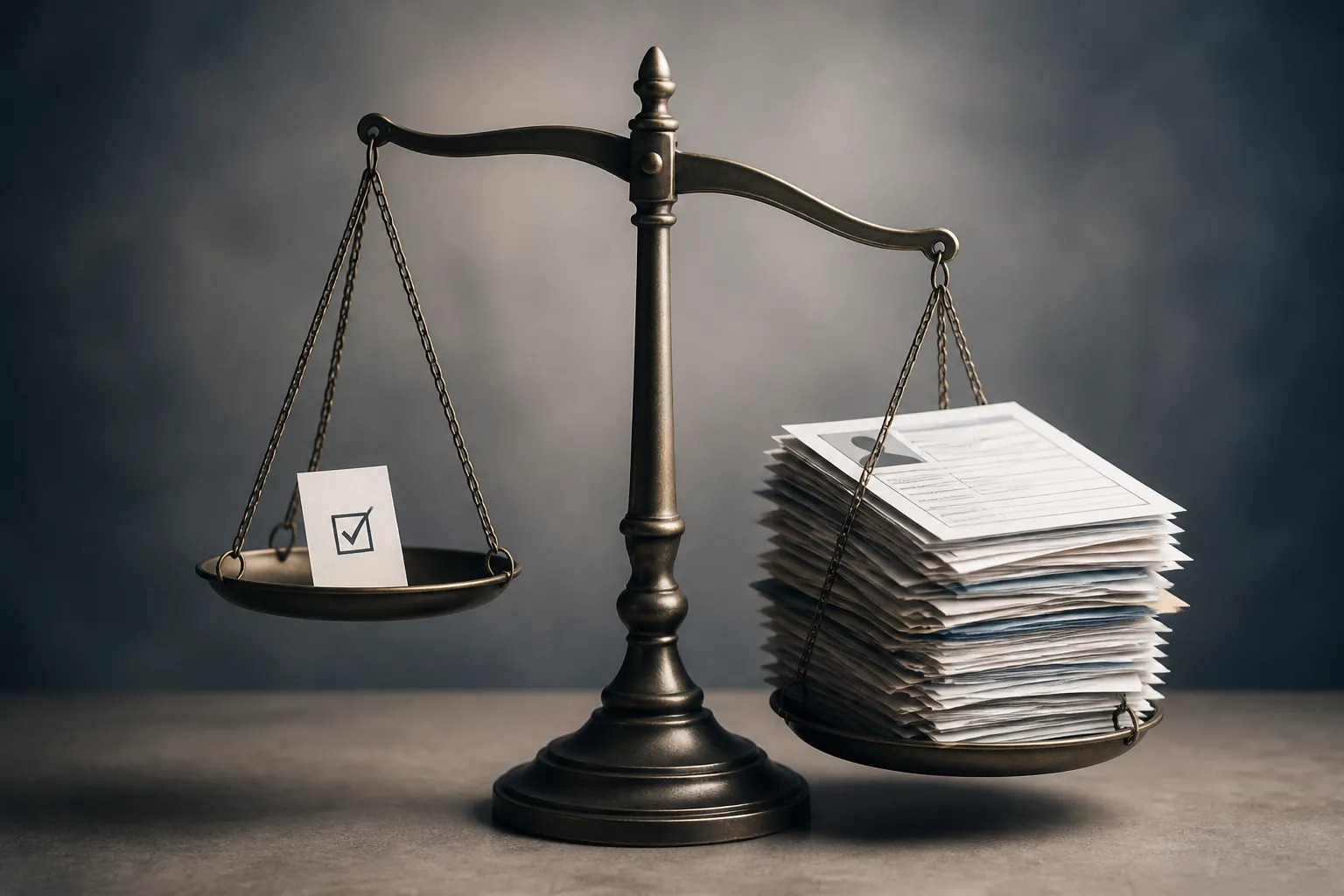
The citizen burden is not evenly distributed
The documentary-proof issue is often described as if every eligible voter has a passport, birth certificate, naturalization certificate, or citizenship-marked license ready to produce. The available estimates do not support that assumption. BPC reports that more than 21 million citizens lack ready access to documentary proof of citizenship, that UMD’s Center for Democracy and Civic Engagement estimates roughly 9% of eligible citizens lack such documentation, and that the affected group may represent about 12% of registered voters.[3]
Name mismatch is its own channel of burden. BPC also reports a scale of roughly 69 million married people whose current names may no longer match birth certificates.[3] That figure does not mean all of them would be unable to register. It means a proof regime must account for people whose lawful identity trail runs through marriage records, court orders, or other documents that may not be in the same folder as a birth certificate.
Vote.org describes the same practical problem from the voter-facing side: documentation demands fall hardest on citizens who do not have immediate access to the right paper record or whose current names do not match the citizenship document they can locate.[6] A registration deadline does not pause while someone orders a certificate, obtains a certified copy, or finds a name-change record.
Counties would carry the operational and legal risk
County election offices are not passive pipes in this model. They would receive documents, evaluate sufficiency, issue notices, process cures, answer applicants, and defend decisions when a file is wrong. NACo estimated implementation costs at $510 million per election cycle, against $45 million in FY2026 HAVA grants.[7] That comparison is not a constitutional argument; it is the budget line a county lawyer or administrator has to explain.
The liability overlay sharpens the point. Campaign Legal Center’s summary describes a five-year criminal exposure provision and a private right of action in the SAVE Act framework.[8] Those provisions change the incentives inside an election office. When the office faces penalties for accepting an insufficient registration, the safer administrative reflex may be to hold, question, or reject files that are not clean on first review. Eligible citizens then become the buffer against institutional risk.
The constitutional fights are downstream of the factual record
There are real constitutional and statutory issues around documentary proof, voter qualifications, burdens on registration, poll taxes, and federal power over election administration. This article does not re-litigate Crawford, Harper, the 24th Amendment, or Elections Clause theories because those questions are already treated in the site’s SAVE Act voter-ID constitutional challenges record and broader SAVE Act constitutional challenges analysis.
For briefing purposes, the factual sequence comes first. If the noncitizen-voting problem is large, a court or policymaker may view burdens differently. If the measurable problem remains near-zero and the burdens fall predictably on citizens and counties, the same legal doctrines operate against a different administrative record.
What Lankford’s argument proves, and what it does not
Lankford’s core formulation is internally coherent. Citizenship is already required. The current system contains verification points that do not always operate before registration. A license architecture that marks citizenship on REAL IDs would make the documentary-proof model more administrable than a rule that treats ordinary REAL IDs as if they already prove citizenship when, in most states, they do not.
The sourced record still leaves the cost-benefit burden on the proponents of a front-end documentary rule. The documented noncitizen-voting incidence is extremely small. The documented burden is not: Kansas blocked tens of thousands of eligible citizens; national estimates identify millions without ready citizenship documents; name mismatches affect a large class of married citizens; counties face implementation costs and liability exposure.
That is where the legal briefing should land. If back-end verification against government databases can shift the burden away from citizens and onto government systems, why is front-end documentary proof still necessary at this scale?
References
- ICYMI: Lankford Leads Senate Republicans on Floor to Pass SAVE America Act, Ensure Only American Citizens Vote, Senator James Lankford.
- Explainer: SAVE, SAVE America, and MEGA Acts, Issue One, February 27, 2026.
- Six Things to Know About the SAVE America Act, Bipartisan Policy Center, updated July 17, 2026.
- Lankford Introduces Bill to Verify Citizenship on REAL IDs, Strengthen Election Integrity and Ensure Road Safety, Senator James Lankford.
- The Supreme Court and voting identification, SCOTUSblog, March 25, 2026.
- The SAVE Act, Vote.org.
- Senate to vote on SAVE America Act with major impacts to county election administration, NACo, March 13, 2026.
- What You Need to Know About the SAVE Act, Campaign Legal Center, updated July 23, 2026.
- Senate Rejects Another GOP Push to Revive SAVE America Act, Democracy Docket, June 4, 2026.
- The Constitution and the SAVE America Act, National Constitution Center, May 1, 2026.
Operationalizing workflow
No workflow has been explicitly linked to this obligation yet. See Workflows generally.
Illustrative cases
No illustrative case is currently tracked for this obligation. See Risk Digest for documented incidents generally.
← Back to RegulationReport a correction or tip
Spotted an outdated figure, a misstated fact, or a ruling this regulation entry should reflect? Public comments are disabled for this content given the professional cost of a misreported case outcome, penalty amount, or rule text — use the structured correction channel instead.
Report a correction or tip for this record →