
Nvidia's record earnings spotlight legal AI's compliance gap
- Authority
- California Legislature
- Rule type
- pending statute
- Jurisdiction scope
- US state (California)
- Source text
- Read primary rule text ↗
Would prohibit attorneys from delegating legal practice to generative AI; attorneys must supervise AI-generated output and verify cited authorities.
Two events this week define the Nvidia earnings implications for the AI legal tech market more clearly than any after-hours stock move. On August 25, Google launched Gemini Enterprise for Legal, naming Cleary, Freshfields, Weil, and Williams & Connolly in the capability push.[1] One day later, California was considering SB 574 language stating that “an attorney shall not delegate the practice of law to generative artificial intelligence.” The bill remained pending on August 26, with the legislative session due to end August 31; the proposed clause was not then California law.[2]
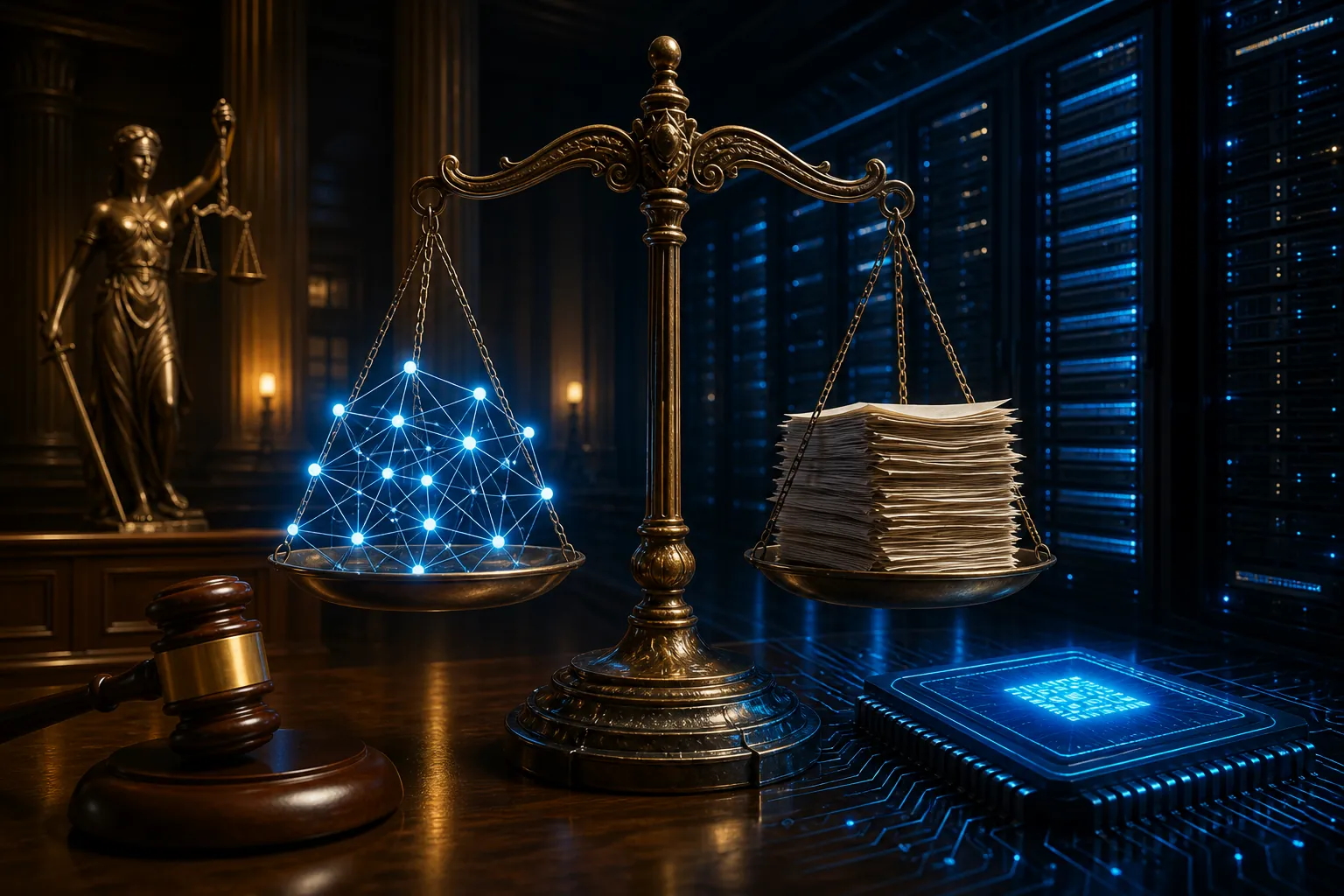
That divergence matters. Legal AI systems are being positioned to undertake increasingly substantial work while lawmakers and professional regulators are emphasizing that responsibility for legal judgment stays with the attorney. Nvidia’s record results, reported August 26, show how quickly the infrastructure beneath those systems is expanding. They do not provide a defense when an automated workflow puts a fabricated authority into a filing.
- Status verified: August 27, 2026 (UTC).
- Legal-background review: Mara Velez.
- Scope: General regulatory and risk analysis, not legal advice. Readers should check the current bill text, applicable professional rules, court orders, and local requirements.
- Source trail: Nvidia’s official results, the SB 574 status report, and the full cited materials are linked below.
What Nvidia’s record quarter actually signals
Nvidia reported $96.221 billion in revenue for its second quarter of fiscal 2027, up 106% from a year earlier. Data Center revenue reached $89.0 billion, a 117% year-over-year increase. Its third-quarter outlook was $108.0 billion, plus or minus 2%, explicitly assuming no Data Center compute revenue from China.[3]
For legal technology buyers, the useful conclusion is limited but consequential: capital continues to flow into the compute layer needed for larger and more active AI workloads. Nvidia also highlighted agent-oriented infrastructure, including Vera Rubin entering full production, Groq 3 LPX, an expanded Agent Toolkit, and a Vera CPU described by the company as the first CPU built for AI agents.[3] These are supply-side signals, not evidence that any particular legal product is reliable or that firms have adopted it effectively.
The contracting and vendor-diligence consequences are addressed separately in the companion analysis for legal tech buyers. The harder issue here is what that infrastructure enables after procurement: systems that can plan, call tools, retrieve material, generate drafts, and continue through multiple actions before a lawyer sees the result.
More agentic work means a larger review surface
A conventional chat interaction produces an answer that a user can inspect immediately. An agentic workflow may break an assignment into subtasks, select sources, run searches, revise its own draft, and pass output to another tool. Each additional action can create material that affects the final product even if it never appears in the final document.
Nvidia has said, citing OpenRouter, that agentic workloads consume roughly 15 times as many tokens as a simple chat request.[4] That is a vendor-cited figure rather than an independent finding, so it should not be treated as a universal ratio. It nevertheless illustrates the operational direction: agentic systems can perform much more machine activity per user request.
In legal work, the review burden does not scale only with the length of the final draft. A supervising attorney may need to understand which sources were retrieved, whether quoted language matches the source, whether an authority remains good law, how a proposition changed during synthesis, and whether the system performed an action outside the approved assignment. A polished memorandum can conceal a long chain of weak intermediate decisions.

Sophisticated users and newer models have not eliminated that problem. In a June interview, Thomson Reuters CEO Steve Hasker described three hallucination incidents during the preceding couple of months at “extraordinarily successful and well-regarded firms.” He said the matters involved frontier models or startups built on them.[5] Three incidents cannot establish a general failure rate, but they are enough to reject the assumption that prestige, technical sophistication, or frontier-model access makes independent verification unnecessary.
The relevant control question is therefore not whether a lawyer glanced at the generated document. It is whether the reviewer could test the underlying legal authorities and reconstruct the consequential parts of the system’s work. If the tool supplies only an answer, or if the firm retains no usable record of retrieval and review, supervision may be asserted without being demonstrable.
California’s proposal and guidance must be kept distinct
SB 574’s proposed Section 6068.1(a)(2) would prohibit an attorney from delegating the practice of law to generative AI. Reporting on the bill identifies hallucinated citations in court briefs as part of the problem to which the proposal responds.[2] But as of this article’s verification date, the legislature had not completed its work. The language is a live policy signal, not a rule that should be described as already governing California attorneys.
The California State Bar’s summer 2026 update sits on a separate track. Its rule-by-rule AI guidance addresses supervision of agentic systems as part of attorneys’ existing professional obligations.[2] Readers can examine the site’s California State Bar AI guidance record for the underlying obligation map.
Placed side by side, the pending bill and the guidance point toward the same practical boundary without having the same legal status: access to an AI system does not itself establish human supervision, and assigning work to a system does not move professional responsibility away from the attorney. The system can assist with legal tasks; it cannot be the person accountable for the filing.
California already has a concrete record of the citation problem. The Bianco AI-citation matter documents fabricated legal citations reaching a contested proceeding. Its significance is not that every AI-assisted filing contains false authorities. It shows what happens when generation reaches the advocacy stage without an effective source check: the lawyer, client, opposing party, and court inherit the remedial work.
What supervision has to make visible
For litigators and firm risk officers, the immediate need is to assign responsibility at the points where automation can affect legal judgment. The answers will vary by matter and tool, but an accountable deployment should make several facts visible:
- which tasks the system was permitted to perform and where human approval was required;
- which lawyer reviewed the resulting analysis, filing language, or recommended action;
- whether cited cases, quotations, statutes, docket entries, and record references were checked against authoritative sources;
- what evidence of that review remains if a partner, client, court, insurer, or regulator later asks for it; and
- whether the reviewer understood the system’s material actions rather than assessing only the fluency of its final answer.
A firm may give every lawyer access to an approved platform and still fail these questions. Tool approval shows that someone accepted the product for specified uses. It does not show that a particular authority was opened, read, and matched to the proposition for which it was cited.
The same distinction applies to model evaluation. The site’s Gemini reliability map for legal work can help identify appropriate and inappropriate uses, but favorable testing does not verify the sources in a later client matter. Product-level assessment and matter-level verification solve different problems.
Firms that need to connect agent behavior to existing professional duties can use the mapping of ABA Formal Opinion 512 to agentic tools. For the operational source-checking sequence, the existing legal verification workflow provides the more appropriate procedure rather than compressing that work into a procurement checklist.
The buyer inherits the last decision
Nvidia’s quarter indicates that the infrastructure available for agentic AI is becoming larger and more heavily funded. Google’s legal launch shows that this capability is moving closer to consequential professional workflows. Neither development determines whether a generated argument is sound, an authority is real, or an autonomous action belongs within the assignment.
Those decisions remain with the lawyer and the firm deploying the system. As legal AI produces more work through longer chains of automated activity, acquisition carries a corresponding burden: identify the supervising human, preserve evidence of review, and independently verify every legal authority that reaches the attorney’s work product. Faster compute does not transfer professional responsibility to the machine.
References
- Google Launches Gemini Enterprise for Legal. Artificial Lawyer, August 25, 2026.
- California SB 574: Will AI’s Home State Kill Off AI for Law?. Artificial Lawyer, August 26, 2026.
- NVIDIA Announces Financial Results for Second Quarter Fiscal 2027. NVIDIA, August 26, 2026.
- NVIDIA Newsroom. NVIDIA.
- Thomson Reuters CEO Steve Hasker on the Next Generation of CoCounsel, the Future of Professionals Report, and Why TR Is Building Its Own LLM. LawSites, June 2026.
Operationalizing workflow
No workflow has been explicitly linked to this obligation yet. See Workflows generally.
Illustrative cases
No illustrative case is currently tracked for this obligation. See Risk Digest for documented incidents generally.
← Back to RegulationReport a correction or tip
Spotted an outdated figure, a misstated fact, or a ruling this regulation entry should reflect? Public comments are disabled for this content given the professional cost of a misreported case outcome, penalty amount, or rule text — use the structured correction channel instead.
Report a correction or tip for this record →