
What Immigration Consequences Follow When TPS Ends
- Authority
- Supreme Court of the United States
- Rule type
- statute
- Jurisdiction scope
- US Federal
- Effective date
- Jun 25, 2026
- Source text
- Read primary rule text ↗
Verify country-specific EAD operative date and calculate unlawful presence start to avoid re-entry bars.
Last verified: July 27, 2026, UTC. This article is a legal-framework reference, not immigration advice. TPS consequences now depend heavily on country-specific USCIS operative dates, court orders, and individual facts; no filing, employment-verification, travel, or removal-risk decision should rely on a general article without checking the current USCIS country page and the applicable docket.
After Mullin v. Doe, the first immigration-law consequence of TPS termination is not a policy mood shift. It is a jurisdictional switch. On June 25, 2026, the Supreme Court held, 6-3, that 8 U.S.C. § 1254a(b)(5)(A) bars federal courts from reviewing non-constitutional challenges to a DHS Secretary’s TPS determination. That forecloses the APA arbitrary-and-capricious route that had been doing much of the emergency work in TPS termination litigation. The Court also rejected the Haiti plaintiffs’ equal-protection theory on the merits, declining to treat the cited statements as sufficient proof of discriminatory purpose.[1]
That distinction matters because “TPS ends” is too blunt to be useful. Mullin does not itself place a person on a plane, cancel every employment document on the same day, or decide every adjustment application. It removes the principal federal-court APA brake on termination decisions. Once the operative country date arrives, the questions become less dramatic and less forgiving: what status, if any, does the person fall back into; when does unlawful presence start counting; whether a TPS-based EAD still authorizes work; and whether any surviving claim or relief application actually reaches the person in time.

The post-Mullin review rule
Section 1254a(b)(5)(A) says there is no judicial review of any TPS determination by the Secretary. Before Mullin, plaintiffs had argued that the bar did not reach APA claims alleging unlawful decision-making process, failure to consult, or arbitrary treatment of country conditions. The Supreme Court read the bar broadly enough to close that door for non-constitutional claims.[1]
Constitutional claims survive in form, but they are not a practical substitute for APA review. The dissent would have allowed review of failure-to-consult and racial-animus evidence; the majority did not. For post-Mullin litigation triage, that means counsel should not describe constitutional claims as a broad safety valve. They remain available only where the plaintiff can plead and prove a constitutional violation on terms that survive the Court’s treatment of the Haiti record.[1]

What happens to the person’s immigration status
When TPS ends for a beneficiary, the person does not receive a new lawful status by default. The person reverts to whatever independent status still exists, if any. A beneficiary who maintained another valid nonimmigrant status may be able to rely on that status. A beneficiary whose only lawful-status treatment came from TPS is in a different position: the TPS-based statutory treatment stops operating.
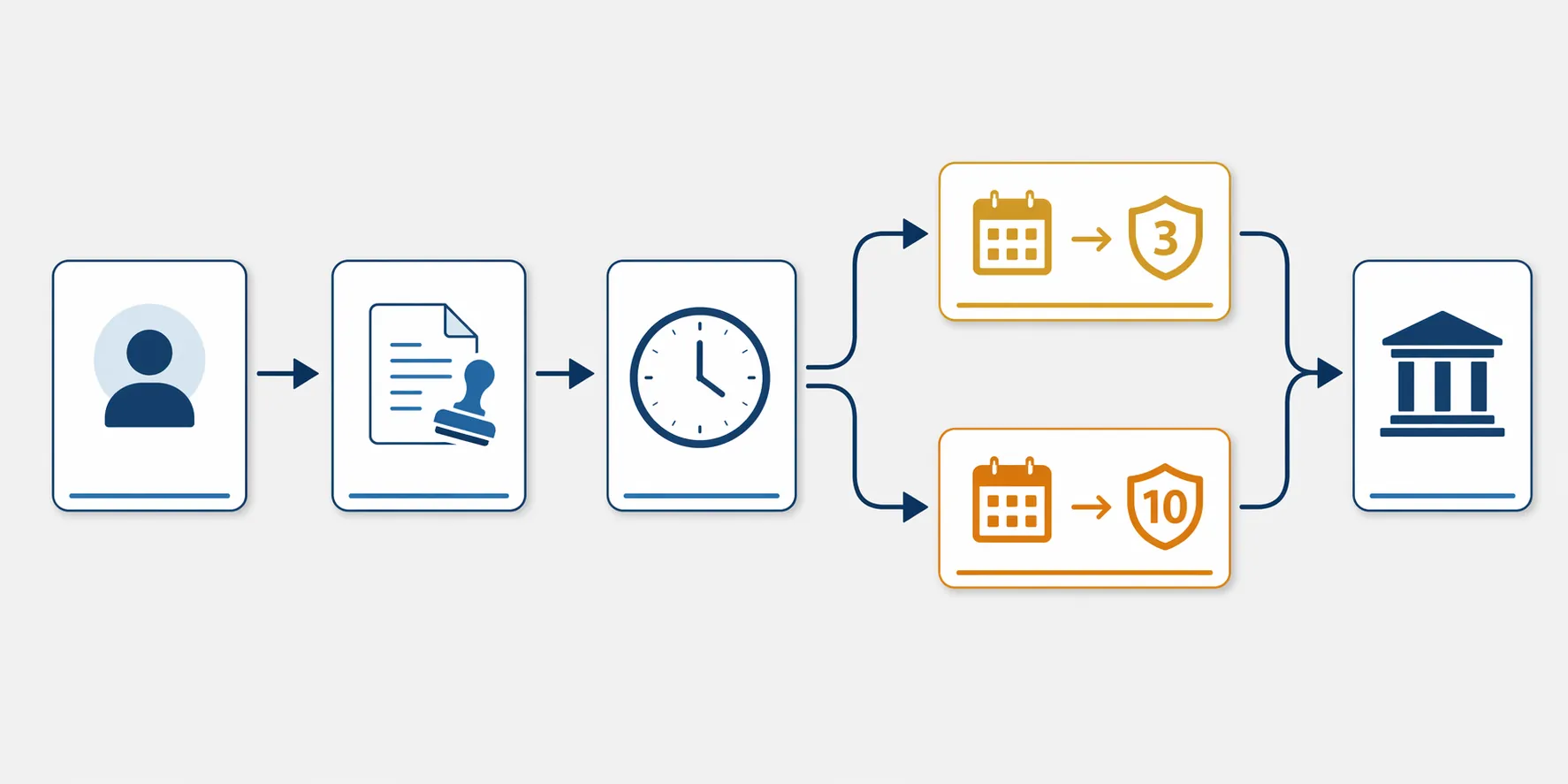
The mechanical point is INA § 244(f)(4). While TPS applies, the statute treats the person as being in, and maintaining, lawful status as a nonimmigrant for certain purposes. When TPS terminates, that treatment ceases. The usual unlawful-presence rules then become the problem. Current legal guidance describes unlawful presence as beginning the day after TPS ends, with departure after more than 180 days triggering the three-year re-entry bar under INA § 212(a)(9)(B)(i)(I), and departure after one year or more triggering the ten-year bar under § 212(a)(9)(B)(i)(II).[2]
| Moment | Immigration consequence |
|---|---|
| TPS remains in effect | TPS-based lawful-status treatment and TPS-based employment authorization may continue, subject to the person’s documentation and country-specific notices. |
| TPS ends and no independent status remains | The person generally no longer has TPS-based lawful-status treatment and becomes exposed to removability. |
| Day after TPS ends | Unlawful presence may begin accruing if no other protection or status interrupts the clock. |
| More than 180 days of unlawful presence, followed by departure | The three-year re-entry bar may be triggered. |
| One year or more of unlawful presence, followed by departure | The ten-year re-entry bar may be triggered. |
| TPS-based EAD reaches its operative lapse date | Work authorization based on that EAD no longer supports employment unless another authorization applies. |
The departure condition is easy to lose in shorthand. The three-year and ten-year bars are triggered by unlawful presence followed by departure, not by the mere passage of 180 days or one year in isolation. But that is not a comfort. Once the clock starts, ordinary acts such as emergency travel, consular processing, or leaving after a removal order can carry consequences that were not present while TPS was still treating the person as lawfully present.
The EAD date is a separate control point
A TPS-based EAD can create a dangerous illusion of continuity if the document face date, a Federal Register notice, a court stay, and a USCIS supersession update do not all say the same thing. For employers, the question is not whether the worker once had TPS. It is whether the document presented still authorizes work under the latest country-specific rule. For workers, the same date can decide whether an ordinary shift becomes unauthorized employment.
The operative-date picture was unstable as of July 27, 2026. Employer guidance after Mullin identified country-specific EAD lapse dates rather than a single national TPS date: Haiti, Syria, and Burma on July 27; Somalia on July 29; Ethiopia and South Sudan on July 30; and Yemen with a July 24 date that had lapsed amid unresolved ambiguity.[3]
That is why compliance review should be documentary, not country-assumption based. A payroll file that was safe under an automatic extension may become unsafe when USCIS posts a superseding notice. A reverification calendar that ignores litigation stays may cut off a worker too early. A reverification calendar that ignores a new operative lapse date may leave the employer relying on an expired authorization. The legal issue is the current authorization basis, not the employer’s memory of the country designation.
Country status as of July 27, 2026
The country layer should be treated as a dated status check, not a permanent chart. The immediate post-Mullin impact fell most visibly on Haiti and Syria: reports described the Haiti termination as affecting roughly 350,000 TPS holders and the Syria termination as affecting roughly 6,000 holders.[4][5]
| Country | Status point to verify before reliance |
|---|---|
| Haiti | Termination became effective after Mullin; TPS-based work authorization required immediate country-specific verification. |
| Syria | Termination became effective after Mullin; TPS-based work authorization required immediate country-specific verification. |
| Burma | Court-ordered stay remained part of the posture, but post-Mullin dissolution risk increased. |
| Ethiopia | Court-ordered stay remained part of the posture, but post-Mullin dissolution risk increased. |
| Somalia | Court-ordered stay remained part of the posture, but post-Mullin dissolution risk increased. |
| South Sudan | Court-ordered stay remained part of the posture, but post-Mullin dissolution risk increased. |
| Yemen | July 24 operative date had lapsed amid ambiguity; underlying stays remained in place and required docket-level verification. |
| El Salvador | Designation was set to expire September 9, 2026, with no DHS extension or termination determination announced as of July 27, 2026; this remained a forward-looking verification point. |
Burma, Ethiopia, Somalia, South Sudan, and Yemen were not in the same posture as Haiti and Syria simply because they appeared in the same litigation ecosystem. Existing court-ordered stays still mattered, but Mullin changed the odds around those stays because the non-constitutional review theory supporting many injunctions had been cut off.[6]
Yemen deserves its own caution because the July 24 operative date had passed without a clean new USCIS bulletin as of the available reporting window, while underlying court stays remained in place. That is the kind of posture where a general country label is most likely to mislead: one person may be asking whether an EAD supports work today, another whether removal can proceed, and another whether a pending application keeps some separate protection alive.
El Salvador is different again. Its TPS designation was set to expire September 9, 2026, and DHS had not announced an extension or termination determination by July 27, 2026, despite the approaching expiration. For compliance teams, it belongs on a forward-looking watchlist, not in a concluded-termination bucket.
Readers who need the Haiti-specific procedural history can start with the Haiti TPS litigation timeline. Readers tracking work-authorization fragmentation across countries should compare the current USCIS posting against the country-by-country TPS work authorization map and any later court order.
Removal exposure does not wait for a new headline
Once TPS no longer protects a beneficiary and no independent status or protection applies, the person may be placed in removal proceedings. The filing of proceedings is discretionary and uneven, but the legal exposure is not imaginary. The person has lost the TPS-based shield that previously interrupted ordinary removability analysis.
This is where sloppy wording hurts real files. A beneficiary may have a pending family petition, an employer willing to sponsor, a U.S.-citizen spouse, or a fear claim. None of those facts, by itself, means the person remains in lawful status after TPS ends. Some facts may support a relief path. Some may merely explain why removal would be contested. Some may do nothing until a waiver, visa number, admission issue, or deadline problem is solved.
For enforcement context, the relevant practical question is who has to make a decision next: the worker deciding whether to keep working, the employer deciding whether reverification is required, the lawyer deciding whether travel is reckless, or the family deciding whether consular processing would trigger a bar. The legal clock can run quietly while those decisions are postponed.
Remaining relief paths, without pretending they are interchangeable
Adjustment of status remains possible for some former TPS holders, but it is not a universal answer. The threshold problem is often INA § 245(a), which generally requires the applicant to have been inspected and admitted or paroled. Pre-Mullin case law split over whether TPS itself counts as an admission: the Ninth Circuit in Ramirez v. Brown and the Sixth Circuit in Flores v. USCIS treated TPS favorably for that purpose, while the Eleventh Circuit in Serrano did not.[7]
That split should not be overread. The cases predate Mullin, and no post-Mullin appellate decision in the cited authorities decides whether the Supreme Court’s reading of the TPS statute changes the adjustment-admission analysis. The safer description is narrower: circuit law and entry history may preserve or defeat adjustment eligibility, and the answer can change by geography.
Advance parole can matter, especially under strategies associated with Matter of Arrabelly and Yerrabelly, because parole may help satisfy the threshold entry requirement for adjustment in some cases. It is a potential pathway, not a promise. Travel after TPS termination can interact with unlawful-presence bars, removal orders, pending proceedings, and changing agency practice. Any advice that treats departure as an easy reset is the kind of advice that creates the next emergency.[7]
Asylum is also not closed merely because TPS ended. But asylum requires individualized proof, is constrained by the one-year filing deadline unless an exception applies, and operates inside a badly congested adjudication system. PBS, citing TRAC, reported a 3.2 million-case immigration court backlog in 2026.[4] A fear claim may be essential for one person and unavailable for another who comes from the same TPS-designated country.
Other relief categories can matter depending on facts: family-based petitions, employment-based sponsorship, cancellation of removal, waivers, U or T status, VAWA relief, or deferred action. Listing them is less useful than sorting the file. The first pass should identify current status, entry and parole history, unlawful-presence exposure, criminal issues, prior removal orders, family relationships, pending petitions, country-specific fear evidence, and controlling circuit law.
A triage sequence for practitioners and employers
For a former or soon-to-be former TPS holder, the useful sequence is not “protected” versus “unprotected.” It is date, status, clock, document, and forum.
- Confirm the country-specific TPS and EAD operative date on USCIS.gov, then check whether a later court order or USCIS supersession notice changes it.
- Identify whether the person has any independent lawful status or protection apart from TPS.
- Calculate the unlawful-presence start date from the day after TPS ends, unless another status or protection interrupts accrual.
- Separate presence risk from departure risk: the three-year and ten-year bars require departure after the relevant unlawful-presence period.
- Review EAD validity for employment purposes separately from removal risk and separately from pending immigration applications.
- Classify any court challenge as constitutional or non-constitutional before assuming federal jurisdiction exists after Mullin.
Employers should keep that sequence narrower than immigration counseling. I-9 compliance requires reverification of work authorization when required; it does not authorize an employer to decide removal exposure, travel consequences, or relief eligibility. For Haiti-specific employer issues, compare the current facts against the Haiti TPS employer compliance guide.
Where Mullin leaves the law
The operative consequence of Mullin is not that every TPS holder from every affected country has the same result on the same day. Haiti and Syria moved immediately; other countries remained tied to stays, lapse dates, and dissolution risk; El Salvador remained a pending expiration problem. The legal work now sits in those differences.
After TPS ends, the immigration-law answer is a sequence, not a slogan: the person reverts to prior status or no status; TPS-based lawful-status treatment stops; unlawful presence may begin the next day; departure after the statutory thresholds can trigger three-year or ten-year bars; TPS-based EADs lapse on country-specific operative dates; removability exposure returns; and federal-court review is largely limited to constitutional claims that remain difficult after the Court’s treatment of the Haiti equal-protection record.
Mullin does not itself deport anyone. It removes the main APA review mechanism that had slowed TPS terminations. After that, three facts control most of the immediate legal risk: the operative EAD and TPS date, the unlawful-presence clock, and the narrow constitutional-review channel that remains.
References
- Supreme Court Closes Courthouse Doors on TPS Termination Challenges, Just Security, June 2026, link
- After TPS Expires, What Are My Immigration Options?, NOLO, June 26, 2026, link
- After Mullin: A Practical Guide for Employers with TPS Workers, Morgan Lewis, June 2026, link
- What’s next for immigrants with TPS status after Supreme Court ruling, PBS News, July 2026, link
- Temporary protected status program explainer after Supreme Court ruling, NPR, June 29, 2026, link
- Temporary Protected Status (TPS) Terminations, FWD.us, link
- Potential Adjustment of Status Options After the Termination of TPS, Cyrus Mehta, January 2018, link
Operationalizing workflow
No workflow has been explicitly linked to this obligation yet. See Workflows generally.
Illustrative cases
No illustrative case is currently tracked for this obligation. See Risk Digest for documented incidents generally.
← Back to RegulationReport a correction or tip
Spotted an outdated figure, a misstated fact, or a ruling this regulation entry should reflect? Public comments are disabled for this content given the professional cost of a misreported case outcome, penalty amount, or rule text — use the structured correction channel instead.
Report a correction or tip for this record →